What book is this?
Edit: Found it. The Homosexual Society by Richard Hauser. It's available on
the internet archive but seems to be a rare book. I've barely found anything on the author himself but I did find this
curious blog post from someone who claimed he met him. Also claiming he was a sociologist and Austrian Jew who fled to London in 1938, hated Marx from a feminist perspective, and that he contributed to the 1957 Wolfenden report which led to the decriminalization of homosexuality in the UK. Trying to get a copy of it now to see if this is true.
Also found this gay publication's
butthurt article on it.
Attaching screenshot of blog + comments for archive.
Yeah, psychology was a largely Jewish field (Alfred Adler, Sigmund Freud), and it has roots in Marxism, especially sexual studies (the
daughter of Marx was a friend of Havelock Ellis, one of the pioneers of the field). Unpacking and trying to find (sometimes contrive) a meaning from anything/everything was very culturally Jewish (especially from 1850-oneward) but that's a whole other thing. Psychology, "as a science," is more philosophical and political rather than
strictly scientific*.
It's kind of hard to wrap your head around, but a Feminist pre-Critical Feminist Theory (Marxist "Bourgeoisie" =
basically the "Patriarchy") didn't substitute class for gender. was close attention to masculinity's relationship with society and men in general. When you hear radical feminist types try to sell the idea of feminism to non-feminists, they tend to trot out these really old concepts which have otherwise been supplanted by more modern, less subtle ones. Just like Lenin thought the revolution had to be lead and its changes dictated by a core vanguard of elite Proletariat, Critical Feminists and Critical Queers substitute the Proletariat with women and queers (or more broadly speaking—"academics") respectively.
Modern Marxism isn't strictly Marxism, it's Marxist-Leninist, which might be "tomato, tomato," but it's more like "tomato, potato" in terms of how different they are. One of the big influential pieces was Lenin painting a hard target on who the bourgeoisie were as opposed to Marx who more or less would call the Bourgeoisie anyone who had a strict control over market prices and value. The Leninist influences are how you got to the demonisation of "men" in CFT, "white men" in post-colonial/CRT, and finally "straight white men" in CQT. (Feminist, Race, and Queer).
Hauser thought in-born homosexuality was miniscule compared to the number of habitual homosexuals—nature vs nurture. Liberal vs Conservative mindsets over which was true or not have switched over the years but in psychology nurture took precedence over nature for a long time. 1920s to 1960s was probably the range of "nurture" psychology being in vogue, and thereafter any attempts to find how certain characters of people came about was either suppressed or never given the time of day, unless it was in a
supportive context.
Though it wasn't without reason. The infamous
John Money experiment was ultimately rooted in taking this idea to its logical extreme—that gender-identity was nurtured. He did this to try and
cure transsexuality, accidentally becoming its biggest enabler, but I digress.
Hauser believed that if homosexuality was destigmatised, and some changes were made to education and parenting, the only homosexuals left would be the few "genetic freaks," as he called them (though he was quoting the homosexuals themselves).
He treated homosexuality in some men as a sort of addiction, one which they could escape or never get in the first place under the right circumstances.
It's strange to think this comes from an ultimately liberal and utilitarian mentality. He disliked the frothing hated of homosexuals because it prevented study on them.

The attitude toward homosexuals was akin to that many have towards so-called "trans children" i.e. "they'll grow out of it." He points out that many homosexuals fervently deny ever being in such a position where they could "grow out of it".

The book even has testimony of one such desisted homosexual.

The philosophical/political-relationship with psychology is present in the book's highlighting of the homosexuals as a "minority," in which several striking observations are noted which are applicable today to not just homos but any other minority. ("Freemasonry" = the in-group helping itself, often congregating in certain fields of work to do so)
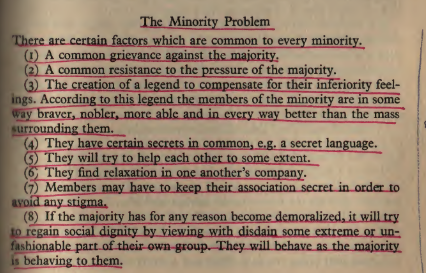
The Minority Problem
There are certain factors which are common to every minority.
(1) A common grievance against the majority.
(2) A common resistance to the pressure of the majority.
(3) The creation of a legend to compensate for their inferiority feel¬
ings. According to this legend the members of the minority are in some
way braver, nobler, more., able and in every wav better than the mass
surrounding them.
(4) They have certain secrets in common, e.g. a secret language.
(5) They will try to help each other to some extent.
(6) They find relaxation in one another’s company.
(7) Members mav have to keep their association secret in order to
avoid any stigma
(8) If the majority has for any reason become demoralized, it will try
to regain social dignity bv viewing with disdain some extreme or un¬
fashionable part of their- own-group. They will behave as the majority
is behaving to them.
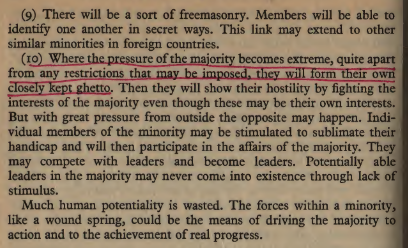
9) There will be a sort of freemasonry. Members will be able to
identify one another in secret ways. This link may extend to other
similar minorities in foreign countries.
(10) Where the.pressure of the majority becomes extreme, quite apart
from any restrictions that may be imposed they will form their own
closely kept ghetto. Then they will show their hostility bv fighting the
interests of the majority even though these may be their own interests.
But with great pressure from outside the opposite may happen. Indi¬
vidual members of the minority may be stimulated to sublimate their
handicap and will then participate in the affairs of the majority. They
may compete with leaders and become leaders. Potentially able
leaders in the majority may never come into existence through lack of
stimulus.
Much human potentiality is wasted. The forces within a minority,
like a wound spring, could be the means of driving the majority to
action and to the achievement of real progress.
I'd recommend the book if for no other reason than it's occasionally funny.


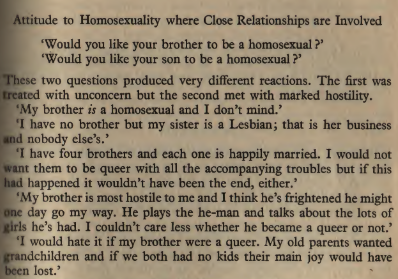
"Gay brother or gay son?" circa 1962

TLDR: Psychology is Jewish and Marxist philosophically (the relationship between X, Y, and Z comes from external forces wanting to achieve one intent or another).
The Homosexual Society is worth reading if only for the novelty of its content but also because its observations remain applicable today.
*There were attempts to scan the brains of homosexuals and transexuals post-2000s but they were predictably stopped by protesting homos and activists. "Muh conversion therapy" and such. When said information from scans is paired with the fact our brains continue to mould and re-shape as we age, this more or less confirms that, yes, homosexuality can be dictated by nurture, not nature. This makes it a choice in some respects, and I'd argue a facet of why this line of thought isn't followed is because it'll put more responsibility on parents and teachers. The "nurture" perspective This doesn't mean the person is intrinsically bad or evil just because they became one, but what can happen is certain behaviours associated with homosexuality can be adhered, which
are harmful.


