UN Tasmanian tiger declared extinct 80 years ago ‘spotted’ eight times

Eight reported sightings of a creature believed to be extinct are forcing experts to wonder whether it could still be alive.

The Tasmanian tiger, a large striped marsupial carnivore with almost Loch Ness Monster status Down Under, was thought to have died out in 1936, when the last one known died in captivity.

But newly released Australian government documents show sightings have been reported as recently as two months ago.

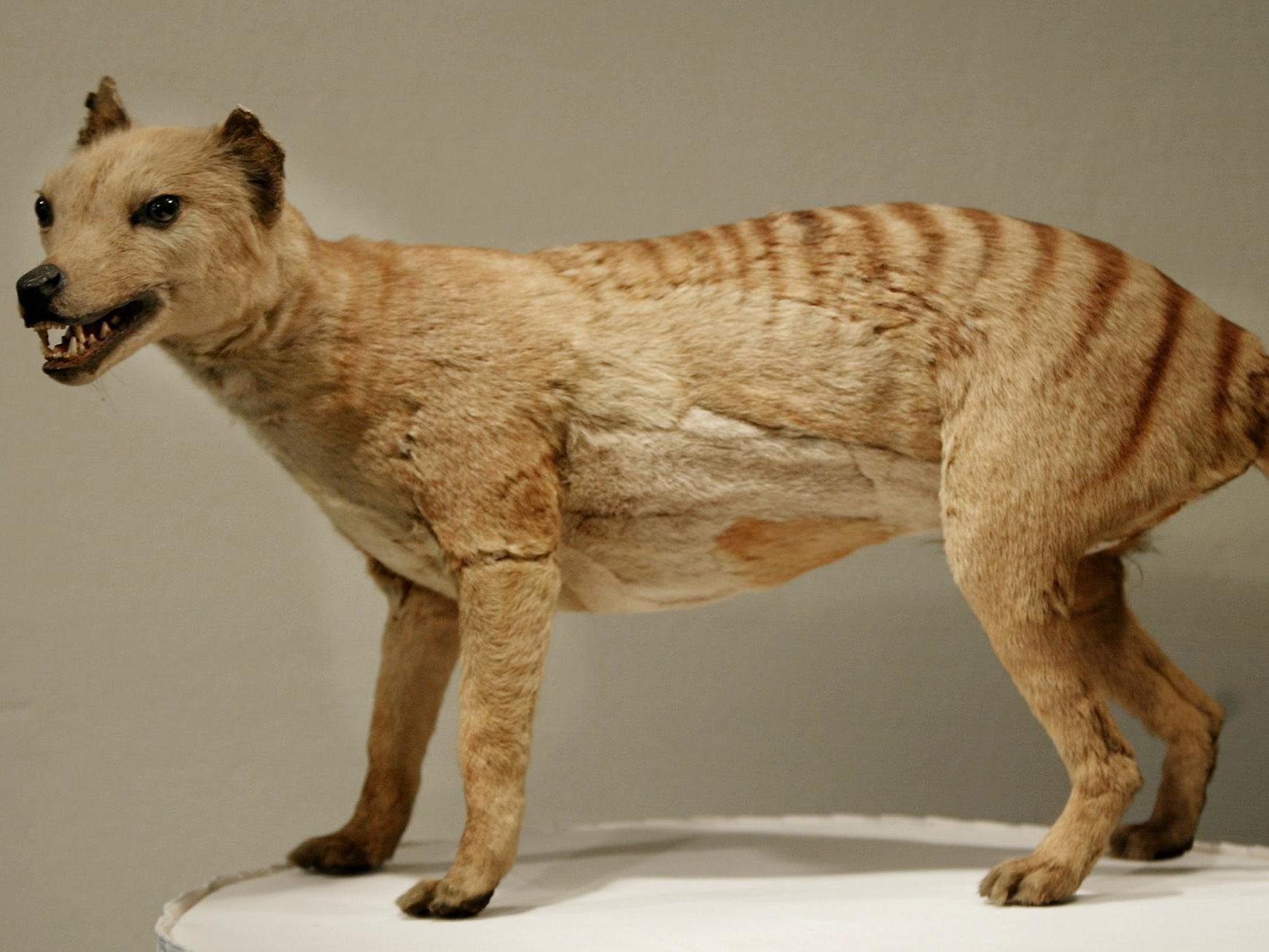
The species, officially called a thylacine, resembled a cross between a large cat, a fox and a wolf. It had yellowish brown fur, powerful jaws and a pouch for its young like a kangaroo.

Among eight sightings in the past three years was one from a couple from Western Australia visiting the island of Tasmania in February, who said they saw one of the creatures crossing the road.
The animal “turned and looked at the vehicle a couple of times” and “was in clear view for 12-15 seconds,” the report read. Both people in the car “are 100 per cent certain that the animal they saw was a thylacine.”


It had stripes down its back, the report read.

Another report the same month described a striped “cat-like creature” moving through the mist in the distance, CNN reported.

“I am accustomed to coming across most animals working on rural farms ... and I have never come across an animal anything close to what I saw in Tasmania that day,” the witness said.

In 2017, another driver reported seeing a possible thylacine near in northwestern Tasmania. He “seemed certain that if it was a cat it was a bloody big one,” the report said.

Most recently, in July, a man in southern Tasmania, near the state capital of Hobart, reported seeing a footprint that seemed to match that of the Tasmanian tiger.

Native to both Tasmania and the Australian mainland, it was the only member of the Thylacinidae family to survive into modern times, according to the Australian Museum.

European colonists in the 19th century killed thousands of thylacines for attacking sheep.

What was thought to be the last one of its kind died in Hobart Zoo in 1936, although there have been regular claims of unsubstantiated sightings, giving the animal an almost mythical status in Tasmanian culture.

Tasmania’s Department of Primary Industries, Parks, Water and Environment released the document detailing the eight reported sightings.

In 2002, scientists at the Australian Museum replicated thylacine DNA, opening the door to potentially reviving the species with cloning technology.
 
Remind me again. Why don’t we clone animals like this?
They are on the list, but as others have pointed out it's hard to do.
Every few years there's a press beat up about how thylacines may not be extinct. This one has no more credibility than the others.

While we do quite regularly discover small species previously thought to be extinct, we're talking about a 30kg carnivorous predator here. If they existed in sufficient numbers to ensure the continued survival of the species over the last 80 years, we should have found some kind of evidence - whether it's poop or bones.
There was a beat up a few months ago and so i went and had a look at their amazing new evidence. This is it.

The Tasmanian Devil is also under threat so it might not be the best choice.
That's more from the super cancer / disease though isn't it?
 
Your thoughts have all been imputed and put into consideration and I have decided that we should clone these things anyway because hella yes.
 
I love thylacines, they're my favorite animal and I'll probably cry im happiness if there's ever a verifiable and confirmed sighting.
8 sightings in 80 years?
that's less than bigfoot, yetis, aliens, or the loch ness monster
The article focused just on the last three years, but it probably should have noted the hundreds of sightings that (allegedly) have occurred in the 80 years since they were declared extinct. They're definitely not all very credible, I recall seeing a Animal Planet special about thylacines where one dude claimed not just to have spotted one 50+ times but to have been attacked by a juvenile thylacine, which...this guy might have just huffed a little too much petrol.

I'm on mobile right now so linking will be a pain- but there's supposed footage of one shot back in 2008 that got some publicity in 2016 (I think?). The footage is not very good and I personally don't think it's a thylacine. I'll have to find the video in a bit-


*Edit* Here's the footage I was thinking of! I remembered the animal in the footage as looking different, this does have a very similar thylacine body shape. The stripes aren't visable at all though.
I want there to be a legit sighting someday, my inner 10 year old would be so happy.
 
Última edición:
That video could be a diseased fox suffering from mange. That would explain the bare tail. It's very difficult to tell tho because of how low rez the video is.

I wish dearly that there are still Thylacines alive, tho they must have needed to inbreed like hell in order to keep surviving. Even if we found life specimens, it might not be enough to have a healthy population.
 
That's more from the super cancer / disease though isn't it?

Yeah, although you have to consider that a thylacine would probably be vulnerable to diseases which affect its closest living relative. Diseases to which it's naive would probably be a big challenge if it were to ever be successfully cloned - or even if it has somehow managed to survive in isolation for the last 80 years.
 
While I hope they are still around because they're my favorite animal, bringing back a full healthy population to an area that has already environmentally moved on from having a thriving number might be troublesome, especially since they wers outcompeted by invasive species. They will need a solution for that first.
 
Not only that but also

i cannot even begin to comprehend how much the Tasmanian state government, let alone the news outlets and even the federal government would pay you for proof that tasmanian tigers are still trundling around in the wilds

youd probably be able to declare yourself king of tasmania

On the other hand Tourism around Tassie Tiger is huge. If they keep the dream alive people will keep coming to try and photograph the long extinct, non-existent creature.
 
We have a massive feral cat problem here so without clear photos, reports of a "cat-like creature" should probably be considered likely to be a feral cat. They can get pretty big, too.


In Tasmania you tend to get reports of "thylacines" being spotted. In Victoria it tends to be "pumas" or "cougars".

1571411519625.png

Garfield's been working out.
 
What was it they were trying to clone just this year, might have been those cave lion cubs-- that only 1 in 8 eggs were viable and of the 3 they implanted into a surrogate they all failed. Cloning technology still sucks equus capensis nuts.

In any case they already tried to clone thylacines and it didn't work out, there was a documentary about it back in 2003 that you can probably find on YouTube.

Edit: 2001
1571446203899.png
 
They actually mentioned cloning animals who got extinct due to human intervention and said it was not the same case. It's during their lunch meeting at the beginning. The difference would be that dinosaurs aren't made to live along humans because we're separated by millions of years. Other animals can survive along humans and viceversa.

I would not be ok with things like woolly mammoths who have lost their niche in the eco-system long ago. At this point it would be more like an invasive species. Unfortunately that is the animal you always hear about when this thing comes up. Because there are so many well presevered mammoths out there.

We can't clone dodos or quaggas because of a lack of usable DNA. I don't even know if there are any physical samples of Steller's Sea Cow. It's really sad that humanity has destroyed so many species out of sheer stupidity and greed. But I think we should be really wary about cloning anything that comes from an era too far back. We have enough recently extinct and functionally extinct animals to worry about. So if it ever becomes easier and some breakthrough is made I would rather see recent animals over Jurassic Park menageries.

Anyway, I have been reading about these thylacine citings for ages now. I don't think they are going to find anything. It's fun to dream though.
 
If there is one animal that i'd love to see brought back from extinction and shouldn't be too difficult, it is the United States only indigenous Parrot species the Carolina Parakeet.

But I'd really love to see such an unique animal such as the Thylacine be rediscovered or brought back again.
 
They're more than likely cases of misidentification - humans have shit eyesight and when you're out in places that don't have markers to help judge distance (like open fields), a normal cat or dog can be unnaturally large. The same goes for most cryptid sightings; add on things such as diseases and genetic mutations and you got yourself a chupacabra sighting (which usually are foxes with sarcoptic mange - they lose a lot of their fur and their skin scabs and thickens due to the incessant biting and scratching they do to try to relieve themselves, they even get a bit loopy due to said itching because they're unable to sleep well or hunt).
I remember seeing a documentary about the Loch Ness monster where the new theory was that it was a Greenland shark that wandered into the loch and that was what people saw for centuries, as these sharks have an insanely low metabolism and can live to be at least 250 years old.

While I do wish a small population of thylacines somehow escaped extinction, it's all but impossible when there's no physical evidence of them existing (bones, paw prints, scat) in the first place.

...You know that one photo from the late 1800s of a guy standing among a literal mountain of bison skulls? Like hundreds of thousands of them? Honestly, it's legit fucking frightening to me how we can utterly decimate an entire species in such a short time frame. Though I feel like humans do seem to reach an epiphany with what they're doing, but by the time that happens, it's either realized just in time (bison) or it's too little, too late (thylacine).
 
Atrás
Top Abajo