Navegación
Instalar la aplicación
Cómo instalar la aplicación en iOS
Sigue el video de abajo para ver cómo instalar nuestro sitio como una aplicación web en tu pantalla de inicio.
Nota: Esta función puede no estar disponible en algunos navegadores.
Más opciones
Variación de estilo
Estás usando un navegador desactualizado. Es posible que no muestre este u otros sitios web correctamente.
Deberías actualizar o usar un navegador alternativo.
Deberías actualizar o usar un navegador alternativo.
🌟 Internet Famous Kevin Jimenez / kevinjimenez / Threat Interactive / threatinteractive / @ThreatInteract - >>> The "optimization expert" that will save vidya games. Tim Sweeney hates him! FIND OUT HOW, CLICK HERE! <<<
- Iniciador del tema jammercat
- Fecha de inicio
-
🔧 Site instability resolved. You can report double-posts and broken attachments. For bigger issues, use the Technical Grievances thread.
🇵🇦 Nuestro primer dominio localizado está en español en kiwifarms.pa. Our first localized domain is on Spanish on kiwifarms.pa. -
Want to keep track of this thread?
Accounts can bookmark posts, watch threads for updates, and jump back to where you stopped reading.
Create account

Soggy Floppa
kiwifarms.net
- Registrado
- 4 de Nov, 2023
Tonemapping is extremely complicated, and few people truly understand it, I think Microsoft has like one guy that is in charge of HDR and Dolby Vision for their games. This guy has an unhealthy obsession with specifically MGSV and he will always point to it for everything graphics related.New meltdown just dropped.
Ver archivo adjunto 8480427
(Archive)
Ver archivo adjunto 8480433
(Archive)
Ver archivo adjunto 8480438
(Archive)

- Registrado
- 14 de Nov, 2022
Need for Speed?This guy has an unhealthy obsession with specifically MGSV and he will always point to it for everything graphics related.

A Pleasant Disposition
kiwifarms.net
- Registrado
- 31 de Ene, 2025
I enjoyed this individuals videos enough to remember his YouTube name, and am unfamiliar enough with how graphic processing works to have fully believed his grift. I think what caught me was the recent reality of excellent hardware and shit software making for a marginally better computing experience (versus the past of shit [limited] hardware and excellently coded software).
With that said (I checked other forums and couldn't find a thread dedicated to the topic), what about his claims are incorrect? I saw the others were saying he's a moron who doesn't know anything about this subject, but since I also am a moron who doesn't know anything about this subject, is there a good explanation of why the modern Unreal Engine does things the way it does? Or, what are actually superior ways to do things?
With that said (I checked other forums and couldn't find a thread dedicated to the topic), what about his claims are incorrect? I saw the others were saying he's a moron who doesn't know anything about this subject, but since I also am a moron who doesn't know anything about this subject, is there a good explanation of why the modern Unreal Engine does things the way it does? Or, what are actually superior ways to do things?


Private Tag Reporter
kiwifarms.net
- Registrado
- 7 de Jul, 2024
I watched one video of this guy, thought he had good points but was a smarmy dickhead (also felt this way about PirateSoftware so I'm 2 for 2 on spotting lolcows).
Anyone who has a vested interest in complaining but not fixing a problem is usually themselves part of the problem.
Anyone who has a vested interest in complaining but not fixing a problem is usually themselves part of the problem.
Soggy Floppa
kiwifarms.net
- Registrado
- 4 de Nov, 2023
I can explain Nanite and it's reason for existing and what it solves and what he doesn't actually understand about it.is there a good explanation of why the modern Unreal Engine does things the way it does?
Do you remember the Megatexture that Id software was pushing way back when. The Megatexture is something called virtualized texturing, the idea is that you can have absolutely massive high detail textures for everything, but you can't send all of that to the GPU without running out of memory fast, so they automatically only send in the parts of the giant texture that are needed for the current frame to the GPU. The texture exists and the GPU can just load in the only part it needs when needed so VRAM is not bloated, this got later adapted into most major engines as catch all texture streaming (though that can also apply to a different type of streaming where all the highest mipmap levels of all textures are loaded, and then visible textures only have their lower mips streamed in to the GPU as needed), Megatexturing/Atlasing also gives the benefit of not needing to use up texture sample slots since everything is all on one giant texture and you just index the coordinates needed, this (atlasing) has largely been superceded by Bindless textures which is a whole other can of worms that I'm not equipped to explain. This is why late 7th gen and 8th gen games had texture pop in problems btw.
Nanite is this concept applied to geometry, only send to the GPU the level of detail that you currently need at the moment, and stream it in and out like mipmaps for 3d models, where each mip level is a lower quality version of the mesh. This means any geometry can be as complex as you want since only the level that is necessary for your current camera is loaded, instead of the entire 200 million tri model. Of course this wouldn't work with just geometry streaming, since the way GPUs render means they dislike tiny triangles because of overshading, a tangent I will now go on.
GPUs run programs called shaders, shaders run parallel and is basically just math that colors pixels. GPUs batch these programs into 2x2 pixel grids, since each pixel will need surrounding pixel information for things such as mipmapping or pixel derivatives, but the issue with doing this is that you can have cases where the GPU runs for most of the pixels in the quad, but only one of the pixels actually draws, this happens a lot with very small or very thin geometry. MSAA (Multi Sample Anti-Aliasing) applies this same principle and will decrease your performance the more thin or tiny geometry there is, since it runs the shader for geometry edges multiple times per pixel for each coverage level (2x, 4x, 8x). This is fine if the math to draw your pixels is not super complicated, but modern PBR rendering is a LOT of math compared to non-PBR and this overshading (not overdraw, different thing) causes a lot of math to run more than it needs to.
Overdraw is when geometry is drawn over, meaning the time spent drawing the pixels that get drawn over was wasted, which can get really bad when pixels start costing a lot with modern rendering. Games used to be drawn (and some still are) with Forward rendering, which means as the geometry is drawn, it is also shaded and lit at the same time, because the geometry drawn is the completed geometry, you are able to do hardware multisampling (MSAA), the problem with traditional forward rendering was that to render lights you would have to iterate a list of all lights for every surface being drawn in a loop, so you could easily get exponential shader instructions with each light added to the scene, and being forward rendered means a lot of overdraw would occur rendering back to front, overdraw that costs because of the cost of lights. The solution to this (though it was only really an issue on console hardware at the time) was deferred rendering, where instead of rendering the final shaded surface when you render the geometry, instead you render a series of buffers, depth, normal, diffuse, specular (or roughness and metal etc for PBR, I won't go into the full detail of bitmasking for shader types and stuff), and then you render the lights using those textures that make up the scene, only for where lighting affects the surfaces. Because the textures are just 2d this removes a lot of overdraw and lets you break light limits, but because you are sending multiple textures around you can't use MSAA anymore, since to do it you would need to multisample every buffer and work without rasterized pixels until the end, which is excessively expensive.
Deferred turned into clustered Deferred or Forward (or Forward+, where a couple thin buffers are also stored to allow some effects), where lights are now calculated using a froxel (frustum voxel) grid from the camera, and only lights within the affected grid area are shaded, essentially removing the light limitation issues with traditional forward rendering and optimizing deferred lights further, this is what essentially all modern games use now. Examples of modern games that use clustered forward rendering are Doom 2016, Doom Eternal, Detroit Become Human, and all Source 2 games except Dota 2 and Deadlock. Most games use deferred still, or the more recent, and getting back to the Nanite explanation, Visibility buffer rendering.
Visibility buffer rendering is the hot new thing and I'm not fully equipped to explain it properly, so check out this blog post for a breakdown with visuals. The gist is that a visibility buffer is created which only stores visible pixels, and then the deferred buffers are created using that, meaning there is zero overdraw and overshading is reduced heavily. Nanite combines this with a custom software rasterizer for when triangles get small enough, because of the aformentioned overshading, and do some 2d imposter stuff. It's all very complicated but essentially it means Nanite: Reduces overdraw as much as possible, renders geometry very fast, streams geometry in and out of VRAM like mipmaps allowing for extremely high detail meshes without the cost, automatically reduces meshes down with clustered LODs. Of course this is not a magic bullet and Nanite incurs a heavy overhead cost for turning it on, but if your scene is complex enough to perform better with nanite on, then any further addition does not increase the cost. It's also VRAM heavy since its sending a lot of geometry in and out of VRAM, combined with all the other Unreal 5 features all being virtualized, meaning on the GPU, so Lumen, Virtual Shadow Maps, Nanite, it all hammers the VRAM a lot. If you are VRAM starved, open an Unreal 5 game with Nanite, stop moving and look at the framerate, then move around and see how the framerate drops quite a bit, until you stop moving again. This is because Nanite is moving a bunch of data in and out of VRAM as you move around.
Epic's solution to their very heavy shaders, the cost of Nanite, and especially Lumen, is mandatory upscaling, since rendering fewer pixels means you can run faster. They also use temporal upscaling as a denoiser for Lumen and Virtual Shadow Maps (which use hybrid software/hardware raytracing when enabled). Unreal is doing a lot, which is why it runs like a chunky turd, but for the majority of games its complete overkill.
I probably explained things poorly or incorrectly, so if anyone wants to correct me go ahead. The Unreal docs explain a lot about Nanite and the other systems, and Epic has a lot of GDC talks on the subjects as well.
- Registrado
- 14 de Nov, 2022
This "Alex Goldring" interlocutor is making horribly dogshit points thoughAlso more shitflinging on twitter at 11.
How many times do I have to tap the "just because something is common does not mean it's popular, and more importantly, it doesn't mean it's good" sign?What's the most common anti-aliasing technique today? It's Tempotal-Anti-Aliasing [sic]
The most common weight category in the USA today is "obese"
Yeah no, this is an unacceptable argument, for economies are not free. Not only are people taxed and the money is fake, there are also tons of regulations and laws in place (esp. "intellectual property") getting rid of competitors before anyone can even have a chance to throw money their wayIf we accept that people vote with their wallets - the people have voted, and it is in favor of the noise.
Soggy Floppa
kiwifarms.net
- Registrado
- 4 de Nov, 2023
TAA is being used as a denoiser though. It's half the reason DLSS exists, and its also the reason games started to get so blurry. When you feed an incomplete noise filled image in and then blur the frames together you get blurry out, garbage in garbage out. It's why games that still used TAA but didn't rely on any denoising hold up a lot better, such as Elden Ring for a recent example, or going back to the early TAA in Crysis 2 and 3.
Read any recent graphics paper and they pretty much all say something along the lines of "throw it before your TAA pass and use it to denoise".
SSR only became noisy when it was moved from just regular screen space reflection where its mirroring and distorting the rendered image, into stochastic screen space reflection around the same time as the move to PBR, where its screen space raytracing, thus requiring denoising since the sample count is too low. This is also why SSR in Cyberpunk 2077 is the most expensive option in the game.
Read any recent graphics paper and they pretty much all say something along the lines of "throw it before your TAA pass and use it to denoise".
SSR only became noisy when it was moved from just regular screen space reflection where its mirroring and distorting the rendered image, into stochastic screen space reflection around the same time as the move to PBR, where its screen space raytracing, thus requiring denoising since the sample count is too low. This is also why SSR in Cyberpunk 2077 is the most expensive option in the game.

jammercat
kiwifarms.net
- Registrado
- 6 de Ene, 2026
Another video just came out.
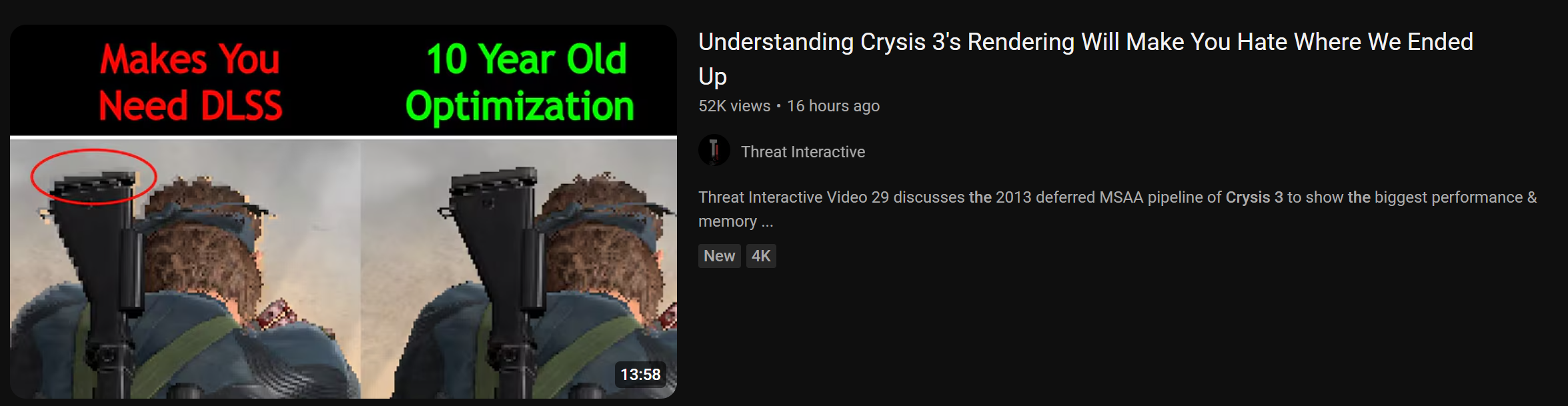
(Archive)
One goyim is (((noticing))) and he got called out by savior optimzation messiah.
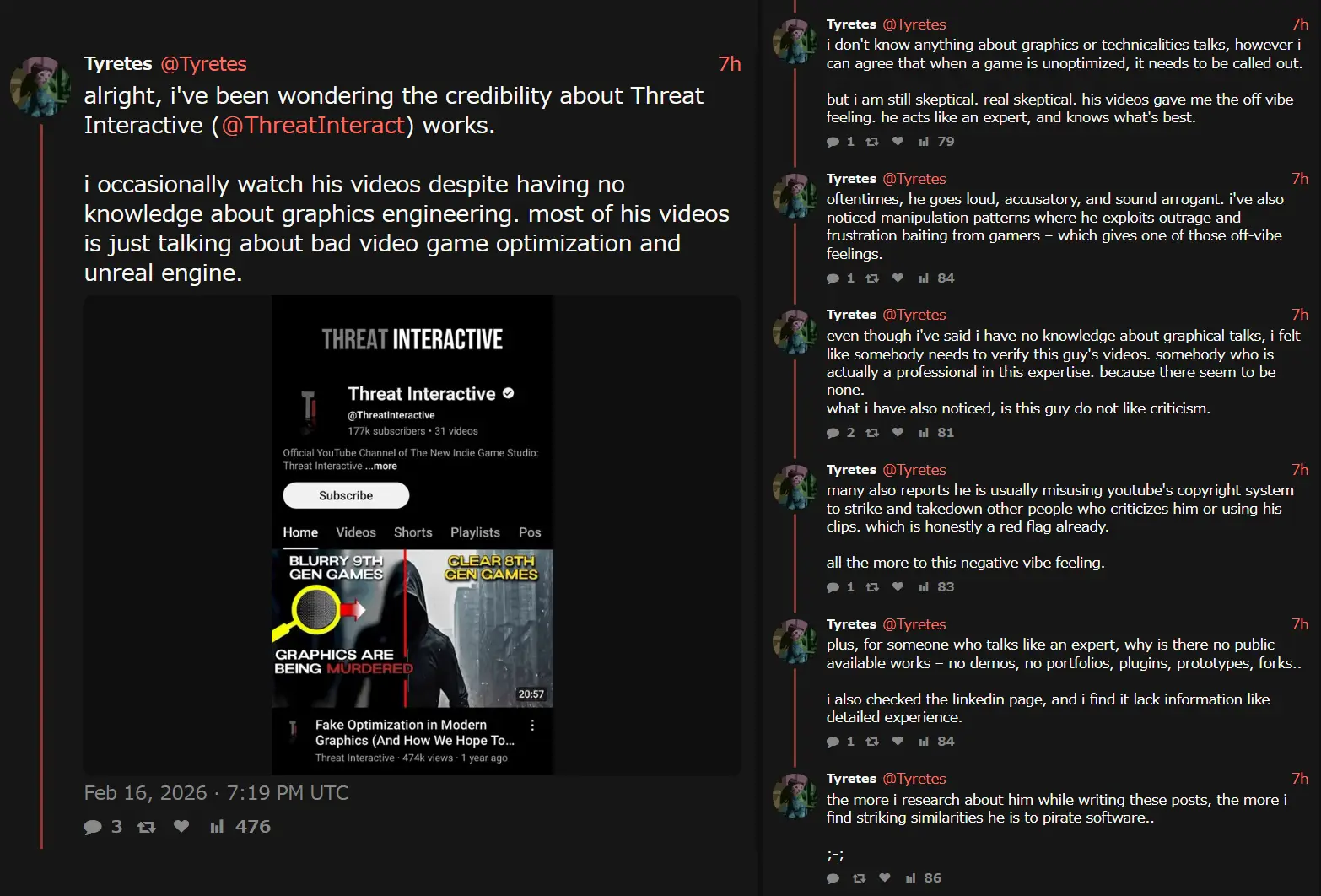
(Archive)

(Archive)
Threat Interactive seems to constantly search for his name on Reddit.

(Archive)
There seem to be recent videos about Threat Interactive’s antics when I searched for his videos. I wonder how long it will take for these videos to be taken down.

(Archive)

(Archive)
EDIT (2/19/26):
His so-called discord server has been confirmed to be fake.

(Archive)
According to this guy, his old discord server was closed down because he gotten backlash for copystriking others?

(Archive / More Archive)
Apparently the Crysis reddit OP is a three day old account shilling his youtube channel, which is why Threat Interactive responded so quickly lol.
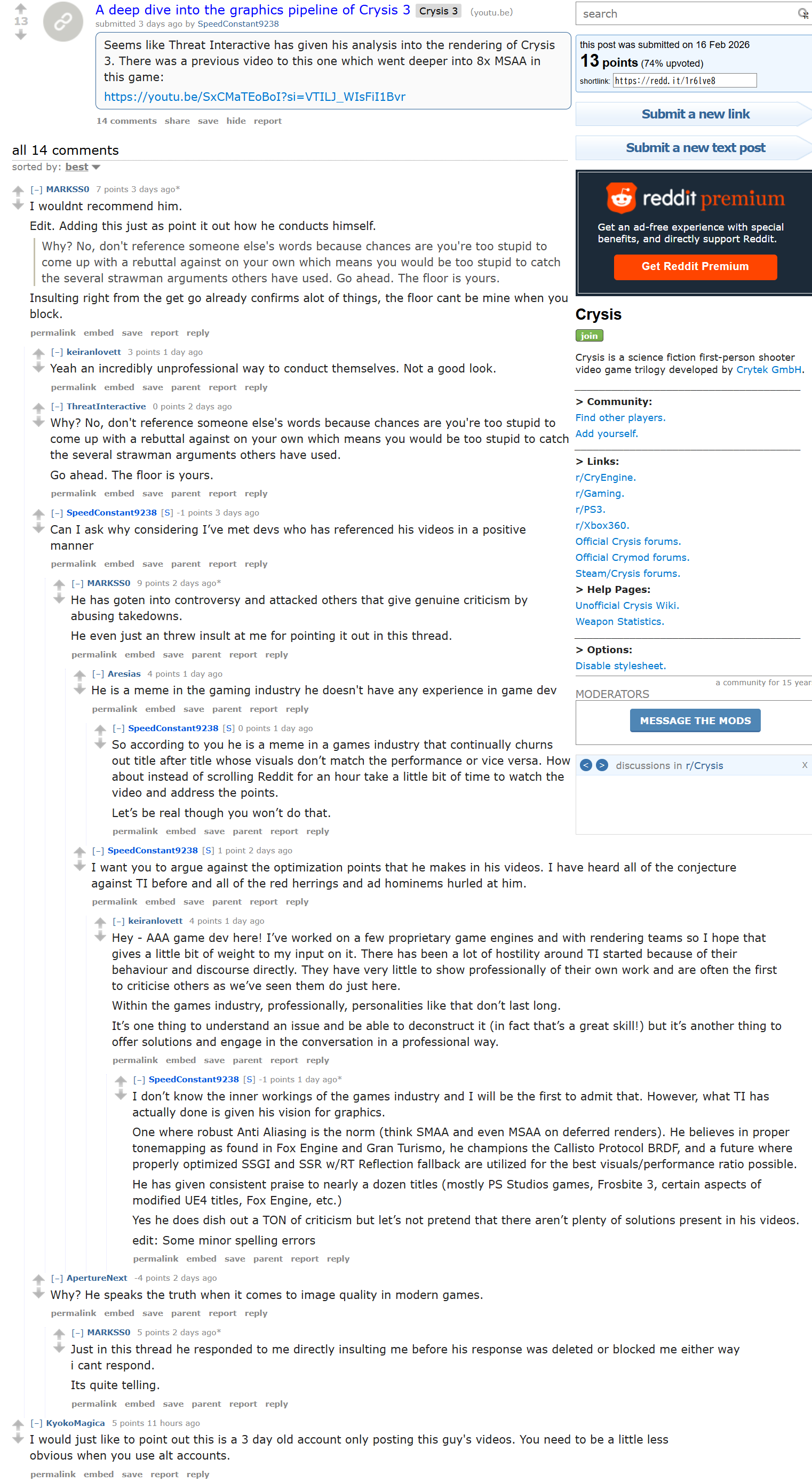
(Archive)


Page 1: https://archive.md/2H6Qa
Page 2: https://archive.md/PhDWV

(Archive)

(Archive)
So much shilling.

(Archive)
Make you wonder why he stopped posting videos on his main reddit account months ago.

(Archive)

(Archive)
Stephanie Woflie just changed profile picture on Linkedin. Is she SpeedConstant9238?


(Archive)
One goyim is (((noticing))) and he got called out by savior optimzation messiah.
(Archive)
(Archive)
Threat Interactive seems to constantly search for his name on Reddit.
(Archive)
There seem to be recent videos about Threat Interactive’s antics when I searched for his videos. I wonder how long it will take for these videos to be taken down.
(Archive)
(Archive)
EDIT (2/19/26):
His so-called discord server has been confirmed to be fake.
(Archive)
According to this guy, his old discord server was closed down because he gotten backlash for copystriking others?
(Archive / More Archive)
Apparently the Crysis reddit OP is a three day old account shilling his youtube channel, which is why Threat Interactive responded so quickly lol.
(Archive)
Page 1: https://archive.md/2H6Qa
Page 2: https://archive.md/PhDWV
(Archive)
(Archive)
So much shilling.
(Archive)
Make you wonder why he stopped posting videos on his main reddit account months ago.
(Archive)
(Archive)
Stephanie Woflie just changed profile picture on Linkedin. Is she SpeedConstant9238?
Archivos adjuntos


Última edición:

- Registrado
- 12 de Jul, 2024
You say Elden Ring TAA isn't that bad yet all games with TAA look like liquid dogshit especially in movement, I disabled motion blur so the trees and whatnot shouldn't fucking blur when I gently move the camera. Sorry, it's probably a worse visual artifact than motion blur with chromatic aberration because every time you just nudge the camera all the detail is wiped in a blur. Fuck TAA. Fuck TAA and that's final. I'm not compromising anymore. I'm tired of the reliant games for it too like RDR2. MY GRAPHICS SHOULD NOT FUCKING BREAK DOWN IF I HAVE THE OPTION FOR MSAA OR NVIDIA DOWNSCALING FUCK OFF YOU STUPID FUCKING JEET CODERS. TAA is like PS2 Vice City trails but at least the trails were with the vhs aesthetic and added great color to the game. It's a fucking cancer to those who desire clarity with basic 1080p 60fps games. It's not a huge ask. Even on higher resolution monitors, TAA is still ass cancer just less noticeable or so copers tell me. I may as well fucking play with my glasses off at that point and experience the full blur.
It's a shame, are there any actual YouTubers who know their nerd shit who can properly break down everything wrong with modern graphical engines, lost techniques (like basic fucking geometric mirror illusion reflections which they don't do anymore I assume because the poly count is too high on all geo now...) and so forth? Or will I still have to individually research each topic for the real nerd shit?
It's a shame, are there any actual YouTubers who know their nerd shit who can properly break down everything wrong with modern graphical engines, lost techniques (like basic fucking geometric mirror illusion reflections which they don't do anymore I assume because the poly count is too high on all geo now...) and so forth? Or will I still have to individually research each topic for the real nerd shit?
Última edición:
jammercat
kiwifarms.net
- Registrado
- 6 de Ene, 2026
After doing a investigation, OP reddit account, which is three day old is shilling Threat Interactive youtube videos on multiple subreddits. I have a suspicion that Stephanie Wolfie (or it's just kevin being schizo again) is behind the account. I'll be keeping a eye on the account. I also edited a few things to the post.Threat Interactive seems to constantly search for his name on Reddit.
> red herrings and ad hominems
(Archive)
(Archive)
jammercat
kiwifarms.net
- Registrado
- 6 de Ene, 2026
New video is up.
His response for no games or engine fork.
cobson7223
kiwifarms.net
- Registrado
- 9 de Mar, 2026
You should include the books written by his girlfriend(Stephanie Wolfe). Some weird stuff and very poor quality,
www.amazon.com/stores/author/B00Y639SYG
You can see some previews here, most children can write better than this.
As for that reddit account he almost certainly has a lot of alt accounts, this isn't the only reddit account doing it.
www.amazon.com/stores/author/B00Y639SYG
You can see some previews here, most children can write better than this.
As for that reddit account he almost certainly has a lot of alt accounts, this isn't the only reddit account doing it.
Última edición:

Bilibin
kiwifarms.net
- Registrado
- 19 de Ago, 2020
Seems like Kevin caught the attention of Gamers Nexus after calling them "marketing slaves" and after hiding/deleting his comment, GM decided to feature him in their video.
https://x.com/GamersNexus/status/2031725056234287224


https://x.com/GamersNexus/status/2031725056234287224
- Registrado
- 14 de Nov, 2022
22:40GM decided to feature him in their video.
Everything before that is unrelated

- Registrado
- 22 de Nov, 2018
Local segment archive:Seems like Kevin caught the attention of Gamers Nexus after calling them "marketing slaves" and after hiding/deleting his comment, GM decided to feature him in their video.
https://x.com/GamersNexus/status/2031725056234287224
Ver archivo adjunto 8685742
Ver archivo adjunto 8685743
Ver archivo adjunto 8685744
https://youtube.com/watch?v=r2SG4T0wymk:1363
14:47
jammercat
kiwifarms.net
- Registrado
- 6 de Ene, 2026