This is really good, thank you!
Gunshot wounds: Radiology and wound ballistics
by M.L. Fackler, '97
TDLR: After the bullet deforms on impact, it crushes maximally the amount of tissue it makes contact with, slowing it down immediately (this is obvious intuitively but a massive slowdown and repositioning occurs after the bullet makes contact with tissue massively affecting its velocity.)

TLDR: Unless directly hit by the bullet or fragments, there's unlikely to be any damage to surrounding vessels or bones. Again, really obvious, but the cavitation (the empty space in your body suddenly created by the bullet) is unlikely to cause damage to surrounding tissue on its own.
TLDR: Bullets travelling too fast can be as performance inhibiting as bullets travelling too slow. A bullet travelling too fast may deform and decrease penetration depth or fragment immediately upon entry creating surface-level wounds in the tissue. Shorter barrel lengths are unlikely to mushroom the bullet which are less likely to lodge into body.
TLDR: Higher velocity M16 rounds are more likely to fragment in the skin, but if the tissue path is shorter the M16 round is more likely to produce a cleaner wound (ice pick-type) than if it has to travel through more tissue.
TLDR: Civilian rounds are more likely to fragment in tissue than military rounds, causing greater tissue damage i.e. civilian bullets cause messier wounds than military ones.
TLDR: When a bullet enters someone, that's where most of the velocity is concentrated. Upon entering tissue it immediately yaws (changes angle) breaking apart and causing the most damage.

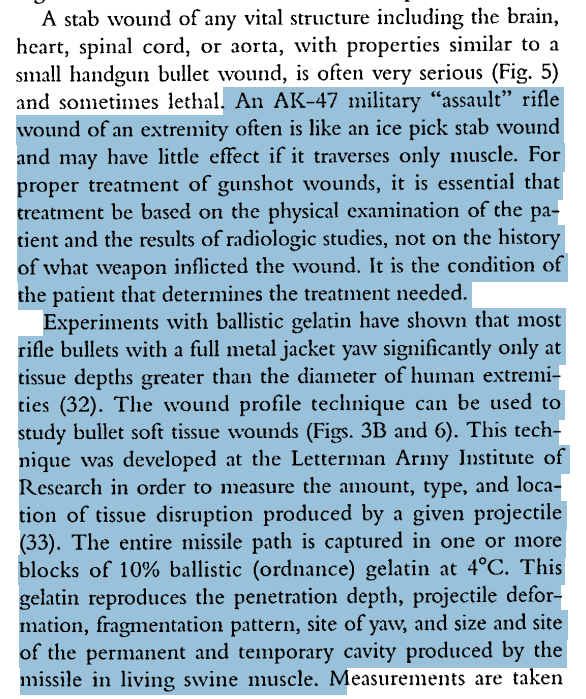
TLDR: Wounds produced by certain weapons/rounds are not consistent. Gelatine experiments with FMJ rounds show yaw at greater depths than demonstrable in more accurate facsimiles of human tissue, and is only really useful for demonstrating deformity and damage in shallow wounds.
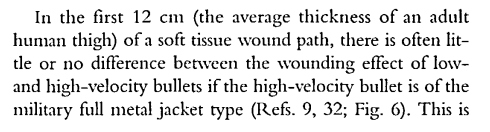
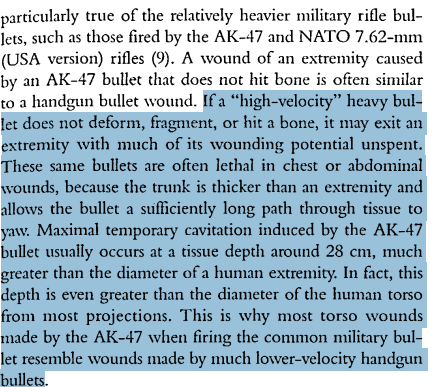
TLDR: So long as a "high-velocity" bullet does
not (1) deform (2) fragment (3) hit bone – it is likely to exit the person. However, higher velocity rounds are also more likely to fragment, decreasing the likelihood of punching through to the other end of the person shot, resembling lower-velocity handgun bullets.
I've included the PDF where I got these extracts.


