Victor Mignogna v. Funimation Productions, LLC, et al. (2019) - Vic's lawsuit against Funimation, VAs, and others, for over a million dollars.

I find the conduct of the lawltwatter to be utterly baffling. It's somewhat excusable to mouth off on a potential case you came across in passing, because there's a good possibility it will never see a court due to the expense of bringing it. But, Good Lord, this stuff is in front of a judge. There are going to be rulings. Why on Earth would you make declarative statements about a case you are proudly ignorant of and go out of your way to be utterly disdainful of the other side? You're just setting yourself up to be shown a fool. WHYYYYYYYY????

(And yes, that is a rhetorical question. Internet backpats are the opium of the exceptional.)

You can find this sort of stupid shit in the lead up to the Oberlin judgment, too. And the Hulk Hogan judgment.

Some people are entirely willing to make fools of themselves over and over and expect you to forget it by the next time they're making idiotic pronunciamentos about some other thing they're also wrong about.

(Wow I actually thought I just made up pronunciamento as a word and it's actually a real word lol.)
 
The Panty & Stocking pajama party thing showed that they generally have no issue whatsoever with ribald humor in public and to the extent there was any vaguely sexual banter in the jellybean incident it was mutual banter and not harassment.
I really didn't understand how 'ribald' panty&stocking was, amazon had blu-ray on sale so picked it up, kind of subpar animation but HOLY HELL the scripts and things that Jamie 'wrote' for her and Monica to say while doing VA work. They better hope that Ty doesn't use it to impeach their "oh I'm so innocent" act. I'm a jaded old fart and the 'show' shocked me in parts.
 
You can find this sort of stupid shit in the lead up to the Oberlin judgment, too. And the Hulk Hogan judgment.

Some people are entirely willing to make fools of themselves over and over and expect you to forget it by the next time they're making idiotic pronunciamentos about some other thing they're also wrong about.

(Wow I actually thought I just made up pronunciamento as a word and it's actually a real word lol.)
Memory holing things that don't go your way is the de facto tactic today. That thing the news has been screeching about 24/7 for the last couple weeks disappears as soon as it comes out that the facts don't match the narrative. Then it's on to the next outrage. There will always be another Vic for the foreseeable future. Social media vultures will swoop in looking for asspats as they take selfies over some fresh roadkill will just move on and never acknowledge they spent months or years refusing to see the truth in front of their faces. Facts are not important, only the narrative. You just move onto the next event when the facts and narrative don't align.
 
I don't think she was in any such position. I think they called her in to give legitimacy to some bullshit they'd already decided to do, and they even cut her "investigation" short when it wasn't panning out. She wasn't the one who made the call here.

The reason I think she was in that position is mainly due to her having the ability to make that call within Sony, and Sony has essentially full control over Funi. Unless the role of an executive director for employee relations (within Sonys P&O department) is very different from what they do where I live, Denbow should have been able to make that call.

Also I'm not quite sure that it was Funimation that cut the investigation short, as they shouldn't have been able to. She's a Sony exec, not a Funimation employee. Sony controls Funimation, not the other way around. How would Funimation or Monica have cut the Sony investigation short? At most they could have become less cooperative, unless I'm missing something? From what I can tell, rather than being cut short, she didn't even try to investigate properly.
 
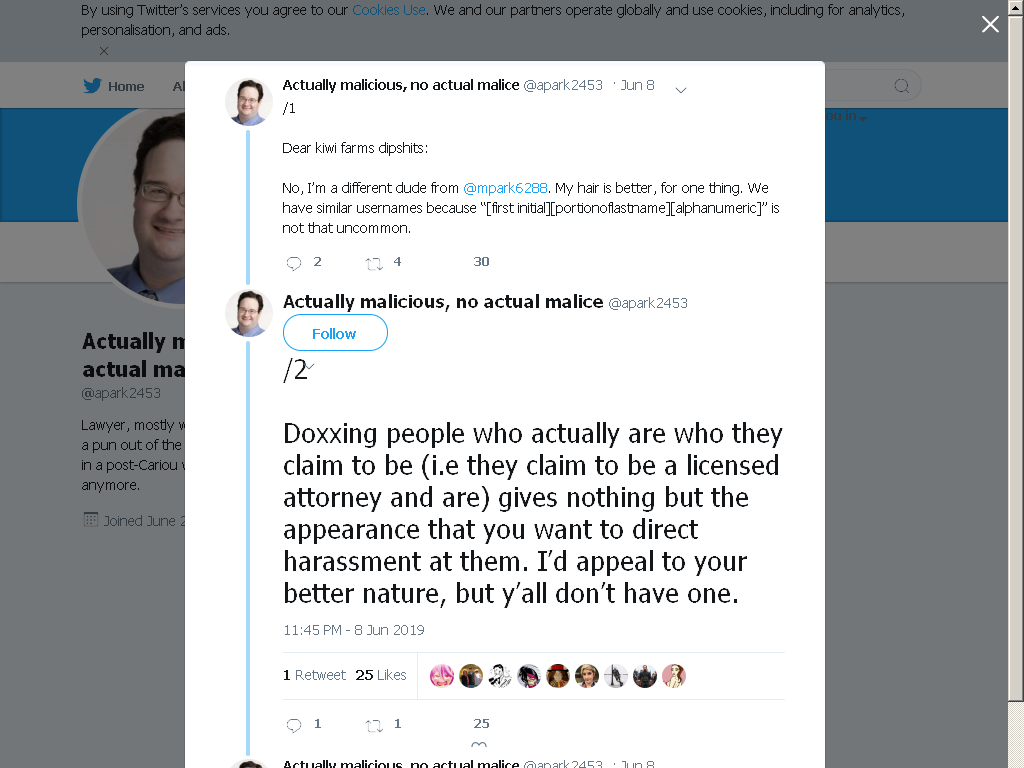
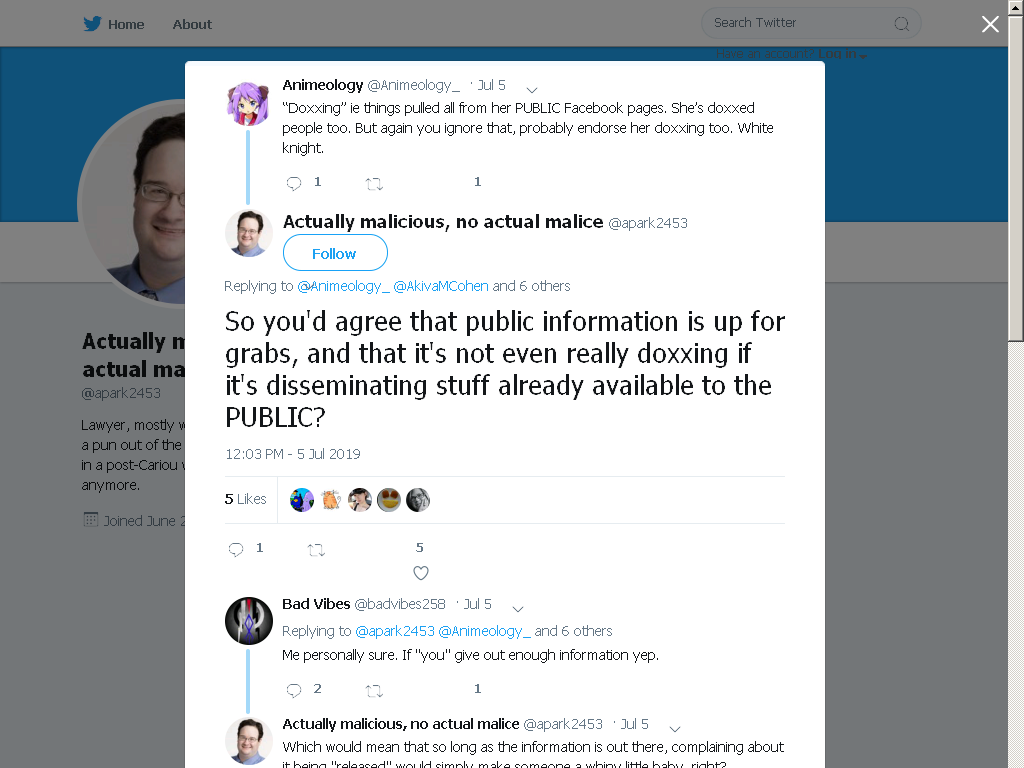
The dude is one of those miracle twitter lawyers.
- twitter account created 6 june 2019: check
- Immediately spamming kickvic slogans: check
- Immediately following doucette akiva & co (bonus: following 'pronous bio'): check
- 2 days after creation, call kiwifarms 'dipshit' : check
- More than 100 tweet /day: check
- Whining all the time because everyone else thinks wrong: check

Seems legit.

edit:
When kiwi doxx Cuck Lightyears and an other weirdo:
830139


When MoRon doxx Racket:
830140


Seem to be honest. No axe to grind.
 
Última edición:
Affidavits, while not 100% perfect evidence, are still fairly persuasive in most courts. I think if you look at a lot of rape cases, they essentially come down to he-said/she-said, and one way or the other you're relying on witness testimony.
That's actually not entirely true. While cases like this often come down to he said/she said affadavits alone are not usually considered enough and instead you generally need to have some form of fact finding, usually a cross examination, to go with it.

This has actually been a huge thing over the last few years since Obama, in his infinite wisdom, has insisted that universities need to adjudicate sexual assaults and the like under their Tilte IX obligations. Several students punished through them have successfully sued, and won, often on the argument that in he said/she said cases, mere statements aren't enough.
 
That's actually not entirely true. While cases like this often come down to he said/she said affadavits alone are not usually considered enough and instead you generally need to have some form of fact finding, usually a cross examination, to go with it.

And you'd better have a damned good reason why someone who has sworn an affidavit isn't available for deposition or to give testimony at trial (therefore subjecting themselves to cross examination).

Last we heard, Chupp gave the defendants the option of withdrawing the affidavits if those who swore them wish to remain anonymous. We're not even certain at this point that they will be entered into evidence.
 
This makes lawtwatter's reaction to the soye texts even more confusing. It's such blatant racketeering, he offered a hefty fiscal sponsorship, then said it's not gonna happen if vic is attending. the quid pro quo is in the fucking text thread. how can anyone see that as anything else?
He conditioned his sponsorship on Vic's absence, that's very clear. What's not clear is how that rises to the level of tortious interference, because this sort of horse-trading takes place ALL the time in business. It's like Coke offering to sponsor a stadium so long as the stadium stops selling Pepsi.
Nick Rekieta has spent a lot of time explaining why these common laws that you are writing about here do not apply. Basically, because it’s Texas. If this had happened in almost any other state, Vic would not have the case that he does. Have you watched Nick’s streams? There are a lot of them, but he provides the in-depth legal analysis it sounds like you’re looking for (if you are engaging in good faith).
I have tried to get through Nick's streams, but I just can't. He does not explain effectively or efficiently (and I listen to a LOT of legal podcasts).
 
What's not clear is how that rises to the level of tortious interference, because this sort of horse-trading takes place ALL the time in business. It's like Coke offering to sponsor a stadium so long as the stadium stops selling Pepsi.

Let's pretend your metaphor makes sense and go with it shall we?
The situation you describe would be "I may sponsor you if you DO NOT invite Vic after this" But vic was already invited to Kamehacon at this point so the situation with your Cola/Pepsi Situation would be as follows: Stadium XYZ has a running contract to sell Pepsi but this contract also allows them to sell coca-cola products (Vic was fine having other VAs around) but now Coca-Cola steps in and says "Yeah we sponsor your stuff but you have to get rid of this already running contract and ban Pepsi products from your premises" THAT'S tortious interference with an existing contract.
 
Stadium XYZ has a running contract to sell Pepsi but this contract also allows them to sell coca-cola products (Vic was fine having other VAs around) but now Coca-Cola steps in and says "Yeah we sponsor your stuff but you have to get rid of this already running contract and ban Pepsi products from your premises" THAT'S tortious interference with an existing contract.
No, it's not. Businesses have a privilege to compete for business (at least generally--I will assume this holds for Texas but it's Texas), which is why the comparison is exceptional.
 
No, it's not. Businesses have a privilege to compete for business (at least generally--I will assume this holds for Texas but it's Texas), which is why the comparison is exceptional.
competing for business and outright blackmailing somebody into breaking a running contract are two completely seperate things. I specified that in my example a contract was already present for a reason. If it was "We only sponsor you if you never sign a contract with Pepsi to begin with" we'd be in my previously mentioned example, which you completely cut out for whatever reason, where no problem was present. THAT would be competing for a business. The example you cited me on is one company outright interfering in another companies contract and costing them a business relationship.
 
competing for business and outright blackmailing somebody into breaking a running contract are two completely seperate things. I specified that in my example a contract was already present for a reason. If it was "We only sponsor you if you never sign a contract with Pepsi to begin with" we'd be in my previously mentioned example, which you completely cut out for whatever reason, where no problem was present. THAT would be competing for a business. The example you cited me on is one company outright interfering in another companies contract and costing them a business relationship.
Shouldn't also forget that most contracts have a term thus allowing Coke/Pepsi to negotiate with the stadium after that term is up thus it also avoids prospect of business.
 
competing for business and outright blackmailing somebody into breaking a running contract are two completely seperate things. I specified that in my example a contract was already present for a reason. If it was "We only sponsor you if you never sign a contract with Pepsi to begin with" we'd be in my previously mentioned example, which you completely cut out for whatever reason, where no problem was present. THAT would be competing for a business. The example you cited me on is one company outright interfering in another companies contract and costing them a business relationship.
I deleted my initial response because I had a few issues on unfair business practices to resolve however...

It is perfectly within Coke's privilege to interfere with an existing contract with Pepsi provided it uses fair business practices to do so. (No "We'll sell you product at 50% the cost"). The actions Coke takes must be wrongful even if they were done outside the context of TI for it to be TI. Meanwhile, Morgan Stanley, not being a competitor to Pepsi, would be engaging in TI if they did the exact same thing Coke did to terminate Pepsi's contract.

Edit: And I thought it would be obvious that I cut out the "no existing contract" part because, if I'm saying that it's OK for Coke to cut Pepsi out even if there is a pre-existing contract, there would be no issue with Coke cutting Pepsi out if there wasn't. But, apparently that's something that needs to be said?
 
Última edición:
He conditioned his sponsorship on Vic's absence, that's very clear. What's not clear is how that rises to the level of tortious interference, because this sort of horse-trading takes place ALL the time in business. It's like Coke offering to sponsor a stadium so long as the stadium stops selling Pepsi.

All that is required in Texas is that a contract existed and that due to the actions of a third party it no longer does. It doesn't even matter if Kamehacon was already planning to break the contract when Ron interfered (this same issue came up in Meyer v Waid).

No-one is denying that this shit happens all the time in business. That doesn't mean it's lawful. In one of the streams with Ty he says that this kind of stuff used to happen on the golf course with no witnesses. In this particular case, though, there is a written record.
 
All that is required in Texas is that a contract existed and that due to the actions of a third party it no longer does. It doesn't even matter if Kamehacon was already planning to break the contract when Ron interfered (this same issue came up in Meyer v Waid).

No-one is denying that this shit happens all the time in business. That doesn't mean it's lawful. In one of the streams with Ty he says that this kind of stuff used to happen on the golf course with no witnesses. In this particular case, though, there is a written record.

And here is a case where they still found TI AFTER someone decided to break a contract.

 
It is perfectly within Coke's privilege to interfere with an existing contract with Pepsi provided it uses fair business practices to do so. (No "We'll sell you product at 50% the cost"). The actions Coke takes must be wrongful even if they were done outside the context of TI for it to be TI. Meanwhile, Morgan Stanley, not being a competitor to Pepsi, would be engaging in TI if they did the exact same thing Coke did to terminate Pepsi's contract.

Businesses will constantly market themselves to potential customers, even if that customers is doing business with one of their competitors. However, there's a big difference between "consider us next time" and interfering with an existing contract. Also, the kinds of contracts that large companies like Coke and Pepsi write up are going to include early termination clauses so that there's a lot less incentive for breaking the contracts.

Large businesses don't want to engage in illegal practices agains their competition either, because they realize that if they can get away with it, then so can the competition. The end result would be more resources that each company has to spend for no overall increase in the amount of total product that can be sold. The damage to the brand if it ever came out would also be too large to make it worth while. There was an old story about someone who worked at Coca Cola trying to sell a secret recipe or something like that to Pepsi. Pepsi reported the person back to Coke who got the FBI involved.

Most corporate espionage is from other countries where it's much harder to seek legal remedy. The larger problem is typically that companies collude in some manner, typically through price fixing or by entering into secret pacts not to hire away employees from each other which pushes wages down. Occasionally you'll get a few bad actors that might engage in something like TI, but it's not the norm for larger companies.
 
Businesses will constantly market themselves to potential customers, even if that customers is doing business with one of their competitors. However, there's a big difference between "consider us next time" and interfering with an existing contract. Also, the kinds of contracts that large companies like Coke and Pepsi write up are going to include early termination clauses so that there's a lot less incentive for breaking the contracts.
It's mainly that last bit that's the issue. Not only are they going to include those clauses, but they're also going to include an NDA as to the conditions of the contract (as we saw in the KC contract). This makes attacking the contract very hard if, say, Pepsi were giving very unfavorable terms to the venue that Coke could exploit if known.

But the fact is, if the opportunity does emerge (such as Coke uncovering footage of Ramon Laguarta kicking the venue owner's dog), competitors do have privilege to interfere. Beyond that, we're arguing over practicality, not legality.

Edit: Here is a company advertising breaching contract to switch to them.:
Still on contract?
We'll pay it off.

Get a new phone and we’ll pay off your current phone and service contracts – up to $650 per line or $350 in early termination fees, via virtual prepaid card and trade-in credit.
 
Última edición:
Atrás
Top Abajo