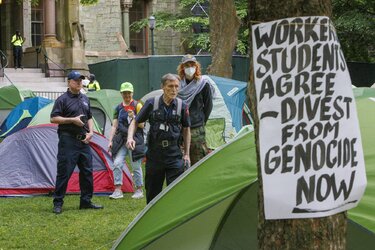
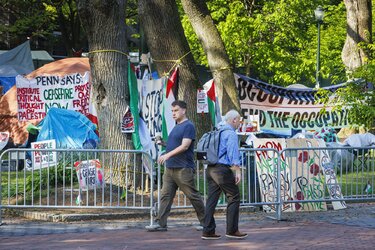
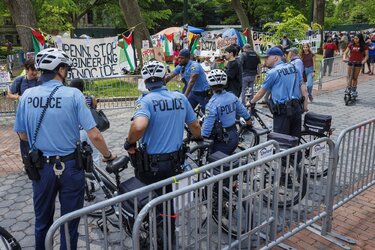
US Universities Struggle as Pro-Palestinian Demonstrations Grow - Dozens were arrested Monday at N.Y.U. and Yale, but officials there and at campuses across the country are running out of options to corral protests that are expected to last the rest of the school year.

Universities Struggle as Pro-Palestinian Demonstrations Grow
The New York Times (archive.ph)
By Alan Blinder
2024-04-23 04:48:02GMT

ny01.jpg
Police arrest protesters outside of New York University on Monday night. Credit...Adam Gray for The New York Times

At New York University, the police swept in to arrest protesting students on Monday night, ending a standoff with the school’s administration.

At Yale, the police placed protesters’ wrists into zip ties on Monday morning and escorted them onto campus shuttles to receive summonses for trespassing.

Columbia kept its classroom doors closed on Monday, moving lectures online and urging students to stay home.

Harvard Yard was shut to the public. Nearby, at campuses like Tufts and Emerson, administrators weighed how to handle encampments that looked much like the one that the police dismantled at Columbia last week — which protesters quickly resurrected. And on the West Coast, a new encampment bubbled at the University of California, Berkeley.

Less than a week after the arrests of more than 100 protesters at Columbia, administrators at some of the country’s most influential universities were struggling, and largely failing, to calm campuses torn by the conflict in Gaza and Israel.
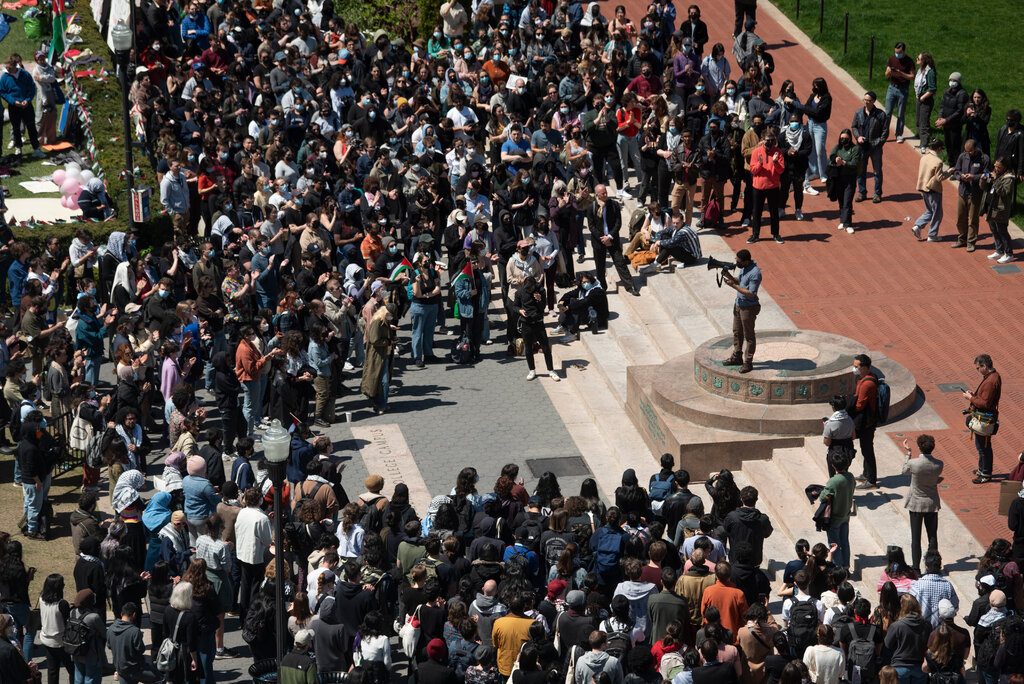
ny02.jpg
Despite arrests at Columbia last week, protests continued on campus on Monday.Credit...C.S. Muncy for The New York Times

During the turmoil on Monday, which coincided with the start of Passover, protesters called on their universities to become less financially tied to Israel and its arms suppliers. Many Jewish students agonized anew over some protests and chants that veered into antisemitism, and feared again for their safety. Some faculty members denounced clampdowns on peaceful protests and warned that academia’s mission to promote open debate felt imperiled. Alumni and donors raged.

And from Congress, there were calls for the resignation of Columbia’s president, Nemat Shafik, from some of the same lawmakers Dr. Shafik tried to pacify last week with words and tactics that inflamed her own campus.

The menu of options for administrators handling protests seems to be quickly dwindling. It is all but certain that the demonstrations, in some form or another, will last on some campuses until the end of the academic year, and even then, graduation ceremonies may be bitterly contested gatherings.

For now, with the most significant protests confined to a handful of campuses, the administrators’ approaches sometimes seem to shift from hour to hour.

“I know that there is much debate about whether or not we should use the police on campus, and I am happy to engage in those discussions,” Dr. Shafik said in a message to students and employees early Monday, four days after officers dressed in riot gear helped clear part of Columbia’s campus.

“But I do know that better adherence to our rules and effective enforcement mechanisms would obviate the need for relying on anyone else to keep our community safe,” she added. “We should be able to do this ourselves.”

Protesters have demonstrated with varying intensity since the Oct. 7 Hamas attack on Israel. But this particular round of unrest began to gather greater force last Wednesday, after Columbia students erected an encampment, just as Dr. Shafik was preparing to testify before Congress.

At that hearing in Washington, before a Republican-led House committee, she vowed to punish unauthorized protests on the private university’s campus more aggressively, and the next day, she asked the New York Police Department to clear the encampment. In addition to the more than 100 people arrested, Columbia suspended many students. Many Columbia professors, students and alumni voiced fears that the university was stamping out free debate, a cornerstone of the American college experience.

The harsher approach helped lead to more protests outside Columbia’s gates, where Jewish students reported being targeted with antisemitic jeers and described feeling unsafe as they traveled to and from their campus.

The spiraling uproar in Upper Manhattan helped fuel protests on some other campuses.

“We’re all a united front,” said Malak Afaneh, a law student protesting at University of California, Berkeley. “This was inspired by the students at Columbia who, in my opinion, are the heart of the student movement whose bravery and solidarity with Palestine really inspired us all.”

The events at Columbia also rippled to Yale, where students gathered at Beinecke Plaza in New Haven, Conn., for days to demand that the university divest from arms manufacturers.

Yale’s president, Peter Salovey, said Monday that university leaders had spent “many hours” in talks with the protesters, with an offer that included an audience with the trustee who oversees Yale’s Corporation Committee on Investor Responsibility. But university officials had decided late Sunday that the talks were proving unsuccessful, and Dr. Salovey said, they were troubled by reports “that the campus environment had become increasingly difficult.”

The authorities arrested 60 people on Monday morning, including 47 students, Dr. Salovey said. The university said the decision to make arrests was made with “the safety and security of the entire Yale community in mind and to allow access to university facilities by all members of our community.”

In the hours after the arrests, though, hundreds of protesters blocked a crucial intersection in New Haven.

ny03.jpg
Students protesters occupied an intersection near the campus of Yale University on Monday.Credit...Adrian Martinez Chavez for The New York Times

“We demand that Yale divests!” went one chant.

“Free Palestine!” went another.

Far from being cowed by the police, protesters suggested that the response at Beinecke Plaza had emboldened them.

“It’s pretty appalling that the reaction to students exercising their freedom of speech and engaging in peaceful protest on campus grounds — which is supposed to be our community, our campus — the way that Yale responds is by sending in the cops and having 50 students arrested,” said Chisato Kimura, a law student at Yale.

The scene was less contentious in Massachusetts, where Harvard officials had moved to limit the possibility of protests by closing Harvard Yard, the 25-acre core of the campus in Cambridge, through Friday. Students were warned that they could face university discipline if they, for instance, erected unauthorized tents or blocked building entrances.

On Monday, Harvard’s Palestine Solidarity Committee said on social media that the university had suspended it. National Students for Justice in Palestine, a loose confederation of campus groups, said it believed the decision was “clearly intended to prevent students from replicating the solidarity encampments” emerging across the United States. Harvard said in a statement that it was “committed to applying all policies in a content-neutral manner.”

Elsewhere in the Boston area, protesters had set up encampments at Emerson College, the Massachusetts Institute of Technology and Tufts University. But those protests, for now, appeared more modest than the ones at Yale and in New York, where demonstrators constructed an encampment outside N.Y.U.’s Stern School of Business.

ny04.jpg
Protesters outside of New York University, before police arrived.Credit...Adam Gray for The New York Times
ny05.jpg
“Students, students, hold your ground!” protesters roared. “N.Y.U., back down!”Credit...Adam Gray for The New York Times

N.Y.U. officials tolerated the demonstration for hours but signaled Monday night that their patience was wearing thin. Police officers gathered near the protest site as demonstrators ignored a 4 p.m. deadline to vacate it. As nightfall approached, sirens blared and officers, donning helmets and bearing zip ties, mustered. Prisoner transport vans waited nearby.

“Students, students, hold your ground!” protesters roared. “N.Y.U., back down!”

Soon enough, police officers marched on the demonstration.

“Today’s events did not need to lead to this outcome,” said John Beckman, a university spokesman in a statement. But, he said, some protesters, who may not have been from N.Y.U., breached barriers and refused to leave. Because of safety concerns, the university said it asked for assistance from the police.

At Columbia, Dr. Shafik ordered Monday’s classes moved online “to de-escalate the rancor.”

She did not immediately detail how the university would proceed in the coming days, beyond saying that Columbia officials would be “continuing discussions with the student protesters and identifying actions we can take as a community to enable us to peacefully complete the term.”

Some students and faculty members said support for Dr. Shafik was eroding, with the university senate preparing for the possibility of a vote this week to censure the president. Supporters of the censure complained that Dr. Shafik was sacrificing academic freedom to appease critics.

But Dr. Shafik was castigated on Monday by the very people she was accused of appeasing when at least 10 members of the U.S. House of Representatives demanded her resignation.

“Over the past few days, anarchy has engulfed Columbia University,” Representative Elise Stefanik, Republican of New York and one of Dr. Shafik’s chief interrogators last week, wrote with other lawmakers. “As the leader of this institution, one of your chief objectives, morally and under law, is to ensure students have a safe learning environment. By every measure, you have failed this obligation.”

A university spokesperson said that Dr. Shafik was focused on easing the strife and that she was “working across campus with members of the faculty, administration, and board of trustees, and with state, city, and community leaders, and appreciates their support.”

Amid the acrimony, and with scores of green, blue and yellow tents filling the Columbia encampment, parts of the campus sometimes took on an eerie, surreal quiet on a splendid spring day.

ny06.jpg
Some faculty members said support for Dr. Shafik was eroding.Credit...CS Muncy for The New York Times
ny07.jpg
At Columbia, many Jewish students stayed away from campus for Passover.Credit...Bing Guan for The New York Times

The unease was never all that far away, though, even with many Jewish students away from campus for Passover.

“When Jewish students are forced to watch others burning Israeli flags, calling for bombing of Tel Aviv, calling for Oct. 7 to happen over and over again, it creates an unacceptable degree of fear that cannot be tolerated,” Representative Daniel Goldman, Democrat of New York, said outside Columbia’s Robert K. Kraft Center for Jewish Student Life.

By then, in another symbol of the crisis enveloping Columbia, Mr. Kraft, an alumnus and owner of the New England Patriots, had launched his own broadside and suggested he would pause his giving.

“I am no longer confident that Columbia can protect its students and staff,” he wrote in a statement, “and I am not comfortable supporting the university until corrective action is taken.”
 
The UW-Milwaukee apparently won't clear the encampment,

1715181455368.png

the UWM Foundation has agreed to "make efforts to divest," ("I pinkie-promise I'll try not to give or receive money from Israel")

1715181526476.png

the protesters have claimed they can stay there until fall, (apparently, they only have enough energy for the summer - does the harshness of winter and lake-effect snow really take precedence over those Palestinian kids?)

1715181604981.png

and now the encampment has doubled in size

1715181326763.png

(complete with security guards who allegedly follow people when they're on campus and take pictures of them).

1715180778011.jpeg 1715180802632.jpeg 1715180862686.jpeg 1715180834327.png

A lot of graffiti too:
1715180906985.png 1715180973184.jpeg 1715180996693.jpeg 1715181028891.jpeg 1715181076036.png

They've put a bunch of signs up.
1715181137109.jpeg

I regret to inform you that there's a mongoloid (who is thirsty for Laura Loomer) that is trying to rile up the Gaza protesters.

He showed a clip of the graffiti (some airhead in a vest was trying to block him) while commenting that the building has been "defaced" and it's such a great use of tax dollars. He was doing another tour of the encampment when three fat/ugly girls came up to him, followed him, and blocked his view (around 38:30). I guess "press/media" aren't welcomed.

1715183608579.png 1715184004103.png 1715184033065.png 1715183872723.png 1715184362836.png

There was a video of a Jewish guy trying to rile up the crowds too.
1715183353262.png 1715183412096.png
 
Última edición:
Princeton is being utterly inhumane, by not letting protestors (who have dorm rooms) put up tents and they're getting damp.
You love to see it. :story:

Goddamn but these "protesters" are a bunch of pussies. One of my thoughts going forward is that the universities should have a strict "no tents" policy, and it looks like the Jersey lads are doing it right. Let these people be uncomfortable for a night.

"The last time I was damp like this, papa took the ketch back to harbor immediately, and my au pair made me hot cocoa with marshmallows. The university is being uncivilized!"
 
You guys ever stop and think "huh, why does a tiny nation in the middle east have such power over the western world?" then you stop your train of thought because it's not okay to be antisemitic? I do.
 
To find masked mob members who attacked UCLA camp, police using Jan. 6 tactics
Los Angeles Times (archive.ph)
By Richard Winton
2024-05-07 13:41:15GMT
Spoiler
ucla01.jpg
A pro-Palestinian protester clashes with a pro-Israel supporter at an encampment at UCLA on May 1. (Wally Skalij / Los Angeles Times)

It is shaping up to be perhaps the biggest case in the history of the UCLA Police Department: how to identify dozens of people who attacked a pro-Palestinian camp at the center of campus last week.

The mob violence was captured on live television, but it took three hours for police to bring it to an end. Those involved left, and no arrests were made.

But the trail is not cold.

UCLA detectives are now scanning hundreds of images in an attempt to identify the attackers. They intend to use technology that captures facial images and compares them to other photos on the internet and social media to put names to faces, according to law enforcement sources.

The same technology has allowed police to identify suspects in smash-and-grab retail burglaries. It also was the heart of the Jan. 6 investigation, in which videos of those storming the U.S. Capitol helped the FBI identify many of the assailants and led federal prosecutors to charge more than 1,300 people. In those cases, investigators often were able to find social media images of the assailant wearing the same clothing as during the attack.

“Technology has made the entire community into the eyes of law enforcement,” said retired Los Angeles police Capt. Paul Vernon, who led an effort after a mini-riot following the Lakers’ NBA championship victory in 2010 that resulted in dozens of arrests based on videos, social media posts and security footage. “Photo recognition has gotten a lot easier.”

Vernon said an investigator also could gather cellphone data from the immediate area to prove an individual was there at the time of the incident. In some cases, assailants may have posted to their social media accounts, essentially bragging about their actions. Officers wearing body cameras may have also captured some of the behavior, he said.

The attackers likely came in vehicles, so UCLA police will be examining data from license plate readers for movements near campus on May 1. Security cameras on streets neighboring the campus where they likely parked could yield more clues.

Along with continuing protests, finding those who attacked the camp will be a major challenge for newly installed UCLA Associate Vice Chancellor Rick Braziel, a former Sacramento police chief. Braziel will be tasked with bringing to justice those responsible for what Chancellor Gene Block called a “dark chapter in our campus history.”

On Monday night, Block outlined actions the school is taking in the aftermath of last week’s violence. University police will work with the Los Angeles Police Department and the Los Angeles County district attorney’s office to identify and prosecute the assailants “to the fullest extent of the law,” he said. The university “also connected with the FBI about possible assistance,” Block said in a statement.

Despite the technology, the probe faces hurdles. Some of the attackers wore masks, making it harder to identify them. In those instances, detectives will look for a moment before or after the attack when the perpetrators’ faces were revealed, an official who was not authorized to discuss the investigation told The Times.

There is also deep anger among some protesters in the camp because it took so long for police to stop the attack. That distrust could take a toll. Many of the students who were injured, some of whom were hospitalized with their wounds, have gone to groups such as the Council on American-Islamic Relations for Southern California but haven’t spoken with campus police.

UCLA is a small police department, so it is reaching out to other agencies and private entities to access the technology needed in the investigation, law enforcement sources said. But so far, UCLA hasn’t made a public appeal seeking information on specific suspects.

In the wake of the Jan. 6 attack, the FBI made arrests based on information from relatives, work colleagues, teammates, former friends and ex-significant others after the FBI released photos of suspects. An army of web sleuths and politically knowledgeable social media watchers known as “sedition hunters” also dedicated themselves to identifying the mob and turning their names over to the FBI.

Images from the UCLA attack are springing up on Instagram. In one case, a man can be seen using a plank to hit a pro-Palestinian protester and then punching and kicking others. Dressed in a black sweatshirt, white sweatpants and a black cap, his bearded face is not hidden. Police can use that image to track him down or ask for help identifying him.

“Holding the instigators of this attack accountable and enhancing our campus safety operations are both critical,” Block said. “Our community members can only learn, work and thrive in an environment where they feel secure.”

The PROTESTORS won't be held accountable and will be given everything they want.

The counter-protestors will be prosecuted to the full extant of the law.

You know it, I know it.
 
Man Is Charged After Hitting Pro-Palestinian Protester With His Car
The New York Times (ghostarchive.org)
By Hurubie Meko
2024-05-08 17:58:38GMT
A man who got into an argument with pro-Palestinian demonstrators before hitting one with his car on the Upper East Side of Manhattan on Tuesday has been charged with assault, according to the police.

The man, Reuven Kahane, 57, was arguing with two demonstrators around 9 a.m. when he struck a 55-year-old woman with his vehicle, the police said. In reaction, the demonstrators hit Mr. Kahane’s car.

Mr. Kahane was charged with second-degree assault. The demonstrator who was hit, Maryellen Novak, was treated at Weill Cornell Medical Center for minor injuries. She was arrested and charged with criminal mischief and unlawful assembly. The other demonstrator involved, John Rozendaal, 63, was also arrested and charged with criminal mischief.

Mr. Kahane was arraigned Wednesday morning and released without bail. The Manhattan district attorney’s office declined to prosecute Ms. Novak and Mr. Rozendaal, according to a statement.

Lawyers for Mr. Kahane, Sara Shulevitz and Mindy Meyer, said that “more facts will come to light” in the course of the case.

“We’re confident that our client will be exonerated of all charges,” they said.

According to public and genealogical records, Mr. Kahane is cousins with Rabbi Meir Kahane, the Brooklyn-born founder of the Jewish Defense League and leader of a militant anti-Arab fringe movement in Israel who was killed shortly after addressing a Zionist conference in New York City in 1990.

Asked about the familial connection, Ms. Shulevitz and Ms. Meyer said they “haven’t seen his family tree, and it’s unrelated to this case.”

The protesters on Tuesday were part of a group of about 25 people demonstrating outside of 755 Park Avenue, the police said, and the group was walking away when Mr. Kahane got into “a verbal dispute” with two of them.

A student group, Columbia University Apartheid Divest, disputed the police account, saying in a statement that Mr. Kahane drove up to the protesters in his car and asked for a flier before “grabbing the protester’s arm.”

As they were leaving, the group said, he “circled the block to drive into our peaceful demonstration” and struck a person whom they identified as one of the group’s de-escalation team members.

The episode is the second time in a week that members of their group have been assaulted and the fourth hospitalization, the statement said.

The incident on the Upper East Side came a week after police officers in riot gear arrested dozens of pro-Palestinian demonstrators from a Columbia University building they were occupying. For two weeks in April and May, a protest encampment took over a central lawn on campus, spurring protests at schools around the country aimed at pressuring universities to divest funds from companies connected to the Israeli military campaign in Gaza.

In a phone call on Wednesday, Mr. Rozendaal said that he was also at the demonstration as a de-escalator at the request of the student group. He had attended other demonstrations as a protester, but on Tuesday his sole role was “keeping people safe,” he said.

Mr. Rozendaal, a musician who lives in Manhattan, declined to give an account of what led to the confrontation with Mr. Kahane or the aftermath. But he said that during their demonstration in front of a Columbia University trustee’s home, they were approached by people who were “ really, really angry.”

“It was a challenge during those two hours to have compassion for everybody on the scene because anger comes from fear and it doesn’t come from nowhere,” he said. “But it also felt like it was making people unsafe.”

As the group was leaving the area, he said, the confrontation with Mr. Kahane occurred.

Mr. Rozendaal, who was not struck, said he was released from central booking — where people arrested are taken to be processed — around 2:30 a.m. on Wednesday and was told that the Manhattan district attorney’s office had “declined to prosecute” his case.

“The story is what’s happening to the people in Gaza and United States’ complicity and Columbia University’s complicity,” he said. “And the other piece of the story is the courage of Columbia University students in refusing to be complicit. And I was there to support that.”
 

130 arrested at UMass Amherst pro-Palestine protest​

Police arrested over 130 protestors at a pro-Palestine encampment on the UMass Amherst campus after administrators ordered the students to disperse Tuesday night, according to a statement from the university and videos documenting the clash.

As of Wednesday morning, UMass Police reported 109 people booked in charges and pending charges for about 25 others, UMass Amherst said in a statement.

The police action came just hours after student protestors formed their second encampment of the semester on the South Lawn of the Student Union to push the university to divest from organizations connected to Israel, among other demands.

The protestors formed their first encampment on April 29 but dismantled the next morning on threat of arrest and disciplinary action. Student organizers stated in an open letter on the UMass SJP Instagram they reformed the camp on Tuesday “in light of the horrifying invasion of Rafah.”
In a letter to the campus community, university Chancellor Javier Reyes said the school would open a dialogue with students but the “encampment must be removed.”

“While we have told demonstrators that failure to remove the tents and barriers may result in arrests, this is not the outcome we had hoped for,” Reyes wrote in the letter Tuesday evening. “Moments ago, I asked the University of Massachusetts Police Department to begin dispersing the crowd and dismantling the encampment. Let me be clear – involving law enforcement is the absolute last resort.”

Videos from the UMass student group Young Communist League on Instagram show police in heavy gear zip tying, tackling and arresting protestors. In one shot, police appear to tackle a protestor running towards another person being restrained on the ground by three police appearing to punch and using something causing a bright flashing light.

Israel-Hamas war protesters and police clash on Texas campus, Columbia University begins suspensions
The SJP organizers listed demands in their open letter, including wide disclosure of connections with “war profiteers,” defense contractors and Israel affiliates, divestments from those entities, cutting ties with the corporation Raytheon and study abroad programs in Israel, and dropping sanctions and charges for 57 students arrested during a pro-Palestine sit-in in October.

“If at any point you choose to arrest or sanction students, this offer for dialogue and negotiation is off the table,” the SJP open letter stated.

In the Chancellor’s letter, Reyes said the administration spoke with student protestors for over an hour and a half but did not reach an agreement. The Board of Trustees agreed to consider the divestment calls at their June meeting, the UMass Foundation Board “received a request to consider divestment” and the school was reviewing student protestors’ cases, Reyes said.

On Wednesday, UMass student groups also organized a rally in the Student Union and called for Reyes to resign. Reyes took office less than one year ago in July 2023.

“As chairman of the UMass Board of Trustees, I want to offer the Board’s full and unwavering support for Chancellor Javier Reyes,” said Board Chair Stephen Karam on Wednesday.

The ACLU of Massachusetts cited concerns following the arrests, including alleged attempts to hide the police action on the campus from press and legal observers. Press were also restricted from viewing interactions between police and protestors on the MIT campus on Monday.

The ACLU also noted resources for student protestors on legal recourse and information on their rights on campus.

“Campus administrators have an obligation to protect students’ safety on campus; at the same time, they must take all necessary measures to protect students’ right to protest,” wrote Carol Rose, Executive Director of the ACLU of Massachusetts. “Calling heavily armed police on student political expression is an inherently dangerous choice. With protests ongoing, including at Harvard and MIT, the ACLU continues to urge campus officials and police to show restraint and engage in dialogue and other nonviolent approaches – not force.”
 
Man ID’d as cousin of controversial Rabbi Meir Kahane arrested for ramming NYC pro-Palestinian protester
New York Daily News (ghostarchive.org)
By Ellen Moynihan, Cayla Bamberger, Rocco Parascandola, Thomas Tracy, and Graham Rayman
2024-05-08 21:58:46GMT
car01.jpg
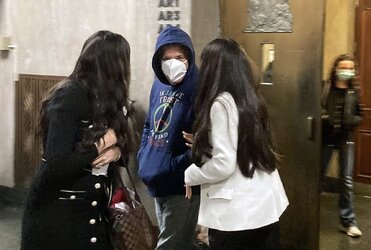
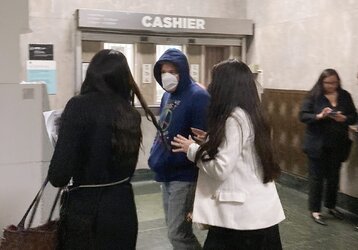
Reuven Kahane (center, in blue hoodie and mask) is pictured leaving Manhattan Criminal Court. He was flanked by his two attorneys, Mindy Meyer (in white) and Sara Shulevitz (in black). Kahane is accused of deliberately striking a pro-Palestinian protester with his vehicle on Monday, May 6, 2024. (Tom Tracy / New York Daily News)

A man identified as a cousin of Rabbi Meir Kahane — the controversial founder of the Jewish Defense League assassinated in a Manhattan hotel — has been arrested for ramming his car into a pro-Palestinian protester on the Upper East Side.

Reuven Kahane, a 57-year-old real estate developer, was arrested at Park Ave. and E. 72nd St. by police following the clash with protesters picketing the home of a Barnard College trustee Tuesday morning, cops said.

Protesters quickly identified Reuven Kahane as a cousin of Meir Kahane, and on Wednesday the Times of Israel reported the same. Reuven Kahane has also been identified as a cousin of the firebrand rabbi in past media reports through the decades.

Kahane and his lawyer declined at court to discuss the case or his relationship to Meir Kahane.

“We haven’t seen his family tree, so we can’t comment,” said the lawyer, Sara Shulevitz.

Meir Kahane was barred from Israel’s parliament for anti-Arab views before being gunned down in 1990. His assassin, El Sayyid Nosair, was an adherent of the blind sheikh Omar Abdel Rahman, whose sect was linked to the 9/11 attacks. Nosair was also convicted of involvement in the 1993 World Trade Center bombing.

The homes of four Columbia and Barnard College trustees were picketed early Tuesday. At Park Ave. and E. 72nd St., the police said about 25 pro-Palestinian demonstrators started protesting at about 8:45 a.m.

“The arresting officer observed the incident and witnessed the defendant continue to move into the crosswalk in spite of multiple people crossing at the crosswalk,” the prosecutor said during Reuven Kahane’s arraignment in Manhattan Criminal Court Wednesday morning.

“The allegation is that the victim placed her hands on front of the vehicle to signal the defendant to stop, and the defendant nonetheless moved forward with his vehicle, causing her to suffer back pain, leg pain and other injuries.”

Reuven Kahane, wearing a blue hoodie that read “In Jah we trust and find peace,” was arraigned on felony assault charges and released without bail. He did not speak in court or to reporters.

Prosecutors requested supervised release, noting though it was his first arrest, the seriousness of the charge merited more stringent monitoring.

car02.jpg
Reuven Kahane (center, in blue hoodie and mask) is pictured leaving Manhattan Criminal Court. He was flanked by his two attorneys, Mindy Meyer (in white) and Sara Shulevitz (in black). Kahane is accused of deliberately striking a pro-Palestinian protester with his vehicle on Monday, May 6, 2024. (Tom Tracy / New York Daily News)

The victim, identified by police sources as Mary Ellen Novak, 55, was charged with criminal mischief for banging on the hood of Reuven Kahane’s car, police said. She was treated at New York-Presbyterian Hospital Weill Cornell.

Prosecutors ultimately declined to prosecute Novak and another protester hit with the same charge.

A statement from the protester group CU Apartheid Divest described the victim as a “deescalator” there to prevent confrontations. The statement accused Kahane of purposefully driving into the woman.

The group also pointed out Kahane is related to radical rabbi and political leader Meir Kahane.

“Reuven Kahane is a relative of the late Israeli fascist leader,” the statement said. “Followers of [Meir] Kahane have been responsible for numerous violent attacks against Palestinians.”

Past media reports have tied the name Reuven Kahane to activist activities.

Kahane was identified as a cousin of the rabbi in a 1990 Los Angeles Times article after the assassination. “This is the final sacrifice,” Reuven Kahane, then 23, was quoted as saying. “He’s been receiving threats since day one.”

A 2003 Jewish Week article also identified him as a cousin of the slain rabbi.

car03.jpg
Rabbi Meir Kahane, a controversial Israeli political leader and founder of the Jewish Defense League, outside Manhattan Criminal Court in 1971. (Charles Ruppmann / New York Daily News)

In 2018, he wrote an op-ed in the Jewish News of Northern California on an issue involving Jewish schools in the Bay Area. That article identified him as a real estate developer based in New York and Oakland. He has a J.D. and rabbinical degree from Yeshiva University.

“There’s a lot to take in on this case, but we maintain our client’s innocence,” Reuven Kahane’s lawyer Shulevitz told the Daily News.

Protest organizers in a statement said “Kahane’s actions follow a round of incendiary claims from public officials urging violence against student protesters.”

They pointed to a comment on X by Councilwoman Vickie Palladino who called protesters “monsters” and said, “It’s our job to slay them.”

“Oh my God,” Julie Friedkin, Kahane’s wife told the Daily News by telephone. “I’m sure it was an accident.”

The pro-Palestinian protesters picketed the home of Barnard trustees Francine Lefrak of the LeFrak real estate family, which donated to a center for well-being at the college.

Kahane founded the Jewish Defense League in 1968 to mount armed responses to antisemitic acts. He moved to Israel and was elected but banned from Parliament after Israel passed a law barring parties with a racist platform.
 
‘Are you a Zionist?’ Checkpoints at UCLA encampment provoked fear, debate among Jews
Los Angeles Times (archive.ph)
By Jenny Jarvie
2024-05-09 19:07:56GMT
ucla01.jpg
Some Jewish students at UCLA said they felt intimidated as protesters scrawled graffiti on campus buildings and set up barricades. Above, Powell Library on April 29. (Brian van der Brug / Los Angeles Times)

Eilon Presman was about 100 feet from the UCLA Palestinian solidarity encampment when he heard the screams: “Zionist! Zionist!”

The 20-year-old junior, who is Israeli, realized the activists were pointing at him.

“Human chain!” they cried.

A line of protesters linked arms and marched toward him, Presman said, blocking him from accessing the heart of UCLA’s campus. Other activists, he said, unfurled kaffiyeh scarves to block his view of the camp.

“Every step back that I took, they took a step forward,” Presman said. “I was just forced to walk away.”

ucla02.jpg
Pro-Palestinian activists demonstrate in UCLA’s Bruin Plaza after arrests were made at the Westwood campus Monday. (Brian van der Brug / Los Angeles Times)

It’s been a week since police swarmed the UCLA campus and tore down the pro-Palestinian camp, arresting more than 200 people. But the legacy of the encampment remains an issue of much debate, particularly among Jewish students, who make up nearly 8% of the university’s 32,000 undergraduates.

In the days leading up to April 30 — when pro-Israel counterprotesters attacked the camp with fists, bats and chemical spray, and police took hours to stop the violence — frustration had swelled among many Jews: Viral videos showed activists restricting the passage of students they targeted as Zionists.

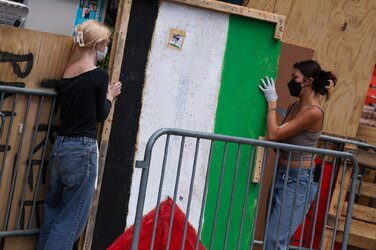
Some Jewish students said they felt intimidated as protesters scrawled graffiti — “Death 2 Zionism” and “Baby Killers” — on campus buildings and blocked access with wooden pallets, plywood, metal barricades and human walls.

The pro-Palestinian student movement includes various strains of activism, including calls for a cease-fire in Gaza, support for Hamas and demands that universities divest from firms doing business with Israel. But on campuses across the country, no word has become more charged than “Zionist.”

ucla03.jpg
A pro-Israel activist peels a pro-Palestinian sticker off a sign on May 2 as a protest encampment was dispersed. (Brian van der Brug / Los Angeles Times)

In its most basic definition, a Zionist is somebody who believes that the Jewish people have a right to statehood in their ancestral homeland as a place of refuge from centuries of persecution — in other words, that Israel, established as a Jewish state in the wake of the Holocaust, has a right to exist.

Using that definition, the Anti-Defamation League considers anti-Zionism a form of antisemitism. But protesters — including many Jews — draw a sharp distinction, arguing that it is Zionism that led to a massive displacement of Palestinians seven decades ago and today fuels Israel’s right-wing government and the assault on Gaza that they say amounts to genocide.

Some of the Jewish students who took part in the encampment played a role in excluding Zionists.

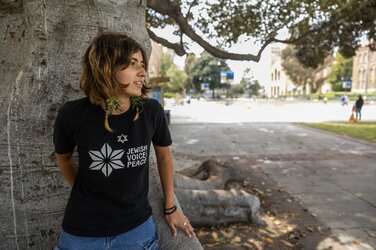
Members of Jewish Voice for Peace at UCLA, a small but rapidly growing group on campus, argue they had a moral responsibility to pressure university officials to divest from Israel.

ucla04.jpg
UCLA facilities employees clean up and dismantle the pro-Palestinian encampment on campus May 2. (Brian van der Brug / Los Angeles Times)

The camp and its checkpoints, they said, were not hostile to Jews. Restricting fellow students from entering was just a pragmatic move to protect protesters inside from physical, verbal or emotional abuse.


“We are committed to keeping each other safe,” said Agnes Lin, 22, a fourth-year art and art history student and member of Jewish Voice for Peace. Anyone who agreed to the UC Divest Coalition’s demands and community guidelines, she said, was welcome.

“What is not welcome is Zionism,” she added. “Or anyone who actively adheres to a very violent, genocidal political ideology that is actively endangering people in Gaza right now.”

In practice, students who supported the existence of Israel were kept out — even if they opposed Israel’s right-wing government and its bombardment of Gaza.

Senior Adam Thaw, 21, said activists blocked him and others from accessing a public walkway to Powell Library.

After telling him they were not letting anyone through, a male activist eyed his Star of David necklace: “If you’re here to espouse that this is antisemitism, then you can leave.”

ucla05.jpg
Senior Adam Thaw is on UCLA’s student board of Hillel, the largest Jewish campus organization in the world. (Genaro Molina / Los Angeles Times)

“Who are you to tell me where I can and cannot go?” said Thaw, who is on UCLA’s student board of Hillel, the largest Jewish campus organization in the world.


As complaints from Jewish students mounted, UCLA declared the encampment “unlawful.” In an April 30 statement, Chancellor Gene Block said most activists had been peaceful, but the tactics of some were “shocking and shameful.”

“Students on their way to class,” he said, “have been physically blocked from accessing parts of the campus.”

::​

The campus was dark and hushed when Sabrina Ellis joined dozens of activists at 4 a.m. to set up the encampment on the lawn of Dickson Court.

After pitching tents and erecting barricades of wooden pallets and sheets of plywood, Ellis, a 21-year-old international student from Brazil, took shifts guarding the entrance.

Ellis didn’t call it a checkpoint. The goal was to exclude and physically block “agitators” — anyone who might be violent, record students or disagree with the cause.

“Our top priority isn’t people’s freedom of movement,” Ellis said. “It is keeping people in our encampments physically and emotionally safe.”

The longtime member of Jewish Voice for Peace — who wore a large Star of David over her T-shirt and a kaffiyeh wrapped around her shoulders — said the camp “was not profiling based on religion.”

But as activists blocked Zionist students from public campus space, they faced charges that they engaged in viewpoint discrimination.

ucla06.jpg
Sabrina Ellis, a junior and a member of Jewish Voice for Peace at UCLA, was part of the pro-Palestinian encampment from the beginning. (Myung J. Chun / Los Angeles Times)

Before allowing anyone in, Ellis said, a protester read the demands of the encampment, which included calling for UC and UCLA to divest all funds from companies “complicit in the Israeli occupation,” boycott all connections with Israeli universities, sever ties with the Los Angeles Police Department and demand a permanent cease-fire.

Then, activists ran through their safety guidelines: Ask before taking a photo or video; wear a mask to limit the spread of COVID; do not post identifying information or photos; and no engagement with counterprotesters.

If students didn’t agree, “we would just kindly tell them that they’re not allowed to come in,” Ellis said.

Some Jewish students were shaken by the experience, arriving at Hillel upset and even crying.

“They were genuinely going about their day and couldn’t get access as protesters asked them, ‘Are you a Zionist?’ or looked at their necklace,” said Daniel Gold, executive director of Hillel at UCLA.

::​

For pro-Palestinian activists who are Jewish, the camp was a peaceful space to promote justice, a welcoming interfaith community with therapist-led processing circles and candlelit prayer services.

Blue tarps and blankets were put down in the middle of the lawn for Islamic prayers and a Passover Seder and a Shabbat service.

On the first evening, about 100 activists, many Jewish, sat in a circle to pray, sing, drink grape juice and eat matzo ball soup, matzo crackers and watermelon.

“It was really beautiful,” said Lin, the art major. “We were trying to hold these spaces to show that Judaism goes beyond Zionism.”

ucla07.jpg
An encampment of pro-Palestinian demonstrators at UCLA’s Dickson Plaza on April 29. (Brian van der Brug / Los Angeles Times)

Other Jewish students were more wary as they navigated the camp.

Presman, who moved to the U.S. when he was 12 and identifies as a Zionist, was alarmed when he scanned the quad on the first day. He saw signs saying “Israelis are native 2 HELL,” he said, and banners and graffiti showing inverted red triangles, a symbol used in Hamas propaganda videos to indicate a military target.

“Do people know what that means?” he wondered.

Tucking his Star of David under his T-shirt, Presman said, he entered and approached activists, introducing himself as an Israeli citizen.

“Maybe we can find common ground,” he said, asking, “one human being to the other?”

Some students put their hands up, he said, blocking him as they walked away. Others treated the conversation as a joke. One protester, he said, told him that everything Hamas did was justified.

Presman said he had one good conversation: An activist who identified as anti-Zionist admitted not being 100% educated on what Zionism was, but agreed that Israel should exist. They came to the conclusion the activist was a Zionist.

ucla08.jpg
Pro-Palestinian encampment participants reinforce the camp barriers at UCLA on May 1. (Brian van der Brug / Los Angeles Times)

But most of Presman’s exchanges, he said, ended negatively when activists realized he was defending Zionism. He said he was called a “dirty Jew” and “white colonizer.”

Other students — even those who did not fully support the encampment — said they did not experience such slurs.

Rachel Burnett, a senior who described herself as a non-Zionist Jew, disagreed with the call for divestment and academic boycotts, especially of UCLA’s Nazarian Center, an educational center for the study of Israeli history, politics and culture.

Entering the camp after a classmate vouched for her, Burnett was disturbed by anti-Israeli signs and graffiti that named Abu Ubaida, the spokesperson for the military wing of Hamas. But she also bonded with protesters, including a woman in a hijab.

“Of course, some protesters deny Oct. 7 or condone violence as long as it can be put under the guise of decolonial resistance, which is obviously horrific,” Burnett said. “But that’s not the case of many students inside the encampment.”

ucla09.jpg
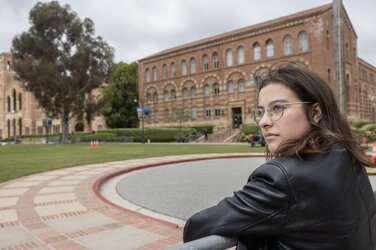
Rachel Burnett, a senior who described herself as a non-Zionist Jew, disagreed with the call for divestment and academic boycotts, especially of UCLA’s Nazarian Center, an educational center for the study of Israeli history, politics and culture. (Myung J. Chun / Los Angeles Times)

Burnett contrasted what she saw as a peaceful, friendly mood inside the camp with the pro-Israel counterprotests where people held up benign slogans, such as “Bring the Hostages Home,” but engaged in hostile behavior.

As counterprotesters converged for a Sunday rally, she said, a pro-Israel activist spat on her and told she should have been slaughtered in the kibbutzim on Oct. 7.

Just as some pro-Palestinian activists demonized all Zionists as evil and pro-genocide — ignoring the wide range of viewpoints within the Zionist community — Burnett thought some pro-Israel counterprotesters were dehumanizing student activists in the encampment and spreading a “mass hysteria narrative.”

As the encampment expanded — and organizers set up entrance points near Royce Hall and Powell Library — some Jewish students took videos that swiftly went viral.

“It’s time to go,” a protester wearing a yellow safety vest and kaffiyeh told a student in one video as he guarded an entrance near Powell Library. “You don’t have a wristband.”


A standoff ensued.

“Are you a Zionist?” the protester asked.

“Of course I’m Zionist,” the student replied.

“Yeah, we don’t let Zionists inside.”
UCLA alleges protesters arrested Monday had tools to barricade buildings
Los Angeles Times (archive.ph)
By Richard Winton, Dakota Smith, and Teresa Watanabe
2024-05-09 03:47:03GMT
ucla01.jpg
Pro-Palestinian supporters were arrested at the Westwood campus of UCLA on Monday. (Brian van der Brug / Los Angeles Times)

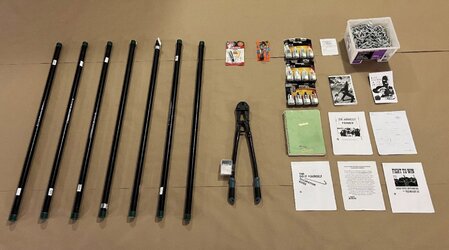
UCLA police say protesters arrested Monday at a university garage had materials that could be “used to unlawfully enter and barricade a building.”

In a news release Wednesday, campus police said some of those arrested had “heavy-duty metal pipes, bolt cutters, epoxy adhesive, super glue, padlocks [and] heavy-duty chains,” as well as literature “encouraging vandalism and violence.” Police said they’d seized a copy of the “The Do-It-Yourself Occupation Guide.”

UCLA has faced criticism for the arrests of the 44 pro-Palestinian protesters — 35 of whom, according to police, were students. Participants said they were gathering for a peaceful protest. Some called the actions by police harassment and intimidation.

Those who were arrested Monday were escorted from the parking garage to an L.A. County Sheriff’s Department bus. Police said four of the group had also been arrested May 2, when more than 200 people were taken into custody at the encampment outside Royce Hall, which police dismantled.

ucla02.jpg
Police say items they took from protesters included metal pipes, heavy duty adhesives, bolt cutters, chains and literature. (UCLA Police Department)

There was at least one independent journalist arrested. He said he was booked on conspiracy to commit burglary, despite initially being stopped — and let go — by officers who said he was violating a curfew for people unaffiliated with the university. He disputed that he engaged in any unlawful behavior.

None of those arrested have been formally charged with a crime, and UCLA has not specified who had the items in their possession.

The arrests capped days of upheaval at UCLA, including a mob attack on the pro-Palestinian encampment late the night of April 30.

Los Angeles Mayor Karen Bass on Wednesday compared the the attack on the camp to the Jan. 6 attack on the U.S. Capitol, saying it “came out of nowhere.”

Shortly before 11 p.m. that night, a large pro-Israeli group arrived on the Westwood campus and attacked pro-Palestinian protesters.

The mob ripped down barricades, hurled objects, launched fireworks and sprayed mace, injuring several at the encampment, which had been standing outside Royce Hall since April 25.
No one has been arrested in the attack. UCLA police are working with the Los Angeles Police Department and the FBI to identify the assailants.

“Frankly, it reminded me of Jan. 6,” said Bass, a former member of Congress who was at the Capitol complex when rioters stormed the government building in January 2021.

Bass has previously spoken in emotional terms about Jan. 6, calling it a tragedy that threatened the lives of journalists, emergency responders and others.

Speaking about the level of coordination of the attack, Bass said she had “no idea,” although she said she didn’t “think that however many people just all woke up at the same time and decided to go to UCLA.”

Monday’s arrests followed avowals by UCLA officials to improve security after the April 30 violence. UCLA’s police chief, John Thomas, has faced growing scrutiny after a string of serious security lapses surrounding the incident. Thomas had assured university leadership he could mobilize law enforcement in minutes, according to three sources who were not authorized to speak publicly. The attack, however, spun out over several hours before law enforcement took control.

Just days before, Thomas had been asked to create a written safety plan as tensions on the campus skyrocketed, but he never did it, according to the sources.

Bass declined to weigh in on Thomas’ actions and whether he should resign, saying that it is a university issue.

When the initial fight broke out, only six UCLA police officers were at the scene, and they were heavily outnumbered. Bass said that, based on what she knew, she believed the LAPD responded appropriately.

In a televised interview with Fox 11, the mayor appeared to criticize the university for its lack of a plan.

“So calling a local [police] station while a protest is happening is not going to generate 80, 90, 100 police officers in a matter of minutes. Unfortunately, it took hours,” Bass said. “I learned in this process that if you’re going to have a big problem like that, you have to notify law enforcement in advance so they can muster the troops.”

UC President Michael V. Drake has ordered an independent investigation led by Philadelphia’s former police chief.

Thomas has said he advised UCLA’s leadership from the beginning not to allow the encampment because it violated campus rules and he feared it could lead to escalating problems.

The chief said he developed a response that relied on private security and made sure to alert the LAPD if problems arose. He acknowledged that he did tell others it would be only minutes for a response, but said he was referring to a general response, not a force large enough to handle the melee that unfolded.

Thomas told The Times when a problem broke out, UCLA’s leadership authorized him to request mutual aid. But he said the LAPD told him there was a problem with the payment system between the city and the state so the arrangements “couldn’t be done by the time of the attack.”

On Wednesday, Bass rejected the notion that there was “some payment delay” to the LAPD and that the police force withheld service.

“That is absolutely false,” Bass said. “LAPD was not notified in time. And so when the request was made of LAPD — I don’t remember the exact time, but it was between 11 and 11:30 — I believe the attack had already been well underway.

“LAPD did not have the capacity on such short notice to mobilize full force,” the mayor said.

Bass said she returned early from Washington, D.C., early the morning after the attack after speaking on the phone with UCLA Chancellor Gene Block and LAPD Interim Chief Dominic Choi.

Bass, in the Fox 11 interview, also questioned why the university allowed the counterprotest to take place next to the pro-Palestinian encampment, which had been largely peaceful until then.
Michael Schill: Here’s why I reached an agreement with Northwestern protesters
Chicago Tribune (archive.ph)
By Michael Schill
2024-05-09 17:02:55GMT
University presidents are between a rock and a hard place when it comes to the wave of protests and tent encampments on our campuses.

Bring in police, and we risk the physical safety of our students, staff, faculty and police for a result that is often unsustainable. Meet with students to reach a mutually satisfactory agreement, and we are accused of capitulating to the “mob.” Here are the reasons why I chose to reach an agreement with Northwestern University protesters.

Right upfront, let me be honest about my biases. I am a proud Jew who practices many of our rituals. Being Jewish is core to my identity, and I grew up with a love for Israel, which remains today. My family has experienced antisemitism, and so claims by some that I have collaborated with antisemitic people feel like personal affronts.

One of the things I love about being Jewish is our culture of rationality and tolerance. This fits with the core value of universities to engage in dialogue and seek to bridge differences peacefully. When a tent encampment popped up on Deering Meadow on April 25, I immediately met with senior administrators to establish a set of principles. First and foremost, we needed to protect the health and safety of our entire community, including our Jewish students. Second, we believe in free expression, but that most assuredly does not include antisemitic or anti-Muslim harassment or intimidation. Third, any protest needed to be in substantial compliance with our demonstration policy, which prohibits tents.

With the help of a handful of exceptional faculty members, we began meeting with student protesters. They asked for several changes to university policy including divestment from Israel and the end of an academic program that focused on Israeli innovation. We said a flat no to both. But we did say we understood their isolation and alienation and wanted to work with them to improve life at Northwestern for Muslim students and students from the Middle East and North Africa.

That began three days and nights of difficult but productive discussions. Ultimately, we came to an agreement that they would take down the tent encampment and bring the demonstration into compliance with our rules and regulations. We would permit peaceful demonstrations on Deering Meadow for roughly a month and provide greater information to students about our investments. We also agreed to establish a house for Muslim and Middle Eastern students to eat, pray and socialize, something already enjoyed by our Jewish, Catholic, Lutheran, Black and female students. The university also committed to including Gaza in our Scholars at Risk program, which brings students and faculty members from war-torn or devastated areas to Northwestern, a program we employed with Ukraine amid the current war with Russia as well as Tulane University following Hurricane Katrina.

So where are we today? The tents are down, removing a source of antisemitic intimidation to many of our Jewish students. Our students are testing the edges of our agreement as one might expect from intelligent, idealistic young people. We have largely removed outside, more radical influences from the peaceful demonstrations taking place on Deering Meadow. And we stand ready to commence disciplinary proceedings against anyone who breaks our rules or engages in antisemitic or anti-Muslim behavior.

This resolution — fragile though it might be — was possible because we chose to see our students not as a mob but as young people who were in the process of learning. It was possible because we tried respectful dialogue rather than force. And it was possible because we sought to follow a set of principles, many of which I would argue are core to the tenets of Judaism.

I hope that our de-escalation proves stable and that we can be an example for other universities.

Michael Schill is president of Northwestern University.
 
Gov. Shapiro calls for Penn to disband pro-Palestinian encampment as 6 students are placed on leave
The Philadelphia Inquirer (archive.ph)
By Beatrice Forman and Susan Snyder
2024-05-09 18:59:23GMT
penn01.jpg
Eugene C. Janda, chief of fire and emergency services at the University of Pennsylvania, tours the Gaza Solidarity Encampment on Thursday, May 9, 2024. Alejandro A. Alvarez / Staff Photographer

Citing increasing unlawfulness, Gov. Josh Shapiro on Thursday called on the University of Pennsylvania to disband a pro-Palestinian encampment that has spent two weeks on the Ivy League campus.

“Over the last 24 hours... the situation has gotten even more unstable and out of control,” Shapiro said during an event in Westmoreland County. “More rules have been violated, more laws have been broken. That is absolutely unacceptable.

“It is past time for the university to act to address this, to disband the encampment and to restore order and safety on campus.”

Penn did not immediately respond to a request for comment.

Shapiro’s comments mark a change in stance from last week, when he deferred questions about whether the encampment should be disbanded to the university.

“I don’t think it’s my judgment on that that matters,” he said at that time. “I think it’s the university’s judgment that matters. They’re closer to it, they see it.”

Interim Penn president J. Larry Jameson has said repeatedly that the encampment should come down.

It’s unclear what impact Shapiro’s remarks will have on the encampment’s fate. In December, his criticism of former Penn president Liz Magill’s testimony before a congressional committee about the school’s handling of antisemitism on campus proved a critical turning point in what became a bipartisan censure and she resigned days later.

Earlier this week, there was a unified front among city leaders — including Mayor Cherelle L. Parker, Police Commissioner Kevin Bethel, and District Attorney Larry Krasner — that the encampment in its current form should not be disbanded using force, and that Penn should resolve the matter peacefully.

An expansion, discipline, and commencement changes
It’s unclear whether the events of the last 24 hours — which included the expansion of the encampment, another defacing of Penn’s iconic Benjamin Franklin statue, and the comments from Pennsylvania’s Democratic governor, who is Jewish — will change that. A spokesperson for the mayor’s office declined comment.

Also on Thursday, six students were placed on mandatory leaves of absence from Penn for participating in the encampment. One of them — an international student — was also evicted from on-campus housing.

The discipline came after encampment members moved about a dozen tents from one side of College Green to the other Wednesday night, effectively taking over the popular graduation photo spot. Organizers began to take down barriers as nearly 200 people chanted, “Disclose, divest, defend” — shorthand for the encampment’s demandsthe Daily Pennsylvanian reported. That move happened in response to what the student organization UPenn Against the Occupation called “the administration’s continued bad-faith negotiations.”

On the Benjamin Franklin statue’s forehead, protesters drew an inverted red triangle, which has conflicting meanings as a reference to a Palestinian flag and the target markers used in Hamas’ tactical videos. The triangle appeared to have been washed off of Franklin’s forehead by Thursday morning.

A Penn spokesperson confirmed in a statement Thursday that the university “issued mandatory temporary leaves of absence for 6 students in accordance with our policies and pending the results of the Center for Community Standards and Accountability disciplinary investigations. These actions relate to the University’s continuing response to the unauthorized encampment on College Green.”

Penn has also announced changes to its commencement ceremony scheduled for May 20, adding airport-style checks before entry and prohibiting signs, posters, and flags.

penn02.jpg
Pedestrians making way across University of Pennsylvania campus by the pro-Palestinian encampment on April 29.Alejandro A. Alvarez / Staff Photographer

The encampment is part of a movement on U.S. college campuses calling for universities to disclose their funding sources and divest their endowments from entities benefiting from the ongoing war in Gaza, where the death toll for Palestinians has surpassed 34,000.

Those placed on leave Thursday are among the 12 students who received disciplinary notices early in the Penn encampment’s two-week stint for violations of the university’s Guidelines on Open Expression, which govern free speech and protest on campus.

The six students placed on leave are barred from academic buildings and campus writ large. They also aren’t allowed to participate in university programming — including “graduation-related events,” according to a letter from Vice Provost Karu Kozumma obtained by The Inquirer.

“Your role as an organizer in the encampment has contributed to increasingly unsafe conditions,” Kozuma wrote in the letter. “You and other organizers have persisted in fostering a situation that poses a threat to order.”

Two of the impacted students were on the negotiation team that met with Jameson, the Freedom School of Palestine — one of the groups participating in the encampment — said in a statement posted to X (formerly Twitter). Three of the students are seniors. All are women.

Sophomore Eliana Atienza, 19, is among the students placed on mandatory leave. An international student from the Philippines, Atienza told The Inquirer she was barred from entering her dorm when the discipline went into effect, and that access to her student ID was shut off.

“I’m the only one made homeless by this,” said Atienza. Her family lives in the Philippines. Friends have offered up their homes instead.

Atienza said she is unsure how Penn’s actions will impact her visa.

Stalled negotiations
The encampment’s expansion came after a two-hour-long negotiation session with Penn leadership Tuesday that organizers initially described as favorable.

penn03.jpg
Pro-Israeli and pro-Palestinian supporters engage on the College Green at the University of Pennsylvania on May 2. Heather Khalifa / Staff Photographer

But in a meeting between encampment organizers and Penn administrators on Wednesday, the tenor changed.

“The negotiations yesterday went incredibly poorly. Things went from, ‘Oh, we’re going to give you maybe several demands,’ to ‘We’re not going to give you anything,” said an encampment spokesperson who declined to be named due to doxxing and safety concerns. The spokesperson declined to elaborate on specific sticking points.

Encampment members are also asking for the university to defend pro-Palestinian speech on campus, including amnesty for students involved in the protests.

The spokesperson went on to say that encampment leaders would “always be open” to talks with Penn administration, but none are currently scheduled.

Unclear path to resolution
More than 2,600 people have been arrested for participating in pro-Palestinian encampments, according to a tracker from The Appeal. Universities have asked city and state police forces to disband the protests, resulting in a wide array of unrest.

A New York City police officer accidentally fired a gun while removing protesters from a Columbia University building, and officers at the University of Arizona and the University of Texas at Austin intentionally discharged rubber bullets and pepper balls while breaking up their respective encampments. At the University of California Los Angeles, officers stood by for hours as counter-protesters beat encampment members with sticks and shot off fireworks.

Penn has requested support from the Philadelphia Police Department in disbanding the encampment, which city officials have been reluctant to offer.

penn04.jpg
Philadelphia bicycle police at Gaza Solidarity Encampment on May 1.Alejandro A. Alvarez / Staff Photographer

Jameson contended that the protests at Penn have not been peaceful, citing vandalism to the Benjamin Franklin statue, reports of threatening speech, and instances of agitation from counter-protesters. Over the past two weeks, a man entered the encampment with a large a knife, another was cited for harassment after spraying down tents with chemicals, and videos posted to Instagram showed people calling for a “UCLA 2.0″ while banging pots and pans outside the barricades.

Jewish students have reported 132 incidents of harassment surrounding the encampment, according to the results of a survey conducted by the Penn President’s Jewish Student Advisory Council. Board members of Penn’s Herbert D. Katz Center for Advanced Judaic Studies urged Jameson to “restore order” on campus by disbanding the encampment.

Meanwhile, a petition circulated by Penn senior Eyal Yakoby calling for the FBI and CIA to investigate the encampment has received more than 1,500 signatures, the student said in a tweet.

“I feel betrayed by the university, who just two days ago said that everyday the encampment exists, it presents a danger to the community,” said Yakoby, who is Jewish. “They need to stand by their word.”
In Letter, 540 Jewish Columbia Students Defend Zionism, Condemn Protests
The New York Times (archive.ph
By Sharon Otterman
2024-05-09 19:42:16GMT
col01.jpg
In the letter, Jewish students said they loved Israel, but also that they don’t always agree with its policies.Credit...Bing Guan for The New York Times

A group of Jewish Columbia students has written an emotional and forceful public letter that takes on one of the most divisive issues on college campuses: whether opposition to Israel should be equated with antisemitism.

In the letter, the students argue that “Judaism cannot be separated from Israel.” They also charge that anti-Zionist Jews who deny Israel’s right to exist and stand with pro-Palestinian protesters “tokenize themselves” and try to delegitimize the experiences of Zionist Jews on campus.

Some of the students who signed the letter, which had 540 signatories as of Thursday morning, have already spoken publicly against Columbia for the antisemitism they say they have faced there. One student testified before Congress about the issue; others have been counterprotesters at pro-Palestinian rallies. Others have not spoken out before.

In all, by Thursday the letter was signed by just over 10 percent of the estimated 5,000 Jewish undergraduates and graduate students at Columbia and its affiliated colleges. All signatories gave their names, college affiliation and year of graduation, unlike some public letters, that allow for anonymous signatures.

Titled “In Our Name: A Message from Jewish Students at Columbia University,” the letter represents the views of students who state that they love Israel, even though they do not always agree with the actions of the Israeli government.

“Our love for Israel does not necessitate blind political conformity,” the letter stated. “It’s quite the opposite. For many of us, it is our deep love for and commitment to Israel that pushes us to object when its government acts in ways we find problematic.”

The letter did not specifically critique any Israeli actions, stating that “our visions for Israel differ dramatically from one another.” Yet, it continued, “we all come from a place of love and an aspiration for a better future for Israelis and Palestinians alike.”

The letter comes as Columbia copes with a deeply divided campus reeling from two recent police interventions against pro-Palestinian activism on campus, including the takeover of a campus building that resulted in more than 200 arrests. On Monday, Nemat Shafik, Columbia’s president, canceled the main graduation ceremony, citing security concerns, and the main campus remains in a state of partial lockdown.

It was unclear how the letter would impact tensions on campus. Columbia and its affiliated schools have Jewish and non-Jewish faculty and students who are strongly anti-Zionist and who argue that Zionism is a not a requirement for Jewish identity.

At pro-Palestinian rallies on campuses at Columbia and beyond, the shouting of anti-Zionist slogans — including “we don’t want no Zionists here” — is common. Anti-Zionist demonstrators argue that this is not antisemitic, a distinction that not everyone accepts.

For students who identify as Zionists, it has been deeply hurtful.

The Anti-Defamation League defines Zionism as the movement for the self-determination and statehood for the Jewish people in their ancestral homeland in the land of Israel. But the definition is contested, and some see it as a movement that controversially conflates Jewish religious identity with a modern political, nationalist project.

The students in their letter seek to clarify what they believe it means and why they believe the way protesters interpret the concept is wrong.

“There’s a huge misconception that Zionism necessitates conformity with the Israeli government, and anti-Zionism means criticism of it,” said Elisha Baker, a Columbia undergraduate. “But that is not the case. And one of our goals is to make very clear that Zionism is the belief in Israel’s right to exist, and anti-Zionism is the denial of that right.”

Most of the signatories, the open letter stated, “did not choose to be political activists.” But they have felt compelled to speak because they feel demonized “under the cloak of anti-Zionism” and forced to publicly defend their Jewish and Zionist identities.

“We proudly believe in the Jewish People’s right to self-determination in our historic homeland as a fundamental tenet of our Jewish identity,” they wrote. “Contrary to what many have tried to sell you — no, Judaism cannot be separated from Israel. Zionism is, simply put, the manifestation of that belief.”

“We are proud to be Jews, and we are proud to be Zionists,” they wrote.

Mr. Baker wrote the letter, along with Eliana Goldin, Eden Yadegar and Rivka Yellin. Mr. Baker said in an interview that the letter began circulating among students on Saturday and that he expected the number of signatories to grow.

“This letter was about amplifying Jewish voices that have been silenced for seven months and about making very clear that there is a unified Jewish community on campus,” he said.

In the letter, the students said they felt betrayed and hurt by the views of many of their fellow students, and by the treatment some Zionist students faced at the encampment that took over a Columbia lawn for two weeks before being removed by police. The protesters who set up the tents have demanded, among other things, that the university divest from Israel.

The letter said that students were not surprised when one of the encampment’s leaders, Khymani James, said that “‘Zionists don’t deserve to live’ and that they were lucky he was “not just going out and murdering Zionists.”

Pro-Palestinian student organizers with Columbia’s encampment disavowed those comments, which were made in January, and Mr. James apologized. He has been suspended from school and banned from campus.

Maryam Alwan is an organizer with Columbia’s chapter of Students for Justice in Palestine, which was suspended last fall. She said in a recent interview: “I think that antisemitism is horrible, but I don’t think that using the conflation of antisemitism and anti-Zionism as an excuse to crack down on pro-Palestine advocacy is justifiable or related in any sense.”

The letter, though, disputes that distinction.

“If the last six months on campus have taught us anything, it is that a large and vocal population of the Columbia community does not understand the meaning of Zionism, and subsequently does not understand the essence of the Jewish People,” the students wrote. “Yet despite the fact that we have been calling out the antisemitism we’ve been experiencing for months, our concerns have been brushed off and invalidated.”

The students ended the letter on a note of conciliation, saying they want to work to repair the campus together.

“While campus may be riddled with hateful rhetoric and simplistic binaries now, it is never too late to start repairing the fractures and begin developing meaningful relationships across political and religious divides,” they wrote. “Our tradition tells us, ‘Love peace and pursue peace.’”
 
Can anyone tell me what is the difference between a Palestinian and the larger Arab ethnicity. Not trying to be smartass, I am genuinely curious.
Basically, there is zero difference apart from one small thing.
Every place the palestinians go to in the arab world, they cause so much problems.
They tried to coup the kingdom of Jordan back in the 70s, was one of the major parties in the Lebaons civil war and supported Saddam back in the first gulf war.
So to the shock of nobody, the rest of the arab world fucking hate them.
 
Whats the difference between a Muslim and a Jew?
You're joking right? I mean the religions have clear distinctive theologies, customs, and views on cosmology.
Basically, there is zero difference apart from one small thing.
Every place the palestinians go to in the arab world, they cause so much problems.
They tried to coup the kingdom of Jordan back in the 70s, was one of the major parties in the Lebaons civil war and supported Saddam back in the first gulf war.
So to the shock of nobody, the rest of the arab world fucking hate them.
I hear the Egyptian, Jordanians, Lebanese, Saudis, and the Sudanese don't really like having direct contact with them. I also don't see what makes a Palestinian a Palestinian.
 
Atrás
Top Abajo