US Universities Struggle as Pro-Palestinian Demonstrations Grow - Dozens were arrested Monday at N.Y.U. and Yale, but officials there and at campuses across the country are running out of options to corral protests that are expected to last the rest of the school year.

Universities Struggle as Pro-Palestinian Demonstrations Grow
The New York Times (archive.ph)
By Alan Blinder
2024-04-23 04:48:02GMT

ny01.jpg
Police arrest protesters outside of New York University on Monday night. Credit...Adam Gray for The New York Times

At New York University, the police swept in to arrest protesting students on Monday night, ending a standoff with the school’s administration.

At Yale, the police placed protesters’ wrists into zip ties on Monday morning and escorted them onto campus shuttles to receive summonses for trespassing.

Columbia kept its classroom doors closed on Monday, moving lectures online and urging students to stay home.

Harvard Yard was shut to the public. Nearby, at campuses like Tufts and Emerson, administrators weighed how to handle encampments that looked much like the one that the police dismantled at Columbia last week — which protesters quickly resurrected. And on the West Coast, a new encampment bubbled at the University of California, Berkeley.

Less than a week after the arrests of more than 100 protesters at Columbia, administrators at some of the country’s most influential universities were struggling, and largely failing, to calm campuses torn by the conflict in Gaza and Israel.
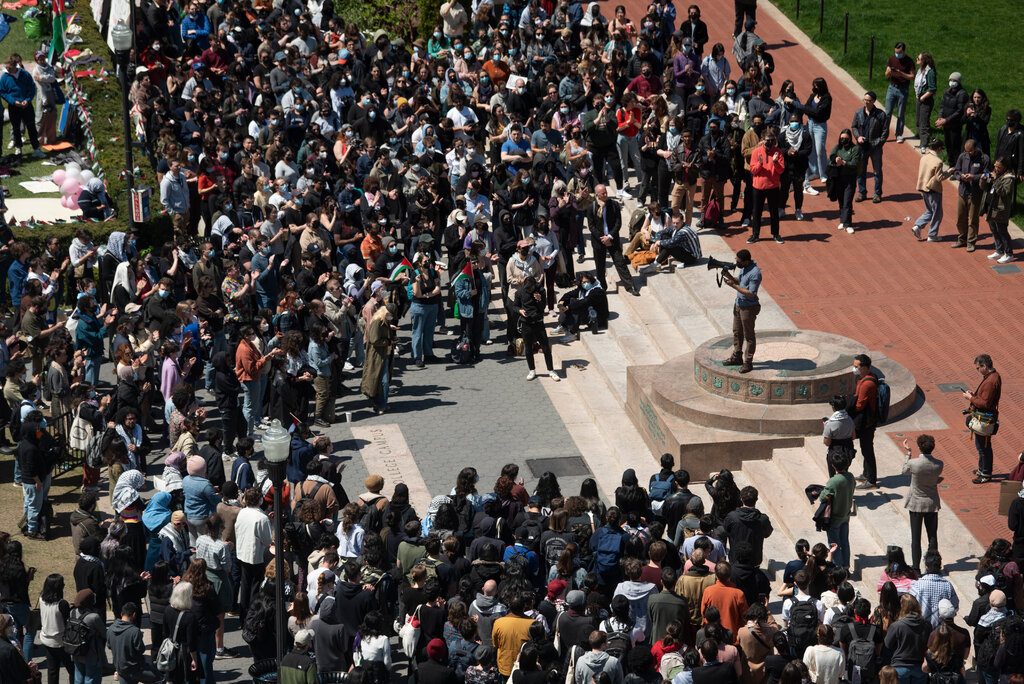
ny02.jpg
Despite arrests at Columbia last week, protests continued on campus on Monday.Credit...C.S. Muncy for The New York Times

During the turmoil on Monday, which coincided with the start of Passover, protesters called on their universities to become less financially tied to Israel and its arms suppliers. Many Jewish students agonized anew over some protests and chants that veered into antisemitism, and feared again for their safety. Some faculty members denounced clampdowns on peaceful protests and warned that academia’s mission to promote open debate felt imperiled. Alumni and donors raged.

And from Congress, there were calls for the resignation of Columbia’s president, Nemat Shafik, from some of the same lawmakers Dr. Shafik tried to pacify last week with words and tactics that inflamed her own campus.

The menu of options for administrators handling protests seems to be quickly dwindling. It is all but certain that the demonstrations, in some form or another, will last on some campuses until the end of the academic year, and even then, graduation ceremonies may be bitterly contested gatherings.

For now, with the most significant protests confined to a handful of campuses, the administrators’ approaches sometimes seem to shift from hour to hour.

“I know that there is much debate about whether or not we should use the police on campus, and I am happy to engage in those discussions,” Dr. Shafik said in a message to students and employees early Monday, four days after officers dressed in riot gear helped clear part of Columbia’s campus.

“But I do know that better adherence to our rules and effective enforcement mechanisms would obviate the need for relying on anyone else to keep our community safe,” she added. “We should be able to do this ourselves.”

Protesters have demonstrated with varying intensity since the Oct. 7 Hamas attack on Israel. But this particular round of unrest began to gather greater force last Wednesday, after Columbia students erected an encampment, just as Dr. Shafik was preparing to testify before Congress.

At that hearing in Washington, before a Republican-led House committee, she vowed to punish unauthorized protests on the private university’s campus more aggressively, and the next day, she asked the New York Police Department to clear the encampment. In addition to the more than 100 people arrested, Columbia suspended many students. Many Columbia professors, students and alumni voiced fears that the university was stamping out free debate, a cornerstone of the American college experience.

The harsher approach helped lead to more protests outside Columbia’s gates, where Jewish students reported being targeted with antisemitic jeers and described feeling unsafe as they traveled to and from their campus.

The spiraling uproar in Upper Manhattan helped fuel protests on some other campuses.

“We’re all a united front,” said Malak Afaneh, a law student protesting at University of California, Berkeley. “This was inspired by the students at Columbia who, in my opinion, are the heart of the student movement whose bravery and solidarity with Palestine really inspired us all.”

The events at Columbia also rippled to Yale, where students gathered at Beinecke Plaza in New Haven, Conn., for days to demand that the university divest from arms manufacturers.

Yale’s president, Peter Salovey, said Monday that university leaders had spent “many hours” in talks with the protesters, with an offer that included an audience with the trustee who oversees Yale’s Corporation Committee on Investor Responsibility. But university officials had decided late Sunday that the talks were proving unsuccessful, and Dr. Salovey said, they were troubled by reports “that the campus environment had become increasingly difficult.”

The authorities arrested 60 people on Monday morning, including 47 students, Dr. Salovey said. The university said the decision to make arrests was made with “the safety and security of the entire Yale community in mind and to allow access to university facilities by all members of our community.”

In the hours after the arrests, though, hundreds of protesters blocked a crucial intersection in New Haven.

ny03.jpg
Students protesters occupied an intersection near the campus of Yale University on Monday.Credit...Adrian Martinez Chavez for The New York Times

“We demand that Yale divests!” went one chant.

“Free Palestine!” went another.

Far from being cowed by the police, protesters suggested that the response at Beinecke Plaza had emboldened them.

“It’s pretty appalling that the reaction to students exercising their freedom of speech and engaging in peaceful protest on campus grounds — which is supposed to be our community, our campus — the way that Yale responds is by sending in the cops and having 50 students arrested,” said Chisato Kimura, a law student at Yale.

The scene was less contentious in Massachusetts, where Harvard officials had moved to limit the possibility of protests by closing Harvard Yard, the 25-acre core of the campus in Cambridge, through Friday. Students were warned that they could face university discipline if they, for instance, erected unauthorized tents or blocked building entrances.

On Monday, Harvard’s Palestine Solidarity Committee said on social media that the university had suspended it. National Students for Justice in Palestine, a loose confederation of campus groups, said it believed the decision was “clearly intended to prevent students from replicating the solidarity encampments” emerging across the United States. Harvard said in a statement that it was “committed to applying all policies in a content-neutral manner.”

Elsewhere in the Boston area, protesters had set up encampments at Emerson College, the Massachusetts Institute of Technology and Tufts University. But those protests, for now, appeared more modest than the ones at Yale and in New York, where demonstrators constructed an encampment outside N.Y.U.’s Stern School of Business.

ny04.jpg
Protesters outside of New York University, before police arrived.Credit...Adam Gray for The New York Times
ny05.jpg
“Students, students, hold your ground!” protesters roared. “N.Y.U., back down!”Credit...Adam Gray for The New York Times

N.Y.U. officials tolerated the demonstration for hours but signaled Monday night that their patience was wearing thin. Police officers gathered near the protest site as demonstrators ignored a 4 p.m. deadline to vacate it. As nightfall approached, sirens blared and officers, donning helmets and bearing zip ties, mustered. Prisoner transport vans waited nearby.

“Students, students, hold your ground!” protesters roared. “N.Y.U., back down!”

Soon enough, police officers marched on the demonstration.

“Today’s events did not need to lead to this outcome,” said John Beckman, a university spokesman in a statement. But, he said, some protesters, who may not have been from N.Y.U., breached barriers and refused to leave. Because of safety concerns, the university said it asked for assistance from the police.

At Columbia, Dr. Shafik ordered Monday’s classes moved online “to de-escalate the rancor.”

She did not immediately detail how the university would proceed in the coming days, beyond saying that Columbia officials would be “continuing discussions with the student protesters and identifying actions we can take as a community to enable us to peacefully complete the term.”

Some students and faculty members said support for Dr. Shafik was eroding, with the university senate preparing for the possibility of a vote this week to censure the president. Supporters of the censure complained that Dr. Shafik was sacrificing academic freedom to appease critics.

But Dr. Shafik was castigated on Monday by the very people she was accused of appeasing when at least 10 members of the U.S. House of Representatives demanded her resignation.

“Over the past few days, anarchy has engulfed Columbia University,” Representative Elise Stefanik, Republican of New York and one of Dr. Shafik’s chief interrogators last week, wrote with other lawmakers. “As the leader of this institution, one of your chief objectives, morally and under law, is to ensure students have a safe learning environment. By every measure, you have failed this obligation.”

A university spokesperson said that Dr. Shafik was focused on easing the strife and that she was “working across campus with members of the faculty, administration, and board of trustees, and with state, city, and community leaders, and appreciates their support.”

Amid the acrimony, and with scores of green, blue and yellow tents filling the Columbia encampment, parts of the campus sometimes took on an eerie, surreal quiet on a splendid spring day.

ny06.jpg
Some faculty members said support for Dr. Shafik was eroding.Credit...CS Muncy for The New York Times
ny07.jpg
At Columbia, many Jewish students stayed away from campus for Passover.Credit...Bing Guan for The New York Times

The unease was never all that far away, though, even with many Jewish students away from campus for Passover.

“When Jewish students are forced to watch others burning Israeli flags, calling for bombing of Tel Aviv, calling for Oct. 7 to happen over and over again, it creates an unacceptable degree of fear that cannot be tolerated,” Representative Daniel Goldman, Democrat of New York, said outside Columbia’s Robert K. Kraft Center for Jewish Student Life.

By then, in another symbol of the crisis enveloping Columbia, Mr. Kraft, an alumnus and owner of the New England Patriots, had launched his own broadside and suggested he would pause his giving.

“I am no longer confident that Columbia can protect its students and staff,” he wrote in a statement, “and I am not comfortable supporting the university until corrective action is taken.”
 
‘Violent’ Columbia protester is heir to ad empire, has mansion, model babymama — and long rap sheet

...I'm gonna have a heart attack and die from not-surprise.

It's the same everywhere. The anti-Putin protestors of the early 10s were children of state-contract embezzlers. The anti-Soviet protestors of the early 80s were children of party bosses. Protesting is the ultimate leisure-class activity, more than tattoos and nose rings, it shows you're as untouchable as can be.
 
...I'm gonna have a heart attack and die from not-surprise.

It's the same everywhere. The anti-Putin protestors of the early 10s were children of state-contract embezzlers. The anti-Soviet protestors of the early 80s were children of party bosses. Protesting is the ultimate leisure-class activity, more than tattoos and nose rings, it shows you're as untouchable as can be.
One day the actual working class will hang the posers, keep hope alive.
 
“I think a lot of our demands, like calling for a cease-fire, could’ve been fulfilled the exact same day,” Ayesh said. “But it’s day five, and we haven’t heard anything.”
The lion, the witch and the audacity of this bitch.

Would bleach in a cookie even be dangerous? I'd think it would cook away completely.

Everyone knows that laxatives are the connoisseurs preferred method, especially when there is limited/overcrowded access to bathrooms.
 
If Jews thought they were religiously or racially superior, why would they allow converts?
They almost never do and the israeli government barely recognizes any converts, but they will take even neonazis if they pass a DNA test that says they are jewish. I will admit that at least they are consistent because even when the hebrews were a bunch of nobodies goat herders living under the greek/macedonian boot they wouldn't allow just any greek who fell for the monotheistic meme to join. In retrospective this fucked over the jews as evidenced by christianity turning from a jews-only cult to "anyone can join, no penis business needed!" which led to unprecedented religious growth. Really judaism could've been as successful as christianity had they dropped the ethno-elitism.

Another example is islam but they actually stopped the conversions because the jizzya tax scheme was so profitable they wanted more non-muslim around so they could bleed them dry.
I wonder if they've finally started to realize that you can't punch people into supporting the Israeli government.
Actually you can, most normies will bow down to the new zionist supremacist laws. The problem is the tiny amount who wont, mostly muslims, and who in turn will get their lives destroyed. They are gonna radicalize fast, all the way too, and they wont be pacifists either...
"Republicans" right, where were these all-powerful republicans when any student to the right of lenin was getting fucked over?

Unless you mean "non-christian" republicans, but I bet there are many "non-christian" democrats in there too.
Cool, when do they start?
Never? jews created an all-powerful omnipotent and omniscient god with more rules than D&D and dumber laws than medieval europe, but have tons of tricks to evade the rules they created thinking that a god that sees everything all the time wont notice, and if he does then he wont mind that his little creations are fucking him over.

Then awful shit happens to the jews and their god never helps them..............maybe yahweh is real?
SOROS PAID ME TO BE HERE
Somebody tell the drawing boomer which religion soros is...
Well jews and millions of normal white gentiles.
I agree with Houllenbecq that if islam rises in the west most christian and even atheist normies will simply convert, specially the males.

When that happens most religious minorities will wax nostalgic about the "christian era" because they'll be fucked forever after this.
Asking for ID? THAT'S RAYCISS!
One day the actual working class will hang the posers, keep hope alive.
Never happened, if anything the working class always gets screwed over to death when communism happens. They do get payback sometimes, like when stalin needed to get rid of all the useful idiots (aka: intellectuals and provocateurs) who were getting uppity so he got ivan the farmhand to tortured them to death in siberia. Of course when ivan went back home he found everybody had starved to death because of stalin's retardness.
 
Peaceful demonstrations continue after pro-Palestinian encampment on campus of University of Chicago cleared
Chicago Sun-Times (archive.ph)
By Mary Norkol
2024-05-07 13:33:15GMT
c01.jpg
University of Chicago police block pro-Palestinian protesters from entering the campus after officers began tearing down an encampment early Tuesday, May 7, 2024. Ashlee Rezin/Sun-Times

Hundreds of demonstrators are rallying peacefully and a barricade was taken down after police cleared out a pro-Palestinian encampment on the campus of the University of Chicago early Tuesday in Hyde Park.

The action began around daybreak as campus police, who were earlier keeping students from entering the quad, surrounded the university’s main quadrangle in the Hyde Park neighborhood.

But shortly before 8 a.m., police removed the barricade, allowing protesters back onto the quad.

Heavy university police presence remained as protesters made their way to the steps of Edward H. Levi Hall, where they linked arms peacefully while police, are also on the stairs behind them, surrounded the group on the ground.

The crowd appeared to swell to nearly 400 people.

Protesters with bikes blocked the street on South Ellis Avenue as one pointed to cars trying to pass, telling them to turn around.

One police officer could be heard telling protesters making their way back to the quad: “No signs, no tents, nothing for the encampment.”

As of about 7 a.m. the encampment was fully cleared and it became a standoff, according to a senior organizer named Sammy who didn’t give her last name out of safety concerns.

No injuries or arrests but people were being pushed to the ground, Sammy told the Sun-Times.

Earlier, work crews could be seen dismantling tents and loading them and other items onto trucks.

The encampment was peaceful and the demonstrators demands of the university were clear, according to Sammy. The university hasn’t met with student organizers since Sunday.

“I think it shows the University of Chicago wants to protect free speech but doesn’t listen to what we’re saying,” Sammy said.

The encampment took a lot of energy and resources to upkeep, and it’s unlikely it will be resurrected, Sammy said.

But the encampment isn’t the whole strategy in trying to persuade the university to divest from Israel and disclose its financial investments.

“This is one tactic in a much larger campaign,” she said.

After Columbia University and the University of Southern California canceled their commencement ceremonies due to the protests, that’s a concern of University of Chicago organizers, Sammy said.

“But we all agree stopping a genocide is more important than walking across a stage,” Sammy said.

One driver passing the standoff rolled down his window, shouting “Hamas, Nazis,” at the group. One protester yelled back and the two argued before the driver pulled away.

They were expecting a raid at 3 a.m. and the police apparently waited until the students went to sleep and came back at 4:30 in riot gear, Sammy added.

About 6:45 a.m. as University of Chicago police in riot gear held the line grasping stacks of zip ties, protesters chanted: “Which side are you on my people, which side are you on?”

Other chants broke out: “Free, free Palestine” and
“Paul, Paul, where are you?” “Whose campus? Our campus? Whose quad? Our quad? Whose university? Our university.”

The university’s president is Paul Alivisatos.

One speaker said they were hoping for a peaceful end to the encampment, but asked, “What about this police presence is peaceful?”

Alivisatos released a statement via the social media platform X explaining why they intervened Tuesday morning.

UChicago United organizers set up the encampment a little more than a week ago — joining hundreds of other students across the country — to express support for the Palestinian people and to call on the university to disclose its financial investments and to divest from “death in Gaza, the South Side and beyond.”

On Monday, a coalition of over 120 faculty and academic staff from the University of Chicago had called on the school’s administration to resume negotiations with the pro-Palestinian encampment organizers.

University of Chicago Faculty for Justice in Palestine said administrators suspended negotiations Sunday.

Any action to remove the University of Chicago encampment or its inhabitants would be “indefensible,” said Elham Mireshghi, an assistant instructional professor in the Divinity School.

Over the weekend, nearly 70 protesters were arrested at a pro-Palestinian encampment set up outside the School of the Art Institute of Chicago.

At Northwestern University, pro-Palestinian protesters were able to reach an agreement with administrators. The deal requires the university to disclose information about any investments to people associated with the university within 30 days of an inquiry, to re-establish a committee with student representatives to advise on investments and to fully fund tuition for five Palestinian undergraduate students, among other agreements — in exchange for the encampment being reduced to one aid tent.

At DePaul University, an encampment remains in the main quad of the school’s Lincoln Park campus. University officials say they have requested a meeting Monday with the DePaul Divest Coalition.

c02.jpg
Items from a pro-Palestinian encampment appear in a dumpster after University of Chicago police cleared out the area and temporarily blocked protesters from entering the university’s main quadrangle Tuesday, May 7, 2024. Ashlee Rezin/Sun-Times
U. of C. police clear protest encampment early Tuesday, days after president announces intention to intervene
Chicago Tribune (archive.ph)
By Caroline Kubzansky and Nell Salzman
2024-05-07 12:19:39GMT
note: there's a gallery of 50+ pics on the site, but I'm too lazy to post them

University of Chicago Police cleared a pro-Palestine protest encampment in a brief raid at the South Side university early Tuesday morning, organizers said.

About 50 UCPD officers began dismantling tents and makeshift barriers surrounding them around 4:30 a.m. Tuesday, protester Christopher Iacovetti said.

“They started throwing everything in every possible direction,” said Iacovetti, a PhD student at the university.

There had been no arrests made by about 7:30 a.m. according to school officials, but dozens of protesters remained in the area. Some began to reenter the main quad at around 8 a.m., which was marked with patches of brown grass where tents had been hours before.

Police had brought printed “final notices” to occupants of the encampment, which were later ripped and strewn at protesters’ feet when they locked arms against a barricade and a line of UCPD officers outside a side entrance to the quad on South Ellis Avenue later Tuesday morning.

“If you are not arrest ready, you need to back out because they’re going to arrest everybody,” warned Jessica Darrow, professor at University of Chicago’s Crown School of Social Work, Policy and Practice warned the protesters.

Several dozen protesters faced university police as and chanted, “we are the encampment! We are the encampment!” along with other slogans calling on the university of disclose and drop its financial ties to Israel.

Police put up a yellow plastic barrier and the chants got angrier. Some protesters screamed insults directly into officers faces.“How does it feel to be on the wrong side of history?” they asked. “Shame on you!”

Organizers had spent much of the night preparing for an anticipated police incursion, the second night in a row the expectation of clearance had circulated among those camping out beneath the gothic buildings that ring the university’s main quad.

The encampment has occupied the main quad of the University of Chicago since April 29. It’s one of many other large-scale student protests across the country in demanding the university divest from companies with ties to Israel, including weapons manufacturers supplying arms to Israel’s military amid the mounting death toll in Gaza. More than 34,000 Palestinians have been killed, according to the Health Ministry.

Israel launched its bombardment of Gaza after Hamas’ Oct. 7 attack on southern Israel, where the group killed some 1,200 people and took 250 hostages. President Joe Biden last week defended the right to protest but insisted that “order must prevail” at college campuses, as some in Chicago’s Jewish community demanded action at local universities to prevent hate speech.

On Friday, university president Paul Alivisatos claimed the encampment had produced a “systemic disruption” to daily life and announced the university was prepared to “intervene” hours before protesters had a brief confrontation with a group of fraternity brothers trying to place an American flag near a pole where activists had raised a Palestinian flag.

Alivisatos issued a statement Tuesday morning saying safety concerns had only grown over the past few days as negotiations failed. There had been no arrests in the police action, the statement read, but that discipline against students could be forthcoming.

“There were areas where we were able to achieve common ground, but ultimately a number of the intractable and inflexible aspects of their demands were fundamentally incompatible with the University’s principled dedication to institutional neutrality,” Alivisatos said in the statement.

“The University remains a place where dissenting voices have many avenues to express themselves, but we cannot enable an environment where the expression of some dominates and disrupts the healthy functioning of the community for the rest,” he said.

Protesters anticipated a police raid Sunday night and put out a call for activists and organizers to join them on the quad, though their preparations died down around 3 a.m. Monday morning.

After the encampment was cleared, some students gathered on the steps in front of the administration building. Four hours after the encampment was removed, they spoke out with their last messages of protest, holding up Palestinian flags and banging on drums.
Ending the Encampment
The University Of Chicago (archive.ph)
By Paul Alivisatos
2024-05-07
Dear Members of the University Community,

Last Monday and Friday, I shared how we would approach making decisions about the encampment. Protest is a strongly protected form of speech in the UChicago culture, and the demonstrators had multiple opportunities to express their views. But many aspects of the protests also interfered with the free expression, learning, and work of others. Safety concerns have mounted over the last few days, and the risks were increasing too rapidly for the status quo to hold. This morning, the University intervened to end the encampment.

The protesters were given an opportunity to disassemble their structures and depart the encampment, and there have been no arrests. Where appropriate, disciplinary action will proceed.

Over multiple days, including through the weekend, we engaged with the representatives of the encampment to work toward a resolution. There were areas where we were able to achieve common ground, but ultimately a number of the intractable and inflexible aspects of their demands were fundamentally incompatible with the University’s principled dedication to institutional neutrality. As such, we could not come to a resolution.

The University remains a place where dissenting voices have many avenues to express themselves, but we cannot enable an environment where the expression of some dominates and disrupts the healthy functioning of the community for the rest.

Paul Alivisatos
 
Última edición:
To find masked mob members who attacked UCLA camp, police using Jan. 6 tactics
Los Angeles Times (archive.ph)
By Richard Winton
2024-05-07 13:41:15GMT
ucla01.jpg
A pro-Palestinian protester clashes with a pro-Israel supporter at an encampment at UCLA on May 1. (Wally Skalij / Los Angeles Times)

It is shaping up to be perhaps the biggest case in the history of the UCLA Police Department: how to identify dozens of people who attacked a pro-Palestinian camp at the center of campus last week.

The mob violence was captured on live television, but it took three hours for police to bring it to an end. Those involved left, and no arrests were made.

But the trail is not cold.

UCLA detectives are now scanning hundreds of images in an attempt to identify the attackers. They intend to use technology that captures facial images and compares them to other photos on the internet and social media to put names to faces, according to law enforcement sources.

The same technology has allowed police to identify suspects in smash-and-grab retail burglaries. It also was the heart of the Jan. 6 investigation, in which videos of those storming the U.S. Capitol helped the FBI identify many of the assailants and led federal prosecutors to charge more than 1,300 people. In those cases, investigators often were able to find social media images of the assailant wearing the same clothing as during the attack.

“Technology has made the entire community into the eyes of law enforcement,” said retired Los Angeles police Capt. Paul Vernon, who led an effort after a mini-riot following the Lakers’ NBA championship victory in 2010 that resulted in dozens of arrests based on videos, social media posts and security footage. “Photo recognition has gotten a lot easier.”

Vernon said an investigator also could gather cellphone data from the immediate area to prove an individual was there at the time of the incident. In some cases, assailants may have posted to their social media accounts, essentially bragging about their actions. Officers wearing body cameras may have also captured some of the behavior, he said.

The attackers likely came in vehicles, so UCLA police will be examining data from license plate readers for movements near campus on May 1. Security cameras on streets neighboring the campus where they likely parked could yield more clues.

Along with continuing protests, finding those who attacked the camp will be a major challenge for newly installed UCLA Associate Vice Chancellor Rick Braziel, a former Sacramento police chief. Braziel will be tasked with bringing to justice those responsible for what Chancellor Gene Block called a “dark chapter in our campus history.”

On Monday night, Block outlined actions the school is taking in the aftermath of last week’s violence. University police will work with the Los Angeles Police Department and the Los Angeles County district attorney’s office to identify and prosecute the assailants “to the fullest extent of the law,” he said. The university “also connected with the FBI about possible assistance,” Block said in a statement.

Despite the technology, the probe faces hurdles. Some of the attackers wore masks, making it harder to identify them. In those instances, detectives will look for a moment before or after the attack when the perpetrators’ faces were revealed, an official who was not authorized to discuss the investigation told The Times.

There is also deep anger among some protesters in the camp because it took so long for police to stop the attack. That distrust could take a toll. Many of the students who were injured, some of whom were hospitalized with their wounds, have gone to groups such as the Council on American-Islamic Relations for Southern California but haven’t spoken with campus police.

UCLA is a small police department, so it is reaching out to other agencies and private entities to access the technology needed in the investigation, law enforcement sources said. But so far, UCLA hasn’t made a public appeal seeking information on specific suspects.

In the wake of the Jan. 6 attack, the FBI made arrests based on information from relatives, work colleagues, teammates, former friends and ex-significant others after the FBI released photos of suspects. An army of web sleuths and politically knowledgeable social media watchers known as “sedition hunters” also dedicated themselves to identifying the mob and turning their names over to the FBI.

Images from the UCLA attack are springing up on Instagram. In one case, a man can be seen using a plank to hit a pro-Palestinian protester and then punching and kicking others. Dressed in a black sweatshirt, white sweatpants and a black cap, his bearded face is not hidden. Police can use that image to track him down or ask for help identifying him.

“Holding the instigators of this attack accountable and enhancing our campus safety operations are both critical,” Block said. “Our community members can only learn, work and thrive in an environment where they feel secure.”
Some colleges that had been permissive of pro-Palestinian protests begin taking a tougher stance
Associated Press (archive.ph)
By Charles Rex Arbogast, Steve LeBlanc, and Pat Eaton-Robb
2024-05-07 21:28:09GMT

CHICAGO (AP) — Police cleared a pro-Palestinian tent encampment at the University of Chicago on Tuesday after administrators who had initially adopted a permissive approach said the protest had crossed a line and caused growing concerns about safety.

University President Paul Alivisatos acknowledged the school’s role as a protector of freedom of speech after officers in riot gear blocked access to the school’s Quad but also took an enough-is-enough stance.

“The university remains a place where dissenting voices have many avenues to express themselves, but we cannot enable an environment where the expression of some dominates and disrupts the healthy functioning of the community for the rest,” Alivisatos wrote in a message to the university community.

Tensions have continued to ratchet up in standoffs with protesters on campuses across the U.S. — and increasingly, in Europenearly three weeks into a movement launched by a protest at Columbia University. Some colleges cracked down immediately on protests against the Israel-Hamas war. Among those that have tolerated the tent encampments, some have begun to lose patience and call in police over concerns about disruptions to campus life, safety and the involvement of nonstudents.

Since April 18, just over 2,600 people have been arrested on 50 campuses, figures based on AP reporting and statements from universities and law enforcement agencies.

But not all schools are taking that approach, with some letting protesters hold rallies and organize their encampments as they see fit.

The president of Wesleyan University, a liberal arts school in Connecticut, has commended the on-campus demonstration — which includes a pro-Palestinian tent encampment — as an act of political expression. The camp there has grown from about 20 tents a week ago to more than 100.

“The protesters’ cause is important — bringing attention to the killing of innocent people,” university President Michael Roth wrote to the campus community Thursday. “And we continue to make space for them to do so, as long as that space is not disruptive to campus operations.”

The Rhode Island School of Design, where students started occupying a building Monday, affirms students’ rights to freedom of speech and peaceful assembly and supports all members of the community, a spokesperson said. The RISD president and provost were meeting with the demonstrators.

Campuses have tried tactics from appeasement to threats of disciplinary action to resolve the protests and clear the way for commencements.

At the University of Chicago, hundreds of protesters gathered for at least eight days until administrators warned them Friday to leave or face removal. On Tuesday, law enforcement dismantled the encampment.

Officers later picked up a barricade erected to keep protesters out of the Quad and moved it toward the demonstrators, some of whom chanted, “Up, up with liberation. Down, down with occupation!” Police and protesters pushed back and forth along the barricade as the officers moved to reestablish control.

Officials at the University of North Carolina, Chapel Hill, told deans and department chairs Monday that some students have been informed by instructors opposing the suspension of student protesters that they will withhold grades.

The school provost’s office said it will support “sanctions for any instructor who is found to have improperly withheld grades.”

At the Massachusetts Institute of Technology, protesters were given a deadline to voluntarily leave or face suspension. Many left, according to an MIT spokesperson, who said protesters breached fencing after the arrival of demonstrators from outside the university. On Monday night, dozens remained at the encampment in a calmer atmosphere, listening to speakers and chanting before taking a pizza break.

Sam Ihns, a graduate student studying mechanical engineering and a member of MIT Jews for a Ceasefire, said the group has been there for two weeks and is calling for an end to the killing in Gaza.

“Specifically, our encampment is protesting MIT’s direct research ties to the Israeli Ministry of Defense,” he said.

Many protesters want schools to divest from companies that do business with Israel or otherwise contribute to the war effort. Others simply want to call attention to the deaths in Gaza and for the war to end.

Wesleyan senior Uday Narayanan said students there are prepared to protest through the summer if that’s what it takes for their demands to be met.

“Our tuition dollars are still going toward the brutalization of Palestinians,” the 21-year-old physics major said. “So, ultimately, even though our president has said, ‘Oh, I’m not going to call the cops. Oh, I’m not going to beat up students,’ that’s still not enough, and that’s not the bare minimum for us.”

And as Wesleyan’s May 26 commencement approaches, some protesters fear they will be forcibly removed from the center of campus, adjacent to the field where the ceremony is to take place.

“The longer we are here, the more that their facade of laid back, hands off is falling away,” said Batya Kline, a 22-year-old graduate student. “We know that the university does not want us here, and we know that they can change their pace at the drop of a hat without letting us know.”

Frank Straub, senior director of violence prevention at nonprofit advocacy organization Safe and Sound Schools, said these and past protests have shown the need for early dialogue among the university, police and protesters to establish ground rules.

Straub said Wesleyan, for example, needs to have conversations about commencement and where protesters can be, and should make sure a plan is in place to respond, should protesters want to get arrested, so that can be done without violence.

“By their nature, protests are adversarial, but I think we can have controlled adversity,” he added. “And I think the more campus officials are engaged with the protesters and the more police are included in those conversations, that’s critically important.”

The protests stem from the conflict that started Oct. 7 when Hamas militants attacked southern Israel, killing about 1,200 people, mostly civilians, and taking roughly 250 hostages.

Vowing to destroy Hamas, Israel launched an offensive in Gaza that has killed more than 34,500 Palestinians, about two-thirds of them women and children, according to the Health Ministry in the Hamas-ruled territory. Israeli strikes have devastated the enclave and displaced most of its inhabitants.
 
“I think a lot of our demands, like calling for a cease-fire, could’ve been fulfilled the exact same day,” Ayesh said. “But it’s day five, and we haven’t heard anything.”
This is a line of thinking you see a lot of in SJWs. Powerful people could solve all of society's ills--war, poverty, injustice, pollution, crime, climate change, etc.--if they wanted to. The fact that they have not done so is proof that they are tacitly complicit in perpetuating said ills. Never mind problems of coordination, economics, human nature, or the laws of physics or biology; it all comes down to moral failure by the privileged.

In this case, Joe Biden could end the war in Gaza today with a couple of phone calls if he really wanted to. He has not done this, therefore he is knowingly permitting the war to continue, therefore he is complicit in the continued deaths of Palestinians. Because there is no legitimate reason why he would simply comply with such an obviously virtuous demand other than him being evil.

1.png
2.png
3.png
 
U-Va. president, other leaders defend steps that led to arrests at protest
The Washington Post (archive.ph)
By Karina Elwood and Olivia Diaz
2024-05-07 23:37:25GMT
University of Virginia and police officials defended actions that led to the arrests of more than 25 pro-Palestinian protesters on campus grounds over the weekend, even as faculty members and others criticized what they saw as an overly aggressive response.

In a virtual town hall Tuesday, Tim Longo, chief of police at U-Va., said that officials offered to let demonstrators stay if they took down their tents and that authorities moved in Saturday only when they refused. James E. Ryan, the university’s president, said that police were met with “physical confrontation and attempted assault” and that officials then called in Virginia State Police.

“We felt like this was escalating and had the potential to get out of hand,” Ryan said at the town hall.

But faculty members who witnessed the arrests questioned that account, saying law enforcement personnel were too heavy-handed in breaking up a peaceful demonstration.

“What we saw on Saturday was brutal,” Laura Goldblatt, an assistant professor of English and global studies who has been helping student demonstrators and witnessed Saturday’s arrests, said in an interview.

The arrests came after dozens of law enforcement officers in riot gear surrounded a student encampment at Virginia’s flagship university in Charlottesville and used pepper spray to disperse people from the area. Demonstrators first set up the encampment on a lawn outside the school chapel on April 30, joining other protests over the Israel-Gaza war on college campuses around the country.

Tents were erected on the site Friday night because of rainy weather, demonstrators said. The next day, law enforcement officers arrived in increasing numbers. By Saturday afternoon, police with riot shields and headgear began to clear the encampment, pushing students to the ground and pulling them by their arms. Police used zip ties and pepper spray, causing protesters to flee while clutching their eyes.

U-Va. officials said 27 people were arrested: 12 students; four professors; three former employees and students; and eight with no affiliation to the school.

More than 2,300 people have been arrested on campuses across the country over the past two weeks, according to a Washington Post tally of news reports and police and university statements.

Walt Heinecke, president of the American Association of University Professors of U-Va., said that the decisions on Saturday were miscalculated. Heinecke, who spent days in the encampment as a faculty liaison to the student protesters, said the encampment had been a peaceful space until the police showed up.

“It didn’t need to happen. It could have been avoided,” Heinecke, an associate professor in the school of education and human development, said in an interview. “Our president has missed the boat on this one.”

At the virtual town hall, Ryan addressed the frustration about what unfolded Saturday but said the response ultimately came down to safety.

“My colleagues and I have worked quite hard to build a level of trust with students, faculty, staff and members of the broader Charlottesville community,” said Ryan, who has led U-Va. since 2018. “I’m fully and painfully aware that we lost some of that trust on Saturday, and that it’s very difficult to regain trust.

“At the same time, as a president, I make decisions that I think are in the best interests of the entire community, not one segment of it. And that includes making decisions that others vehemently disagree with.”
Officials said the encampment violated a university policy that all tents require a preapproved permit.

On a public document outlining health and safety regulations, officials originally wrote that there was an exemption for “recreational tents.” But the language was deleted by Saturday morning.

The clash on Saturday came nearly seven years after the Unite the Right rally in Charlottesville, in which a self-professed neo-Nazi drove his car through a crowd of counterprotesters, killing 32-year-old Heather Heyer and injuring 35 others.

On Tuesday, university officials said some decisions made over the weekend were partly an attempt to not repeat failures made at the fatal rally.

“I think in hindsight, some of the difficulties with 2017 was not reacting quickly enough,” Ryan said. “And so I was thinking that if we don’t act and we don’t move, and we just let this unfold, are we going to be faced tomorrow with not 22 tents, but 50 tents or 75 tents?”

Heinecke and other faculty members rejected the university’s claims that the demonstration posed a safety threat. The university’s AAUP chapter issued a letter Tuesday condemning the university’s decisions and calling for the legal and disciplinary actions taken against students to be reversed.

From our own ample first-hand accounts, we find allegations that the demonstrators were unusually disruptive or a source of any danger to others unfounded,” the letter reads.

The Rev. Adam Lawrence Dyer, a religious studies doctoral student, was not a part of the encampment but said in an interview that he watched the police confrontation on Saturday and felt shocked by the events that played out. He said other students and departments have voiced their frustrations with the university’s response and want more answers.

“There was a decision at some point to perceive a threat,” he said. “But there was no actual threat.”

Heinecke said he spent the afternoon on Saturday checking in with students as they were being confronted by police. Since then, he and other faculty members have offered support to students who were jailed.

“All I cared about on Saturday was about the safety of our students,” he said.
Chicago police actions at pro-Palestinian protest near Art Institute under investigation
Chicago Sun-Times (archive.ph)
By Violet Miller and Sophie Sherry
2024-05-07 21:21:32GMT
The People’s Art Institute accused law enforcement of yanking people’s hair, strangling and hitting people with batons and metal fences at the Saturday protest.
chi01.jpg
Pro-Palestinian protesters and Chicago police officers face each other Saturday as students at the School of the Art Institute of Chicago set up an encampment outside the museum to protest the Israel-Hamas war. Anthony Vazquez/Sun-Times

The Civilian Office of Police Accountability has opened a preliminary investigation into complaints against Chicago police officers at a pro-Palestinian protest near the Art Institute of Chicago on Saturday, officials confirmed.

COPA opened a preliminary investigation to determine whether it or the Chicago Police Department’s Bureau of Internal Affairs will take over the inquiry into officer conduct.

The Chicago Police Department said COPA had its “full cooperation” for the investigation but didn’t comment further.

A Sun-Times reporter captured video Saturday of police and protesters pushing and shoving as police attempted to move protesters from West Monroe Street back onto the sidewalk of South Michigan Avenue.

The video, posted to X, formally known as Twitter, shows one officer pushing a protester in the head with his open hand and then doing the same to another protester.


Guidelines for the police department require members to only use force that’s “objectively reasonable, necessary, and proportional in order to ensure the safety of a member or third person, stop an attack, make an arrest, control a subject, or prevent escape.”

This occurred a few hours before police cleared the encampment, arresting 68 people related to trespassing charges at the request of the museum.

The People’s Art Institute, one of the groups that put together the encampment, said at least five protesters, including two who were arrested, were taken to hospitals after police swept the encampment.

They accused law enforcement of yanking people’s hair, strangling and hitting people with batons and metal fences at the protest outside the gate, in addition to hitting, elbowing and slamming protesters to the ground and stepping on them during the arrests.

“Unnecessary violence and aggression were the norm,” the group said in a statement Monday. “Many people who were arrested were injured, and two arrested students needed to be taken to the ER.”

In a statement, the police department said officers spent more than two hours negotiating with demonstrators to clear the area without arrests.

“During multiple rounds of negotiations, SAIC student protesters were promised amnesty from academic sanction and trespassing charges if they agreed to relocate. The School also agreed to meet with a student group to discuss their demands,” the museum spokesperson said.

But organizers said Martin Berger, School of the Art Institute Chicago provost and senior vice president of academic affairs, initially gave them until 6 a.m. Sunday to consider this offer of relocation.

Student liaisons from the People’s Art Institute say they asked for the deadline to be moved to 10 a.m. and Berger informed them that “he would see what he could do.”

At 3:30 p.m., members of the People’s Art Institute said they met to discuss the proposal. But 30 minutes later, organizers said Berger rejected the 10 a.m. deadline, rescinded the prior offer of 6 a.m., and announced the SWAT team would be entering the garden within seven minutes.

On Friday, Mayor Brandon Johnson and Chicago Police Supt. Larry Snelling said they didn’t want to unnecessarily escalate any protests by having police interfere and deferred decisions to the owners of the property where protests take place.

“Individuals on [the Art Institute’s] private property, they wanted them removed,” Johnson said at an unrelated news conference Monday. “When AIC made that request, obviously the police department reacted. Look, my ultimate desire and goal is to ensure that fundamental rights are protected and we’re working to keep people safe, and that was accomplished.”

It also comes as the city prepares to see a large number of protesters ahead of the Democratic National Convention, including new policies such as one regarding mass arrests the department is calling “coordinated multiple arrests” — prompting some civil liberties groups to say the city isn’t prepared for August.

Last month the City Council approved a $750,000 settlement for a man whose leg was broken and ACL torn when he was allegedly clubbed by police during the demonstrations after the 2020 murder of George Floyd. In March, the city approved $52.75 million in settlements tied to alleged police abuse and wrongdoing, including a $45 million settlement for a then-15-year-old boy who suffered a traumatic brain injury after an unauthorized police chase.
 
Arizona State scholar on leave after video of verbal attack on woman in hijab goes viral
NBC News (archive.ph)
By Dennis Romero
2024-05-08 01:32:12GMT


An Arizona State University postdoctoral research scholar is on leave as the institution investigates his confrontation with a woman in a hijab that was captured on video, the school said Tuesday.

The confrontation happened Sunday during a pro-Israel rally just outside campus in Tempe. Viral cellphone video shows the scholar, Jonathan Yudelman, and another man, not identified, confront the woman, who was wearing a hijab.

It's not clear what happened before the video captures Yudelman facing off with the woman, but in the clip, he said, "I’m literally in your face — that’s right."

The woman backs away as Yudelman repeatedly advances, sometimes with his hands raised, and gets inches away from her.

"You’re disrespecting my religious boundaries," the woman says.

"You disrespect my sense of humanity, b----," Yudelman says back.

asu01.jpg
Arizona State University research scholar Jonathan Yudelman. KPNX

In a statement, the Arizona chapter of the Council on American-Islamic Relations condemned the incident, calling for "law enforcement to arrest Arizona State University (ASU) professor Jonathan Yudelman for allegedly harassing and assaulting a Muslim woman in a hijab during his participation in a pro-Israel protest near campus."

"Such behavior is not only discriminatory but also violates the fundamental principles of academic integrity and respect for diversity that professors should uphold inside and outside of the classroom," said Azza Abuseif, executive director of the chapter, who called on ASU to fire Yudelman.

On Tuesday, the university responded to the video and criticism of Yudelman.

"ASU is aware of the allegations against Jonathan Yudelman and is investigating them," it said in a statement. "Dr. Yudelman is on leave and will remain so pending the outcome of the investigation."

Yudelman did not respond to requests for comment sent to his ASU email address and through contacts at other institutions he has been affiliated with recently.

NBC affiliate KPNX of Phoenix interviewed Yudelman before the confrontation. He described pro-Palestinian protests at universities across the country as "campuses being taken over by supporters of terrorism" and decried what he described as "Jewish students' being intimidated."

"It was important to come out and make a statement for the community," he said.

A campus rabbi who advises students who organized the pro-Israel rally and who spoke at the event didn't immediately respond to a request for comment. One of the student groups that organized the event Sunday, Chabad at ASU, also didn't respond.

The university's Students for Justice in Palestine chapter also didn't immediately respond to a request for comment.

Yudelman is a scholar at ASU's School of Civic and Economic Thought and Leadership. The university listed him as teaching classes titled "Great Debates in American Politics" and "Great Ideas of Politics and Ethics."

He is also listed as an assistant professor of political theory in intellectual foundation at the University of Austin in Texas, and he has also held postdoctoral positions at Princeton, Harvard and Baylor, according to his University of Austin biography.

"His current research focuses on early modern political theory, the idea of progress, sources of political authority, and the intersection of politics and religion," it says.

Yudelman is listed as being on the faculty of the Tikvah Fund, a nonprofit organization in New York City that promotes Jewish ideas and describes itself on its website as “politically Zionist, economically free-market oriented, culturally traditional, and theologically open-minded.”

A spokesperson for Arizona State said around 100 people attended Sunday's pro-Israel rally, which was in contrast to global protests and campus encampments critical of Israel's warfare in neighboring Gaza following Hamas militants' surprise attack on Israel on Oct. 7.

The spokesperson said one person not affiliated with the school was arrested and accused of spray-painting university property during a "pro-Palestine" rally the previous weekend.
Pro-Palestine protesters arrested inside MSU Denver building
The Denver Post (archive.ph)
By Katie Langford
2024-05-08 01:37:48GMT
Auraria campus police arrested a small group of pro-Palestine protesters inside a Metropolitan State University of Denver building Tuesday night.

Approximately 14 people sat in a circle in the Advanced Manufacturing Sciences Institute, leading chants in support of Palestine as more protesters outside chanted and banged on the building, according to an Instagram livestream from the Colorado Palestine Coalition.

At least 10 protesters, including two wheelchair users, were arrested as of 6:30 p.m. Most appeared to be released after about an hour, leaving the building carrying yellow pieces of paper.

Protesters earlier in the day entered the Tivoli Student Union as Angie Paccione, executive director of the Colorado Department of Higher Education, met with a group of protesters just before noon, Auraria and MSU officials said in statements.

Protesters meeting with Paccione threatened “to disrupt commencement ceremonies if demands were unmet,” campus officials said in a statement.

Another group “forcefully entered and occupied” executive offices at the student union for about an hour before agreeing to meet with campus leaders at another time and leaving, according to the statement.

In a message titled “Protesters escalate tactics,” Metro State President Janine Davidson incorrectly stated that protesters used zip ties to lock the doors to the student union.

Davidson later said that police, not protesters, locked the doors with zip ties.

Campus officials also claimed there was evidence of “trespassing, biohazard threats and blocked city roads” over the past few days, along with vandalism and an increase in antisemitic language and messages.

Student organizers set up an encampment on the Tivoli Quad on April 25 and pledged to stay until university officials meet their demands, including divesting from funding and programs related to Israel.

Denver and Auraria police arrested 45 people for trespassing and resisting arrest and removed tents on April 26, but protesters set the tents up again almost immediately.
 
:story:


Jonathan Yudelman was a postdoctoral fellow at the Program on Constitutional Government at Harvard University. His main area of research is ancient and modern political theory and the early modern origins of liberalism. He earned a PhD from Boston College in political science, and holds an MA in philosophy and a BA in Jewish thought, both from the Hebrew University. He has written on cultural, political, and religious issues in the American Mind, Azure, City Journal, First Things, the Los Angeles Review of Books, and other publications.

Morris and Marilyn Moscowitz Senior Fellow, The Herzl Institute, Jerusalem, 2019-2020
 
GW president says school needs help from DC police as protesters call for beheadings

Archive

WASHINGTON (TND) — The president of George Washington University said late Sunday night her school needs the help of local police to restore law and order as anti-Israel encampment activities continue.

GW President Ellen Granberg’s released a statement Sunday denouncing the encampment degeneration over the weekend. Granberg also said the school cannot restore order without the help of Washington’s Metropolitan Police Department (MPD).

“The demonstration, like many around the country, has grown into what can only be classified as an illegal and potentially dangerous occupation of GW property,” Gransberg said. “It is also essential to highlight that at no point was this encampment lawful.”

As a university, we are not equipped to single-handedly manage an unprecedented situation such as this,” Gransberg added.
Gransberg’s campus notice marks the first time GW has publicly sought MPD’s assistance with the encampment.

While acknowledging MPD is providing an increased security presence on and around the occupied portions of the encampment, Gransberg said GW cannot regain campus control on its own.

When unlawful activities go beyond these limits, we must rely on the support and experience of the DC Metropolitan Police Department,” Gransberg said.
Social media video surfaced over the weekend of an encampment activity called “People’s Tribunal” where GW protesters acted out sentencing senior university officials to death.

The first official the protesters pretended to sentence was Christopher Alan Bracey, GW’s African American provost.

“Bracey, Bracey we see you,” protesters chanted. “You assault students too.”

As a proxy for Bracey sat in a chair before protesters, an encampment leader rendered the fake verdict.

Off to the motherf****** gallows with you too,” the encampment leader said.
This mock court was held for GWU’s board of trustees and for the school’s president, shouting for these individuals to be beheaded.

“To the guillotine,” protesters said.

The outside influence factor​

In Sunday evening’s notice to GW’s community, Gransberg said her campus is being infiltrated by individuals that are not students.

t is clear that this is no longer a GW student demonstration,” Gransberg said. “It has been co-opted by individuals who are largely unaffiliated with our community and do not have our community’s best interest in mind.”

The National Desk (TND) saw messaging and material during a GW encampment visit Friday evening unrelated to Israel’s war against Hamas.

Newspapers and propaganda articles from the Party for Socialism and Liberation (PSL) were pinned around the encampment.

“GW revolutionaries support revolutions,” one flier said.

PSL is a national organization that believes capitalism is in a crisis and that socialism is the only form of government that will usher in a fairer society.

The populist left-wing group also calls for the overthrowing of the U.S. government, according to its website.

The idea that capitalists’ grip on society and their increasingly repressive state can be abolished through any means other than a revolutionary overturn is an illusion,” PSL’s website says.

Washington Mayor Muriel Bowser and MPD have largely remained silent as Gransberg intensifies her call for law enforcement intervention.

When pressed Monday about why her office has not ordered law enforcement intervention, a spokesperson forwarded TND a newsletter Bowser's office sent later Friday afternoon.

Bower praised Washington residents for refusing to “escalate the divisive rhetoric” in an email entitled “Our DC Values.”

“[W]e will monitor and ensure access to streets, parks, and safe and sanitary conditions; and we will continue to be supportive of universities or other private entities who need help,” Bower said.

And the Chief and her team at MPD will always have the final say on public safety matters, especially how our resources are deployed,” the email added.
MPD did not immediately respond to comment requests on Monday.

Bowser and MPD Chief Pamela Smith are expected to testify about Washington’s encampment response on Wednesday at 1 p.m. before the U.S. House Committee on Oversight and Accountability.
 
Atrás
Top Abajo