Universities Struggle as Pro-Palestinian Demonstrations Grow
The New York Times (archive.ph)
By Alan Blinder
2024-04-23 04:48:02GMT

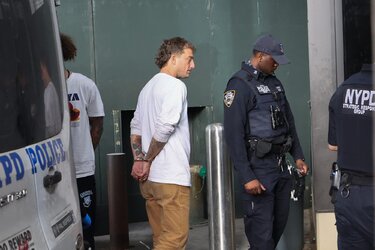
Police arrest protesters outside of New York University on Monday night. Credit...Adam Gray for The New York Times
At New York University, the police swept in to arrest protesting students on Monday night, ending a standoff with the school’s administration.
At Yale, the police placed protesters’ wrists into zip ties on Monday morning and escorted them onto campus shuttles to receive summonses for trespassing.
Columbia kept its classroom doors closed on Monday, moving lectures online and urging students to stay home.
Harvard Yard was shut to the public. Nearby, at campuses like Tufts and Emerson, administrators weighed how to handle encampments that looked much like the one that the police dismantled at Columbia last week — which protesters quickly resurrected. And on the West Coast, a new encampment bubbled at the University of California, Berkeley.
Less than a week after the arrests of more than 100 protesters at Columbia, administrators at some of the country’s most influential universities were struggling, and largely failing, to calm campuses torn by the conflict in Gaza and Israel.
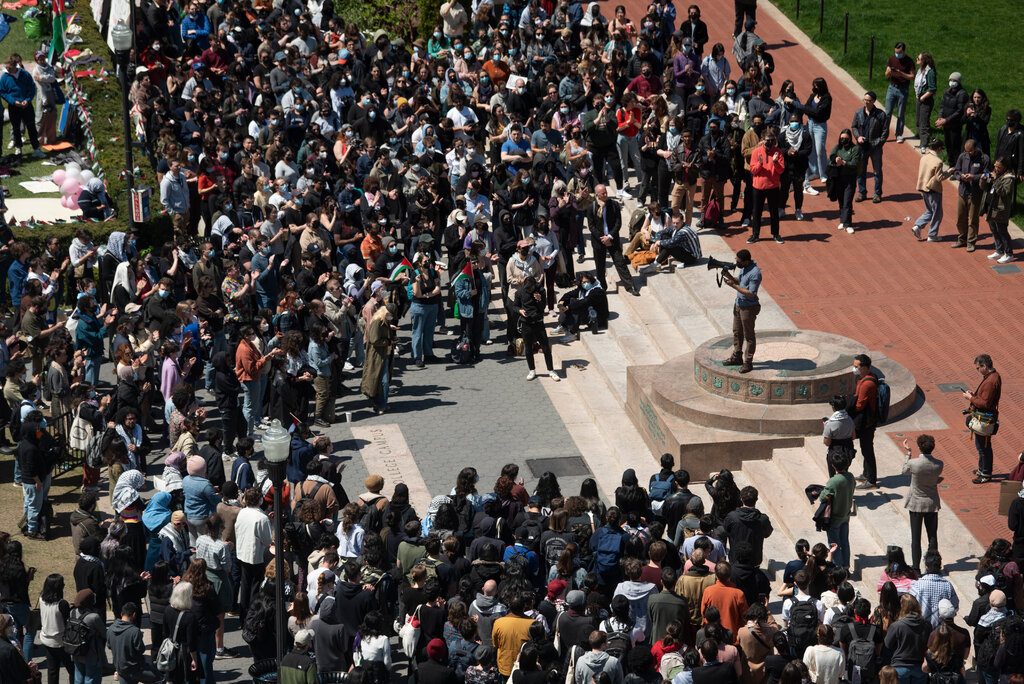
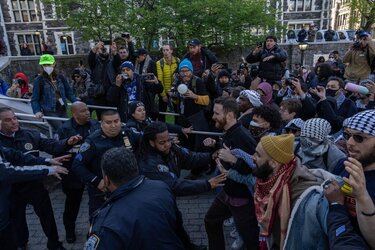
Despite arrests at Columbia last week, protests continued on campus on Monday.Credit...C.S. Muncy for The New York Times
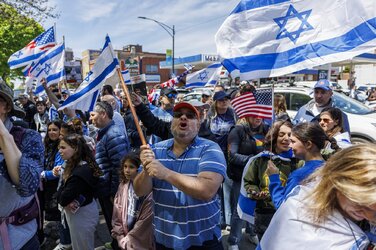
During the turmoil on Monday, which coincided with the start of Passover, protesters called on their universities to become less financially tied to Israel and its arms suppliers. Many Jewish students agonized anew over some protests and chants that veered into antisemitism, and feared again for their safety. Some faculty members denounced clampdowns on peaceful protests and warned that academia’s mission to promote open debate felt imperiled. Alumni and donors raged.
And from Congress, there were calls for the resignation of Columbia’s president, Nemat Shafik, from some of the same lawmakers Dr. Shafik tried to pacify last week with words and tactics that inflamed her own campus.
The menu of options for administrators handling protests seems to be quickly dwindling. It is all but certain that the demonstrations, in some form or another, will last on some campuses until the end of the academic year, and even then, graduation ceremonies may be bitterly contested gatherings.
For now, with the most significant protests confined to a handful of campuses, the administrators’ approaches sometimes seem to shift from hour to hour.
“I know that there is much debate about whether or not we should use the police on campus, and I am happy to engage in those discussions,” Dr. Shafik said in a message to students and employees early Monday, four days after officers dressed in riot gear helped clear part of Columbia’s campus.
“But I do know that better adherence to our rules and effective enforcement mechanisms would obviate the need for relying on anyone else to keep our community safe,” she added. “We should be able to do this ourselves.”
Protesters have demonstrated with varying intensity since the Oct. 7 Hamas attack on Israel. But this particular round of unrest began to gather greater force last Wednesday, after Columbia students erected an encampment, just as Dr. Shafik was preparing to testify before Congress.
At that hearing in Washington, before a Republican-led House committee, she vowed to punish unauthorized protests on the private university’s campus more aggressively, and the next day, she asked the New York Police Department to clear the encampment. In addition to the more than 100 people arrested, Columbia suspended many students. Many Columbia professors, students and alumni voiced fears that the university was stamping out free debate, a cornerstone of the American college experience.
The harsher approach helped lead to more protests outside Columbia’s gates, where Jewish students reported being targeted with antisemitic jeers and described feeling unsafe as they traveled to and from their campus.
The spiraling uproar in Upper Manhattan helped fuel protests on some other campuses.
“We’re all a united front,” said Malak Afaneh, a law student protesting at University of California, Berkeley. “This was inspired by the students at Columbia who, in my opinion, are the heart of the student movement whose bravery and solidarity with Palestine really inspired us all.”
The events at Columbia also rippled to Yale, where students gathered at Beinecke Plaza in New Haven, Conn., for days to demand that the university divest from arms manufacturers.
Yale’s president, Peter Salovey, said Monday that university leaders had spent “many hours” in talks with the protesters, with an offer that included an audience with the trustee who oversees Yale’s Corporation Committee on Investor Responsibility. But university officials had decided late Sunday that the talks were proving unsuccessful, and Dr. Salovey said, they were troubled by reports “that the campus environment had become increasingly difficult.”
The authorities arrested 60 people on Monday morning, including 47 students, Dr. Salovey said. The university said the decision to make arrests was made with “the safety and security of the entire Yale community in mind and to allow access to university facilities by all members of our community.”
In the hours after the arrests, though, hundreds of protesters blocked a crucial intersection in New Haven.

Students protesters occupied an intersection near the campus of Yale University on Monday.Credit...Adrian Martinez Chavez for The New York Times
“We demand that Yale divests!” went one chant.
“Free Palestine!” went another.
Far from being cowed by the police, protesters suggested that the response at Beinecke Plaza had emboldened them.
“It’s pretty appalling that the reaction to students exercising their freedom of speech and engaging in peaceful protest on campus grounds — which is supposed to be our community, our campus — the way that Yale responds is by sending in the cops and having 50 students arrested,” said Chisato Kimura, a law student at Yale.
The scene was less contentious in Massachusetts, where Harvard officials had moved to limit the possibility of protests by closing Harvard Yard, the 25-acre core of the campus in Cambridge, through Friday. Students were warned that they could face university discipline if they, for instance, erected unauthorized tents or blocked building entrances.
On Monday, Harvard’s Palestine Solidarity Committee said on social media that the university had suspended it. National Students for Justice in Palestine, a loose confederation of campus groups, said it believed the decision was “clearly intended to prevent students from replicating the solidarity encampments” emerging across the United States. Harvard said in a statement that it was “committed to applying all policies in a content-neutral manner.”
Elsewhere in the Boston area, protesters had set up encampments at Emerson College, the Massachusetts Institute of Technology and Tufts University. But those protests, for now, appeared more modest than the ones at Yale and in New York, where demonstrators constructed an encampment outside N.Y.U.’s Stern School of Business.

Protesters outside of New York University, before police arrived.Credit...Adam Gray for The New York Times

“Students, students, hold your ground!” protesters roared. “N.Y.U., back down!”Credit...Adam Gray for The New York Times
N.Y.U. officials tolerated the demonstration for hours but signaled Monday night that their patience was wearing thin. Police officers gathered near the protest site as demonstrators ignored a 4 p.m. deadline to vacate it. As nightfall approached, sirens blared and officers, donning helmets and bearing zip ties, mustered. Prisoner transport vans waited nearby.
“Students, students, hold your ground!” protesters roared. “N.Y.U., back down!”
Soon enough, police officers marched on the demonstration.
“Today’s events did not need to lead to this outcome,” said John Beckman, a university spokesman in a statement. But, he said, some protesters, who may not have been from N.Y.U., breached barriers and refused to leave. Because of safety concerns, the university said it asked for assistance from the police.
At Columbia, Dr. Shafik ordered Monday’s classes moved online “to de-escalate the rancor.”
She did not immediately detail how the university would proceed in the coming days, beyond saying that Columbia officials would be “continuing discussions with the student protesters and identifying actions we can take as a community to enable us to peacefully complete the term.”
Some students and faculty members said support for Dr. Shafik was eroding, with the university senate preparing for the possibility of a vote this week to censure the president. Supporters of the censure complained that Dr. Shafik was sacrificing academic freedom to appease critics.
But Dr. Shafik was castigated on Monday by the very people she was accused of appeasing when at least 10 members of the U.S. House of Representatives demanded her resignation.
“Over the past few days, anarchy has engulfed Columbia University,” Representative Elise Stefanik, Republican of New York and one of Dr. Shafik’s chief interrogators last week, wrote with other lawmakers. “As the leader of this institution, one of your chief objectives, morally and under law, is to ensure students have a safe learning environment. By every measure, you have failed this obligation.”
A university spokesperson said that Dr. Shafik was focused on easing the strife and that she was “working across campus with members of the faculty, administration, and board of trustees, and with state, city, and community leaders, and appreciates their support.”
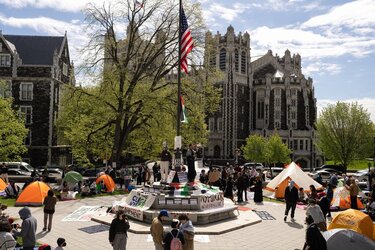
Amid the acrimony, and with scores of green, blue and yellow tents filling the Columbia encampment, parts of the campus sometimes took on an eerie, surreal quiet on a splendid spring day.

Some faculty members said support for Dr. Shafik was eroding.Credit...CS Muncy for The New York Times

At Columbia, many Jewish students stayed away from campus for Passover.Credit...Bing Guan for The New York Times
The unease was never all that far away, though, even with many Jewish students away from campus for Passover.
“When Jewish students are forced to watch others burning Israeli flags, calling for bombing of Tel Aviv, calling for Oct. 7 to happen over and over again, it creates an unacceptable degree of fear that cannot be tolerated,” Representative Daniel Goldman, Democrat of New York, said outside Columbia’s Robert K. Kraft Center for Jewish Student Life.
By then, in another symbol of the crisis enveloping Columbia, Mr. Kraft, an alumnus and owner of the New England Patriots, had launched his own broadside and suggested he would pause his giving.
“I am no longer confident that Columbia can protect its students and staff,” he wrote in a statement, “and I am not comfortable supporting the university until corrective action is taken.”
The New York Times (archive.ph)
By Alan Blinder
2024-04-23 04:48:02GMT
Police arrest protesters outside of New York University on Monday night. Credit...Adam Gray for The New York Times
At New York University, the police swept in to arrest protesting students on Monday night, ending a standoff with the school’s administration.
At Yale, the police placed protesters’ wrists into zip ties on Monday morning and escorted them onto campus shuttles to receive summonses for trespassing.
Columbia kept its classroom doors closed on Monday, moving lectures online and urging students to stay home.
Harvard Yard was shut to the public. Nearby, at campuses like Tufts and Emerson, administrators weighed how to handle encampments that looked much like the one that the police dismantled at Columbia last week — which protesters quickly resurrected. And on the West Coast, a new encampment bubbled at the University of California, Berkeley.
Less than a week after the arrests of more than 100 protesters at Columbia, administrators at some of the country’s most influential universities were struggling, and largely failing, to calm campuses torn by the conflict in Gaza and Israel.
Despite arrests at Columbia last week, protests continued on campus on Monday.Credit...C.S. Muncy for The New York Times
During the turmoil on Monday, which coincided with the start of Passover, protesters called on their universities to become less financially tied to Israel and its arms suppliers. Many Jewish students agonized anew over some protests and chants that veered into antisemitism, and feared again for their safety. Some faculty members denounced clampdowns on peaceful protests and warned that academia’s mission to promote open debate felt imperiled. Alumni and donors raged.
And from Congress, there were calls for the resignation of Columbia’s president, Nemat Shafik, from some of the same lawmakers Dr. Shafik tried to pacify last week with words and tactics that inflamed her own campus.
The menu of options for administrators handling protests seems to be quickly dwindling. It is all but certain that the demonstrations, in some form or another, will last on some campuses until the end of the academic year, and even then, graduation ceremonies may be bitterly contested gatherings.
For now, with the most significant protests confined to a handful of campuses, the administrators’ approaches sometimes seem to shift from hour to hour.
“I know that there is much debate about whether or not we should use the police on campus, and I am happy to engage in those discussions,” Dr. Shafik said in a message to students and employees early Monday, four days after officers dressed in riot gear helped clear part of Columbia’s campus.
“But I do know that better adherence to our rules and effective enforcement mechanisms would obviate the need for relying on anyone else to keep our community safe,” she added. “We should be able to do this ourselves.”
Protesters have demonstrated with varying intensity since the Oct. 7 Hamas attack on Israel. But this particular round of unrest began to gather greater force last Wednesday, after Columbia students erected an encampment, just as Dr. Shafik was preparing to testify before Congress.
At that hearing in Washington, before a Republican-led House committee, she vowed to punish unauthorized protests on the private university’s campus more aggressively, and the next day, she asked the New York Police Department to clear the encampment. In addition to the more than 100 people arrested, Columbia suspended many students. Many Columbia professors, students and alumni voiced fears that the university was stamping out free debate, a cornerstone of the American college experience.
The harsher approach helped lead to more protests outside Columbia’s gates, where Jewish students reported being targeted with antisemitic jeers and described feeling unsafe as they traveled to and from their campus.
The spiraling uproar in Upper Manhattan helped fuel protests on some other campuses.
“We’re all a united front,” said Malak Afaneh, a law student protesting at University of California, Berkeley. “This was inspired by the students at Columbia who, in my opinion, are the heart of the student movement whose bravery and solidarity with Palestine really inspired us all.”
The events at Columbia also rippled to Yale, where students gathered at Beinecke Plaza in New Haven, Conn., for days to demand that the university divest from arms manufacturers.
Yale’s president, Peter Salovey, said Monday that university leaders had spent “many hours” in talks with the protesters, with an offer that included an audience with the trustee who oversees Yale’s Corporation Committee on Investor Responsibility. But university officials had decided late Sunday that the talks were proving unsuccessful, and Dr. Salovey said, they were troubled by reports “that the campus environment had become increasingly difficult.”
The authorities arrested 60 people on Monday morning, including 47 students, Dr. Salovey said. The university said the decision to make arrests was made with “the safety and security of the entire Yale community in mind and to allow access to university facilities by all members of our community.”
In the hours after the arrests, though, hundreds of protesters blocked a crucial intersection in New Haven.
Students protesters occupied an intersection near the campus of Yale University on Monday.Credit...Adrian Martinez Chavez for The New York Times
“We demand that Yale divests!” went one chant.
“Free Palestine!” went another.
Far from being cowed by the police, protesters suggested that the response at Beinecke Plaza had emboldened them.
“It’s pretty appalling that the reaction to students exercising their freedom of speech and engaging in peaceful protest on campus grounds — which is supposed to be our community, our campus — the way that Yale responds is by sending in the cops and having 50 students arrested,” said Chisato Kimura, a law student at Yale.
The scene was less contentious in Massachusetts, where Harvard officials had moved to limit the possibility of protests by closing Harvard Yard, the 25-acre core of the campus in Cambridge, through Friday. Students were warned that they could face university discipline if they, for instance, erected unauthorized tents or blocked building entrances.
On Monday, Harvard’s Palestine Solidarity Committee said on social media that the university had suspended it. National Students for Justice in Palestine, a loose confederation of campus groups, said it believed the decision was “clearly intended to prevent students from replicating the solidarity encampments” emerging across the United States. Harvard said in a statement that it was “committed to applying all policies in a content-neutral manner.”
Elsewhere in the Boston area, protesters had set up encampments at Emerson College, the Massachusetts Institute of Technology and Tufts University. But those protests, for now, appeared more modest than the ones at Yale and in New York, where demonstrators constructed an encampment outside N.Y.U.’s Stern School of Business.
Protesters outside of New York University, before police arrived.Credit...Adam Gray for The New York Times
“Students, students, hold your ground!” protesters roared. “N.Y.U., back down!”Credit...Adam Gray for The New York Times
N.Y.U. officials tolerated the demonstration for hours but signaled Monday night that their patience was wearing thin. Police officers gathered near the protest site as demonstrators ignored a 4 p.m. deadline to vacate it. As nightfall approached, sirens blared and officers, donning helmets and bearing zip ties, mustered. Prisoner transport vans waited nearby.
“Students, students, hold your ground!” protesters roared. “N.Y.U., back down!”
Soon enough, police officers marched on the demonstration.
“Today’s events did not need to lead to this outcome,” said John Beckman, a university spokesman in a statement. But, he said, some protesters, who may not have been from N.Y.U., breached barriers and refused to leave. Because of safety concerns, the university said it asked for assistance from the police.
At Columbia, Dr. Shafik ordered Monday’s classes moved online “to de-escalate the rancor.”
She did not immediately detail how the university would proceed in the coming days, beyond saying that Columbia officials would be “continuing discussions with the student protesters and identifying actions we can take as a community to enable us to peacefully complete the term.”
Some students and faculty members said support for Dr. Shafik was eroding, with the university senate preparing for the possibility of a vote this week to censure the president. Supporters of the censure complained that Dr. Shafik was sacrificing academic freedom to appease critics.
But Dr. Shafik was castigated on Monday by the very people she was accused of appeasing when at least 10 members of the U.S. House of Representatives demanded her resignation.
“Over the past few days, anarchy has engulfed Columbia University,” Representative Elise Stefanik, Republican of New York and one of Dr. Shafik’s chief interrogators last week, wrote with other lawmakers. “As the leader of this institution, one of your chief objectives, morally and under law, is to ensure students have a safe learning environment. By every measure, you have failed this obligation.”
A university spokesperson said that Dr. Shafik was focused on easing the strife and that she was “working across campus with members of the faculty, administration, and board of trustees, and with state, city, and community leaders, and appreciates their support.”
Amid the acrimony, and with scores of green, blue and yellow tents filling the Columbia encampment, parts of the campus sometimes took on an eerie, surreal quiet on a splendid spring day.
Some faculty members said support for Dr. Shafik was eroding.Credit...CS Muncy for The New York Times
At Columbia, many Jewish students stayed away from campus for Passover.Credit...Bing Guan for The New York Times
The unease was never all that far away, though, even with many Jewish students away from campus for Passover.
“When Jewish students are forced to watch others burning Israeli flags, calling for bombing of Tel Aviv, calling for Oct. 7 to happen over and over again, it creates an unacceptable degree of fear that cannot be tolerated,” Representative Daniel Goldman, Democrat of New York, said outside Columbia’s Robert K. Kraft Center for Jewish Student Life.
By then, in another symbol of the crisis enveloping Columbia, Mr. Kraft, an alumnus and owner of the New England Patriots, had launched his own broadside and suggested he would pause his giving.
“I am no longer confident that Columbia can protect its students and staff,” he wrote in a statement, “and I am not comfortable supporting the university until corrective action is taken.”