Disaster The world's first solar road has officially crumbled into a total failure - "At least we tried"

Source.
1566076008618.png


In July, the French daily newspaper Le Monde reported that the 0.6-mile (1 kilometre) solar road was a fiasco.

In December 2016, when the trial road was unveiled, the French Ministry of the Environment called it "unprecedented". French officials said the road, made of photovoltaic panels, would generate electricity to power streetlights in Tourouvre, a local town.

But less than three years later, a report published by Global Construction Review says France's road dream may be over. Cracks have appeared, and in 2018, part of the road had to be demolished due to damage from wear and tear.

Even at its peak, the road was only producing half of the expected energy, because engineers didn't take into consideration rotting leaves falling on the road.

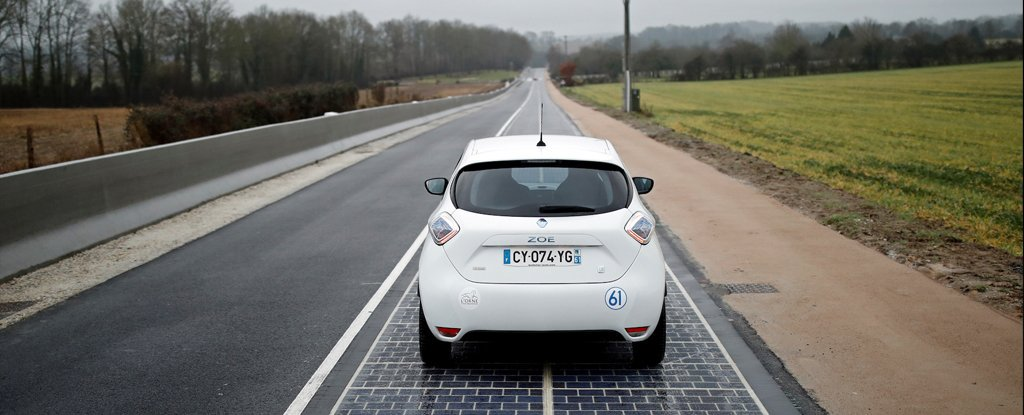
Here what the road looked like in all of its former glory, and how it got to this point.

1566076028004.png


It was all smiles and high hopes in 2016, when the world's first solar panel road, called Wattway, opened. France spent US$5.2 million on 0.6 miles (1 kilometre) of road, and 30,000 square feet (3,000 square metres) of solar panels. It was hailed as the longest solar road in the world.

Media gathered around to take a walk down what was thought to be the road of the future. The French minister for energy said she wanted to have solar panels on one mile of road every 621 miles in the country within the next five years.

Despite grey skies on the day of the inauguration, France was leading the world for solar transportation.

But the brake was never removed, and the wheels never started rolling - so to speak.

It was a bold move beginning a solar panel trial in Normandy, France, since the region doesn't have the most sunshine. Caen, a city in Normandy, only has 44 days of strong sunshine in a year. Thunderstorms also reportedly broke solar panels on the road.

The trial road was meant to produce about 150,000 kWh a year, which is enough power to provide light for up to 5,000 people, every day. Instead, it was making just under 80,000 in 2018, and fewer than 40,000 by July 2019.

Colas, the company that built the road, said in 2016 that the solar panels were covered with resin containing sheets of silicon to make them capable of withstanding all traffic. But since the opening, panels have come loose or broken into little pieces.

In May 2018, 300 feet (90 metres) of the road had to be demolished since it wasn't salvageable.

1566076045200.png


The engineers also didn't take into account the effects of leaves, which caused damage and limited the amount of electricity the panels could produce. They also didn't think about the pressure and weight from tractors, two locals told Le Monde.

And now the trial looks like it's all over. Wattway's managing director Etienne Gaudin told Le Monde that it would not be going to market.

"Our system is not mature on long distance traffic," he said. The company would focus on creating electricity for smaller things, like CCTV cameras and lighting bus shelters.
A damn shame, really. I think it's a pretty cool idea, it just needs to evolve over time.
As a gearhead, by the time this technology is perfected, I wonder if burnouts would be even more illegal than what they currently are?

 
The concrete industry may be the only entity in human history to benefit from communism, by way of it's corresponding love of shoddily-built, no-frills, stack-a-prole apartment blocks.
 
Solar is a completely dead end as far as energy production goes. Only scientific illiterates and idiots believe it can work.

Problems with Solar comes in fives:

1) The hotter a solar panel, the worse the efficiency. This is because, contrary to popular belief, the way photo-voltaic cells work, their reactions are more efficient at cooler temperatures than hotter ones.

2) Energy loss. A lot of sunlight is basically lost as heat. Until photovotalic cells can absorb the heat as well as light, they won't be up to snuff.

3) The battery limit. The battery limit is basically that after a certain point, a battery cannot be shrunk down any more. So you have these huge batteries required to capture this energy.

4) Solar Cell size. The size of photovoltaic cells is still too big and absorbs too little.

5) As with all green energy, with the exceptions of geothermic and hydro, solar is extremely unreliable. You've got sunny days and you've got cloudy days. So your energy will never be constant as a flowing river, a liquid or solid amount of energy, or nuclear. The amount of energy from 2 l kg lumps of coal refined in the same way from the same mine is basically identical. Same with natural gas. The problem is that you cannot provide a consistent amount of wattage.

As an emergency, secondary energy source? Solar has potential. If you're sure society won't fully collapse in the next two decades, if you put them on your roof, you could save 10 to 30k over 20 years. As a PRIMARY green energy source? It has a long, long way to go.

Fun fact: China used more concrete in 3 years than the USA used in 250 years....

This is used to build ghost cities and is part of the Chinese economic shuffle to sustain their growth. Also they're fueling the global depletion of sand. Which has lead to black markets and sand cartels that literally kill people for sand. It can be worth millions. Like you've got guys in dump trucks literally driving up to beaches and stripping them of the sand on them.

Because of this insane waste and growth, people are starting to strip beaches and rivers for it. Desert sand is useless in construction because its too eroded.
 
Última edición:
But if you're gonna go full solar, you'll need a fuckton of batteries to store all that power for when the sun isn't shining. Lithium ion is the best battery tech we have right now, but mining lithium takes a huge toll on the environment; nuclear would actually be much cleaner than solar for mass energy production, even accounting for uranium mining and the (actually very easily handled) nuclear waste products.
Lithium ain't a rare earth metal either.

Elements like neodymium are rare earth metals.
 
5) As with all green energy, with the exceptions of geothermic and hydro, solar is extremely unreliable.

Hydro can be unreliable, during hot summer months with droughts and little to no rain the reservoirs can start to become depleted resulting in less power output due to them limiting the amount of water going through the turbines. With ten hydro electric power plants on the same river that will a serious negative effect.

A thing that doesn't make them unreliable or unpredictable just uneven in their output, depending on where they are located, is the spring when all the snow melts, snowfall can also vary from year to year, and they have to fully open the intakes to get rid of the water. Hydro will always have peaks and valleys in their energy production.

There needs to be a nuclear power option to cover situations like these.
 
Atrás
Top Abajo