Social Justice Warriors - Now With Less Feminism Sperging

This is a new twist on an old schtick. I remember 20 years ago, math problems that talked about how much money you'd make if you sold x number of widgets for $y were noted for being "culturally biased". As in, they made the assumption that the student accepted capitalism as a valid economic system.

If you're capable of doing math, you probably aren't a communist in the first place. So of course it's biased toward the kind of people who can understand math.

If you can't, well, enjoy your Troon Studies degree.
 
8KbSKgT.jpg
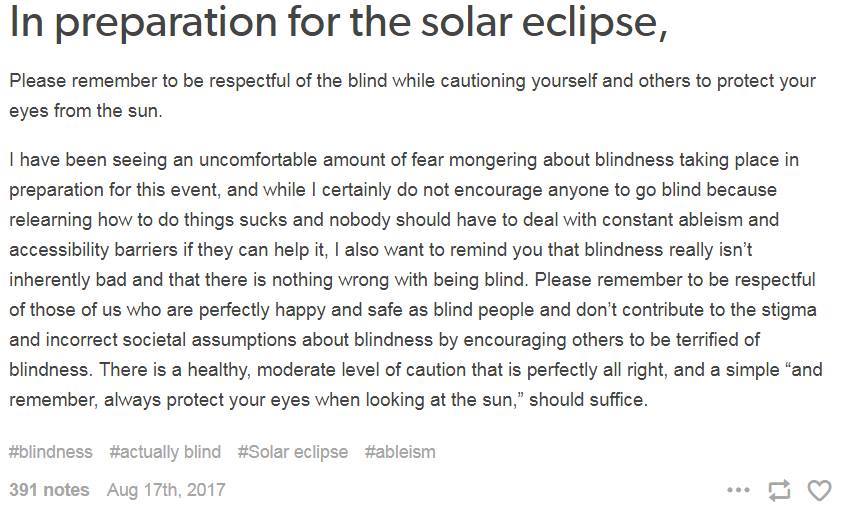
Since these people love being the victim, and blindness makes you a good victim, why didn't more SJWs stare at the sun the other day to gain some points in the fight against ableism. Even if you only go partially blind, even for only a few months (the most likely result), there's a lot of social justice points to be obtained. And you didn't do it deliberately, you did it for science!
 
So what are the good points to "black urban culture"?

Not any more, but once upon a time I'd have said "rap." Of course what goes without saying is that left to its own devices, rap would've remained the domain of community center parties in New York, rather than developing into a worthwhile and commercially viable musical genre. Its successful transformation came not from black innovation, but commercial risk-taking by Jewish managers and record label execs. So while Ice Cube may bitch about how Eazy-E "let a Jew break up (his) crew," that same Jew (Jerry Heller) is the only reason anybody knows who the hell O'Shea Jackson Jr is.
 
I assume this article about who gets to be black was written by a white person?

Scarily enough it was written by a black dude that doesn't believe his policing of what is and isn't black isn't racist. Also he fires out like 5 "articles" a day so he might be a bot on a site that is the black version of Jezebel.
 
Not any more, but once upon a time I'd have said "rap." Of course what goes without saying is that left to its own devices, rap would've remained the domain of community center parties in New York, rather than developing into a worthwhile and commercially viable musical genre. Its successful transformation came not from black innovation, but commercial risk-taking by Jewish managers and record label execs. So while Ice Cube may bitch about how Eazy-E "let a Jew break up (his) crew," that same Jew (Jerry Heller) is the only reason anybody knows who the hell O'Shea Jackson Jr is.
i dunno fam in the late 70s or early 80s sugarhill records was going mainstream and that was owned by a black couple.
Ver archivo adjunto 267571
She just shared this:

Ver archivo adjunto 267572

This is stupid on so many levels, my brain's struggling to know where to begin.

Kiwis! You know what to do.
why is there never any respect for the victims jfc.
 
I'm genuinely curious here

What part of Western Black Culture are we supposed to admire?

They talk like black culture is some monolithic entity that whitey is desperate trying to beat down and will soon break free.

So what are the good points to "black urban culture"?

I can think of several.

Jazz, the blues and early rock 'n' roll -- whether or not you appreciate hip-hop, surely you enjoy one or more of these genres.

Barbecue and soul food.

The incredibly visceral, impactful literary work created by black authors -- today people focus more on Morrison and Angelou, but I'm talking more about Hughes, Brooks, Baldwin.

The great black centers of the early 1900s. Bronzeville and Harlem -- and all the other neighborhoods of upwardly-mobile, professional black people who struggled against a hugely prejudiced society and made their segregated communities into something far beyond a ghetto. These centers were crowded with public housing by Great Society programs that had no intent of integrating neighborhoods but instead brought in people who were less likely to try to strive for upward mobility, and made those neighborhoods go into decline. Anywhere middle-class black people lived, the government made sure to fill up with as many generationally-impoverished black people as it could, hence the decline of those neighborhoods in the 70s. With less public housing available, and less welfare assistance overall, both Bronzeville and Harlem turned back into middle/upper-middle class neighborhoods while poorer black people were relegated to places further from city centers.

There is an element of black American culture that doesn't get talked about much any more, but used to be a major, huge part of what it meant to be black. For a long time, because of redlining and a lack of industrial-scale capital to make capital improvements, black communities have had to be self-reliant with less. If you look into the history of one of those neighborhoods I mentioned above, or if you go today to rural towns in Georgia that were founded as freed slave colonies, you'll see people sticking together and creating community to do what you could with very little. There are still rural Southern towns that are almost all black and lack all grocery stores in large part due to racial issues (you'd have no doubt this was the motivation if you saw what the white towns a couple of towns over put on their billboards about America and the Confederacy). But you know what those towns have instead? Some person with a little bit of money will try to open up a "store" in a house that has a few shelves and a less-than-convenience-store level selection, and they'll make a little on the markup but never enough to get rich. The idea of having to work harder to get ahead, but wanting to do that anyway to make a better community, was a big deal to many black communities in the 20th century.

A lot of these ideas have sort of been erased by the most recent couple of generations of media production. Black people are held up in our culture (usually by white media moguls who decide what to promote and what not to promote, so let's not think of this as coming from the black community itself) only when they live for pleasure and spend tons of money. Love him or hate him, Kanye's got a point:

You see it's broke nigga racism
That's that "Don't touch anything in the store"
And this rich nigga racism
That's that "Come in, please buy more"

The fact that people today even have to ask "what's good about black culture" is kind of crazy, honestly, and reflects what a good job these media properties have done in destroying the image of black culture as creating a vibrant, artistic landscape in urban areas and a soulful, social one in rural areas. Even white people in the 1950s who were racist as shit would have said things like "well, they sure know their music, don't they?"

But today, if you're less than 35, you probably don't have much exposure to that kind of black culture beyond reading "A Dream Deferred" in 10th grade or hearing Chuck Berry play at some nostalgia restaurant. It didn't take long to erase what was an incredible thread of American culture and transform it into something that would be unrecognizable in terms of values, social norms, and stereotypes to anyone from the Harlem Renaissance.
 
I can think of several.

Jazz, the blues and early rock 'n' roll -- whether or not you appreciate hip-hop, surely you enjoy one or more of these genres.

Barbecue and soul food.

The incredibly visceral, impactful literary work created by black authors -- today people focus more on Morrison and Angelou, but I'm talking more about Hughes, Brooks, Baldwin.

The great black centers of the early 1900s. Bronzeville and Harlem -- and all the other neighborhoods of upwardly-mobile, professional black people who struggled against a hugely prejudiced society and made their segregated communities into something far beyond a ghetto. These centers were crowded with public housing by Great Society programs that had no intent of integrating neighborhoods but instead brought in people who were less likely to try to strive for upward mobility, and made those neighborhoods go into decline. Anywhere middle-class black people lived, the government made sure to fill up with as many generationally-impoverished black people as it could, hence the decline of those neighborhoods in the 70s. With less public housing available, and less welfare assistance overall, both Bronzeville and Harlem turned back into middle/upper-middle class neighborhoods while poorer black people were relegated to places further from city centers.

There is an element of black American culture that doesn't get talked about much any more, but used to be a major, huge part of what it meant to be black. For a long time, because of redlining and a lack of industrial-scale capital to make capital improvements, black communities have had to be self-reliant with less. If you look into the history of one of those neighborhoods I mentioned above, or if you go today to rural towns in Georgia that were founded as freed slave colonies, you'll see people sticking together and creating community to do what you could with very little. There are still rural Southern towns that are almost all black and lack all grocery stores in large part due to racial issues (you'd have no doubt this was the motivation if you saw what the white towns a couple of towns over put on their billboards about America and the Confederacy). But you know what those towns have instead? Some person with a little bit of money will try to open up a "store" in a house that has a few shelves and a less-than-convenience-store level selection, and they'll make a little on the markup but never enough to get rich. The idea of having to work harder to get ahead, but wanting to do that anyway to make a better community, was a big deal to many black communities in the 20th century.

A lot of these ideas have sort of been erased by the most recent couple of generations of media production. Black people are held up in our culture (usually by white media moguls who decide what to promote and what not to promote, so let's not think of this as coming from the black community itself) only when they live for pleasure and spend tons of money. Love him or hate him, Kanye's got a point:

You see it's broke nigga racism
That's that "Don't touch anything in the store"
And this rich nigga racism
That's that "Come in, please buy more"

The fact that people today even have to ask "what's good about black culture" is kind of crazy, honestly, and reflects what a good job these media properties have done in destroying the image of black culture as creating a vibrant, artistic landscape in urban areas and a soulful, social one in rural areas. Even white people in the 1950s who were racist as shit would have said things like "well, they sure know their music, don't they?"

But today, if you're less than 35, you probably don't have much exposure to that kind of black culture beyond reading "A Dream Deferred" in 10th grade or hearing Chuck Berry play at some nostalgia restaurant. It didn't take long to erase what was an incredible thread of American culture and transform it into something that would be unrecognizable in terms of values, social norms, and stereotypes to anyone from the Harlem Renaissance.
well, someone knows there history
 
I'm betting there's a Blind community like there's a Deaf community. I know the Deaf community tries to deliberately have deaf children, and hates those implants that can cure certain types of deafness, so no it wouldn't surprise me if there's an equally stupid group of blind people.
The Deaf culture can be real pricks. There was this college that wanted to teach sign language, but since the teacher wasn't deaf, the deaf community did what they could to complain and shut it down. I posted an entry on what should they do if they can't find a capable deaf person to teach the class and one of them responded to go online and take classes from deaf people on those sites.
 
I'm genuinely curious here

What part of Western Black Culture are we supposed to admire?

They talk like black culture is some monolithic entity that whitey is desperate trying to beat down and will soon break free.

So what are the good points to "black urban culture"?
You can sell your Link (foodstamps) for cash and get dank weed in many ghettofuxated neighborhoods
 
The Deaf culture can be real pricks. There was this college that wanted to teach sign language, but since the teacher wasn't deaf, the deaf community did what they could to complain and shut it down. I posted an entry on what should they do if they can't find a capable deaf person to teach the class and one of them responded to go online and take classes from deaf people on those sites.

At the risk of veering a little too far off-topic, since the "deaf rights activists" are their own special breed of bullshit whose infection of society predates the birth of the modern social justice movement, the most offensive example of their "how dare you not cater to us special snowflakes, now all must suffer" attitude is crystallized in the recent UC Berkeley case. With the goal of improving public knowledge, Berkeley had made more than 20,000 video lectures accessible to anybody for free via the internet. A couple of employees of Gallaudet, the deaf university that incubates the community's worst impulses, filed an ADA complaint with the Department of Justice because the videos weren't subtitled, making them inaccessible to the deaf. The DOJ sided with the deaf activists, and gave Berkeley the choice of either subtitling 20,000+ videos or removing public access. Given the massive investment of time and money required to comply with the ADA, Berkeley did the logical thing and removed public access. So now millions of people around the world, including many impoverished people in the developing world who cannot afford a university education have lost access to excellent college lectures in computer science, mathematics, and other practical subject areas that could help them to rise out of poverty. There's a special place in hell for those people.
 
Última edición:
At the risk of veering a little too far off-topic, since the "deaf rights activists" are their own special breed of bullshit whose infection of society predates the birth of the modern social justice movement, the most offensive example of their "how dare you not cater to us special snowflakes, now all must suffer" attitude is crystallized in the recent UC Berkeley case. With the goal of improving public knowledge, Berkeley had made more than 20,000 video lectures accessible to anybody for free via the internet. A couple of employees of Gallaudet, the deaf university that incubates the community's worst impulses, filed an ADA complaint with the Department of Justice because the videos weren't subtitled, making them inaccessible to the deaf. The DOJ sided with the deaf activists, and gave Berkeley the choice of either subtitling 20,000+ videos or removing public access. Given the massive investment of time and money required to comply with the ADA, Berkeley did the logical thing and removed public access. So now millions of people around the world, including many impoverished people in the developing world who cannot afford a university education have lost access to excellent college lectures in computer science, mathematics, and other practical subject areas that could help them to rise out of poverty. There's a special place in hell for those people.

Deaf people are assholes
 
I can think of several.

Jazz, the blues and early rock 'n' roll -- whether or not you appreciate hip-hop, surely you enjoy one or more of these genres.

Barbecue and soul food.

The incredibly visceral, impactful literary work created by black authors -- today people focus more on Morrison and Angelou, but I'm talking more about Hughes, Brooks, Baldwin.

The great black centers of the early 1900s. Bronzeville and Harlem -- and all the other neighborhoods of upwardly-mobile, professional black people who struggled against a hugely prejudiced society and made their segregated communities into something far beyond a ghetto. These centers were crowded with public housing by Great Society programs that had no intent of integrating neighborhoods but instead brought in people who were less likely to try to strive for upward mobility, and made those neighborhoods go into decline. Anywhere middle-class black people lived, the government made sure to fill up with as many generationally-impoverished black people as it could, hence the decline of those neighborhoods in the 70s. With less public housing available, and less welfare assistance overall, both Bronzeville and Harlem turned back into middle/upper-middle class neighborhoods while poorer black people were relegated to places further from city centers.

There is an element of black American culture that doesn't get talked about much any more, but used to be a major, huge part of what it meant to be black. For a long time, because of redlining and a lack of industrial-scale capital to make capital improvements, black communities have had to be self-reliant with less. If you look into the history of one of those neighborhoods I mentioned above, or if you go today to rural towns in Georgia that were founded as freed slave colonies, you'll see people sticking together and creating community to do what you could with very little. There are still rural Southern towns that are almost all black and lack all grocery stores in large part due to racial issues (you'd have no doubt this was the motivation if you saw what the white towns a couple of towns over put on their billboards about America and the Confederacy). But you know what those towns have instead? Some person with a little bit of money will try to open up a "store" in a house that has a few shelves and a less-than-convenience-store level selection, and they'll make a little on the markup but never enough to get rich. The idea of having to work harder to get ahead, but wanting to do that anyway to make a better community, was a big deal to many black communities in the 20th century.

A lot of these ideas have sort of been erased by the most recent couple of generations of media production. Black people are held up in our culture (usually by white media moguls who decide what to promote and what not to promote, so let's not think of this as coming from the black community itself) only when they live for pleasure and spend tons of money. Love him or hate him, Kanye's got a point:

You see it's broke nigga racism
That's that "Don't touch anything in the store"
And this rich nigga racism
That's that "Come in, please buy more"

The fact that people today even have to ask "what's good about black culture" is kind of crazy, honestly, and reflects what a good job these media properties have done in destroying the image of black culture as creating a vibrant, artistic landscape in urban areas and a soulful, social one in rural areas. Even white people in the 1950s who were racist as shit would have said things like "well, they sure know their music, don't they?"

But today, if you're less than 35, you probably don't have much exposure to that kind of black culture beyond reading "A Dream Deferred" in 10th grade or hearing Chuck Berry play at some nostalgia restaurant. It didn't take long to erase what was an incredible thread of American culture and transform it into something that would be unrecognizable in terms of values, social norms, and stereotypes to anyone from the Harlem Renaissance.
I've learned more about black culture and history in the US on a forum where we mock autists than any other site. The world truly has gone mad.
 
Atrás
Top Abajo