ere's a basic summary for those working, I'll edit and add to this as the stream goes:
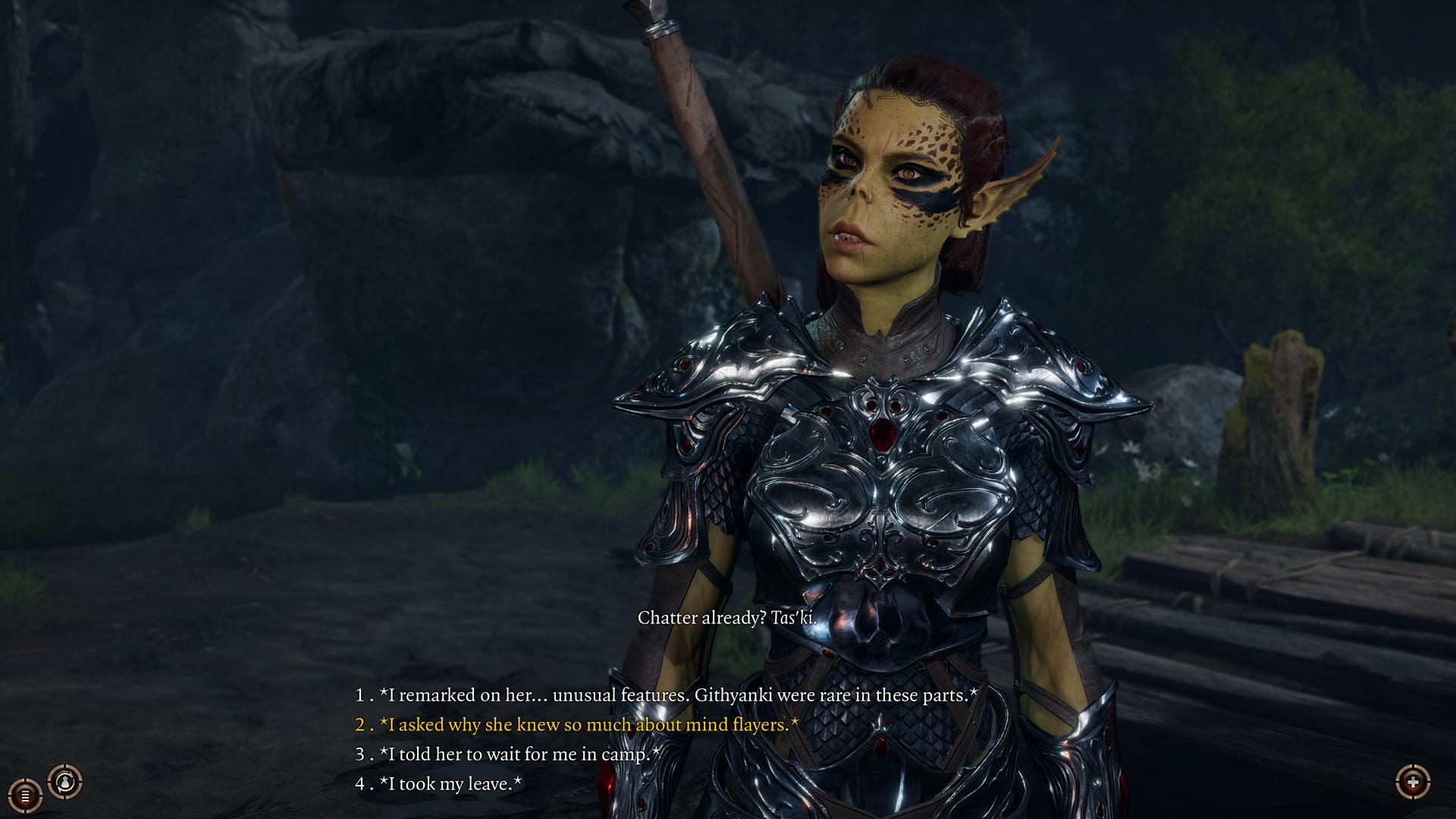
- Character Creations includes: Drow, Githyanki, Half Drow, Halfing, Tiefling, Dwarf, Elf, and Half-Elf. More races to come. You can create an original character or use a premade one with their own story and quirks, similar to Divinity OS2. Other "origin" characters will be companions.
- Races and templates, such as vampires, have restrictions such as not being in sun or crossing moving water. This applies to vampirespawn, including one of the origin characters you can select. The vampirespawn gets unique dialogue to have the option to cut a conversation short to try to feed on the other person.
- Classes include: Wizard, cleric, warlock, fighter, rogue, ranger. More will be added over time in updates
- Cantrip selection including mage hand, which is noteable as it is a favorite among D&D players. Mage hand can shove, throw, and interact with the terrain and game world in other ways.
- The story is centered around Mind Flayers/Illithids. A tadpole inserted in you at character creation, and it can be assumed this happens to all the companions you'll meet. Looks like the mind flayers invade from the far-realms via spelljammers (ships that can cross the astral plane). Soldiers mounted on wyverns (or another draconid) combat them. All of this happens in cinematics, it is unclear if this type of scene manifests in gameplay. The setting starts east of Baldur's Gate, on the sword coast in Faerun.
- The main character doesn't seem to speak their lines of dialogue like in Mass Effect or Dragon Age, save for special occasions like internal commentary. Think more Elder Scrolls, Fallout 3 and New Vegas, or Baldur's Gate 1&2. Otherwise NPC dialogue seems fully voiced. The camera for conversations will zoom in and have more detailed animation than typical CRPG's, and is more reminiscent of Dragon Age in that regard. There d20 rolls used to make skill checks in dialogue, such as persuasion and imitation
- Combat seems to be fully turn based with no options for Real-Time-With-Pause.
- You can also enter turn based mode outside of combat, which can be useful for trying to sneak into or carefully approach an encounter. The streamer used this often in a dungeon to perform careful actions in a trap filled hallway.
- Looks like your party caps out at four players/companions
- "Rolling advantage" exists in this game as well, such as being elevated above an enemy while attacking with a ranged weapon. This greatly increases hit chance.
- Terrain operates similarly to Divinity Original Sin 2, in terms of affecting how people can traverse them and what status effects they'll gain by moving over them. Fire, grease, water, rough terrain, etc. are a few examples.
- You get a single action point, instead of many like divinity. This operates as a standard action to attack or cast spells, and does not include your movement per turn.
- You can also do non magical, non direct attacks such as shoving an enemy to put some distance between you and others or shove them off a cliff. Moving away frm an enemy's threat range triggers an attack of opportunity. You can use a jump as a bonus action to avoid this the AOO. Dash actions presumably use up your standard action but increase your movement that turn.
- If you surprise someone, you get initiative on them. I couldn't tell exactly, but I assume you gain an extra surprise round to react against them.
- Different weapons can provide unique actions, for example bows and arrows can be used to pin an enemy.
- Losing all HP does not mean death, rather you become "downed". Each round a death save is made, three successes means they'll come back. three fails means they die.
- You can throw items. Mage hand can be used for this as well. Thrown items deal damage.
- You can dip bows into fire for a damage type bonus. It is unclear if this type of functionality exists for all weapon and terrain types
- Your Menu has skills, spellbook, inventory, stats, resistences, etc
- While exploring the world, You can move game world objects, including making crates into stairs to reach higher elevations.
- Passive skill checks occur, such as a nature check while walking by a cache hidden in a rock.
- You get a camp that will expand over time as you progress and gain companions. Resting heals and presumably restores spells. At the beginning it's just bedrolls and a fire. It is unclear what functionality your camp will gain, but supposedly this is where your character will think to themselves and have internal dialogues, as well as interactions with companions
- You can scale and jump up short walls and inclines. You can jump off of massive inclines, and survive with the use of spells like featherfall. Verticality seems to be much more prevalent than other CRPGs
- Jumping actions are also used in tighter quarters, such as jumping from crate to crate that you move with mage hand to get across a floor with an unfavorable terrain type, like grease. Looks like a clumsy game of the-floor-is-lava.
- When hiding, such as in shadows or other "obscured" areas, you make a skill check to see if you hide successfully. Light is dynamic for these purposes and can be manipulated through spells, and other light sources.
- There are unique items, such as the Amulet of Joy and Sorrow, which allows you to speak with the dead
- There was a noteable glitch where the streamer rapidly went into and out of combat preventing him from doing much, he ended the presentation there then went to Q&A (these are heavily paraphrased):
- Q: "What advice do you have for someone with awful luck, other than playing on easy?
- A: There are ways to gain advantage, which are a huge help for difficult checks
- Q: "Can you Respec companions?"
- A: Ability points, yes. Classes, this is undecided.
- Q: "Do spell slots recharge after a long rest?"
- A: Yes
- Q: "Was the companion supposed to react when the PC mentioned being a vampire?"
- A: (I'll be honest, I didn't understand his answer)
- Q: "What consoles will this release on?"
- A: The announced systems are currently just PC and Stadia
- Q: "Will we see companions from previous Baldur's Gate games?"
- A: I cannot answer that question
- Q: "Will the game be strictly turn based?"
- A: Yes
- Q: "Will there be any kind of alignment?"
- A: D&D 5e doesn't have the same focus on alignment as previous editions. Instead of reacting to alignment, NPCs and companions will react to specific types of behavior.
- Q: "Can you start off good then become evil? (Changing alignment?)"
- A: Alignment doesn't show up at all in the game presently
- Q: "Could you talk a bit more about early access?"
- A: The game will roll out in early access and will take community feedback into account for the full release. He said early access will release with "a lot of content"
So far the verdict is if you're a Divinity Original Sin fan, you'll be very happy with this video. If you were on the side of the fence that was hoping for the return of Real-Time-With-Pause, you'll be disappointed with this video. That said, the turn based combat seems to convey D&D 5e combat much better than AD&D 2e combat from the first two games, in my opinion.