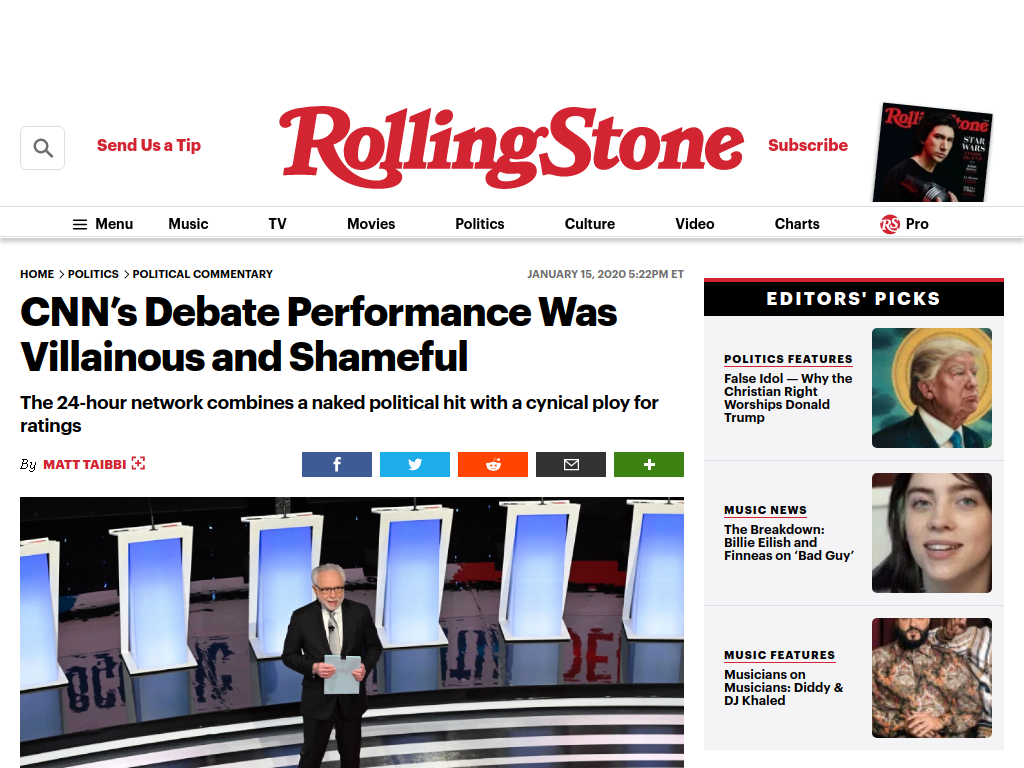
The 24-hour network combines a naked political hit with a cynical ploy for ratings

www.rollingstone.com
archived 16 Jan 2020 02:26:53 UTC

archive.li
CNN debate moderator Abby Phillip asked Bernie Sanders in the Tuesday debate in Des Moines:
“CNN reported yesterday — and Senator Sanders, Senator Warren confirmed in a statement — that, in 2018, you told her you did not believe that a woman could win the election. Why did you say that?”
Not “did you say that,” but “why did you say that?”
Sanders denied it, then listed the many reasons the story makes no sense: He urged Warren herself to run in 2016, campaigned for a female candidate who won the popular vote by 3 million votes, and has been saying the opposite in public for decades. “There’s a video of me 30 years ago talking about how a woman could become president of the United States,” he said.
Phillip asked him to clarify: He never said it? “That is correct,” Sanders said. Phillip turned to Warren and deadpanned: “Senator Warren, what did you think when Senator Sanders told you a woman could not win the election?”
That “when” was as transparent a media “fuck you” as we’ve seen in a presidential debate. It evoked memories of another infamous CNN ambush, when Bernard Shaw in 1988 crotch-kicked Mike Dukakis with a question about whether he’d favor the death penalty for someone who raped and murdered his wife, Kitty.
This time, the whole network tossed the mud. Over a 24-hour period before, during, and after the debate, CNN bid farewell to what remained of its reputation as a nonpolitical actor via a remarkable stretch of factually dubious reporting, bent commentary, and heavy-handed messaging.
The cycle began with a “bombshell” exposé by CNN reporter MJ Lee. Released on the eve of the debate, Lee reported Warren’s claim that Sanders told her a woman couldn’t win in a December 2018 meeting.
Lee treated the story as fact, using constructions such as, “Sanders responded that he did not think a woman could win,” and “the revelation that Sanders expressed skepticism that Warren could win.”
Lee said “the conversation” opened a window into “the role of sexism and gender inequality in politics”: The conversation also illustrates the skepticism among not only American voters but also senior Democratic officials that the country is ready to elect a woman as president …
Although Lee said she based the story on “the accounts of four people,” they were “two people Warren spoke with directly soon after the encounter,” and “two people familiar with the meeting.” There were only two people in the room, Sanders and Warren. Lee’s “four people” actually relied on just one source, Warren.
If this sounds familiar, it’s because it’s the same construction that’s driven countless other shaky stories in the past, from WMD reports to Russiagate speculations. An unconfirmable hearsay story is conveyed by one source, who gives the reporter the numbers of two or three other people in the office who’ve heard the same tale from the same place. Voilà: A one-source pony is now factual “according to several people familiar with the matter.”
CNN hyped the “feud” between Sanders and Warren the whole day before the debate. “This is a heavyweight match tonight. This is going to be frisky, it’s going to be competitive,” former DNC chair and commentator Terry McAuliffe said. This was the ratings-humping aspect of this gross episode.
On The Lead With Jake Tapper — where the anchor was forced to play devil’s advocate and bring up the “did it even happen?” question — there was scoffing about the senator’s denials. Here’s an exchange between Tapper and Hilary Rosen, a longtime Democratic strategist:
Jake Tapper: Hilary, let me start with you. The explanation that we heard from the Sanders campaign last night was basically, ‘Look, they got their wires crossed.’… What Senator Sanders was trying to say was Trump will exploit misogyny and sexism and make it difficult for a woman to win.
Hilary Rosen: Yes.
Jake Tapper: He wasn’t saying he doesn’t believe a woman will win.
Hilary Rosen: What they were saying is the little lady misunderstood. [Laughter]
The debate preview show hosted by Anderson Cooper and featuring the likes of McAuliffe, former Clinton comms person Jess McIntosh, and former senior adviser to Barack Obama David Axelrod, was full of hand-wringing about how the Democratic Party is moving too far to the left. Panelists worried aloud about how more “moderate” candidates like Pete Buttigieg, Joe Biden, and Amy Klobuchar (the recipient of obsessive attention within media circles despite a comically consistent absence of real-people support) might get traction through the debate.
A consistent question was whether Warren would “engage” Sanders on the “women can’t win” story, or whether someone else like Klobuchar might:
Gloria Borger: In the fight between, you know, between Warren and Sanders over gender and whether he told her that a woman couldn’t win, I don’t think they’re going to engage on that tonight. That took place —
Anderson Cooper: Governor McAuliffe was out here earlier saying that he thinks they may not engage on it, but that Senator Klobuchar …
David Axelrod: Yes, I think that’s right. I think that’s right.
Sanders wasn’t always mentioned by name in exchanges about the party’s unfortunate extremist drift, but we know who Axelrod was talking about when he suggested that Klobuchar or Buttigieg might say, “We can talk about Medicare for All. But here on planet Earth …”
Of course, there were times when Sanders was mentioned, like when Dana Bash offered this gibberishy mouthful about the “commander-in-chief test”:
Do [voters] want a Bernie Sanders anti-interventionist, or do they want somebody who has experience and who has — as I’m sure you will hear behind us — voted for things like the Iraq war and maybe has made other decisions that he doesn’t regret and has been a leader on national security, but also has some that he does?
CNN factory-produces these banal meanderings, worrying over the chances of establishment candidates and how they might overcome the irrational urges of the electorate (“It’s head or heart,” as Bash put it). It’s elite messaging in numbing quantity, to the point where you feel like screaming, “We get it!”
This continued during the debate, with the chryon featuring questions like, “How will [Sanders] avoid bankrupting the country?” Or: “Does Sanders owe voters an explanation of how much his health plan will cost them and the country?”
After Phillip pulled the “When Sanders said that horrible thing we can’t prove happened, how did you feel?” trick with Warren, she moved to Klobuchar, who by coincidence was the person panelists predicted might “go for the jugular” over this story: “Senator Klobuchar,” Phillip said, “What do you say to people who say a woman can’t win the election?” Again, the sleazy construction of the question presupposed that someone actually did say it.
I wondered online how long it would take for someone after the debate to declare Klobuchar the winner. It turned out to be the very first comment on Anderson Cooper’s wrap-up show, from Gloria Borger: “Well, I think that Amy Klobuchar tried her hardest to distinguish herself as a pragmatist who can tell the rest of the Democrats to get real.”
Then McIntosh said this: I think what Bernie forgot was that this isn’t a he said/she said story. This is a reported-out story that CNN was part of breaking. So, to have him just flat-out say no, I think wasn’t — wasn’t nearly enough to address that for the women watching.
Poor Anderson Cooper was forced to intercede and point out that it literally is a he said/she said story (and not remotely “reported out,” I might add). Soon after, Bash said it was an “out-of-the-park moment” for Warren, adding that the story was a litmus test for gender solidarity:
And so she is trying to use that moment and explain why, not just a woman, but her as the woman in that position, should be really seriously considered. And it was a clever way of doing it because she also brought in the other woman on the stage, almost — a sister in solidarity.
Rounding out the cycle of completely predictable messaging, Van Jones said, “There was a banana peel sent out there for Bernie to step on when he came with his comments about women. I think Bernie stepped on it and slid around.” He concluded, “[Warren] knocked that moment out of the park.”
After the debate, Trump fans online were in full schadenfreude mode, crowing about how “the left” finally understood that CNN really is fake news. Overall, #CNNisgarbage trended and #fuckCNN wasn’t far behind.
If the network doesn’t see trouble in this, it’s delusional. Voters on both sides of the aisle have changed since the Bernard Shaw days. They pay more attention to media manipulations, and it doesn’t get much more manipulative than punching above the facts to advance transparent political narratives, which is a new and accepted habit in the commercial news landscape.
We’ll find out in Iowa and New Hampshire what Democratic Party voters believe about that Warren-Sanders meeting, but that grimy story pales in comparison to the bigger picture: Episodes like this are why people hate the media.
----------------------------------------------------------------------------------
"This is an unusually vile performance by CNN," tweeted Rolling Stone contributing editor Matt Taibbi.

www.commondreams.org
archived 16 Jan 2020 05:53:33 UTC

archive.li
Critics of the corporate media as well as supporters and staffers of Sen. Bernie Sanders' campaign blasted the moderators of the CNN/Des Moines Register Democratic presidential debate Tuesday night for employing centrist talking points and demonstrating a bias against Sanders in how they framed questions.
The debate, which ran over two hours, was moderated by the Register's Brianne Pfannenstiel and CNN's Wolf Blitzer and Abby Phillip. It featured six of the 12 remaining Democratic candidates: Sanders (I-Vt.), former Vice President Joe Biden, Sen. Elizabeth Warren (D-Mass.), Sen. Amy Klobuchar (D-Minn.), billionaire environmentalist Tom Steyer, and former South Bend, Indiana Mayor Pete Buttigieg.
As Common Dreams reported, the financial burden of deploying American forces was notably absent during first part of the debate—a lengthy discussion on foreign policy and war—but the moderators did ask candidates about the costs of implementing Medicare for All healthcare, as Sanders has proposed. That contrast, and the presentation of the healthcare questions, sparked swift condemnation from progressives.
Overall, a team of Rolling Stone writers called the debate moderators' questions "mystifyingly inane." In a piece titled "CNN Completely Botched the Democratic Presidential Debate," HuffPost's Zach Carter called them "awful." According to him, the debate on the whole was "tedious, interminable, frivolous... a fiasco of irrelevance held three weeks before the Iowa caucuses."
"Again and again, CNN anchors substituted centrist talking points for questions―and then followed up predictable responses with further centrist talking points, rarely illuminating any substantive disagreements between the candidates or problems with their policy positions," he wrote.
Carter pointed to examples such as when Phillip noted that Des Moines is an "insurance town" and asked Sanders what will happen to employees of private insurance companies if the country implements Medicare for All. She also asked Sanders, "How would you keep your plans from bankrupting the country?"
Those critiques and examples, along with others, circulated on social media:
The debate led some critics on Twitter to conclude that #CNNisFox or #CNNisTrash:
The debate came just a day after CNN published what critics called a hit piece involving a private conversation between Sanders and Warren in 2018. Citing four unnamed sources—none of whom were in the room for the conversation—CNN reported that Sanders told Warren "he did not believe a woman could win" the presidential race. While Warren issued a statement after the story ran endorsing the findings of the report, Sanders has repeatedly denied it, including during the debate.
A team of writers at The Intercept detailed how CNN handled the topic Tuesday night:
Phillip opened a line of questioning on the recent feud between Sanders and Sen. Elizabeth Warren: "CNN reported yesterday, and, Sen. Sanders, Sen. Warren confirmed in a statement that in 2018 you told her that you did not believe that a woman could win the election. Why did you say that?"
The moderator's use of Warren to confirm a version of the story that originally came from Warren's account of the meeting at the time signaled which side CNN was taking in the he-said/she-said, but it was confirmed by the framing of the question—"Why did you say that?"—rather than asking whether he said it.
Sanders denied the accusation, noting that he had been ready to stand aside for Warren to run in 2016, though she declined to. Phillip pressed to be clear he was denying the charge, then pivoted to Warren, and waved away his denial with such force—"Sen. Warren, what did you think when Sen. Sanders told you a woman could not win the election?"—that Sanders and the audience laughed.
The New Republic's Libby Watson declared that "CNN is truly a terrible influence on this country."
Jeet Heer, a national affairs correspondent at The Nation, wrote in a piece titled "CNN Has It in for Bernie" early Wednesday that "the big loser of the night was the network that hosted the event. CNN was so consistently aligned against Bernie Sanders that it compromised its claim to journalistic neutrality."
"CNN's treatment of Sanders raises a major problem that he's going to have to confront going forward: Some major players in the mainstream media are clearly unafraid to cover him in a biased and one-sided manner," Heer concluded. "But this problem also has an upside: Sanders thrives under adversity, and he can use these examples of bias to fundraise and to mobilize his base. The Sanders campaign is a gamble, and one major uncertainty is whether his base is strong enough to overcome consistently negative media coverage."
Sanders, a longtime critic of the corporate media whose backers have repeatedly called out the U.S. media for ignoring his campaign during this election cycle as part of a #BernieBlackout, had his "single best fundraising hour of any debate so far" during the first hour of Tuesday night's debate, according to Robin Curran, his campaign's digital fundraising director.
"When we fight, we win," Workers for Bernie SATX tweeted in response to Curran's announcement. "And Bernie's gonna win."
Recent polling suggests that may be true—at least, in Iowa. The latest polling from the debate hosts, published Friday, had Sanders in the lead at 20% ahead of the Feb. 3 caucuses. J. Ann Selzer, president of Selzer & Co., which conducted the poll, told the Register, "For real, he could win the caucuses."
----------------------------------------------------------------------------------
As Republican efforts to talk up Bernie Sanders pick up, at least we'll know the motivation behind them.

www.msnbc.com
archived 16 Jan 2020 05:53:39 UTC

archive.li
As those watching the Democratic presidential race have no doubt heard, one of the most recent points of contention has to do with a 2018 conversation between Sens. Bernie Sanders (I-Vt.) and Elizabeth Warren (D-Mass.). At the risk of oversimplifying matters, Warren said she and Sanders disagreed in their private chat about whether a woman could win a presidential election.
The Vermont senator denies having made the comments, and last night in Wisconsin, Donald Trump took the time to side with Sanders.
President Donald Trump weighed in Tuesday night on the feud between Democratic presidential candidates Sen. Bernie Sanders, I-Vt., and Sen. Elizabeth Warren, D-Mass., telling supporters at a campaign rally here that he did not believe that Sanders had said that a woman could not win the 2020 presidential election.
“I don’t believe that he said this,” Trump said, referring to reports that during a private conversation in 2018 Sanders told Warren he did not think a woman could win in 2020 — a statement the Sanders campaign has denied.
“I don’t know him, I don’t particularly like him, he’s a nasty guy,” Trump continued, while defending Sanders and arguing “it’s just not the kind of a thing he’d say.”
Because Donald Trump knows “the kind of things” Bernie Sanders might tell Elizabeth Warren in a private conversation?
A few hours earlier, House Minority Leader Kevin McCarthy (R-Calif.), a close White House ally, spoke at a Capitol Hill press conference and, unprompted, started talking about the existence of Democratic superdelegates – which McCarthy described as “horrific” – before accusing House Speaker Nancy Pelosi (D-Calif.) of delaying the president’s Senate impeachment trial in order to somehow “hurt” Bernie Sanders.
McCarthy added that former Vice President Joe Biden should stop campaigning during Trump’s impeachment trial – out of deference to Sanders, who’ll be tied up at the trial. (McCarthy made no mention of the other senators who’ll also be taken off the campaign trail during the trial.)
All of this may seem bizarre – and to a very real extent, it is – but it’s not accidental. There’s a GOP strategy unfolding, and it’s based on a couple of assumptions.
First, Trump and McCarthy seem to believe Sanders’ supporters can be manipulated – a belief I suspect the Vermonter’s backers will find insulting – and intra-party divisions in Democratic politics can be stoked to ensure Trump’s re-election. McCarthy’s reference to superdelegates was especially notable: some Sanders supporters are under the mistaken belief that Democratic superdelegates derailed the senator’s 2016 candidacy, which is not what happened.
Second, Republican attempts at mischief notwithstanding, the New York Times reports that Donald Trump’s political advisers see Bernie Sanders as “their ideal” general-election opponent. To that end, the article added, members of the president’s team “have been doing what they can to elevate [the independent senator’s] profile and bolster his chances of winning the Iowa caucuses.”
Which, naturally, helps explain why the president sided with Sanders last night, and why McCarthy seemed so focused on helping Sanders yesterday afternoon.
It’s likely that many Democratic primary and caucus voters will look past these tactics, which is just as well. But as these efforts intensify, at least we’ll know the motivation behind them.
Postscript: It’s worth emphasizing, in case this isn’t obvious, that Team Trump may see Sanders as their “ideal” 2020 foe, but Republicans may very well be wrong. Plenty of Democrats saw Donald Trump as the weakest GOP candidate four years ago, and we now know those assumptions didn’t work out especially well.