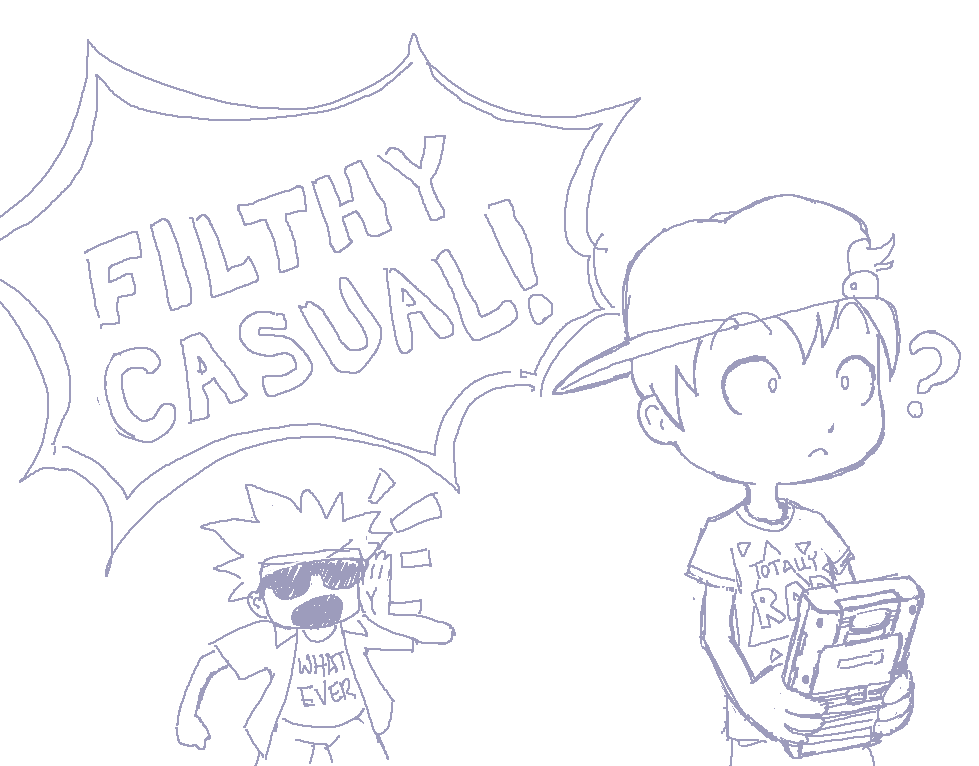
The only issue I see with the study is that it doesn't differentiate age and gender by categories. Really, the two categories necessary are already included elsewhere in the study: casual/social media games and core games. What I mean by core games are the type that are played on a dedicated console or a PC that needs higher specifications than being able to run Flash or HTML5 and Facebook. The only exception to the console rule might be light party or puzzle games on the Wii or XBLA or the PSN (I tend to use Mario Party as the gold bar: if it's lighter than Mario Party then it's a casual game in my eyes). Before I say anything else, the significance of these has nothing to do with the validity of casual games as an entertainment medium. 40-somethings who can't get enough Candy Crush are no less valid than someone dumping hours into Dota 2 or eagerly awaiting Watch Dogs. There is a difference, however, in how they relate to the treatment of women in video games. To me, the "dudebro demographic" is probably a wildcard so I'll leave it out for the sake of argument.
While puzzle games tend to have no plot as they really don't need them, even the games that you do describe as having plot, like Angry Birds, are mostly excuse plots to justify the game's premise. The pigs stole the birds' picnic baskets, so they need to get them back by catapulting at their forts. Basic enough, the story is non-intrusive and contributes to a pick-up-and-play style of gameplay. The hallmark of most successful traditional casual games are that they are particularly pick-up-and-play, and having a deep narrative with engaging characters and winding plot points would unfortunately serve to diminish the pick-up-and-play experience. Sure, it'd draw people in and such and there's no reason that telling a good story would ever be bad, but it takes away from the portability of it.
The engaging story and engaging characters would serve to make a player want to sit down and play it for longer even if the gameplay isn't particularly complex, just to see what happens next. However, it would alienate a lot of the newfound audience who is too busy to make that committment or otherwise would get the story in bite-size amounts and lose meaning along the way. It's much like people I know who find a good book: if they really like it, they won't put it down. On the other hand, if they put it down they won't find as much meaning in it as someone who sat down and read it in a few shots. Animal Crossing is definitely a different beast, but the story is more or less what you make of it rather than a direct narrative, and you can do whatever you want short of whacking Tom Nook to get out of debt. And it's definitely a strong case because the empowerment comes from what you make of yourself. Plus it's addictive as hell...
Now, that's not a bad thing at all. The pick-up-and-play style and the simplicity of the games have drawn in an older crowd and a more diverse crowd gender-wise. However, there has not been much crossover between folks introduced to casual games and the core gaming market. The Wii is a good experiment in this regard. When it first showed up on the market, a lot of folks, old and young, female and male, bought into the system and were interested in the variation in gameplay that could revolutionize the industry. However, there really was no gateway from folks introduced to casual games and what would be considered core games. With the exception of Nintendo's first-party titles, the core games on the system really didn't do that well. No More Heroes did fairly well in the U.S. and Europe, but No More Heroes 2 tanked sales-wise. Madworld tanked saleswise. Okami, despite being a really awesome game, didn't get the sales to back up the hype. Hell, take a look at the Wii's bestselling games list:
http://en.wikipedia.org/wiki/List_of_best-selling_Wii_video_games
The point that I'm trying to make is that unfortunately, the strong female demographic being introduced to casual games isn't likely going to make the jump to core gaming anytime soon. I'm sure that it's happening in some respects, and I know that I like sitting down and playing games on my phone from time to time, but still. I think the numbers aren't painting the whole picture. And again, this is nothing ill-willed against casual gamers at all. This is just for the sake of argument for where the issue of female representation in games is. Before the accessibility of Facebook and the iPhone in '07 allowed for these games to start blooming, the ESA Essential Facts for 2006 showed that then, the gender ratio was 62/38 male to female. As the ratio has decreased to 52/48 this year, the bracket of women over 50 has skyrocketed by 32% over the last year. There has to be a correlation there considering how the casual games market has skyrocketed. Here's the link:
http://www.theesa.com/facts/pdfs/ESA_EF_2006.pdf
As much as I really, really, really wish you could prove me wrong on this (no, I'm dead serious on this, I've grown up with games on the mindset that it was a men's club and I'd love to be proven wrong), I still get the impression that there are quite a few less women out there playing core games in comparison to men. I know I'm not the only one with this sentiment though. Whether this is actually right or not, and I hope it's not, probably influences developers. Perhaps it's a common knowledge argument where the common knowledge isn't actually right. And the main issue with treatment of women in video games tends to come from ones with at least attempts at bigger stories or that are at least less lighthearted than the usual casual games.
I've really noticed though, that with the exception of armor sometimes being skimpier, the best instances of female inclusion tend to come from when there was an option to have a female character or a male character. That way, you catch men who only identify with male characters, females who best identify with other female characters, and those who like playing as both. Personally, I still think Mass Effect has the best way of handling the male and female option, as it allows you to have the complex player character who isn't voiceless but allows you to keep the player character customization that makes everyone happy. That said, Jennifer Hale does a much better job voice acting FemShep than the guy who does MaleShep. Another great example of someone everyone identifies with is Samus pre-Other M. But I already said what I had to say about that earlier. Seriously though, I firmly believe that the Mass Effect path would be the best way of bridging that gap between female players and male players in terms of the identifying with characters argument that gets thrown around a lot. It would involve a bit bigger budget for both voice actors at worst, and it allows developers to not have to compromise. The female character still has to fill the same shoes as the male character so their character isn't diminished in any way, and onyone who wants to play as a male character isn't going to feel shortchanged, as stupid as that sounds. Options are never a bad thing, unless you have to do both options to get a true ending or something which would defeat the purpose...