By Greg Kim
Seattle Times staff reporter
March 23, 2026 at 6:00 am

High-voltage transmission lines are seen from Newhalem, Whatcom County, in the foothills of the North Cascades. In recent years, utilities across the state — including Seattle City Light, PSE, Snohomish County PUD and Tacoma Power — have introduced one or more “demand response” programs to incentivize customers to shift their electricity use by a few hours. (Karen Ducey / The Seattle Times, 2024)
At 6 p.m. on a recent chilly Tuesday, Jim Sullivan’s thermostat in his Maple Valley home automatically turned down to 60 degrees — not because he set it, but because his utility adjusted it down 4 degrees during a “rush hour” event of high energy demand.
In recent years, utilities across the state — including Seattle City Light, PSE, Snohomish County PUD and Tacoma Power — have introduced one or more “demand response” programs like this that incentivize customers to shift their electricity use by a few hours.
Remotely controlled thermostats like Sullivan’s. Water heaters that warm up before people get home from work. Electric vehicles set to charge at night. Home batteries that supply power to the grid in certain hours. Variable rates for electricity.

Maple Valley resident Jim Sullivan';s thermostat automatically adjusted to 60 degrees during a recent "rush hour" event, four degrees lower than he had it set. Utilities, facing pressure over rising rates and affordability concerns, are asking customers to help them manage the costs of increasingly expensive spikes by using less at certain times. (Courtesy of Jim Sullivan)
Their proliferation reflects just how thin the margins between supply and demand for power in the Pacific Northwest have become.
For most of the state’s history, Washingtonians never had to be stingy with their electricity use. But Washington’s hydropower dams are “pretty much tapped out.”
Within the broader risk of an energy shortage, there’s another more nuanced story. Both the supply and demand of electricity are getting spikier — the peaks and valleys of usage and generation spreading further apart — and that could upend the economics of delivering power.
Utilities, facing pressure over rising rates and affordability concerns, are asking customers to help them manage the costs of increasingly expensive spikes by using less at certain times.
Demand response programs can’t solve the broader problem of needing more electricity overall, but experts say even small reductions during peaks can significantly reduce costs.
But utilities will have to navigate a tricky balancing act — cutting costs as much as they can without upsetting customers who expect control over their switches.

Snow builds up on power lines in Burien earlier this month. Utilities are worried about costs surging even higher as the Northwest faces an energy shortage during extreme conditions starting this year, forecast to get significantly worse by 2030. (Ellen M. Banner / The Seattle Times)
On the other end of the equation, clean energy mandates are replacing the steady hum of greenhouse gas emitting power plants with renewables like wind and solar, often called “intermittent” resources in the utility industry because they come and go.
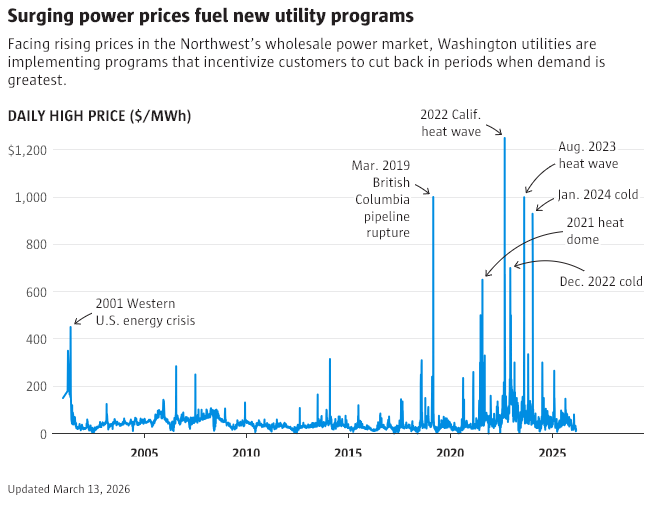
Making matters worse, peaks in demand can coincide with dips in supply.
Take Martin Luther King Jr. Day weekend in 2024, when millions of homes in the Pacific Northwest turned up the heat all at once during a severe cold snap. More than ever, they used electric heat pumps instead of gas furnaces. At the same time, wind power dropped to a near-standstill, which can often happen during extremely hot or cold high-pressure systems.
The region’s utilities didn’t have the power on hand so they bought it from other places like Canada and the Southwestern United States. With so much competition, prices surged to around $1,000 per megawatt hour, more than 10 times normal levels.
Events like this used to be rare. Not anymore.
Utilities are worried about costs surging even higher as the Northwest faces an energy shortage during extreme conditions starting this year, forecast to get significantly worse by 2030, partly driven by the rapid build-out of data centers.
If successful, City Light could theoretically save about $50,000 per hour and PSE $500,000 per hour if those reductions resulted in buying that much less wholesale power during the most expensive periods. Those estimates are under the most extreme conditions and doesn’t include incentivization costs.
Daniel Kirschen, an energy market expert at the University of Washington, said demand response programs can both reduce the power utilities have to buy and lower wholesale electricity prices overall, somewhat dramatically.
Utilities can also potentially avoid or delay building new infrastructure and power generation that sits unused for all but a few days out of the year.
All but two of the 70 people who responded to a recent Seattle Times questionnaire who had tried demand response programs or time-of-use rates said they supported them. The financial incentives were negligible, many said, but they wanted to chip in on sustainability efforts.
“Maybe you can reduce the amount of energy that society needs to generate. And if it means that I might be a little hot some days, OK,” Sullivan said.
Utilities aren’t yet close to getting a critical mass of customers to sign up and stay enrolled. Less than 10% of PSE customers have opted into incentivized programs, less than a fifth of the way to its target.
During a Seattle City Light pilot of a remote thermostat program, people overrode their temperature in about 20% of events, and 15% of people disenrolled altogether, although half were because they moved. The utility said 94% of participants surveyed at the end said they were satisfied or very satisfied.
Tacoma Power said it received very few complaints while it ran a pilot program in 2022 that remotely warmed up people’s water heaters an hour or two before they returned home from their commutes. But a report produced by the utility showed a third of customers who volunteered to participate opted out in the second year.
Setting electric vehicles to charge at night can be one of the most impactful ways for individuals to help the grid, and demand response programs pay customers to do so. But many customers say there aren’t a lot of electricity uses that they can shift to other hours. And low-income people, who are more likely to work in person, may have more trouble making a shift.
That’s one reason Seattle City Light is keeping its time-of-use rates, which will charge different prices for electricity depending on the time, voluntary. Participants will pay 16.7 cents per kilowatt-hour during peak hours between 5 p.m. to 9 p.m. versus 8.4 cents in off-peak hours from midnight to 6 a.m., which a pilot showed could save customers $144 per year compared to normal rates.
Some homeowners who are used to complete control over their appliances are steering clear of these programs altogether.
“I’m sorry, I just don’t want Big Brother or Puget Sound Energy deciding when I should be warm and when I should be cold because they can’t produce enough electricity,” said Alan Smith, a PSE customer in Skagit County.
Control is a delicate issue with demand response programs. Utilities need to know how much they can rely on reduced demand, especially in extreme conditions when both the financial stakes and the temptation to override limits are highest.
In Washington, most demand response programs and time-of-use rates are voluntary and easy to override. That’s not the case everywhere.
In Maryland, where the grid is at greater risk of brownouts and rolling blackouts, participants in one utility’s program are not allowed to override their air conditioner during emergency events and have a limited number of overrides during nonemergency events.
In Benton County, Washington, where two data center campuses are being proposed, all residential customers pay a “demand charge” — a fee based on their highest electricity use during peak hours — and can’t opt out. A Nevada utility is reportedly facing backlash from customers over a similar program.
Kurt Miller, executive director at the nonprofit Northwest Public Power Association, said while demand response works better with more utility control, utilities should be careful about making programs mandatory.
“We do have to know that people are sensitive about how much control a utility has over their stuff,” Miller said.
Source (Archive)
Seattle Times staff reporter
March 23, 2026 at 6:00 am
High-voltage transmission lines are seen from Newhalem, Whatcom County, in the foothills of the North Cascades. In recent years, utilities across the state — including Seattle City Light, PSE, Snohomish County PUD and Tacoma Power — have introduced one or more “demand response” programs to incentivize customers to shift their electricity use by a few hours. (Karen Ducey / The Seattle Times, 2024)
At 6 p.m. on a recent chilly Tuesday, Jim Sullivan’s thermostat in his Maple Valley home automatically turned down to 60 degrees — not because he set it, but because his utility adjusted it down 4 degrees during a “rush hour” event of high energy demand.
In recent years, utilities across the state — including Seattle City Light, PSE, Snohomish County PUD and Tacoma Power — have introduced one or more “demand response” programs like this that incentivize customers to shift their electricity use by a few hours.
Remotely controlled thermostats like Sullivan’s. Water heaters that warm up before people get home from work. Electric vehicles set to charge at night. Home batteries that supply power to the grid in certain hours. Variable rates for electricity.
Maple Valley resident Jim Sullivan';s thermostat automatically adjusted to 60 degrees during a recent "rush hour" event, four degrees lower than he had it set. Utilities, facing pressure over rising rates and affordability concerns, are asking customers to help them manage the costs of increasingly expensive spikes by using less at certain times. (Courtesy of Jim Sullivan)
Their proliferation reflects just how thin the margins between supply and demand for power in the Pacific Northwest have become.
For most of the state’s history, Washingtonians never had to be stingy with their electricity use. But Washington’s hydropower dams are “pretty much tapped out.”
Within the broader risk of an energy shortage, there’s another more nuanced story. Both the supply and demand of electricity are getting spikier — the peaks and valleys of usage and generation spreading further apart — and that could upend the economics of delivering power.
Utilities, facing pressure over rising rates and affordability concerns, are asking customers to help them manage the costs of increasingly expensive spikes by using less at certain times.
Demand response programs can’t solve the broader problem of needing more electricity overall, but experts say even small reductions during peaks can significantly reduce costs.
But utilities will have to navigate a tricky balancing act — cutting costs as much as they can without upsetting customers who expect control over their switches.
Snow builds up on power lines in Burien earlier this month. Utilities are worried about costs surging even higher as the Northwest faces an energy shortage during extreme conditions starting this year, forecast to get significantly worse by 2030. (Ellen M. Banner / The Seattle Times)
Why now?
Energy usage has always spiked in the morning hours before people go to work and in the evening when they come home. But now, more people are heating their homes with electric heat pumps, cooking with induction stoves and charging their vehicles after their commutes. Those can drive not only more overall demand, but higher peaks.On the other end of the equation, clean energy mandates are replacing the steady hum of greenhouse gas emitting power plants with renewables like wind and solar, often called “intermittent” resources in the utility industry because they come and go.
Making matters worse, peaks in demand can coincide with dips in supply.
Take Martin Luther King Jr. Day weekend in 2024, when millions of homes in the Pacific Northwest turned up the heat all at once during a severe cold snap. More than ever, they used electric heat pumps instead of gas furnaces. At the same time, wind power dropped to a near-standstill, which can often happen during extremely hot or cold high-pressure systems.
The region’s utilities didn’t have the power on hand so they bought it from other places like Canada and the Southwestern United States. With so much competition, prices surged to around $1,000 per megawatt hour, more than 10 times normal levels.
Events like this used to be rare. Not anymore.
Utilities are worried about costs surging even higher as the Northwest faces an energy shortage during extreme conditions starting this year, forecast to get significantly worse by 2030, partly driven by the rapid build-out of data centers.
How much could it save?
Through programs to reduce demand, Seattle City Light aims to cut its consumption by about 50 megawatts during peak hours, about 2.5% of its maximum load. State laws require investor-owned utilities like Puget Sound Energy to have programs that can reduce peak loads by 10%.If successful, City Light could theoretically save about $50,000 per hour and PSE $500,000 per hour if those reductions resulted in buying that much less wholesale power during the most expensive periods. Those estimates are under the most extreme conditions and doesn’t include incentivization costs.
Daniel Kirschen, an energy market expert at the University of Washington, said demand response programs can both reduce the power utilities have to buy and lower wholesale electricity prices overall, somewhat dramatically.
Utilities can also potentially avoid or delay building new infrastructure and power generation that sits unused for all but a few days out of the year.
How uncomfortable is it?
Sullivan said he hardly notices the effects of his thermostat adjusting automatically except for a few times a year in the summer when his home gets too hot.All but two of the 70 people who responded to a recent Seattle Times questionnaire who had tried demand response programs or time-of-use rates said they supported them. The financial incentives were negligible, many said, but they wanted to chip in on sustainability efforts.
“Maybe you can reduce the amount of energy that society needs to generate. And if it means that I might be a little hot some days, OK,” Sullivan said.
Utilities aren’t yet close to getting a critical mass of customers to sign up and stay enrolled. Less than 10% of PSE customers have opted into incentivized programs, less than a fifth of the way to its target.
During a Seattle City Light pilot of a remote thermostat program, people overrode their temperature in about 20% of events, and 15% of people disenrolled altogether, although half were because they moved. The utility said 94% of participants surveyed at the end said they were satisfied or very satisfied.
Tacoma Power said it received very few complaints while it ran a pilot program in 2022 that remotely warmed up people’s water heaters an hour or two before they returned home from their commutes. But a report produced by the utility showed a third of customers who volunteered to participate opted out in the second year.
Setting electric vehicles to charge at night can be one of the most impactful ways for individuals to help the grid, and demand response programs pay customers to do so. But many customers say there aren’t a lot of electricity uses that they can shift to other hours. And low-income people, who are more likely to work in person, may have more trouble making a shift.
That’s one reason Seattle City Light is keeping its time-of-use rates, which will charge different prices for electricity depending on the time, voluntary. Participants will pay 16.7 cents per kilowatt-hour during peak hours between 5 p.m. to 9 p.m. versus 8.4 cents in off-peak hours from midnight to 6 a.m., which a pilot showed could save customers $144 per year compared to normal rates.
Some homeowners who are used to complete control over their appliances are steering clear of these programs altogether.
“I’m sorry, I just don’t want Big Brother or Puget Sound Energy deciding when I should be warm and when I should be cold because they can’t produce enough electricity,” said Alan Smith, a PSE customer in Skagit County.
Voluntary or mandatory
All Sullivan has to do to override his thermostat during “rush hour” events is to hit the up button to increase the temperature. If he didn’t have this ability, it’d be a “nonstarter,” he said.Control is a delicate issue with demand response programs. Utilities need to know how much they can rely on reduced demand, especially in extreme conditions when both the financial stakes and the temptation to override limits are highest.
In Washington, most demand response programs and time-of-use rates are voluntary and easy to override. That’s not the case everywhere.
In Maryland, where the grid is at greater risk of brownouts and rolling blackouts, participants in one utility’s program are not allowed to override their air conditioner during emergency events and have a limited number of overrides during nonemergency events.
In Benton County, Washington, where two data center campuses are being proposed, all residential customers pay a “demand charge” — a fee based on their highest electricity use during peak hours — and can’t opt out. A Nevada utility is reportedly facing backlash from customers over a similar program.
Kurt Miller, executive director at the nonprofit Northwest Public Power Association, said while demand response works better with more utility control, utilities should be careful about making programs mandatory.
“We do have to know that people are sensitive about how much control a utility has over their stuff,” Miller said.
Source (Archive)


