Link (Archive)

Learning about racism and the long legacy of violence towards black, brown, and indigenous people has greatly shaped the person I am today. I’ve learned about segregation, enslavement, the Jim Crow era, medical experiments, colonization, American Indian boarding schools, policing, mass incarceration, racist immigration policies, the school-to-prison pipeline, institutional racism, and so much more that I can’t just unlearn. The scholarly activist Ibram X. Kendi has also deeply inspired me to practice and think about antiracism. I know that this world and my country have a long, deep history of racism, and to this day, racism is a reality for many, even if not so explicitly seen by everyone.
Practicing antiracism became an integral part of how I navigated the world. I questioned power. I stood against injustice. But eventually, I had to confront something uncomfortable: despite my commitment to justice, I was still participating in another form of violence, one I hadn’t fully examined. Speciesism
I had never truly stopped to think about the systems that normalize violence against nonhuman animals, how we breed them, confine them, kill them, and call it culture, tradition, or necessity. I realized that the same logic I fought against in the context of race, domination, commodification, and entitlement to another’s body was also present in the way society treats animals.
That’s what led me to veganism and animal rights advocacy. Not out of health trends or purity politics, but out of a desire to live in alignment with the values that already shaped my worldview. If I believe in justice, if I believe in protecting the vulnerable, if I believe no one should suffer for someone else’s comfort, then how could I justify the everyday violence of animal agriculture and just everyday animal practices such as the testing of cosmetics and household cleaning products on animals, cruel testing for medicine, dog fighting and other animal sports, hunting, zoos, circuses, and animal entertainment venues like seaworld, and so much more.
That realization changed everything. I can no longer unsee that cruelty that animals face, and I can no longer separate it from the horrors that human beings also have to face due to continued racism. That’s what this article is about, it’s about asking and challenging those who practice antiracism to open their hearts beyond the boundaries of species, to those who don’t look like us, speak our language, or walk on two legs, and recognize that the fight against oppression doesn’t end with human liberation.
Environmental Racism & Speciesism
One of the most significant intersections of speciesism and racism is through the animal agriculture industry. The speciesist system of factory farms creates environmental racism.
These mega farms where animals are slaughtered to become your food are often placed right near poor, black, and brown communities, polluting their water, ground, and air. These industries directly affect the health of many poor BIPOC communities causing daily living, stress, anxiety, mucous membrane irritation, respiratory conditions, reduced lung function, and acute blood pressure elevation. Additionally, these institutions partake in labor exploitation, and many of those exploited workers are BIPOC, immigrants & refugees, as well as undocumented. Lastly, and no less important, animal-based diets harm many people, especially those in the Black American community.
Housing Insecurity & Pet Policing
Poor communities, and thus many BIPOC communities, are punished due to speciesist pet policies. Breed restrictions, pet deposits, and expensive pet-friendly housing make housing less affordable and accessible to those below the poverty line. Additionally, pet food and veterinary costs are among the primary reasons people have to give up their pets. As many of us antiracists know, classism and racism are essentially inseparable, as redlining and segregation have created disproportionate poverty and low income levels for black and brown people. And thus these issues of poverty and speciesist policies are indeed connected with racism.
There’s also racism involved in breed-specific legislation. Breed-specific legislation that bans or restricts the ownership of dogs such as pitbulls has links to racist rhetoric. Thus, prohibition has been linked to a desire to limit black people’s and Latinos’ access to white communities. The correlationsof black stereotyping and pitbull stereotyping are many, including the idea that both are dangerous, violent, and predatory.
Barriers in Veterinary Care
As already stated, the high costs of veterinary care impact poor people and, thus, disproportionately many people of color. But even when one does go to the vet to provide care for their pets, it’s not unexpected to experience racism, prejudice, and bias. And also not surprising, as it is one of the whitest industries to exist within the US, where over 90%of veterinarians are white. Some of this can even be linked to systemic racism, such as the lack of promotion of the veterinary field to young BIPOC students and the lack of access to veterinary clinics (veterinary care deserts), which is crucial, as many top vet schools require applicants to have experience with animals.
The complicated history of mistrust between BIPOC people and health professionals, the biases and prejudice, microaggressions, lack of diversity, and lack of access and care thus create an intersection that has an impact on not only poor and BIPOC communities but also the animals they care for.
Racialized Animal Cruelty Enforcement
Cultural practices by BIPOC communities have also been heavily policed and stigmatized while ignoring dominant practices. Asians for decades have experienced racism through unfair targeting of their food practices, such as live markets and consumption of certain animals, through rhetoric and unfair criticism that Asians cruelly mistreat animals, eat disgusting animals, or are spreaders of zoonotic diseases. Despite the fact that dominant food cultures, such as those found in factory farms, are just as cruel and also spread zoonotic diseases. Halal and Kosher food practiceshave also faced unjust discrimination, such as racist, Islamophobic, and antisemitic microaggressions, and also bans in Europe for being more “cruel” despite once again the lack of attention to dominant food slaughter practices in Western animal agriculture industries.
Dog meat consumption, cockfighting, Spanish-style bull fighting, Mexican horse tripping, indigenous whaling, and many other animal cultural practices are vilified by animal rights activists and animal lovers in general, whilst dominant practices like factory farming, hunting, rodeos, dog & horse racing, or SeaWorld are normalized or celebrated.
I’m not arguing that cultural practices involving animal cruelty should be immune from critique. But the way we critique matters. If we only target marginalized communities while ignoring systemic violence in dominant (often white) cultural norms, then we’re not advancing animal justice; we’re reinforcing racial hierarchies.
Science was used with pseudoscience to justify racism, likening black, indigenous, and asians to nonhuman animals such as monkeys and apes. Racialized minorities have been discriminated against and oppressed through false scientific ideas such as a lack of intelligence, language, and capacity. However, the cruel treatment of animals and thus domination and their oppression has also been likened to scientific and philosophical ideas of lacking language, intelligence, and capacity.
Animalization and racist discourse also work in two directions: it’s used to strip racialized people of their humanity by comparing them to animals, and it reinforces the idea that animals themselves are inferior, violent, or undeserving of moral consideration. Racist language such as vermin, invaders, and rats has been used on immigrants, Jewish people, and Palestinians, while these terms have been used to legitimize the extermination of “pest” animals. Enslaved Africans were described as brutes and beasts of burden, justifying their status as property, similarly to how domestic animals are also legally considered property and thus exploited and killed.
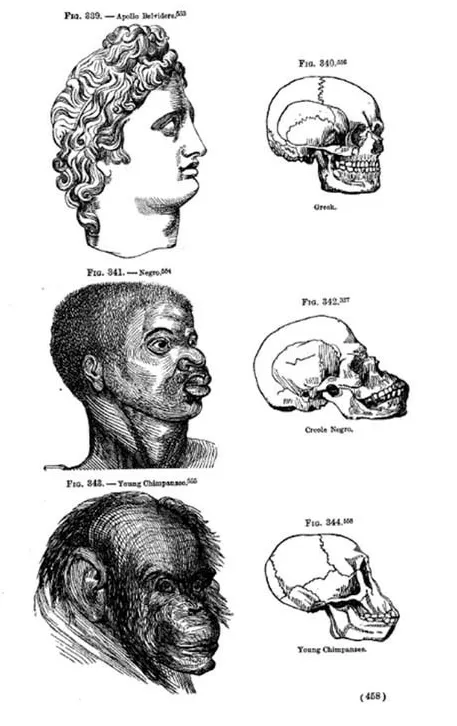
This image above, which was used by white supremacists who ranked socially constructed races, used animals as a parallel. So we can’t say that racism and animal speciesism are separate. As it’s clear here that black people were ranked below white people, and the animal, in this case, an ape, was below a black man. Such ranking of humans and animals is likened to the great chain of being where there was a linear hierarchy between humans, animals, races, plants, etc
I encourage you, antiracist readers, to reflect on what I had to myself, “how could I fight for justice for people who look like me, while still supporting the exploitation of those who don’t, even when they have feathers, fur, or scales? Antiracism is most definitely about justice, but it also involves empathy. Our empathy and justice should not stop at the boundaries of species. Let this be a call to dismantle every structure that orders our world into categories of “more than” or “less than.” Only through genuine intersectional care can we build a future where all sentient beings are seen, heard, and valued. This is what I call SentiJustice, justice for all sentient beings, human and nonhuman alike. Antiracism thus must include Antispeciesism.
Why Antiracists Should Care About Animal Justice
The Injustice I Couldn’t Unsee
I eat vegan because I’m black.Learning about racism and the long legacy of violence towards black, brown, and indigenous people has greatly shaped the person I am today. I’ve learned about segregation, enslavement, the Jim Crow era, medical experiments, colonization, American Indian boarding schools, policing, mass incarceration, racist immigration policies, the school-to-prison pipeline, institutional racism, and so much more that I can’t just unlearn. The scholarly activist Ibram X. Kendi has also deeply inspired me to practice and think about antiracism. I know that this world and my country have a long, deep history of racism, and to this day, racism is a reality for many, even if not so explicitly seen by everyone.
Practicing antiracism became an integral part of how I navigated the world. I questioned power. I stood against injustice. But eventually, I had to confront something uncomfortable: despite my commitment to justice, I was still participating in another form of violence, one I hadn’t fully examined. Speciesism
I had never truly stopped to think about the systems that normalize violence against nonhuman animals, how we breed them, confine them, kill them, and call it culture, tradition, or necessity. I realized that the same logic I fought against in the context of race, domination, commodification, and entitlement to another’s body was also present in the way society treats animals.
That’s what led me to veganism and animal rights advocacy. Not out of health trends or purity politics, but out of a desire to live in alignment with the values that already shaped my worldview. If I believe in justice, if I believe in protecting the vulnerable, if I believe no one should suffer for someone else’s comfort, then how could I justify the everyday violence of animal agriculture and just everyday animal practices such as the testing of cosmetics and household cleaning products on animals, cruel testing for medicine, dog fighting and other animal sports, hunting, zoos, circuses, and animal entertainment venues like seaworld, and so much more.
That realization changed everything. I can no longer unsee that cruelty that animals face, and I can no longer separate it from the horrors that human beings also have to face due to continued racism. That’s what this article is about, it’s about asking and challenging those who practice antiracism to open their hearts beyond the boundaries of species, to those who don’t look like us, speak our language, or walk on two legs, and recognize that the fight against oppression doesn’t end with human liberation.
Shared Logics of Domination
Speciesism, as I define it, is a network of powers that creates, upholds, and promotes injustice between and within sentient nonhuman animals. Speciesism, like racism, goes beyond prejudice; it’s about power and also creating hierarchies of moral worth and ultimately domination and oppression. If we care about justice, we have to examine how speciesism and racism work together to uphold oppression, especially in the everyday systems that affect both humans and animals.Environmental Racism & Speciesism
One of the most significant intersections of speciesism and racism is through the animal agriculture industry. The speciesist system of factory farms creates environmental racism.
These mega farms where animals are slaughtered to become your food are often placed right near poor, black, and brown communities, polluting their water, ground, and air. These industries directly affect the health of many poor BIPOC communities causing daily living, stress, anxiety, mucous membrane irritation, respiratory conditions, reduced lung function, and acute blood pressure elevation. Additionally, these institutions partake in labor exploitation, and many of those exploited workers are BIPOC, immigrants & refugees, as well as undocumented. Lastly, and no less important, animal-based diets harm many people, especially those in the Black American community.
Housing Insecurity & Pet Policing
Poor communities, and thus many BIPOC communities, are punished due to speciesist pet policies. Breed restrictions, pet deposits, and expensive pet-friendly housing make housing less affordable and accessible to those below the poverty line. Additionally, pet food and veterinary costs are among the primary reasons people have to give up their pets. As many of us antiracists know, classism and racism are essentially inseparable, as redlining and segregation have created disproportionate poverty and low income levels for black and brown people. And thus these issues of poverty and speciesist policies are indeed connected with racism.
There’s also racism involved in breed-specific legislation. Breed-specific legislation that bans or restricts the ownership of dogs such as pitbulls has links to racist rhetoric. Thus, prohibition has been linked to a desire to limit black people’s and Latinos’ access to white communities. The correlationsof black stereotyping and pitbull stereotyping are many, including the idea that both are dangerous, violent, and predatory.
Barriers in Veterinary Care
As already stated, the high costs of veterinary care impact poor people and, thus, disproportionately many people of color. But even when one does go to the vet to provide care for their pets, it’s not unexpected to experience racism, prejudice, and bias. And also not surprising, as it is one of the whitest industries to exist within the US, where over 90%of veterinarians are white. Some of this can even be linked to systemic racism, such as the lack of promotion of the veterinary field to young BIPOC students and the lack of access to veterinary clinics (veterinary care deserts), which is crucial, as many top vet schools require applicants to have experience with animals.
The complicated history of mistrust between BIPOC people and health professionals, the biases and prejudice, microaggressions, lack of diversity, and lack of access and care thus create an intersection that has an impact on not only poor and BIPOC communities but also the animals they care for.
Racialized Animal Cruelty Enforcement
Cultural practices by BIPOC communities have also been heavily policed and stigmatized while ignoring dominant practices. Asians for decades have experienced racism through unfair targeting of their food practices, such as live markets and consumption of certain animals, through rhetoric and unfair criticism that Asians cruelly mistreat animals, eat disgusting animals, or are spreaders of zoonotic diseases. Despite the fact that dominant food cultures, such as those found in factory farms, are just as cruel and also spread zoonotic diseases. Halal and Kosher food practiceshave also faced unjust discrimination, such as racist, Islamophobic, and antisemitic microaggressions, and also bans in Europe for being more “cruel” despite once again the lack of attention to dominant food slaughter practices in Western animal agriculture industries.
Dog meat consumption, cockfighting, Spanish-style bull fighting, Mexican horse tripping, indigenous whaling, and many other animal cultural practices are vilified by animal rights activists and animal lovers in general, whilst dominant practices like factory farming, hunting, rodeos, dog & horse racing, or SeaWorld are normalized or celebrated.
I’m not arguing that cultural practices involving animal cruelty should be immune from critique. But the way we critique matters. If we only target marginalized communities while ignoring systemic violence in dominant (often white) cultural norms, then we’re not advancing animal justice; we’re reinforcing racial hierarchies.
Who Gets to Matter
Speaking of hierarchies, at the core of both racism and speciesism is the construction of hierarchies, the ranking of lives based on arbitrary traits like race, species, intelligence, or proximity to whiteness and “civilization.”Science was used with pseudoscience to justify racism, likening black, indigenous, and asians to nonhuman animals such as monkeys and apes. Racialized minorities have been discriminated against and oppressed through false scientific ideas such as a lack of intelligence, language, and capacity. However, the cruel treatment of animals and thus domination and their oppression has also been likened to scientific and philosophical ideas of lacking language, intelligence, and capacity.
Animalization and racist discourse also work in two directions: it’s used to strip racialized people of their humanity by comparing them to animals, and it reinforces the idea that animals themselves are inferior, violent, or undeserving of moral consideration. Racist language such as vermin, invaders, and rats has been used on immigrants, Jewish people, and Palestinians, while these terms have been used to legitimize the extermination of “pest” animals. Enslaved Africans were described as brutes and beasts of burden, justifying their status as property, similarly to how domestic animals are also legally considered property and thus exploited and killed.
This image above, which was used by white supremacists who ranked socially constructed races, used animals as a parallel. So we can’t say that racism and animal speciesism are separate. As it’s clear here that black people were ranked below white people, and the animal, in this case, an ape, was below a black man. Such ranking of humans and animals is likened to the great chain of being where there was a linear hierarchy between humans, animals, races, plants, etc
Justice Without Boundaries
What some of these examples show is that racism is very much connected to speciesism. From material systems of oppression to ideology, racialized people and nonhuman animals face similar forms of oppression, and both racism and speciesism intersect in numerous ways. And thus, with an understanding of oppression being interconnected, our advocacy and justice must be as well.I encourage you, antiracist readers, to reflect on what I had to myself, “how could I fight for justice for people who look like me, while still supporting the exploitation of those who don’t, even when they have feathers, fur, or scales? Antiracism is most definitely about justice, but it also involves empathy. Our empathy and justice should not stop at the boundaries of species. Let this be a call to dismantle every structure that orders our world into categories of “more than” or “less than.” Only through genuine intersectional care can we build a future where all sentient beings are seen, heard, and valued. This is what I call SentiJustice, justice for all sentient beings, human and nonhuman alike. Antiracism thus must include Antispeciesism.
Última edición:


