Link (Archive)
In queer spaces, “bear” has historically been used to refer to gay and bisexual men who are hairy, fat, and sometimes muscular or big-bellied. Offering an alternative to the thin beauty standard often set for queer men, “bear” is a term of endearment used to celebrate body hair, body diversity, and the irreverent typification of gay male dating categories. Like many LGBTQ+ terms, as our conceptions of gender, sexuality, and identity broadly have expanded, so has the bear. In the present day, nonbinary bears, trans bears, and lesbian bears are all wrapped in the tight “bear hug” that makes up the umbrella term.
To learn more about the rich history behind the gay bear subculture alive and well today, read on.
“Bears are usually hunky, chunky types reminiscent of railroad engineers and former football greats,” Mazzei wrote, accompanied by a cartoon illustration of an anthropomorphic bear with a mustache and leather jacket. While the same article detailed other queer creatures in the gay animal kingdom, “bear” is by far the term that went on to have the most enduring life in the popular queer lexicon.
There has, however, been some debate about where the term comes from outside of print, as with many queer intracommunal terms. Some attribute the popularity of “bear” to Bear Magazine, a print publication founded in 1987 by Chris Nelson and Richard Bulger that celebrates bears to this day. The periodical featured images of hot bears and lifestyle articles on bear organizations, parties, and gatherings. But while this magazine literally has “bear” in its title, that still doesn’t answer the question of how the term was popularized in queer spaces and beyond.
While it’s hard to pin down the exact catalyst for what made the term explode, historian, researcher, and professor Les K. Wright points to the mid-1980s and HIV/AIDS epidemic as the birth of the gay bear community we know today.
“The AIDS epidemic was raging – heavier bodies became eroticized, replacing the slender clone ideal,” Wright tells Bear World Magazine.“Bearish men had typically been banned from bathhouses and sex clubs. When the bathhouses were shut down, private sex groups formed, and these men continued to exclude bearish men.”
Because bears had generally been alienated from mainstream gay spaces and beauty standards, bears needed to form their own spaces, founded on the basis of acceptance. This need for accepting community exploded into gatherings where fellow bearish men could meet each other, such as Bear Hug play parties, bear biker clubs, and leather spaces. In his 1997 book, The Bear Book: Readings in the History and Evolution of a Gay Male Subculture, Wright outlines the origins of gay bear identity from this period of time, along with the unexpected factors that shaped the subculture such as “radical lesbianism’s impact.” It’s this wealth of historical knowledge that grounds the bear community today; Cornell University even hosts Wright’s Bear History Project, a living historical archive that continues to be added to date.
Nowadays, bears have a robust party circuit and strong lineup of community events around the world, from Provincetown Bear Week to Bearracuda Chicago to a slew of bear-specific cruises (the boat kind, not the other kind).
Like “twink,” the term has both grown to include different kinds of people and also generated exclusivity based on physical characteristics. The bear community isn’t without such conflict — the early 2000s saw a cultural moment referred to as the “Bears Wars” due to a rift between muscle bears and other bears — but bear spaces rest on a foundation of inclusion as a result of exclusion elsewhere.
“Individuals need to know there is a safe space for them, especially in the bear community,” Xolani Easterwood recently told Bear World Magazine. “It’s not just lumberjacks, jocks, and muscles there. There are fem individuals who just want to be seen and loved, not shunned away.”
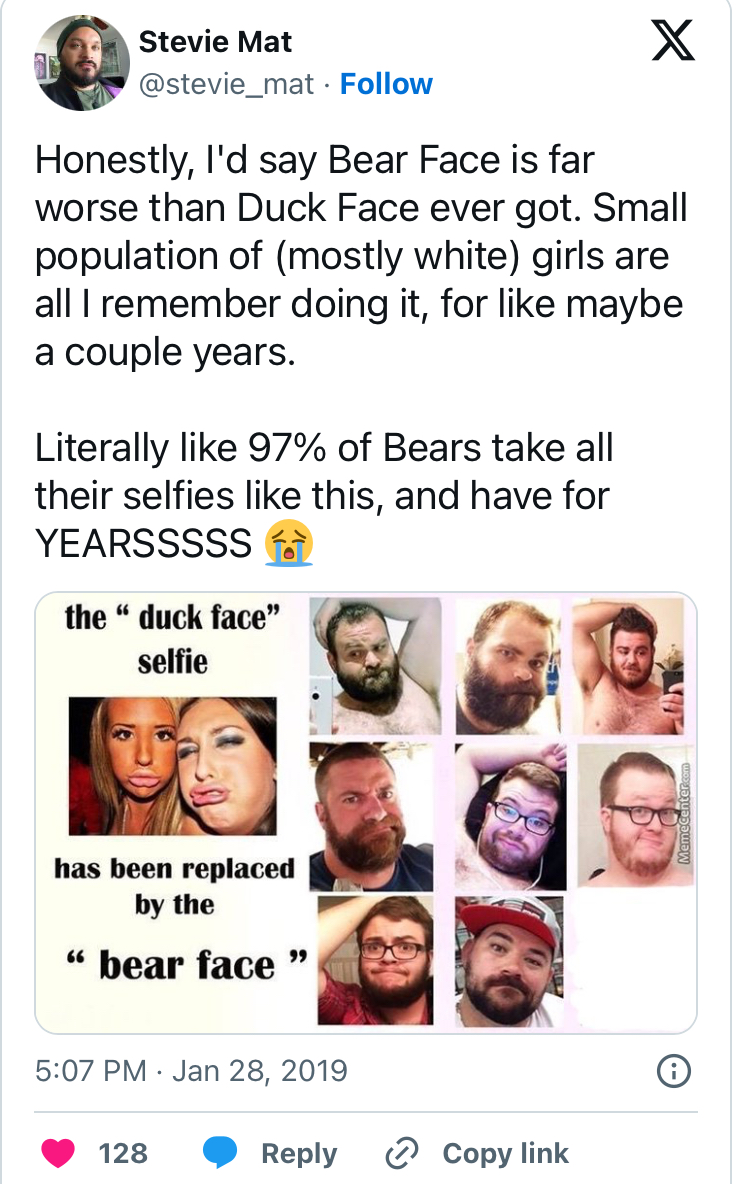
In short, “bear face” or “the bear smirk” is a comedic term used in meme culture to describe a common way in which gay bears smile when they take selfies. It’s a half-smile of sorts that ends in a demure smirk that many people anecdotally say is how bears take photos. If you’re having trouble picturing it, think about the shape of the Amazon logo.
What is a “Bear,” in the Gay Sense?
When you think about a gay bear, some immediate cultural figures might come to mind, like Daniel Franzese in Looking or Spongebob’s Patrick Star. (No? Just me?)In queer spaces, “bear” has historically been used to refer to gay and bisexual men who are hairy, fat, and sometimes muscular or big-bellied. Offering an alternative to the thin beauty standard often set for queer men, “bear” is a term of endearment used to celebrate body hair, body diversity, and the irreverent typification of gay male dating categories. Like many LGBTQ+ terms, as our conceptions of gender, sexuality, and identity broadly have expanded, so has the bear. In the present day, nonbinary bears, trans bears, and lesbian bears are all wrapped in the tight “bear hug” that makes up the umbrella term.
To learn more about the rich history behind the gay bear subculture alive and well today, read on.
What is a bear, and who can use the term?
While “bear” has generally been used to describe queer men who are hairy, fat, and sometimes muscular or big-bellied, the term has since expanded to refer to a variety of people who find kinship within the subculture in relation to their physical appearance. Within the bear umbrella, there are an array of subcategories people use to describe themselves from “cubs” (younger or shorter bears) to “otters” (hairy guys with less body fat) to “muscle bears” (bears with a muscular frame). These days, transmasc bears, transfemme bears, nonbinary bears, and lesbian bears all fall under the bear subculture if they feel it fits them.Where did the term “bear” originate?
Though the exact origins of the term are murky, the first written mentions of gay “bears”occurred as early as 1966 in the meeting minutes of a Los Angeles dance club called the Satyrs, which described the existence of a “bear club” within its walls. The LGBTQ+ publication The Advocate claims that writer George Mazzei coined the term in a 1979 article for the publication titled, “Who’s Who at the Zoo,” which described different gay archetypes in detail, including bears.“Bears are usually hunky, chunky types reminiscent of railroad engineers and former football greats,” Mazzei wrote, accompanied by a cartoon illustration of an anthropomorphic bear with a mustache and leather jacket. While the same article detailed other queer creatures in the gay animal kingdom, “bear” is by far the term that went on to have the most enduring life in the popular queer lexicon.
There has, however, been some debate about where the term comes from outside of print, as with many queer intracommunal terms. Some attribute the popularity of “bear” to Bear Magazine, a print publication founded in 1987 by Chris Nelson and Richard Bulger that celebrates bears to this day. The periodical featured images of hot bears and lifestyle articles on bear organizations, parties, and gatherings. But while this magazine literally has “bear” in its title, that still doesn’t answer the question of how the term was popularized in queer spaces and beyond.
While it’s hard to pin down the exact catalyst for what made the term explode, historian, researcher, and professor Les K. Wright points to the mid-1980s and HIV/AIDS epidemic as the birth of the gay bear community we know today.
“The AIDS epidemic was raging – heavier bodies became eroticized, replacing the slender clone ideal,” Wright tells Bear World Magazine.“Bearish men had typically been banned from bathhouses and sex clubs. When the bathhouses were shut down, private sex groups formed, and these men continued to exclude bearish men.”
Because bears had generally been alienated from mainstream gay spaces and beauty standards, bears needed to form their own spaces, founded on the basis of acceptance. This need for accepting community exploded into gatherings where fellow bearish men could meet each other, such as Bear Hug play parties, bear biker clubs, and leather spaces. In his 1997 book, The Bear Book: Readings in the History and Evolution of a Gay Male Subculture, Wright outlines the origins of gay bear identity from this period of time, along with the unexpected factors that shaped the subculture such as “radical lesbianism’s impact.” It’s this wealth of historical knowledge that grounds the bear community today; Cornell University even hosts Wright’s Bear History Project, a living historical archive that continues to be added to date.
Nowadays, bears have a robust party circuit and strong lineup of community events around the world, from Provincetown Bear Week to Bearracuda Chicago to a slew of bear-specific cruises (the boat kind, not the other kind).
How has the use of the term “bear” evolved over time?
Historically, “bear” has been used to refer to queer men who are fat, hairy, or both, however, the definition has expanded over the years to include trans people and more gender categories broadly. Even in the early days of the term, lesbian bears — playfully referred to as “Ursulas” — were included in conversations around the subculture.Like “twink,” the term has both grown to include different kinds of people and also generated exclusivity based on physical characteristics. The bear community isn’t without such conflict — the early 2000s saw a cultural moment referred to as the “Bears Wars” due to a rift between muscle bears and other bears — but bear spaces rest on a foundation of inclusion as a result of exclusion elsewhere.
“Individuals need to know there is a safe space for them, especially in the bear community,” Xolani Easterwood recently told Bear World Magazine. “It’s not just lumberjacks, jocks, and muscles there. There are fem individuals who just want to be seen and loved, not shunned away.”
What is the “bear smirk”?
In short, “bear face” or “the bear smirk” is a comedic term used in meme culture to describe a common way in which gay bears smile when they take selfies. It’s a half-smile of sorts that ends in a demure smirk that many people anecdotally say is how bears take photos. If you’re having trouble picturing it, think about the shape of the Amazon logo.


