L | A
By Loren Rosson
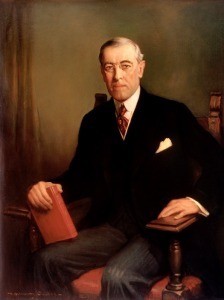
He’s known as one of the most hard-working visionary presidents in American history. He was also the very worst. Here’s the rundown of Wilson’s sins. They fall under his catastrophic global interventions, his domestic evils, and his utter contempt for African Americans, free speech, and liberty in general.
1. Peace (Foreign Policy)
In a sentence, Woodrow Wilson ruined the 20th century and beyond. If he had kept America out of World War I, the war would have ended sooner for the better of all involved… and history would have turned out very differently.
As early as December 1916, the Germans wanted peace talks, and Britain and France would have been forced to take the settlements if the U.S. had stayed out. They rejected the settlements because they expected the U.S. to enter on their side, and that’s what happened in April 1917. The war was an unnecessary mess and the worst act of political malpractice in history. It wasn’t the inevitable result of rival empires; it was caused directly by the Sarajevo assassination in 1914, which led to arbitrary and hot-headed decisions.
America, in any case, had little strategic stake in the war’s outcome. U.S. territory wasn’t threatened by an attack from Germany or its allies.
Wilson claimed a concern about Germany challenging Britain’s “benevolent” command of the seas, but Britain didn’t have a history of being benevolent to the U.S. to begin with and had sometimes posed security threats to America. But because Wilson fawned on Britain (saying famously that the U.S. president should be more like a legislative Prime Minister), he played favorites in violation of U.S. neutrality.
Prior to entering the war, he complained about illegal German U-boat attacks but never objected to the British naval blockade of Germany, which caused starvation, was against international law, and was certainly a war crime.
Wilson entered the war as part of his wider agenda to “sell” American values abroad, enlarge markets overseas, and leave a mark on global affairs. He succeeded in that aim with a vengeance. Not only did he lead America into a pointless slaughter and perpetuate it, the way he did so later caused the largest war in world history (World War II) and the longest war in American history (the Cold War):
National Socialism (World War II)
After the war, Wilson allowed France and Britain to impose the harsh peace on Germany and the unfair war-guilt clause (Article 231 of the Treaty of Versailles), when in fact both sides were equally to blame in starting the war (just as both sides violated U.S. neutrality prior to America’s entry in 1917).
The British hunger blockade continued starving the Germans long after the fighting stopped, and on top of other reparations, overpunished the Germans. Germany had to inflate their currency to pay their debts in devalued marks, causing a hyperinflation worse than in other nations.
German resentment over these injustices and humiliations led directly to the rise of Adolf Hitler. As if Wilson hadn’t done enough on this trajectory, he also pushed for the abdication of Kaiser Wilhelm II, who was a major obstacle in Hitler’s rise to power.
Communism (The Cold War)
During the war, Wilson helped the communists take power in Russia and then made them hate the U.S., thus paving the way for the Cold War that lasted over 40 years. Right after entering the war, he bribed the Provisional government (with $325 million) to remain in the war, which caused the Russian army to sympathize with the Bolsheviks — the only ones who wanted Russia to pull out of the war that most of the army and citizens didn’t want.
The Provisional government fell in the summer of 1917, and the Bolsheviks came to power on the waves of a radicalized population. If not for Wilson’s bribe, the Provisionals may well have survived, and Lenin would have been forgotten.
Lenin, Stalin, and Hitler — monsters all born of the president’s policies. “Wilson,” says Ivan Eland, “screwed up the entire twentieth century and beyond.” That’s not an unfair hindsight perspective, and it’s a lot to answer for.
Even aside from World War I and its calamitous aftermath, Wilson aggressively intervened elsewhere. He was in fact the most interventionist president in U.S. history. He invaded Mexico because, incredibly, a Mexican general refused to give a U.S. naval officer a twenty-one gun salute; the general had apologized to the naval officer for a minor infringement, but Wilson would settle for nothing less than the most formal of military honors; people ended up dying for his vanity.
He invaded Nicaragua in 1914, Haiti in 1915, the Dominican Republic in 1916, Cuba in 1917, Panama in 1918 — and on top of all that, Mexico again, nine other times. These invasions were justified by the propaganda of “spreading democracy” but really served neo-colonial interests like oil (in Mexico), collecting bank revenue (in Haiti and Cuba), and other greedy drives.
The occupation of Haiti not only killed many Haitians but made the country far less democratic, while the occupation of the Dominican Republic created a centralized military that future dictators would use to suppress the people. Wilson’s military offensives caused outrage among Americans, but over the years they have transformed into marks of merit, especially since World War II, when “nation building” abroad became increasingly (and astonishingly) hailed as progressive.
2. Prosperity (Domestic Policy)
Wilson downplayed the impact of the Spanish Flu and refused to implement extensive health measures that medical professionals were recommending that would help slow its spread. Between October 1918 and April 2020, 675,000 Americans were killed by the flu.
Wilson’s second domestic sin was almost as egregious: creating the Federal Reserve. He signed it into law to provide the country with a safer and more stable financial and monetary system. It often does the opposite. The Federal Reserve pinches the working class with perpetual inflation and cheap credit, excessively expands the money supply, devalues the nation’s currency, is responsible for routine bailouts, is unable to generate long-lasting economic recovery, and encourages deficit spending. It’s a century-long debate that still goes on.
I’m not an economist and can’t weigh in with a heavy hand, but I can observe the obvious trends. In the past century, America’s GDP (output) and economic performance have been no more stable, on the whole, than in the 18th and 19th centuries. We’ve had the Great Depression, the Great Recession, and other bad times that make the pre-Fed recessions look mild.
There was a period of strong prosperity in the twenties because the Fed was constrained by the gold standard and the hawkish budget policies of Harding and Coolidge. There was stability in the fifties under Eisenhower, thanks to his aversion to deficit spending. Carter’s appointment of budget-hawk Paul Volcker to the Fed led to the prosperity of the ’80s (not Reagan himself, who spent up the wazoo and caused the recession of 90-91) and to the renewed prosperity in the Clinton years.
It’s not hard to see that when the Federal Reserve is under fiscally conservative administrations (Harding, Coolidge, Eisenhower, Carter, Clinton), America’s economy does sustainably better. When the Fed is used liberally (Hoover, FDR, Bush, and Obama), it produces artificial short-term recovery at best. Bailouts, stimuli, federal deficits, and massive money printing only put off the day by creating another bubble.
It’s well known that Obama had the weakest economic recovery of any post-World War II president and the weakest recovery from any recession in history. His fans always say that his stimulus package “did good”, and it obviously did. But like Hoover’s jump-starts and FDR’s New Deal, it didn’t bring about a strong, sustainable recovery.
The reason Wilson created the Federal Reserve was because he wanted the government to rule the money system with an easy money supply. He got what he wanted, and America got the massive depression in 1929, which the Fed helped cause. This doesn’t mean that right-wing libertarians like Ron Paul are right in demanding that the Federal Reserve be abolished. My own opinion is that the Fed should be reformed, not abolished, as it’s become too enmeshed in our infrastructure to cut off entirely. But it shouldn’t have been created in the first place.
Congress had approved a national bank in 1791 (in Philadelphia), disapproved it in 1811, reapproved it in 1816, and then finally abolished it forever in 1836. By controlling the nation’s money supply, the federal banks had inevitably acquired too much power and gave wealthy or favored owners a large return for little risk, along with other problems. It’s a heavy strike against Wilson for reintroducing the idea.
3. Liberty
Even by early 20th century standards, Wilson was a hard-core white supremacist who tried (unsuccessfully) to get Congress to pass legislation to restrict the civil liberties of blacks.
He put whites in jobs that his Republican predecessors had given to blacks, and he encouraged some of his cabinet members to re-institute racial segregation in federal agencies. He vocally opposed a statement on racial equality in the document that governed the League of Nations. Racial violence escalated during his administration, along with lynchings, anti-black race riots, and of course the birth of the second Ku Klux Klan.
Wilson’s presidency was the worst time in U.S. history for anyone’s civil liberties. Conscription was resurrected from the Civil War: the Selective Service Act of 1917 authorized Wilson to draft men against their will. The Constitution doesn’t authorize a military draft, and the Thirteenth Amendment prohibits involuntary service. This act has never been repealed, and to this day American men are required to register for the draft.
The Espionage Act of 1917 made protests against the draft illegal, as well as criticism of American allies. The Sedition Act of 1918 clarified vague language in the Espionage Act and made any speech, spoken or in print, illegal if it was critical of the war effort or the aims of the government. Wilson used the post office and Justice Department to suppress free speech and ordered the War Department to censor all telegraph and telephone traffic.
He fined and imprisoned thousands for criticizing the war. Filmmaker Robert Goldstein got a ten-year sentence for producing a movie on the American Revolution that portrayed the now-allied British in a naturally bad light. Even two years after the war, in 1920, Wilson vetoed Congress’ repeal of the Espionage and Sedition Acts. He was the worst presidential threat to liberty. John Adams (during the Quasi-War with France) and Abraham Lincoln (during the Civil War) were atrocious too, but Wilson outdid even them.
There’s irony here, in light of America’s war enemy. Germany under Kaiser Wilhelm was more democratic than the United States under President Wilson. Germany provided the freedom to criticize the Kaiser, the rule of law, and due process if arrested. The German Kaiser had less power than the American president, and the Germans had far more leeway to criticize World War I than Americans had. The German empire didn’t use the repressive measures of the French and Belgian empires — or for that matter, the repressive measures of Woodrow Wilson.
Defenders of Wilson point to the Nineteenth Amendment, giving women the right to vote, which passed in 1920. But Wilson had arrested women suffragists and thrown them in jail, where they went on hunger strikes and were force-fed by their captors. He only eventually, reluctantly, supported suffrage, worried about his image.
There were only two good things Wilson did as president. The first was lowering tariffs. The second is signing the Adamson Act, which honored the working man’s efforts to create an eight-hour workday with mandatory overtime pay when workers went over eight hours. But again, it was only after the Railroad Brotherhood threatened a strike (which would affect the nation being prepared for entry into World War I) that Wilson finally requested Congress to pass legislation, which it did in 1916.
These two things, important as they are, don’t come close to atoning for Wilson’s sins, which make him the worst president of all time.
Strange love for Wilson
So why, then, is Woodrow Wilson ranked #11 in the most recent C-SPAN Survey compiled by historians? Here is their criteria:
It’s hard to believe these are typical criteria by which historians judge our presidents. Most of the categories have to do with the president’s charisma and management style, which are irrelevant. Some of the worst leaders in world history have been great public persuaders with superb administration skills. Demagogues and megalomaniacs have put forth clear visions and agendas.
Crisis leadership? Wilson should have avoided the crisis of World War I altogether. That would have made him a good leader. Instead, he got many Americans killed for no good reason, and because of his specific actions, he paved the way for colossal future disasters.
Moral authority? What does that even mean? By my moral standards, Wilson would get no more than 5 out of 100 points. Having good relations with Congress means nothing if you pursue bad policies with Congress.
Conversely, a good president might have bad relations with Congress for vetoing unconstitutional bills out of integrity, as his office demands. Ditto with international relations. Wilson may have been diplomatically smooth, but he pursued atrocious policies with his allies, both during and after the war. The only two criteria that have any substance are economic management and equal justice for all.
For economic management, Wilson’s war efforts and establishment of the Federal Reserve should earn him an abysmally low rating. As a blatant white supremacist, he rates poorly in the justice category, even by these historians, but I’d award him even fewer points.
Contrast the superficial criteria used by the C-SPAN historians with that used by Ivan Eland in Recarving Rushmore. He uses three criteria — peace, prosperity, and liberty — at 20 points each. Wilson’s putrid results are as follows:
Unlike most of the C-SPAN criteria, these categories reflect the actual presidential record. In broad terms, most Americans agree that peace, prosperity, and freedom should be the goals of any U.S. government. We should judge our presidents not by who they were or how they led, but by what they did. Not by how inspiring or charismatic they were, but by the policies they pursued and the impact of those policies. Here’s my score card for Wilson, which is very close to Eland’s:
Peace: 0. For his catastrophic wars and non-stop interventionism, Wilson earns a rotten goose egg.
Prosperity: 2. Mismanaging the Spanish Flu pandemic and creating the Federal Reserve would earn him a zero in this category as well, but like Eland, I throw him a point for lowering tariffs, and then another one for the Adamson Act.
Liberty: 0. Eland throws him a point for the Nineteenth Amendment, but I don’t. Reluctantly advocating for women’s voting rights out of concern for his image after mercilessly punishing those women isn’t a mark of merit, and the amendment would have passed anyway. Wilson’s liberty record is appalling.
So my total also comes to 2/60. Wilson was indeed the very worst president America has ever had.
By Loren Rosson
He’s known as one of the most hard-working visionary presidents in American history. He was also the very worst. Here’s the rundown of Wilson’s sins. They fall under his catastrophic global interventions, his domestic evils, and his utter contempt for African Americans, free speech, and liberty in general.
1. Peace (Foreign Policy)
In a sentence, Woodrow Wilson ruined the 20th century and beyond. If he had kept America out of World War I, the war would have ended sooner for the better of all involved… and history would have turned out very differently.
As early as December 1916, the Germans wanted peace talks, and Britain and France would have been forced to take the settlements if the U.S. had stayed out. They rejected the settlements because they expected the U.S. to enter on their side, and that’s what happened in April 1917. The war was an unnecessary mess and the worst act of political malpractice in history. It wasn’t the inevitable result of rival empires; it was caused directly by the Sarajevo assassination in 1914, which led to arbitrary and hot-headed decisions.
America, in any case, had little strategic stake in the war’s outcome. U.S. territory wasn’t threatened by an attack from Germany or its allies.
Wilson claimed a concern about Germany challenging Britain’s “benevolent” command of the seas, but Britain didn’t have a history of being benevolent to the U.S. to begin with and had sometimes posed security threats to America. But because Wilson fawned on Britain (saying famously that the U.S. president should be more like a legislative Prime Minister), he played favorites in violation of U.S. neutrality.
Prior to entering the war, he complained about illegal German U-boat attacks but never objected to the British naval blockade of Germany, which caused starvation, was against international law, and was certainly a war crime.
Wilson entered the war as part of his wider agenda to “sell” American values abroad, enlarge markets overseas, and leave a mark on global affairs. He succeeded in that aim with a vengeance. Not only did he lead America into a pointless slaughter and perpetuate it, the way he did so later caused the largest war in world history (World War II) and the longest war in American history (the Cold War):
National Socialism (World War II)
After the war, Wilson allowed France and Britain to impose the harsh peace on Germany and the unfair war-guilt clause (Article 231 of the Treaty of Versailles), when in fact both sides were equally to blame in starting the war (just as both sides violated U.S. neutrality prior to America’s entry in 1917).
The British hunger blockade continued starving the Germans long after the fighting stopped, and on top of other reparations, overpunished the Germans. Germany had to inflate their currency to pay their debts in devalued marks, causing a hyperinflation worse than in other nations.
German resentment over these injustices and humiliations led directly to the rise of Adolf Hitler. As if Wilson hadn’t done enough on this trajectory, he also pushed for the abdication of Kaiser Wilhelm II, who was a major obstacle in Hitler’s rise to power.
Communism (The Cold War)
During the war, Wilson helped the communists take power in Russia and then made them hate the U.S., thus paving the way for the Cold War that lasted over 40 years. Right after entering the war, he bribed the Provisional government (with $325 million) to remain in the war, which caused the Russian army to sympathize with the Bolsheviks — the only ones who wanted Russia to pull out of the war that most of the army and citizens didn’t want.
The Provisional government fell in the summer of 1917, and the Bolsheviks came to power on the waves of a radicalized population. If not for Wilson’s bribe, the Provisionals may well have survived, and Lenin would have been forgotten.
Lenin, Stalin, and Hitler — monsters all born of the president’s policies. “Wilson,” says Ivan Eland, “screwed up the entire twentieth century and beyond.” That’s not an unfair hindsight perspective, and it’s a lot to answer for.
Even aside from World War I and its calamitous aftermath, Wilson aggressively intervened elsewhere. He was in fact the most interventionist president in U.S. history. He invaded Mexico because, incredibly, a Mexican general refused to give a U.S. naval officer a twenty-one gun salute; the general had apologized to the naval officer for a minor infringement, but Wilson would settle for nothing less than the most formal of military honors; people ended up dying for his vanity.
He invaded Nicaragua in 1914, Haiti in 1915, the Dominican Republic in 1916, Cuba in 1917, Panama in 1918 — and on top of all that, Mexico again, nine other times. These invasions were justified by the propaganda of “spreading democracy” but really served neo-colonial interests like oil (in Mexico), collecting bank revenue (in Haiti and Cuba), and other greedy drives.
The occupation of Haiti not only killed many Haitians but made the country far less democratic, while the occupation of the Dominican Republic created a centralized military that future dictators would use to suppress the people. Wilson’s military offensives caused outrage among Americans, but over the years they have transformed into marks of merit, especially since World War II, when “nation building” abroad became increasingly (and astonishingly) hailed as progressive.
2. Prosperity (Domestic Policy)
Wilson downplayed the impact of the Spanish Flu and refused to implement extensive health measures that medical professionals were recommending that would help slow its spread. Between October 1918 and April 2020, 675,000 Americans were killed by the flu.
Wilson’s second domestic sin was almost as egregious: creating the Federal Reserve. He signed it into law to provide the country with a safer and more stable financial and monetary system. It often does the opposite. The Federal Reserve pinches the working class with perpetual inflation and cheap credit, excessively expands the money supply, devalues the nation’s currency, is responsible for routine bailouts, is unable to generate long-lasting economic recovery, and encourages deficit spending. It’s a century-long debate that still goes on.
I’m not an economist and can’t weigh in with a heavy hand, but I can observe the obvious trends. In the past century, America’s GDP (output) and economic performance have been no more stable, on the whole, than in the 18th and 19th centuries. We’ve had the Great Depression, the Great Recession, and other bad times that make the pre-Fed recessions look mild.
There was a period of strong prosperity in the twenties because the Fed was constrained by the gold standard and the hawkish budget policies of Harding and Coolidge. There was stability in the fifties under Eisenhower, thanks to his aversion to deficit spending. Carter’s appointment of budget-hawk Paul Volcker to the Fed led to the prosperity of the ’80s (not Reagan himself, who spent up the wazoo and caused the recession of 90-91) and to the renewed prosperity in the Clinton years.
It’s not hard to see that when the Federal Reserve is under fiscally conservative administrations (Harding, Coolidge, Eisenhower, Carter, Clinton), America’s economy does sustainably better. When the Fed is used liberally (Hoover, FDR, Bush, and Obama), it produces artificial short-term recovery at best. Bailouts, stimuli, federal deficits, and massive money printing only put off the day by creating another bubble.
It’s well known that Obama had the weakest economic recovery of any post-World War II president and the weakest recovery from any recession in history. His fans always say that his stimulus package “did good”, and it obviously did. But like Hoover’s jump-starts and FDR’s New Deal, it didn’t bring about a strong, sustainable recovery.
The reason Wilson created the Federal Reserve was because he wanted the government to rule the money system with an easy money supply. He got what he wanted, and America got the massive depression in 1929, which the Fed helped cause. This doesn’t mean that right-wing libertarians like Ron Paul are right in demanding that the Federal Reserve be abolished. My own opinion is that the Fed should be reformed, not abolished, as it’s become too enmeshed in our infrastructure to cut off entirely. But it shouldn’t have been created in the first place.
Congress had approved a national bank in 1791 (in Philadelphia), disapproved it in 1811, reapproved it in 1816, and then finally abolished it forever in 1836. By controlling the nation’s money supply, the federal banks had inevitably acquired too much power and gave wealthy or favored owners a large return for little risk, along with other problems. It’s a heavy strike against Wilson for reintroducing the idea.
3. Liberty
Even by early 20th century standards, Wilson was a hard-core white supremacist who tried (unsuccessfully) to get Congress to pass legislation to restrict the civil liberties of blacks.
He put whites in jobs that his Republican predecessors had given to blacks, and he encouraged some of his cabinet members to re-institute racial segregation in federal agencies. He vocally opposed a statement on racial equality in the document that governed the League of Nations. Racial violence escalated during his administration, along with lynchings, anti-black race riots, and of course the birth of the second Ku Klux Klan.
Wilson’s presidency was the worst time in U.S. history for anyone’s civil liberties. Conscription was resurrected from the Civil War: the Selective Service Act of 1917 authorized Wilson to draft men against their will. The Constitution doesn’t authorize a military draft, and the Thirteenth Amendment prohibits involuntary service. This act has never been repealed, and to this day American men are required to register for the draft.
The Espionage Act of 1917 made protests against the draft illegal, as well as criticism of American allies. The Sedition Act of 1918 clarified vague language in the Espionage Act and made any speech, spoken or in print, illegal if it was critical of the war effort or the aims of the government. Wilson used the post office and Justice Department to suppress free speech and ordered the War Department to censor all telegraph and telephone traffic.
He fined and imprisoned thousands for criticizing the war. Filmmaker Robert Goldstein got a ten-year sentence for producing a movie on the American Revolution that portrayed the now-allied British in a naturally bad light. Even two years after the war, in 1920, Wilson vetoed Congress’ repeal of the Espionage and Sedition Acts. He was the worst presidential threat to liberty. John Adams (during the Quasi-War with France) and Abraham Lincoln (during the Civil War) were atrocious too, but Wilson outdid even them.
There’s irony here, in light of America’s war enemy. Germany under Kaiser Wilhelm was more democratic than the United States under President Wilson. Germany provided the freedom to criticize the Kaiser, the rule of law, and due process if arrested. The German Kaiser had less power than the American president, and the Germans had far more leeway to criticize World War I than Americans had. The German empire didn’t use the repressive measures of the French and Belgian empires — or for that matter, the repressive measures of Woodrow Wilson.
Defenders of Wilson point to the Nineteenth Amendment, giving women the right to vote, which passed in 1920. But Wilson had arrested women suffragists and thrown them in jail, where they went on hunger strikes and were force-fed by their captors. He only eventually, reluctantly, supported suffrage, worried about his image.
There were only two good things Wilson did as president. The first was lowering tariffs. The second is signing the Adamson Act, which honored the working man’s efforts to create an eight-hour workday with mandatory overtime pay when workers went over eight hours. But again, it was only after the Railroad Brotherhood threatened a strike (which would affect the nation being prepared for entry into World War I) that Wilson finally requested Congress to pass legislation, which it did in 1916.
These two things, important as they are, don’t come close to atoning for Wilson’s sins, which make him the worst president of all time.
Strange love for Wilson
So why, then, is Woodrow Wilson ranked #11 in the most recent C-SPAN Survey compiled by historians? Here is their criteria:
Public Persuasion — 77.8
Crisis Leadership — 73.4
Economic Management — 69.5
Moral Authority — 75.7
International Relations — 71.3
Administrative Skills — 70.0
Relations with Congress — 55.2
Vision/Setting an Agenda — 83.0
Pursued Equal Justice for All — 36.2
Performance Within Context of his Times — 71.1
Overall score — 683/1000 = Rank #11
It’s hard to believe these are typical criteria by which historians judge our presidents. Most of the categories have to do with the president’s charisma and management style, which are irrelevant. Some of the worst leaders in world history have been great public persuaders with superb administration skills. Demagogues and megalomaniacs have put forth clear visions and agendas.
Crisis leadership? Wilson should have avoided the crisis of World War I altogether. That would have made him a good leader. Instead, he got many Americans killed for no good reason, and because of his specific actions, he paved the way for colossal future disasters.
Moral authority? What does that even mean? By my moral standards, Wilson would get no more than 5 out of 100 points. Having good relations with Congress means nothing if you pursue bad policies with Congress.
Conversely, a good president might have bad relations with Congress for vetoing unconstitutional bills out of integrity, as his office demands. Ditto with international relations. Wilson may have been diplomatically smooth, but he pursued atrocious policies with his allies, both during and after the war. The only two criteria that have any substance are economic management and equal justice for all.
For economic management, Wilson’s war efforts and establishment of the Federal Reserve should earn him an abysmally low rating. As a blatant white supremacist, he rates poorly in the justice category, even by these historians, but I’d award him even fewer points.
Contrast the superficial criteria used by the C-SPAN historians with that used by Ivan Eland in Recarving Rushmore. He uses three criteria — peace, prosperity, and liberty — at 20 points each. Wilson’s putrid results are as follows:
Peace — 0
Prosperity — 1
Liberty — 1
Overall score — 2/60 = Rank: worst president of all time
Unlike most of the C-SPAN criteria, these categories reflect the actual presidential record. In broad terms, most Americans agree that peace, prosperity, and freedom should be the goals of any U.S. government. We should judge our presidents not by who they were or how they led, but by what they did. Not by how inspiring or charismatic they were, but by the policies they pursued and the impact of those policies. Here’s my score card for Wilson, which is very close to Eland’s:
Peace: 0. For his catastrophic wars and non-stop interventionism, Wilson earns a rotten goose egg.
Prosperity: 2. Mismanaging the Spanish Flu pandemic and creating the Federal Reserve would earn him a zero in this category as well, but like Eland, I throw him a point for lowering tariffs, and then another one for the Adamson Act.
Liberty: 0. Eland throws him a point for the Nineteenth Amendment, but I don’t. Reluctantly advocating for women’s voting rights out of concern for his image after mercilessly punishing those women isn’t a mark of merit, and the amendment would have passed anyway. Wilson’s liberty record is appalling.
So my total also comes to 2/60. Wilson was indeed the very worst president America has ever had.


