By Yair Rosenberg
APRIL 17, 2024
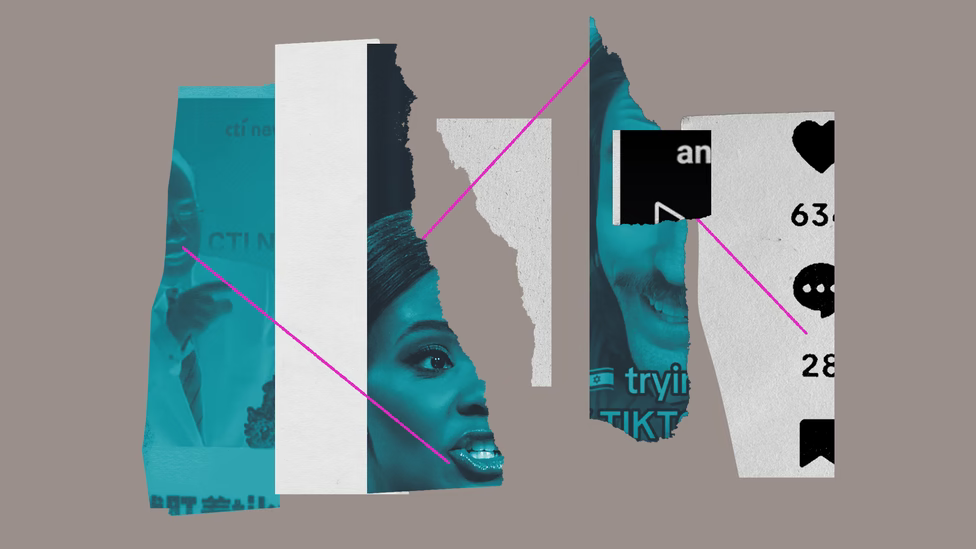
Illustration by The Atlantic. Sources: TikTok; Jason Davis / Getty.
“The entire world knows exactly why the U.S. is trying to ban TikTok,” James Li declared on March 16 to his nearly 100,000 followers on the social-media platform. His video then cut to a subtitled clip of a Taiwanese speaker purportedly discussing how “TikTok inadvertently offended the Jewish people” by hosting pro-Palestinian content. “The power of the Jewish people in America is definitely more scary than Trump,” the speaker goes on. “They have created the options: either ban or sell to the Americans. In reality, it’s neither—it’s selling to a Jewish investment group.”
Li, who calls himself an “indie journalist” and subsequently posted another video blaming Israel for the assassination of President John F. Kennedy, got more than 160,000 views for his TikTok theory—and the video was one of the poorer-performing entries making similar claims on the platform.
What prompted this outburst? On March 13, Congress advanced a bill that would give TikTok’s Chinese parent company six months to sell it or be banned from American app stores. The legislation passed 352–65, with overwhelming bipartisan support, and the rational observer will have no trouble understanding why.
The United States has a long history of preventing foreign adversaries from controlling important communications infrastructure. Washington spent more than a decade, under Democratic and Republican presidents, leading a successful international campaign to block the Chinese telecom giant Huawei from Western markets. Donald Trump attempted to force a TikTok sale back in 2020. The reasons are straightforward: The app has access to the data of some 150 million American users—nearly half the population—but it is owned and controlled by the Chinese company ByteDance. Like all companies in the country, ByteDance is effectively under the thumb of the Chinese Communist Party, which regularly punishes and even disappears business leaders who displease it. A former ByteDance executive has said that the CCP had “supreme access” to the company’s data, and used the info to track protesters in Hong Kong, for example.
Read: Beijing is ruining TikTok
Recent polls show robust public support for TikTok’s ban or sale, and for years, Gallup has found that Americans see China as the country’s greatest enemy. In short, Congress has strong electoral and political incentives to act against TikTok. But spend some time on the platform itself, and you’ll discover a very different culprit behind all this: Jews.
“We were all thinking it: Israel is trying to buy TikTok,” the influencer Ian Carroll told his 1.5 million followers last month. The evidence: Steven Mnuchin, the former Trump Treasury secretary and Goldman Sachs executive, has sought investors to purchase the app. “He’s not Israel, right?” continued Carroll. “Well, let’s peel this onion back one layer at a time, starting with just the fact that he’s Jewish.”
Carroll’s TikTok bio says “do your own research,” and he certainly had research to share. “The censorship is not about China on TikTok,” he explained. Rather, “as a TikTok creator who gets censored all the frickin’ time, I can tell you that the things you get censored about are the CIA and Israel.” Carroll did not address why Israel would go through so much trouble to acquire TikTok if it already controlled the platform, or why the Semitic censors somehow missed his video and its more than 1 million views, not to mention the several similarly viral follow-ups he posted.
In truth, far from suppressing such content, TikTok’s algorithm happily promotes it. I purposely viewed the videos for this piece while logged out of the platform, and it nonetheless began suggesting to me more material along these lines through its sidebar recommendations.
Characteristic of anti-Semitic online discourse, these videos and others like them interchangeably reference individual American Jews, American Jewish organizations like the Anti-Defamation League, American pro-Israel lobbying groups like AIPAC, and the state of Israel, as though they are all part of one single-minded international conspiracy to take down TikTok. When a commenter asked Carroll to “look into universal studios pulling their music from TikTok,” a reference to the Universal Music conglomerate’s dispute with TikTok over royalties, Carroll replied, “Universal CEO is a Jewish man.”
“A foreign government is influencing the 2024 election,” the leftist podcaster and former Bernie Sanders Press Secretary Briahna Joy Gray declared on X in March. “I’m not talking about China, but Israel. In a leaked recording, ADL head Jonathan Greenblatt admitted that Israel had a ‘TikTok problem.’ Suddenly, a divided Congress agrees on one thing: A social media ban.” Greenblatt is an American Jew, the ADL is an American organization, the bill isn’t a ban, and the push for a forced sale predated the Gaza war, but other than that, Gray was on the money.
Yair Rosenberg: Why Facebook and Twitter won’t ban antisemitism
“Banning TikTok became a crucial emergency because what they saw was a bunch of young individuals, essentially people that are going to be the future leaders of America, who were not pro-Israel,” the far-right commentator Candace Owens claimed in March on her popular show at The Daily Wire. She then issued an implied threat: “If TikTok is in fact banned, there is no question that Israel will be blamed, AIPAC will be blamed, the ADL will be blamed, Jews are going to be blamed … You can see that sentiment building.” (Owens left The Daily Wire a week later following a string of anti-Semitic incidents, which included claims that Jews were doing “horrific things” and “controlling people with blackmail,” as well as her favoriting a social-media post that accused a rabbi of being “drunk on Christian blood.”)
At this point, it’s not uncommon to find videos about the TikTok legislation that do not even mention Jews or Israel—like this one with 1.5 million views—yet are flooded with hundreds of comments, garnering tens of thousands of likes, accusing “Zionists,” “Jews,” or AIPAC of being behind it, despite years of national-security reporting on concerns over the platform’s Chinese owners. That alleged Jewish malefactors are being assailed on TikTok even when they are not invoked explicitly in a video illustrates how widely the meme has spread.
Like many conspiracy theories, the notion that Jews are out to ban TikTok contains a grain of truth. Jewish and pro-Israel groups have raised concerns about TikTok’s failure to moderate anti-Semitic content for years, including when it pertains to Israel, but they have never called for the app to be shut down. After the TikTok sale legislation was proposed, the Jewish Federations of North America said it “appropriately balances free speech and individual rights with regulatory action” while asserting that “our community understands that social media is a major driver of the rise in antisemitism, and that TikTok is the worst offender by far.” (Presumably, the organization arrived at this conclusion by spending 10 minutes on the app.) Researchers have found that pro-Palestinian content dwarfs pro-Israel content on TikTok, likely reflecting the platform’s young and international demographic.
But no conspiracy theories or appeals to recent geopolitical developments are necessary to understand why U.S. politicians wouldn’t want one of the most-trafficked social-media networks in America to be run by Communist China via a black-box algorithm. Just this past December, researchers at Rutgers found that anti-China posts on topics like the Hong Kong protests or the regime’s brutal repression of Uyghur Muslims were dramatically underrepresented on TikTok compared with Instagram.
TikTok’s response to allegations that it could function as a foreign influence operation have not exactly allayed concerns. Shortly after the Rutgers study was published, the app restricted access to the tool used by academics to track its content. Last month, it sent multiple alerts to its American users falsely warning that Congress was about to ban TikTok and urging them to contact their representatives. In fact, the bill seeks to force a sale to new ownership, much as congressional scrutiny over data privacy led the dating app Grindr to be sold to non-Chinese owners in 2020.
Simply put, none of what is happening to the social-media platform is new. Neither is the tendency to blame Jews for the world’s problems—but that doesn’t make the impulse any less dangerous. Many understand anti-Semitism as a personal prejudice that singles out Jewish people for their difference, much like other minorities experience racism. But anti-Semitism also manifests as a conspiracy theory about how the world works, alleging that sinister string-pulling Jews are the source of social, political, and economic problems—and this is the sort of anti-Semitism that tends to get people killed.
Yair Rosenberg: Why so many people still don’t understand anti-semitism
Consider recent American history: In 2018, a far-right gunman who blamed Jews for mass immigration murdered 11 people in Pittsburgh’s Tree of Life synagogue. In 2019, assailants tied to the Black Hebrew Israelite movement attacked a kosher supermarket in Jersey City, killing three; one of the shooters had written on social media about Jews controlling the government. In 2022, an Islamic extremist took an entire congregation hostage in Colleyville, Texas, and demanded that a rabbi get a convict released from a nearby prison. These perpetrators—white supremacist, Black extremist, radical Islamist—had essentially nothing in common other than their belief that a Jewish cabal governed world affairs and was the cause of their problems.
The reality is the reverse: Jews constitute just 2 percent of the American population, and although they exercise influence like any other minority, they frequently disagree among themselves and do not dictate the destiny of the majority. Politicians voting against TikTok are pursuing their conception of the national interest, not being suborned to serve some nebulous Jewish interest. Remove the Jews from the equation, and the situation will be the same.
Conspiracy theorists typically claim to be combatting concealed power structures. But as in this case, their delusions make them unable to perceive the way power actually works. Thus, conspiratorial anti-Semitism hobbles its adherents, preventing them from rationally organizing to advance their own causes by distracting them with fantastical Jewish plots.
“Anti-Semitism isn’t just bigotry toward the Jewish community,” the Black civil-rights activist Eric Ward once told me. “It is actually utilizing bigotry toward the Jewish community in order to deconstruct democratic practices, and it does so by framing democracy as a conspiracy rather than a tool of empowerment or a functional tool of governance.”
Anti-Semitic conspiracy theories won’t safeguard TikTok from the bill that’s currently moving through the U.S. legislature. But the more people buy into them, the more they will imperil not only American Jews but American democracy as well.
Yair Rosenberg is a staff writer at The Atlantic and the author of its newsletter Deep Shtetl, about the intersection of politics, culture, and religion.
Source (Archive)
APRIL 17, 2024
Illustration by The Atlantic. Sources: TikTok; Jason Davis / Getty.
“The entire world knows exactly why the U.S. is trying to ban TikTok,” James Li declared on March 16 to his nearly 100,000 followers on the social-media platform. His video then cut to a subtitled clip of a Taiwanese speaker purportedly discussing how “TikTok inadvertently offended the Jewish people” by hosting pro-Palestinian content. “The power of the Jewish people in America is definitely more scary than Trump,” the speaker goes on. “They have created the options: either ban or sell to the Americans. In reality, it’s neither—it’s selling to a Jewish investment group.”
Li, who calls himself an “indie journalist” and subsequently posted another video blaming Israel for the assassination of President John F. Kennedy, got more than 160,000 views for his TikTok theory—and the video was one of the poorer-performing entries making similar claims on the platform.
What prompted this outburst? On March 13, Congress advanced a bill that would give TikTok’s Chinese parent company six months to sell it or be banned from American app stores. The legislation passed 352–65, with overwhelming bipartisan support, and the rational observer will have no trouble understanding why.
The United States has a long history of preventing foreign adversaries from controlling important communications infrastructure. Washington spent more than a decade, under Democratic and Republican presidents, leading a successful international campaign to block the Chinese telecom giant Huawei from Western markets. Donald Trump attempted to force a TikTok sale back in 2020. The reasons are straightforward: The app has access to the data of some 150 million American users—nearly half the population—but it is owned and controlled by the Chinese company ByteDance. Like all companies in the country, ByteDance is effectively under the thumb of the Chinese Communist Party, which regularly punishes and even disappears business leaders who displease it. A former ByteDance executive has said that the CCP had “supreme access” to the company’s data, and used the info to track protesters in Hong Kong, for example.
Read: Beijing is ruining TikTok
Recent polls show robust public support for TikTok’s ban or sale, and for years, Gallup has found that Americans see China as the country’s greatest enemy. In short, Congress has strong electoral and political incentives to act against TikTok. But spend some time on the platform itself, and you’ll discover a very different culprit behind all this: Jews.
“We were all thinking it: Israel is trying to buy TikTok,” the influencer Ian Carroll told his 1.5 million followers last month. The evidence: Steven Mnuchin, the former Trump Treasury secretary and Goldman Sachs executive, has sought investors to purchase the app. “He’s not Israel, right?” continued Carroll. “Well, let’s peel this onion back one layer at a time, starting with just the fact that he’s Jewish.”
Carroll’s TikTok bio says “do your own research,” and he certainly had research to share. “The censorship is not about China on TikTok,” he explained. Rather, “as a TikTok creator who gets censored all the frickin’ time, I can tell you that the things you get censored about are the CIA and Israel.” Carroll did not address why Israel would go through so much trouble to acquire TikTok if it already controlled the platform, or why the Semitic censors somehow missed his video and its more than 1 million views, not to mention the several similarly viral follow-ups he posted.
In truth, far from suppressing such content, TikTok’s algorithm happily promotes it. I purposely viewed the videos for this piece while logged out of the platform, and it nonetheless began suggesting to me more material along these lines through its sidebar recommendations.
Characteristic of anti-Semitic online discourse, these videos and others like them interchangeably reference individual American Jews, American Jewish organizations like the Anti-Defamation League, American pro-Israel lobbying groups like AIPAC, and the state of Israel, as though they are all part of one single-minded international conspiracy to take down TikTok. When a commenter asked Carroll to “look into universal studios pulling their music from TikTok,” a reference to the Universal Music conglomerate’s dispute with TikTok over royalties, Carroll replied, “Universal CEO is a Jewish man.”
“A foreign government is influencing the 2024 election,” the leftist podcaster and former Bernie Sanders Press Secretary Briahna Joy Gray declared on X in March. “I’m not talking about China, but Israel. In a leaked recording, ADL head Jonathan Greenblatt admitted that Israel had a ‘TikTok problem.’ Suddenly, a divided Congress agrees on one thing: A social media ban.” Greenblatt is an American Jew, the ADL is an American organization, the bill isn’t a ban, and the push for a forced sale predated the Gaza war, but other than that, Gray was on the money.
Yair Rosenberg: Why Facebook and Twitter won’t ban antisemitism
“Banning TikTok became a crucial emergency because what they saw was a bunch of young individuals, essentially people that are going to be the future leaders of America, who were not pro-Israel,” the far-right commentator Candace Owens claimed in March on her popular show at The Daily Wire. She then issued an implied threat: “If TikTok is in fact banned, there is no question that Israel will be blamed, AIPAC will be blamed, the ADL will be blamed, Jews are going to be blamed … You can see that sentiment building.” (Owens left The Daily Wire a week later following a string of anti-Semitic incidents, which included claims that Jews were doing “horrific things” and “controlling people with blackmail,” as well as her favoriting a social-media post that accused a rabbi of being “drunk on Christian blood.”)
At this point, it’s not uncommon to find videos about the TikTok legislation that do not even mention Jews or Israel—like this one with 1.5 million views—yet are flooded with hundreds of comments, garnering tens of thousands of likes, accusing “Zionists,” “Jews,” or AIPAC of being behind it, despite years of national-security reporting on concerns over the platform’s Chinese owners. That alleged Jewish malefactors are being assailed on TikTok even when they are not invoked explicitly in a video illustrates how widely the meme has spread.
Like many conspiracy theories, the notion that Jews are out to ban TikTok contains a grain of truth. Jewish and pro-Israel groups have raised concerns about TikTok’s failure to moderate anti-Semitic content for years, including when it pertains to Israel, but they have never called for the app to be shut down. After the TikTok sale legislation was proposed, the Jewish Federations of North America said it “appropriately balances free speech and individual rights with regulatory action” while asserting that “our community understands that social media is a major driver of the rise in antisemitism, and that TikTok is the worst offender by far.” (Presumably, the organization arrived at this conclusion by spending 10 minutes on the app.) Researchers have found that pro-Palestinian content dwarfs pro-Israel content on TikTok, likely reflecting the platform’s young and international demographic.
But no conspiracy theories or appeals to recent geopolitical developments are necessary to understand why U.S. politicians wouldn’t want one of the most-trafficked social-media networks in America to be run by Communist China via a black-box algorithm. Just this past December, researchers at Rutgers found that anti-China posts on topics like the Hong Kong protests or the regime’s brutal repression of Uyghur Muslims were dramatically underrepresented on TikTok compared with Instagram.
TikTok’s response to allegations that it could function as a foreign influence operation have not exactly allayed concerns. Shortly after the Rutgers study was published, the app restricted access to the tool used by academics to track its content. Last month, it sent multiple alerts to its American users falsely warning that Congress was about to ban TikTok and urging them to contact their representatives. In fact, the bill seeks to force a sale to new ownership, much as congressional scrutiny over data privacy led the dating app Grindr to be sold to non-Chinese owners in 2020.
Simply put, none of what is happening to the social-media platform is new. Neither is the tendency to blame Jews for the world’s problems—but that doesn’t make the impulse any less dangerous. Many understand anti-Semitism as a personal prejudice that singles out Jewish people for their difference, much like other minorities experience racism. But anti-Semitism also manifests as a conspiracy theory about how the world works, alleging that sinister string-pulling Jews are the source of social, political, and economic problems—and this is the sort of anti-Semitism that tends to get people killed.
Yair Rosenberg: Why so many people still don’t understand anti-semitism
Consider recent American history: In 2018, a far-right gunman who blamed Jews for mass immigration murdered 11 people in Pittsburgh’s Tree of Life synagogue. In 2019, assailants tied to the Black Hebrew Israelite movement attacked a kosher supermarket in Jersey City, killing three; one of the shooters had written on social media about Jews controlling the government. In 2022, an Islamic extremist took an entire congregation hostage in Colleyville, Texas, and demanded that a rabbi get a convict released from a nearby prison. These perpetrators—white supremacist, Black extremist, radical Islamist—had essentially nothing in common other than their belief that a Jewish cabal governed world affairs and was the cause of their problems.
The reality is the reverse: Jews constitute just 2 percent of the American population, and although they exercise influence like any other minority, they frequently disagree among themselves and do not dictate the destiny of the majority. Politicians voting against TikTok are pursuing their conception of the national interest, not being suborned to serve some nebulous Jewish interest. Remove the Jews from the equation, and the situation will be the same.
Conspiracy theorists typically claim to be combatting concealed power structures. But as in this case, their delusions make them unable to perceive the way power actually works. Thus, conspiratorial anti-Semitism hobbles its adherents, preventing them from rationally organizing to advance their own causes by distracting them with fantastical Jewish plots.
“Anti-Semitism isn’t just bigotry toward the Jewish community,” the Black civil-rights activist Eric Ward once told me. “It is actually utilizing bigotry toward the Jewish community in order to deconstruct democratic practices, and it does so by framing democracy as a conspiracy rather than a tool of empowerment or a functional tool of governance.”
Anti-Semitic conspiracy theories won’t safeguard TikTok from the bill that’s currently moving through the U.S. legislature. But the more people buy into them, the more they will imperil not only American Jews but American democracy as well.
Yair Rosenberg is a staff writer at The Atlantic and the author of its newsletter Deep Shtetl, about the intersection of politics, culture, and religion.
Source (Archive)
Última edición por un moderador:


