https://www.vox.com/22360290/black-lives-matter-protest-crime-ferguson-effects-murder (Archive)
There’s long been a fierce debate about the effect of Black Lives Matter protests on the lethal use of force by police. A new study, one of the first to make a rigorous academic attempt to answer that question, found that the protests have had a notable impact on police killings. For every 4,000 people who participated in a Black Lives Matter protest between 2014 and 2019, police killed one less person.
Travis Campbell, a PhD student in economics at the University of Massachusetts Amherst, released his preliminary findings on the Social Science Research network as a preprint, meaning the study has yet to receive a formal peer review.
While Campbell’s research does not encompass the events of summer 2020, George Floyd’s killing and the subsequent wave of protests became potentially the largest movement in American history, the sudden growth of which relied on a wave of anger and grief at the police homicides Americans are continually greeted with on the news. Opinion columnists, activists, lawmakers, and even the president of the United States (current and former) have weighed in on these protests and what the appropriate policy changes should be. But first, it’s important to grapple with how the protests have already changed policing.
From 2014 to 2019, Campbell tracked more than 1,600 BLM protests across the country, largely in bigger cities, with nearly 350,000 protesters. His main finding is a 15 to 20 percent reduction in lethal use of force by police officers — roughly 300 fewer police homicides — in census places that saw BLM protests.
Campbell’s research also indicates that these protests correlate with a 10 percent increase in murders in the areas that saw BLM protests. That means from 2014 to 2019, there were somewhere between 1,000 and 6,000 more homicides than would have been expected if places with protests were on the same trend as places that did not have protests. Campbell’s research does not include the effects of last summer’s historic wave of protests because researchers do not yet have all the relevant data.
It’s worth noting that Campbell didn’t subject the homicide findings to the same battery of statistical tests as he did the police killings since they were not the main focus of his research. (He intends to do more research on how these protests affected crime rates.) But his research on homicides aligns with other evidence. Omar Wasow, a professor at Princeton University who has done seminal research on the effect of protests, told Vox that the results are “entirely plausible” and “not surprising,” considering existing protest research.
The reasons for this rise in murders are not fully known, but one possible explanation is that police morale drops following scrutiny, leading officers to reduce their efforts and thereby emboldening criminals. Another is that members of the public voluntarily withdraw from engagements with the police after a police homicide delegitimizes the justice system in their eyes. (More on this below.)
Protests can do a lot. They can raise awareness, create solidarity or undermine existing relationships, change public opinion, strengthen or weaken institutions, and affect the outcome of elections. But, according to this study, BLM protests also produce their intended effect.
For lethal force data, there’s no federal database to turn to. Instead, Campbell and other researchers have to rely on nonprofit- and media-collected data, which has some drawbacks. This means Campbell may be missing some police homicides in his research.
Harvard University sociologist Joscha Legewie told Scientific American that the study’s design is “‘very well suited’ for the kind of data Campbell” is looking at.
Additionally, there could be something systematically different about the places that have BLM protests that make them more poised for increased police accountability than places without. For instance, a new mayor or district attorney who championed police reform gets elected and then protest movements mobilize to ensure their desired reforms are implemented.
To account for this problem, Campbell controls for various factors — from the localities’ unemployment rate to the Democratic vote share in the 2008 presidential election — to try to make sure he is isolating the effect of BLM protests on police homicides and other murders. But, unless you’re able to conduct a randomized controlled trial (which is impossible for studies like these), there could always be hidden variables that researchers are unable to account for.
To try to further prove his findings are sound, Campbell also shows that before 2014 there were almost parallel trends of police homicides in both the places that would go on to see protests and places that wouldn’t. That suggests that what changed in 2014 and beyond — regarding both the reduction in police homicides and the increase in murder — is likely the effect of the BLM protests, not some other hidden variable.
Campbell notes that “BLM did not transform into the protests movement it is known as today until the police killings of Eric Garner in New York City and Michael Brown in Ferguson, MO in 2014,” which is why he begins his research with that year.

Campbell also observes that, over time, the gap in police homicide rates widens between places with and without protests. In year zero, he finds a 13 percent drop in police homicides; by year four, that decline expands by 14 percentage points. That means it’s likely that the effect of BLM protests is strong enough to lower the number of police homicides for several years.
Campbell believes there are three potential mechanisms that could have led to this decline, none of which are mutually exclusive.
First, he observed an increase in the use of body cameras and different types of community policing. It’s possible that, in response to BLM protests, police departments implemented reforms that reduced lethal use of force. Campbell’s research finds a significant increase in the likelihood of an agency obtaining body-worn cameras (55.3 percent), patrol officers within a designated geographic area (20.6 percent), and SARA officers, a type of community policing (57.5 percent).
The existing literature on body cameras is mixed, though, undercutting the idea that widespread body camera use alone is the driving force behind declining instances of police brutality.
A Brookings Institution expert explained that while randomized trials “in American and European police departments found that body worn camera’s reduced the number of complaints filed by local residents against the police ... they showed mixed effects on use of force by and against police officers.” In a major 2017 study conducted in Washington, DC, the researchers found that “the behavior of officers who wore cameras all the time was indistinguishable from the behavior of those who never wore cameras.”
One bright spot in the research on body cameras is a recent job market paper by University of Chicago economics researcher Taeho Kim; the nationwide study found that the use of these cameras reduced police-involved homicides by 43 percent.
As for other elements of this possible explanation, the research is less clear. Campbell writes that the lethal force impact of expanding community policing and patrols is “understudied,” but activists have frequently called for community policing in response to instances of police brutality.
Wasow explained that it may not be the specific reforms per se but that the increase of administrative or training changes indicates more people are taking accountability seriously within the justice system. Accountability culture is hard to measure, so researchers can observe it in an uptick in measures like body-worn cameras or community policing. If this is true, police reform may have less to do with specific policies than just an increased commitment to holding officers to a higher standard.
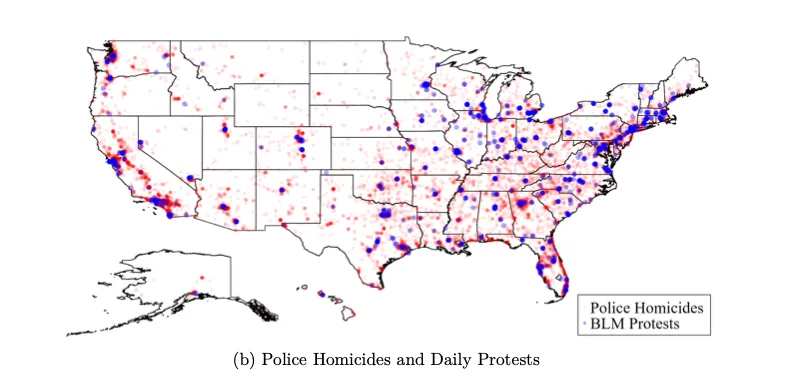
The figures show the location of police homicides and Black Lives Matter (BLM) protests from 2000 to 2019. Blue denotes BLM protests. Red indicates a police homicide.
The second mechanism is that civilians are becoming more wary of the police in the aftermath of these protests and the publicizing of instances of police homicides. That could mean people call 911 less or engage with police officers less of their own volition, which has the effect of reducing civilian/police interactions and thereby fatal interactions as well.
Finally, the third mechanism is something called the Ferguson effect: the supposition that protests against police brutality reduce officer morale and effort due to the “intensified scrutiny from the community and media.” In other words, officers stop doing their jobs as aggressively. This can lead to reduced arrests, especially for less serious crimes like disorderly conduct or marijuana possession.
Deepak Premkumar, a research fellow at the Public Policy Institute of California, found in recently released research that police do reduce their efforts following officer-involved fatalities: Theft arrests fall by 7 percent, and for “quality of life crimes” like disorderly conduct or marijuana possession, arrests decline by up to 23 percent (weed possession alone declines by up to 33 percent).
It’s these latter two mechanisms that could explain the increase in murder following BLM protests.
We don’t know why BLM protests correlated with an increase in the murder rate, and there’s not a lot of research in this space to help guide us. Additionally, Campbell’s research question was focused on the effect of BLM protests on police homicides, so these other observed changes regarding other homicides were not subjected to the same robustness tests.
A number of factors could be driving the increase. Premkumar, who studied the Ferguson effect, also observed a “significant rise” (10 to 17 percent) in murders and robberies following highly publicized officer-involved fatalities.
But from talking with experts, there are a few ways we can understand what may be happening here.
First, it’s possible criminal activity rises in areas that have seen protests because people stop calling the police or working with them out of fear or anger — thereby emboldening criminal behavior. Moreover, some experts believe people will try to resolve their disputes extrajudicially if the system loses legitimacy following a police homicide.
If this were happening, we would expect to see a reduction in the reported rates of low-level crime — fewer low-level crimes would be reported relative to high-level crimes like murders. Murders are less likely to go unnoticed because, well, there’s a missing person and/or a body. So the murder rate is usually the best indicator of what’s actually going on with crime writ large.
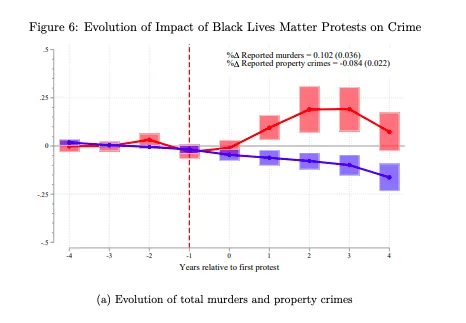
Campbell observes a significant increase in the murder rate but a simultaneous 8.4 percent decrease in total property crimes reported. That is consistent with people voluntarily reducing interactions with the police, and other criminologists are in favor of this explanation. However, research by Michael Zoorob, a PhD student at Harvard University, finds that “across a large number of cities, incidents, and analytic strategies well-publicized brutality incidents do not reduce 911 calls to report common property or violent crimes,” casting doubt on the idea that police homicides reduce voluntary civilian engagement with police.
One other possible explanation for the increased murder rate is that law enforcement officials are the ones voluntarily reducing their interactions with the community and as a result emboldening criminal activity. One way to observe whether police are reducing their efforts is to see whether the share of property crimes cleared falls over this period. In other words, are police not trying as hard — either because they are demoralized or angry at public scrutiny of their behavior — to solve low-level crimes that are reported to them? Campbell observes a 5.5 percent decline in the share of property crimes cleared, which is consistent with police reducing their efforts immediately following the protests.
The good news is that even if Campbell’s finding about the increase in murders following BLM protests holds up to further scrutiny, the effect doesn’t appear to last for long. By year four, Campbell no longer observes a statistically significant increase in murders, indicating that whatever is going on with murders is hopefully not long term.
None of Campbell’s data covers the protests in 2020 or the rise in murders in 2020. As German Lopez explains for Vox, “some experts have cited the protests this summer over the police killings of George Floyd and others,” but Covid-19 made the year so unusual that experts are cautious about drawing any conclusions yet.
There’s long been a fierce debate about the effect of Black Lives Matter protests on the lethal use of force by police. A new study, one of the first to make a rigorous academic attempt to answer that question, found that the protests have had a notable impact on police killings. For every 4,000 people who participated in a Black Lives Matter protest between 2014 and 2019, police killed one less person.
Travis Campbell, a PhD student in economics at the University of Massachusetts Amherst, released his preliminary findings on the Social Science Research network as a preprint, meaning the study has yet to receive a formal peer review.
While Campbell’s research does not encompass the events of summer 2020, George Floyd’s killing and the subsequent wave of protests became potentially the largest movement in American history, the sudden growth of which relied on a wave of anger and grief at the police homicides Americans are continually greeted with on the news. Opinion columnists, activists, lawmakers, and even the president of the United States (current and former) have weighed in on these protests and what the appropriate policy changes should be. But first, it’s important to grapple with how the protests have already changed policing.
From 2014 to 2019, Campbell tracked more than 1,600 BLM protests across the country, largely in bigger cities, with nearly 350,000 protesters. His main finding is a 15 to 20 percent reduction in lethal use of force by police officers — roughly 300 fewer police homicides — in census places that saw BLM protests.
Campbell’s research also indicates that these protests correlate with a 10 percent increase in murders in the areas that saw BLM protests. That means from 2014 to 2019, there were somewhere between 1,000 and 6,000 more homicides than would have been expected if places with protests were on the same trend as places that did not have protests. Campbell’s research does not include the effects of last summer’s historic wave of protests because researchers do not yet have all the relevant data.
It’s worth noting that Campbell didn’t subject the homicide findings to the same battery of statistical tests as he did the police killings since they were not the main focus of his research. (He intends to do more research on how these protests affected crime rates.) But his research on homicides aligns with other evidence. Omar Wasow, a professor at Princeton University who has done seminal research on the effect of protests, told Vox that the results are “entirely plausible” and “not surprising,” considering existing protest research.
The reasons for this rise in murders are not fully known, but one possible explanation is that police morale drops following scrutiny, leading officers to reduce their efforts and thereby emboldening criminals. Another is that members of the public voluntarily withdraw from engagements with the police after a police homicide delegitimizes the justice system in their eyes. (More on this below.)
Protests can do a lot. They can raise awareness, create solidarity or undermine existing relationships, change public opinion, strengthen or weaken institutions, and affect the outcome of elections. But, according to this study, BLM protests also produce their intended effect.
A few notes on methodology
It’s important to understand how Campbell conducted his research and the potential pitfalls when trying to quantify and isolate how protests can affect policy. Researchers who study crime, police lethal force, and protests are hampered by something out of their control: The underlying data can be faulty.For lethal force data, there’s no federal database to turn to. Instead, Campbell and other researchers have to rely on nonprofit- and media-collected data, which has some drawbacks. This means Campbell may be missing some police homicides in his research.
Harvard University sociologist Joscha Legewie told Scientific American that the study’s design is “‘very well suited’ for the kind of data Campbell” is looking at.
Additionally, there could be something systematically different about the places that have BLM protests that make them more poised for increased police accountability than places without. For instance, a new mayor or district attorney who championed police reform gets elected and then protest movements mobilize to ensure their desired reforms are implemented.
To account for this problem, Campbell controls for various factors — from the localities’ unemployment rate to the Democratic vote share in the 2008 presidential election — to try to make sure he is isolating the effect of BLM protests on police homicides and other murders. But, unless you’re able to conduct a randomized controlled trial (which is impossible for studies like these), there could always be hidden variables that researchers are unable to account for.
To try to further prove his findings are sound, Campbell also shows that before 2014 there were almost parallel trends of police homicides in both the places that would go on to see protests and places that wouldn’t. That suggests that what changed in 2014 and beyond — regarding both the reduction in police homicides and the increase in murder — is likely the effect of the BLM protests, not some other hidden variable.
Campbell notes that “BLM did not transform into the protests movement it is known as today until the police killings of Eric Garner in New York City and Michael Brown in Ferguson, MO in 2014,” which is why he begins his research with that year.
The effect of BLM protests on police lethal use of force
The major finding in the paper is that places with BLM protests experienced a statistically significant decline in police homicides. Further, the biggest declines are when protests are relatively large and/or frequent.Campbell also observes that, over time, the gap in police homicide rates widens between places with and without protests. In year zero, he finds a 13 percent drop in police homicides; by year four, that decline expands by 14 percentage points. That means it’s likely that the effect of BLM protests is strong enough to lower the number of police homicides for several years.
Campbell believes there are three potential mechanisms that could have led to this decline, none of which are mutually exclusive.
First, he observed an increase in the use of body cameras and different types of community policing. It’s possible that, in response to BLM protests, police departments implemented reforms that reduced lethal use of force. Campbell’s research finds a significant increase in the likelihood of an agency obtaining body-worn cameras (55.3 percent), patrol officers within a designated geographic area (20.6 percent), and SARA officers, a type of community policing (57.5 percent).
The existing literature on body cameras is mixed, though, undercutting the idea that widespread body camera use alone is the driving force behind declining instances of police brutality.
A Brookings Institution expert explained that while randomized trials “in American and European police departments found that body worn camera’s reduced the number of complaints filed by local residents against the police ... they showed mixed effects on use of force by and against police officers.” In a major 2017 study conducted in Washington, DC, the researchers found that “the behavior of officers who wore cameras all the time was indistinguishable from the behavior of those who never wore cameras.”
One bright spot in the research on body cameras is a recent job market paper by University of Chicago economics researcher Taeho Kim; the nationwide study found that the use of these cameras reduced police-involved homicides by 43 percent.
As for other elements of this possible explanation, the research is less clear. Campbell writes that the lethal force impact of expanding community policing and patrols is “understudied,” but activists have frequently called for community policing in response to instances of police brutality.
Wasow explained that it may not be the specific reforms per se but that the increase of administrative or training changes indicates more people are taking accountability seriously within the justice system. Accountability culture is hard to measure, so researchers can observe it in an uptick in measures like body-worn cameras or community policing. If this is true, police reform may have less to do with specific policies than just an increased commitment to holding officers to a higher standard.
The figures show the location of police homicides and Black Lives Matter (BLM) protests from 2000 to 2019. Blue denotes BLM protests. Red indicates a police homicide.
Finally, the third mechanism is something called the Ferguson effect: the supposition that protests against police brutality reduce officer morale and effort due to the “intensified scrutiny from the community and media.” In other words, officers stop doing their jobs as aggressively. This can lead to reduced arrests, especially for less serious crimes like disorderly conduct or marijuana possession.
Deepak Premkumar, a research fellow at the Public Policy Institute of California, found in recently released research that police do reduce their efforts following officer-involved fatalities: Theft arrests fall by 7 percent, and for “quality of life crimes” like disorderly conduct or marijuana possession, arrests decline by up to 23 percent (weed possession alone declines by up to 33 percent).
It’s these latter two mechanisms that could explain the increase in murder following BLM protests.
Did BLM protests lead to an increase in murder?
This is where things get more speculative. Campbell’s study finds that BLM protests correlate with a 10 percent increase in murder. That is, there were a few thousand more homicides in the places where there were BLM protests than would have been expected if those places followed the same trends as the ones that didn’t see protests.We don’t know why BLM protests correlated with an increase in the murder rate, and there’s not a lot of research in this space to help guide us. Additionally, Campbell’s research question was focused on the effect of BLM protests on police homicides, so these other observed changes regarding other homicides were not subjected to the same robustness tests.
A number of factors could be driving the increase. Premkumar, who studied the Ferguson effect, also observed a “significant rise” (10 to 17 percent) in murders and robberies following highly publicized officer-involved fatalities.
But from talking with experts, there are a few ways we can understand what may be happening here.
First, it’s possible criminal activity rises in areas that have seen protests because people stop calling the police or working with them out of fear or anger — thereby emboldening criminal behavior. Moreover, some experts believe people will try to resolve their disputes extrajudicially if the system loses legitimacy following a police homicide.
If this were happening, we would expect to see a reduction in the reported rates of low-level crime — fewer low-level crimes would be reported relative to high-level crimes like murders. Murders are less likely to go unnoticed because, well, there’s a missing person and/or a body. So the murder rate is usually the best indicator of what’s actually going on with crime writ large.
Campbell observes a significant increase in the murder rate but a simultaneous 8.4 percent decrease in total property crimes reported. That is consistent with people voluntarily reducing interactions with the police, and other criminologists are in favor of this explanation. However, research by Michael Zoorob, a PhD student at Harvard University, finds that “across a large number of cities, incidents, and analytic strategies well-publicized brutality incidents do not reduce 911 calls to report common property or violent crimes,” casting doubt on the idea that police homicides reduce voluntary civilian engagement with police.
One other possible explanation for the increased murder rate is that law enforcement officials are the ones voluntarily reducing their interactions with the community and as a result emboldening criminal activity. One way to observe whether police are reducing their efforts is to see whether the share of property crimes cleared falls over this period. In other words, are police not trying as hard — either because they are demoralized or angry at public scrutiny of their behavior — to solve low-level crimes that are reported to them? Campbell observes a 5.5 percent decline in the share of property crimes cleared, which is consistent with police reducing their efforts immediately following the protests.
The good news is that even if Campbell’s finding about the increase in murders following BLM protests holds up to further scrutiny, the effect doesn’t appear to last for long. By year four, Campbell no longer observes a statistically significant increase in murders, indicating that whatever is going on with murders is hopefully not long term.
None of Campbell’s data covers the protests in 2020 or the rise in murders in 2020. As German Lopez explains for Vox, “some experts have cited the protests this summer over the police killings of George Floyd and others,” but Covid-19 made the year so unusual that experts are cautious about drawing any conclusions yet.


