Tabletop Roleplaying Games (D&D, Pathfinder, CoC, ETC.)

It was worse than that. He thought his wheelchair would automatically hover over stairs, and be in places it shouldn't be, and so on. I keep telling him that he never brought upgrades to his chair. (The Gazelle player himself got around this sort of thing by buying a separate normal pair of prosthetic legs he can switch to.)
So Wheelchair guy quickly ran himself dirt poor from all the chairs he kept buying over destroyed ones, never upgrading, never seeing different options to resolve a situation, basically become useless as a rock when the chair is destroyed and the party has to haul him around.
I regret not killing his character, I really tried, but the dice somehow make damage aimed at him roll low. The character even survived three bombs in a row because two of them did the minimum damage. It was mostly awful for me and the enemies who tried their best to single him out in combat because he was either looking the weakest link in the group or was a sitting duck with no chair.

That sounds like what I'd want if I played a wheelchair character. It's important and can't be just handwaved away with a super magic wheelchair that makes you better than healthy people. Too bad it's not what the player expected.

I wanted to play one of the craftsman wizards in Ars Magica, who eventually completely cripple themselves in imitation of Vulcan as parts of initiation into their mystery cult, and get a heavily enchanted wheelchair, but the craft I wanted to have was mapmaking, which I couldn't make work given the state of cartography in early 13th century and the limitations of magic in Ars Magica (most importantly, magic can't know things on its own). But I learned a lot about 13th century charts and sea navigation while trying to figure that character out.
 
It was worse than that. He thought his wheelchair would automatically hover over stairs, and be in places it shouldn't be, and so on. I keep telling him that he never brought upgrades to his chair. (The Gazelle player himself got around this sort of thing by buying a separate normal pair of prosthetic legs he can switch to.)
So Wheelchair guy quickly ran himself dirt poor from all the chairs he kept buying over destroyed ones, never upgrading, never seeing different options to resolve a situation, basically become useless as a rock when the chair is destroyed and the party has to haul him around.
I regret not killing his character, I really tried, but the dice somehow make damage aimed at him roll low. The character even survived three bombs in a row because two of them did the minimum damage. It was mostly awful for me and the enemies who tried their best to single him out in combat because he was either looking the weakest link in the group or was a sitting duck with no chair.
That sounds like what I'd want if I played a wheelchair character. It's important and can't be just handwaved away with a super magic wheelchair that makes you better than healthy people. Too bad it's not what the player expected.

I wanted to play one of the craftsman wizards in Ars Magica, who eventually completely cripple themselves in imitation of Vulcan as parts of initiation into their mystery cult, and get a heavily enchanted wheelchair, but the craft I wanted to have was mapmaking, which I couldn't make work given the state of cartography in early 13th century and the limitations of magic in Ars Magica (most importantly, magic can't know things on its own). But I learned a lot about 13th century charts and sea navigation while trying to figure that character out.
It's annoying because a wheelchair bound/cripple PC/NPC would be kind of interesting to have to deal with if done properly and not just for asspats from communists who don't play the games anyway. I think it could really work in something like CoC where you got an FDR lookin mawfucka who can't get around but may be critical to solving the mystery and/or (may allah forgive me for even uttering this) may actually be a good character that everyone wants to help and protect.

I just cannot imagine anyone willingly doing that to themselves though and it's especially stupid in D&D where you're magical super heroes, why the fuck don't your legs work nigga. That super mega lich curse on you did a helluva number. It's also such a red flag that someone is fucking around for Reasons that if I ever saw something like that from someone who I don't trust it'd be time to rip cord ASAP.
 
Just re-read the Delta Green discussion from a few dozen pages back.
How does Delta Green act as an idea mine?

Context.
I'm looking for specific types of adventures for a game I want to run, though players will likely pass. A liminal space/analogue horror type game with some action/combat. Two things came up again and again.
First was the module "case files" for a rules lite game "Liminal Horror". It's paywalled, but what I've seen so far doesn't fill me with confidence.

Second was Delta Green. Just that. Delta Green as a whole. The official adventures are supposedly all top tier, as is the game itself. The problem is that what I find online sounds like anti-fun to me.
"OMG! They fixed sanity. Instead of being a number that retires you character when it hits zero, you instead spend time after the session roleplaying therapy sessions!"
"You can play as cool characters like FBI agents and Navy Seals, but the game goes out of it's way to make those jobs mundane and if you fire a weapon for any reason, you have to spend time filing reports justifying the shooting!"
"The adventures are all fantastic. Like the one where you take down a cult of incels!"

I think I'm just going to have to write from scratch, but I wanted to know if there's anything out there.

I must caution that there are a lot of adventures that are absolute dogshit.
It's a shame. But why do they get hyped so much? Is it just because it panders to their politics?

my long-standing idea of a CoC adventure where there is no mythos and it is completely mundane,
There is an adventure like that. Never read it, saw a review online. It's based on the Winchester House, the party investigates and all the supernatural stuff turns out to be part of some scooby doo like plot. No idea if it's any good.
 
I can't because I don't know what that is
"Multiple actors in conflict operating under the fog of war." It's the best way to play the game. Standard RPGs are designed to operate as a bunch of dudes who stick together at all times for no explicable reason, killing things and getting loot. Many games tease the idea of there being some goal - your 1d4 HP-having, color-spray-casting ass aspires to be a grand wizard (not that kind. Or maybe that kind, I'm not your GM) with a big tower and all these arcane experiments. Your sword-and-board, INT-as-a-dumpstat first timer wants to be a warlord, or king of the realm. Warlock wants to be a lich, rogue wants to rule the thieves guild, etc, whatever. Braunstein says - skip the adventure party Getalong Gang part and skip to the end. One player is the king, one is the leader of the powerful band of mercenaries the king is indebted to, one is the mad wizard whose studies put him at odds with the authorities, one is the head of the thieves guild looking to swipe the mercenaries payroll for the biggest heist of their lives, etc.. Give them a central conflict that affects everyone and makes it impossible for everyone to achieve their goals simultaneously, make some simple rules for actions and timing, and let them run wild. Let them conspire and form alliances and backstab one another. They'll love it, I promise.


Just re-read the Delta Green discussion from a few dozen pages back.
How does Delta Green act as an idea mine?

Context.
I'm looking for specific types of adventures for a game I want to run, though players will likely pass. A liminal space/analogue horror type game with some action/combat. Two things came up again and again.
First was the module "case files" for a rules lite game "Liminal Horror". It's paywalled, but what I've seen so far doesn't fill me with confidence.

Second was Delta Green. Just that. Delta Green as a whole. The official adventures are supposedly all top tier, as is the game itself. The problem is that what I find online sounds like anti-fun to me.
"OMG! They fixed sanity. Instead of being a number that retires you character when it hits zero, you instead spend time after the session roleplaying therapy sessions!"
"You can play as cool characters like FBI agents and Navy Seals, but the game goes out of it's way to make those jobs mundane and if you fire a weapon for any reason, you have to spend time filing reports justifying the shooting!"
"The adventures are all fantastic. Like the one where you take down a cult of incels!"

I think I'm just going to have to write from scratch, but I wanted to know if there's anything out there.


It's a shame. But why do they get hyped so much? Is it just because it panders to their politics?


There is an adventure like that. Never read it, saw a review online. It's based on the Winchester House, the party investigates and all the supernatural stuff turns out to be part of some scooby doo like plot. No idea if it's any good.

I actually do kinda like Delta Green's approach to Sanity. Every player has "Bonds," be it a spouse, a friend, a church group, an organization, what have you. When you face sanity loss, you can choose to project onto a bond. Rather than take the San loss, you damage the relationship with that bond. "Home scenes" are meant to be roleplaying this damage - lashing out at your wife because you've seen horrible things you can't talk about with anyone. The home scenes are not 100% necessary, just flavor. But if you're taking that San hit at the same time as the party, you create a new bond - Delta Green - that can grow, representing you withdrawing into the job until it becomes your entire life.

I think it's neat. 🤷‍♂️

As for adventures, I think it's a problem with the creators and the identity of the game. They're stuck in it being a game about "Lovecraft" but also hating Lovecraft. They can't commit to the feeling of Lovecraft (because they don't understand it) and they can't commit to the mythos (because they hate it), so they half ass both. It also doesn't help that they're in love with their own metaplot and DMPCs.

"Lover in the Ice" for instance is about a tropical parasite that makes people goon to death that gets loose during a blizzard - at the same time as the biggest frat party of the season! (This is real)

I don't remember the name, but there's one where the... ghost of Obed Marsh from Innsmouth haunts a town in the American southwest (for metaplot reasons) who restarts his cult and begins a widespread massacre that can only possibly result in the practical end of your campaign.

Another (also blanking on the name) involves the conspiracy around a substance called iirc "protomatter" that higher ups in Majestic 12 (a bunch of metaplot DMPCs) use for life extension, and it gets loose and...turns into a goo person trying to relive the life of the first person exposed to it.

I've spoken at length about Impossible Landscapes in this very thread - about how it is very slickly produced and presented, but absolutely dogshit as a campaign.

The new hotness last I heard was God's Teeth, which I admittedly haven't read, have heard is a vehicle for the author's anti-religion and anti-Trump beliefs.

There ARE good adventures, but a lot of them read like rejected scripts for post-Vince Gilligan X-Files. If that's what you're into, that's cool I guess.
 
Delta Green is better if used as a system that you then make your own campaign for. But I adore it because normal dudes fighting eldritch monsters is one of my favorite things in the world. I don't care what kind of ancient prophetic shit that uppity SCP wannabe motherfucker is on, 7.62 NATO is still gonna blow a fist sized hole through that scaly retard.
 
So, by some bizarre and extremely unlikely stroke of fate, I have somehow managed to luck into a small group of players for an online session-based game I will be DMing. There are 6 total, roughly within the same three hours of time zone, and I am somewhat acquainted with most of them. Furthermore, none of them are trannies (I've heard them all on voice) and they're outright eager to play something that isn't DND 5e.

I genuinely thought I would either die or have a few grandkids before this happened, so I have spent the last four days both stunlocked by the fact that I'm able to do this and overwhelmed with how badly I want to do this. I already have the beginnings of an overarching plot, several sub-plots, and about half of the party figured out (one person's character sheet is complete, three others are nearing completion), but I'm wondering what else is needed. I've finished reading all of the required rule books, some add-ons I want to use, and every single type of character creation (actively went through the processes myself to try and get the hang of them), but not all of the rules are sticking and I find myself needing to consult the rule book more often than I'd like.

For reference: I am going to be running Advanced FASERIP. I decided on FASERIP specifically to lessen the load of learning a new system by choosing lore I'm already familiar with (already well-acquainted with the exact period of the universe it covers), but my players are varyingly acquainted with the setting (most are very casual, two are somewhat well-acquainted but in narrow parts) and I'm going to try and use that to my advantage. I don't need suggestions on taking advantage of the universe or getting to grips with the setting as a result. I'm more looking for help with systems and such.

I'm a first-time DM, this is completely new to me, and I only have a faint idea of what to really do (especially mechanics-wise). As it is, I'm trying my best with:
  • notes on every player character's DM-specific info
  • behind-the-scenes documentation of
    • active teams and their rosters (+ short backstories)
    • overarching plots and where/how major progress in them can be made
      • this includes a shoddy fucking flowchart for the biggest overarching plot because it's basically an extended game of broken telephone that spiraled way out of control
    • an idea dump for the above and any possible random encounters I might need/want to make
  • a public pool of resources where I give links to an online repository with loads of character-specific profiles and downloads for required books alongside important snapshots from the player's books (for easy reference; stuff like turn order, standard rank numbers, etc.), the universal FEAT table, both types of player sheet (I combined the magical player character into a single sheet and added some Advanced formatting to the Primary and Secondary Abilities section)...
  • a plethora of polls on what players would prefer for tone, session time + date, setting, etc.; mostly to gauge interest, somewhat to confirm availability, rarely to inform future plot beats
  • private channels for every player to discuss things one-on-one with me
  • a prominent and easily-accessible section for house rules (a few of which I've already had to implement in advance due to the game seemingly not touching on things like the required FEATs needed to avoid Nullifier Missile effects or whether purchasing a power with resource ranks lets you choose the new power instead of having it be rolled).
  • a roll20 page where all the actual sessioning will be done? (I despise Roll20's interface with all my heart and will likely be switching to Owlbear Rodeo if it has FASERIP support before the campaign begins)
I don't think this is enough, as I'm lost on what to do for maps and only somewhat understand traversal and combat in general. I'm going to give both sections a few more once-overs before the actual game begins, especially since I need to make a combat map for the first floor of the Baxter Building before then (the F4 Compendium's map seems to be purely visual instead of mechanical), but for now it's not sticking well and that's getting in the way of making some decent locations. A breakdown of both systems, made with an inattentive retard in mind, might help and I'd appreciate it greatly.

Character sheets are also a bit iffy-- the site I mentioned linking in my resources dump has a very shitty character creator that hasn't been updated in years, but I can't find many better replacements online. Online resources for this specific system seem to be really scarce in general, with the vast majority of general tabletop resources still being d20/D&D/Pathfinder/CoC-based with almost no alternatives, and there are at least two other Marvel systems (one of which is significantly more popular and current) making resources for Advanced FASERIP even harder to find. I'm just using jpgs for my party as of now, with Paint or any other editing program sufficing for entering stats, but I'd really prefer some sort of modular PDF or online repository to store profiles in. My players have resorted to just using text instead of sheets and it's making things hard to keep track of.

There's no rush, as the first session is in almost exactly one month (July 19th), but I'm trying to get as familiar with all this as I can as early as I can for the sake of easier refinement and helping my players. What exactly does an aspiring DM need to know/do/both before the first session occurs?

TL;DR: Retarded baby has never DM'd before but recently got the chance to do so in about a month. She has spent the last four days trying to learn a system completely new to her (Advanced FASERIP) so that she can DM it and would like some help with finding online resources and figuring out the combat/traversal systems. Some help with DMing in general is also appreciated. Thanks muchly
 
Última edición:
TL;DR: Retarded baby has never DM'd before but recently got the chance to do so in about a month. She has spent the last four days trying to learn a system completely new to her (Advanced FASERIP) so that she can DM it and would like some help with finding online resources and figuring out the combat/traversal systems. Some help with DMing in general is also appreciated. Thanks muchly
Chill. That's item number one.

After that, here's some stuff to consider:

First, don't think primarily in terms of "plots" - just situations. A game is nothing but a series of interesting choices, and my personal philosophy is that a roleplaying game is a series of interesting, immersive choices. You're not scripting a season of TV. If anything, you're pitching the premise for a movie. You should have an initial situation. You should have what would happen if the players do nothing. Beyond that, it's almost entirely reactive. Have interesting ideas for IF the players do this, or if they go here, but never assume that they will do those things. What my players tell me were the best sessions they've ever had are ones where they never actually engaged with entire sprawling plots I devised for them and got entirely hung up on a minor side thing I mentioned in passing to flesh out a scene. I've had games where I've spent weeks planning out Byzantine political intrigue, only for them to spend the entire session at the library.

There's another lesson in that - pay attention to what your players engage with, and give it to them. You're there to entertain them. Making everybody do the tedious kingdom succession plot when they really want to go see what's up with that fisherman's hut you mentioned an hour ago is a great way to lose players.

Building on that - your players are the stars, not your NPCs. If you have to have one NPC talk to another, it should be relatively rare, last less than twenty seconds, and have something relevant to your PCs. Do not sing to your players. If you must sing to your players, don't do it for three straight minutes. (This might be a personal note...)

Players often feel powerful, typically warranted as GMs haven't been generally willing to murder characters for twenty years, so they aren't typically motivated by fear or danger. Give them an NPC they like (and you have very little influence over whether they like this NPC, you have to develop this naturally) and put THEM in danger.

Finally, he hates you and wants you dead for posting here, but Matt Colville's "Running the Game" series on YouTube is a masterclass in the craft.
 
If it's your first time DMing then the keep it simple, stupid, principle applies. Don't worry about making the game perfect just worry about trying to have fun and seeing where things go and never forget that you cannot predict players with any degree of accuracy. They will always do stupid crazy shit that you never saw coming and derail everything, this is part of the suffering but also part of the fun.
 
Somebody already made the "5e" joke, but the serious version is that the demands of the players are at odds with what they want.
That was sort of my point. Sometimes you actually have to force the players to do something they will actually like once they submit to your will. But you do this at the risk of being an overbearing faggot who is insisting on something only YOU would like.

There was a basic moment when I had a slight issue with "let's play Call of Cthulhu" and it was like "bitches it's Call of Cthulhu" and the resistance evaporated and nobody looked back. It was d100 after that.
 
Chill. That's item number one.
unacceptable_lemongrab.gif

First, don't think primarily in terms of "plots" - just situations. A game is nothing but a series of interesting choices, and my personal philosophy is that a roleplaying game is a series of interesting, immersive choices. You're not scripting a season of TV. If anything, you're pitching the premise for a movie. You should have an initial situation. You should have what would happen if the players do nothing. Beyond that, it's almost entirely reactive.
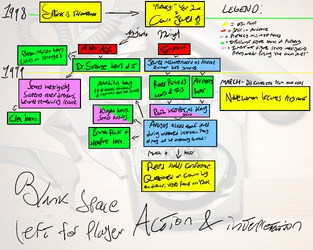
I probably should have clarified-- this is largely what I have plotted out. I'm just calling these things "plots" because it's what I'm used to and it's quick and easy.

To be as clear as possible, I'm going to copy-paste my personal summary for the plot here:

"On Y2K, a human baby will be born in Wiltshire that acts as its own inherent source of magic. It represents the next step in the evolution of humanity on a spiritual level in the same way that mutants represent it on a physical level. It will usher in an age in which human sorcerers no longer need to rely on other dimensions for grand magical power, and will be joined by several (very rare) humans as time goes on.

The birth of this baby vaguely coincides with the attacking of a sphinx in Egypt. Terrified for its life and hoping to find some way of invoking its ancestors' long-dead ruler, Set, the sphinx screams a prophecy that tells of a Crown Jewel arriving on the first of January. It is mostly nonsense, akin to the ramblings of a dying man, but those two aspects strike enough fear in the attacker's heart to cause him to flee. The attacker returns to New York City, frightened beyond words, and tells anyone who will listen of what he'd been told.

Given that the man lives in Greenwich Village, it isn't long before Dr. Strange hears of his crazed ramblings while disguised. The man explains his situation to the good doctor thoroughly, citing the sphinx's prediction of a crown jewel as "the coming of a new age," and concerning the mystic enough (after application of the Eye of Agamotto proves he's speaking the truth) to prompt him to embark on an interdimensional pilgrimage to solve the man's riddle.

Not long after, the crazed man either perishes or vanishes. Those who've heard and believed his ramblings take to the streets, convinced that his disappearance might have meant something, and begin putting up posters all across the city ominously warning of "the crown jewel of tomorrow" ("Have you seen the crown jewel of tomorrow?" -make up some elaboration on its ties to Y2K-). These posters are quickly noticed by local villains and heroes alike, and so begins a tangled web of miscommunications that ultimately misconstrue a scared monster's words into prophecy..."

prophecy_flowchart.png
This is the aforementioned flowchart, drawn up in like 10 minutes just to keep my thoughts in one place while fleshing them out. The Month+ time skip between the last two nodes is also inaccurate and needs to be fixed, but got lost in the rest of my prep and will be returned to later. It's more like 3 weeks between those two events, not a month or more.

It is mostly meant as a means to tie the party together with a bunch of villains and NPCs through something they might have in common. All of the PCs so far are coming from pretty disparate backgrounds, as are many of the villains I'd most like to play, so sending everyone on a "treasure" hunt is basically just the framework for other stuff I want to spin out. I'm hoping that, in pursuing the "crown jewel of tomorrow," players get distracted and find more interesting subplots and corners of the universe to play around in.

The "crown jewel" is just that baby, born in England. He isn't omnipotent or world-changing, he isn't actually the subject of a prophecy (really, his birth just lined up unfortunately with the sphinx's dying gasps), he's the son of a nobleman who acts as a herald for things to come. If the players don't find him, that's fine. The world's top mystic will, instead, and I'll have subplot stuff regarding the kid and the effect his birth has on the magical world going on in the background. I mostly wanted some sort of framework to bring everyone together with, and figured that aping off the pre-2000 hysteria sweeping most of the civilized world would've worked. Then I added a magical flavor to it, to contrast with the heavy scientific focus the Y2K bug always brings, and changed what's usually a world-ending event or disaster into what I thought was a more fitting "apocalypse" to keep stakes somewhat low yet somewhat interesting.

I'm honestly more used to this sort of reactive improv than I am to normal storytelling, due to a variety of factors going back over a decade, so I'm hoping my weaknesses don't lie in that...

Have interesting ideas for IF the players do this, or if they go here, but never assume that they will do those things.
Aye aye, cap'n. I was worried that a lot of my subplot ideas might be kaput since they're pretty vague right now. "Mutant tensions are high and small terrorist cells are cropping up," "the Avengers are having roster troubles so NYC is looking for newer heroes to pick up the slack," mostly vague indeterminate stuff like that. I have some important locations in mind for some of these plots, but not a lot of them. Should I be focusing more on where/when something might happen as opposed to why?

What my players tell me were the best sessions they've ever had are ones where they never actually engaged with entire sprawling plots I devised for them and got entirely hung up on a minor side thing I mentioned in passing to flesh out a scene. I've had games where I've spent weeks planning out Byzantine political intrigue, only for them to spend the entire session at the library.
Another part of me is screaming at myself that I'm overpreparing and I should just start with the one premise for the party's meeting that I have and go from there, specifically due to this kind of stuff, partly as a means of being lazy and not actually doing much plotting work myself. Please don't encourage that part of me. :story:

There's another lesson in that - pay attention to what your players engage with, and give it to them. You're there to entertain them. Making everybody do the tedious kingdom succession plot when they really want to go see what's up with that fisherman's hut you mentioned an hour ago is a great way to lose players.
I'm trying to do this, yeah. It's a little hard atm, when half my players haven't really got characters yet, but it's why I was making all those polls and I've been putting a decent amount of emphasis on having them work with me one-on-one for backstories.

Building on that - your players are the stars, not your NPCs. If you have to have one NPC talk to another, it should be relatively rare, last less than twenty seconds, and have something relevant to your PCs. Do not sing to your players. If you must sing to your players, don't do it for three straight minutes. (This might be a personal note...)
I wouldn't have the balls...

...on a slightly related note, are silly voices required? I'm no good at those.

Players often feel powerful, typically warranted as GMs haven't been generally willing to murder characters for twenty years,
if only I were so kind

so they aren't typically motivated by fear or danger. Give them an NPC they like (and you have very little influence over whether they like this NPC, you have to develop this naturally) and put THEM in danger.

Finally, he hates you and wants you dead for posting here, but Matt Colville's "Running the Game" series on YouTube is a masterclass in the craft.
I'll seek it out and try to learn, then! Many thanks, for both the recommendation and expansive post. :)

What he said, but with the addition of "it's improv", have fun, see where situations lead. The players are the main characters so it's okay to have those cliches.
Which clichés? "The party walks into a bar?"

Don't forget to report here how the sessions went. One of the best things about RPG is listening to people's stories to steal some ideas for our own campaigns.
I probably will, just because I will want feedback and someone to talk to, but I will warn that it'll be very heavy on the comics capeshit and might be kind of impenetrable if you haven't wasted a full year reading old Marvel stuff for the fun of it. Would it still be okay to post that kind of stuff? Or would I need to make it more understandable to warrant it being more than just spam?
 
Última edición:
Which clichés? "The party walks into a bar?"
They just happen to hear conversations at convenient times. Little contrivances to keep things moving, so the party doesn't get derailed (for too long). If they're looking for a guy, they can just stumble into him, and that starts a chase through a city or crowd.
 
I just dm'ed for the first time last week and I had like 15 minutes setting up the VTT and winged the entire session. I didnt do great but my players said they had a fun time, you need to remember that you arent some actor like on youtube and your players want to roll dice and have fun. If they know you are new they will let stuff slide.
 
I actually do kinda like Delta Green's approach to Sanity. Every player has "Bonds," be it a spouse, a friend, a church group, an organization, what have you. When you face sanity loss, you can choose to project onto a bond. Rather than take the San loss, you damage the relationship with that bond. "Home scenes" are meant to be roleplaying this damage - lashing out at your wife because you've seen horrible things you can't talk about with anyone. The home scenes are not 100% necessary, just flavor. But if you're taking that San hit at the same time as the party, you create a new bond - Delta Green - that can grow, representing you withdrawing into the job until it becomes your entire life.

I think it's neat. 🤷‍♂️
I didn't play it, but in a similar vein was the Stress levels in the recent Alien game. There's simply a level when everyone just can't take any more regardless of training or background or job and once you start failing those Stress resistance rolls, your character starts panicking and your actions become harder and harder to do until you just break and run. I think it's a neat mechanic considering most of the time you're playing a space trucker or some other such job. Even the Marine characters have the same Stress reaction. It doesn't matter how many Bug Hunts you've been on, there comes a point when your brain simply says "nope, that's enough."

But the androids don't have that problem. They don't have fear or stress or any of those limitations. Of course that doesn't make them suicidal or one man wrecking crews. Like Bishop said "I may be artificial, but I'm not stupid."
 
I just dm'ed for the first time last week and I had like 15 minutes setting up the VTT and winged the entire session. I didnt do great but my players said they had a fun time, you need to remember that you arent some actor like on youtube and your players want to roll dice and have fun. If they know you are new they will let stuff slide.
Even if you're experienced they'll tend to let shit slide so long as you aren't an asshole about it and everyone is having fun. I've been permaDM'd for years with my group and I'll straight up tell them "I'm too lazy to look it up right now so we'll just do it like this for now" and if they have any objections I'll hear them but my word is still final.
 
Even if you're experienced they'll tend to let shit slide so long as you aren't an asshole about it and everyone is having fun. I've been permaDM'd for years with my group and I'll straight up tell them "I'm too lazy to look it up right now so we'll just do it like this for now" and if they have any objections I'll hear them but my word is still final.
And this is part of the thing about being an absolutely tyrannical dictator. You pretty much HAVE to do this as a GM. But if you're a retard about it, everyone leaves and your game dies. So you really have to be a benevolent tyrant. Your final word has to be something that everyone more or less agrees with. In short, if you go whizzard or something, you're getting punched in the face.
 
Atrás
Top Abajo