Sharp partisan divide over sympathy with striking writers and actors, poll finds
Los Angeles Times (archive.ph)
By Julia Wick
2023-08-04 14:22:34GMT
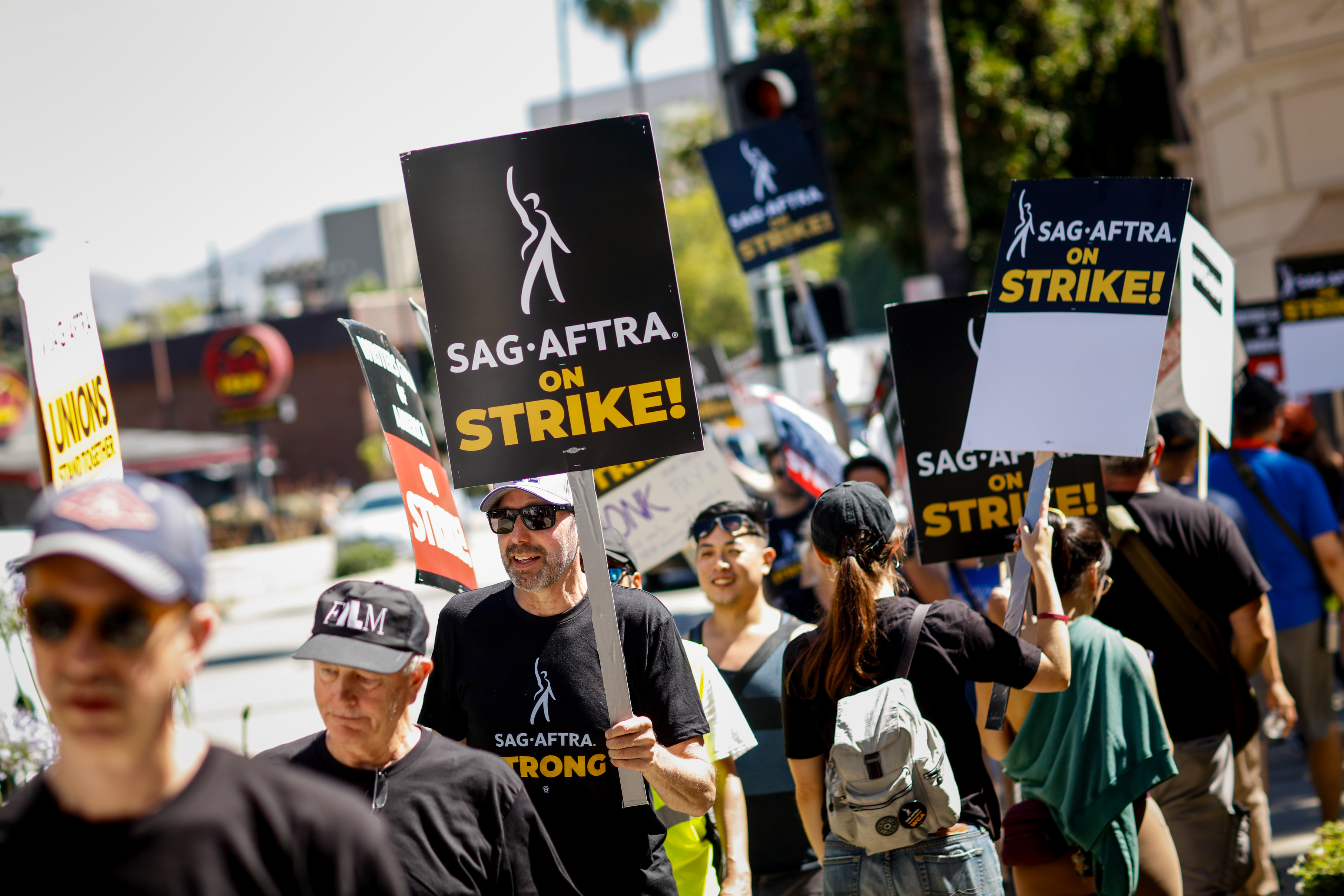
Members of the Screen Actors Guild - American Federation of Television and Radio Artists (SAG-AFTRA) joined members of the Writers Guild of America (WGA) picketing outside the Warner Bros. studio lot, in Burbank on July 14. (Jay L. Clendenin / Los Angeles Times)
The historic labor dispute paralyzing Hollywood is not, on its face, a partisan issue.
Artificial intelligence and residuals on streaming platforms — the most divisive issues in contract negotiations between the studios and unions representing writers and actors — do not map neatly onto the left-right political spectrum.
But there is a strong partisan divide in how Americans view the strikes, according to a new poll for the Los Angeles Times: People who said they voted for President Biden in 2020 were much more likely to side with the striking actors and writers than people who said they voted for former President Trump, according to the poll, which was conducted for The Times by Leger, a Canada-based polling firm with experience in U.S. surveys.
Neither Biden nor Trump voters had particularly warm feelings about the entertainment and media corporations represented by the Alliance of Motion Picture and Television Producers: Ten percent of Trump voters and 6% of Biden voters said they sided with the companies, according to the Times/Leger poll.
But 49% of Biden voters said they were more sympathetic to the writers, actors and their unions, while just 27% of Trump voters said the same.
That’s not surprising, given that Hollywood often plays the bogeyman in right-wing political discourse.
“All else being equal, the fact that actors and writers are artists would make them especially unpopular with the political right,” said Gabriel Rossman, a UCLA professor of sociology. The right tends to identify the elite “as a cultural elite rather than a financial elite,” Rossman said.
Screenwriters represented by the Writers Guild of America went on strike May 2 and actors represented by SAG-AFTRA joined the picket lines in mid-July, grinding most production to a halt. The first double strike of writers and actors since 1960 has triggered broader economic pain in Los Angeles, where restaurants, real estate agents and even local dry cleaners are all feeling the rippling effects.
The picket lines have become a popular stop for California Democratic candidates as well as occasional Republicans. Biden also called for fair pay and benefits for the striking writers and actors. (As a former reality TV star, Trump was actually a longtime SAG-AFTRA member, though he resigned from the guild after the union brought disciplinary action over his alleged role in inciting the Jan. 6 riot at the U.S. Capitol.)
A roughly equal number of Biden and Trump voters (31% and 30%, respectively) said they were equally sympathetic to both sides in the dispute. But Biden voters were much more likely to have an overall opinion, with nearly twice as many Trump voters saying they didn’t have an opinion.
The most obvious explanation for the political disparity is also the simplest one: Democrats have generally been the party of organized labor, while Republicans tend to view unions less favorably.
Democrats have made organized labor a central part of their coalition since at least the New Deal, Rossman noted.
But whom the striking unions represent is also salient to the partisan divide, particularly during a moment when politics have become polarized around social and cultural issues, rather than economics, Rossman said.
Attitudes about cultural capital likely play into how Americans perceive the striking actors and their work.
A plurality of respondents, 45%, said they saw actors in general as “people doing their work like anybody else,” while 38% characterized them as “part of a privileged elite.”
But that view diverged sharply along political lines, with 61% of Biden voters identifying actors as ordinary workers, while 55% of Trump voters categorized them as part of the privileged elite.
City dwellers, a heavily Democratic group, were also more likely to see actors as ordinary workers, while rural residents, predominantly Republican, were more likely to view them as part of a privileged group.
Attitudes about the relative privilege of actors also strongly matched broader opinions about the strike, with a majority of people who saw actors as ordinary workers siding with the unions. Less than a third of respondents who saw actors as privileged sympathized with the unions.
Professional acting is often synonymous with celebrity in the public consciousness, at least among people who aren’t personally familiar with a call sheet. But the average actor in Los Angeles is far more likely to be a member of the creative underclass, squeezing in auditions between shifts at a service job, than a wealthy star.
More than 87% of SAG-AFTRA’s 160,000 members do not bring in the minimum amount of income — $26,470 — required to qualify for the union’s health insurance, according to the union.
Brent Sexton, a character actor who has steadily worked in Hollywood over the last two decades but is far from a household name, described the paradox in a recent interview.
“I think a lot of people think that most actors have it easy. They don’t know the day-to-day hustle. They don’t know the rejection,” said Sexton, who is best known for his work in HBO’s “Deadwood,” NBC’s “Life” and AMC’s “The Killing.”
“They don’t know everything it entails to try to have a career in this business and the constant work that is required. There’s just been a steady degradation of the ability to make a living.”
Ultimately, despite the partisan split in how the public views the double strike, the issues in dispute have little to do with the partisan culture wars, said Steven J. Ross, a professor of history at USC and author of several books about Hollywood and labor history.
“It’s a traditional labor-capital battle,” Ross said. “And whether it was the 1880s or the 2020s, it’s the same basic idea: ‘We want better wages, better conditions.’”
From the time Samuel Gompers founded the American Federation of Labor in 1886, every strike has, at its core, been about the same basic issue: what constitutes a fair share of the profit for workers, Ross said.
New technologies that upset previous models and revenue metrics complicate those fights, since they raise questions about what kind of profits are actually being made. Those debates have played a major role in Hollywood labor divisions for decades, with unions fighting over residuals from movie reruns, home videos and now streaming.
What makes this strike different, Ross said, is the “existential threat” that artificial intelligence poses to many Hollywood jobs.
“This isn’t about just reducing wages and reducing hours and how many episodes, this is about simply replacing you with artificial intelligence,” the historian said.
The Times/Leger poll surveyed 1,002 adult Americans between July 28 and July 30. The results have an estimated margin of error of 3 percentage points in either direction.
Los Angeles Times (archive.ph)
By Julia Wick
2023-08-04 14:22:34GMT
Members of the Screen Actors Guild - American Federation of Television and Radio Artists (SAG-AFTRA) joined members of the Writers Guild of America (WGA) picketing outside the Warner Bros. studio lot, in Burbank on July 14. (Jay L. Clendenin / Los Angeles Times)
The historic labor dispute paralyzing Hollywood is not, on its face, a partisan issue.
Artificial intelligence and residuals on streaming platforms — the most divisive issues in contract negotiations between the studios and unions representing writers and actors — do not map neatly onto the left-right political spectrum.
But there is a strong partisan divide in how Americans view the strikes, according to a new poll for the Los Angeles Times: People who said they voted for President Biden in 2020 were much more likely to side with the striking actors and writers than people who said they voted for former President Trump, according to the poll, which was conducted for The Times by Leger, a Canada-based polling firm with experience in U.S. surveys.
Neither Biden nor Trump voters had particularly warm feelings about the entertainment and media corporations represented by the Alliance of Motion Picture and Television Producers: Ten percent of Trump voters and 6% of Biden voters said they sided with the companies, according to the Times/Leger poll.
But 49% of Biden voters said they were more sympathetic to the writers, actors and their unions, while just 27% of Trump voters said the same.
That’s not surprising, given that Hollywood often plays the bogeyman in right-wing political discourse.
“All else being equal, the fact that actors and writers are artists would make them especially unpopular with the political right,” said Gabriel Rossman, a UCLA professor of sociology. The right tends to identify the elite “as a cultural elite rather than a financial elite,” Rossman said.
Screenwriters represented by the Writers Guild of America went on strike May 2 and actors represented by SAG-AFTRA joined the picket lines in mid-July, grinding most production to a halt. The first double strike of writers and actors since 1960 has triggered broader economic pain in Los Angeles, where restaurants, real estate agents and even local dry cleaners are all feeling the rippling effects.
The picket lines have become a popular stop for California Democratic candidates as well as occasional Republicans. Biden also called for fair pay and benefits for the striking writers and actors. (As a former reality TV star, Trump was actually a longtime SAG-AFTRA member, though he resigned from the guild after the union brought disciplinary action over his alleged role in inciting the Jan. 6 riot at the U.S. Capitol.)
A roughly equal number of Biden and Trump voters (31% and 30%, respectively) said they were equally sympathetic to both sides in the dispute. But Biden voters were much more likely to have an overall opinion, with nearly twice as many Trump voters saying they didn’t have an opinion.
The most obvious explanation for the political disparity is also the simplest one: Democrats have generally been the party of organized labor, while Republicans tend to view unions less favorably.
Democrats have made organized labor a central part of their coalition since at least the New Deal, Rossman noted.
But whom the striking unions represent is also salient to the partisan divide, particularly during a moment when politics have become polarized around social and cultural issues, rather than economics, Rossman said.
Attitudes about cultural capital likely play into how Americans perceive the striking actors and their work.
A plurality of respondents, 45%, said they saw actors in general as “people doing their work like anybody else,” while 38% characterized them as “part of a privileged elite.”
But that view diverged sharply along political lines, with 61% of Biden voters identifying actors as ordinary workers, while 55% of Trump voters categorized them as part of the privileged elite.
City dwellers, a heavily Democratic group, were also more likely to see actors as ordinary workers, while rural residents, predominantly Republican, were more likely to view them as part of a privileged group.
Attitudes about the relative privilege of actors also strongly matched broader opinions about the strike, with a majority of people who saw actors as ordinary workers siding with the unions. Less than a third of respondents who saw actors as privileged sympathized with the unions.
Professional acting is often synonymous with celebrity in the public consciousness, at least among people who aren’t personally familiar with a call sheet. But the average actor in Los Angeles is far more likely to be a member of the creative underclass, squeezing in auditions between shifts at a service job, than a wealthy star.
More than 87% of SAG-AFTRA’s 160,000 members do not bring in the minimum amount of income — $26,470 — required to qualify for the union’s health insurance, according to the union.
Brent Sexton, a character actor who has steadily worked in Hollywood over the last two decades but is far from a household name, described the paradox in a recent interview.
“I think a lot of people think that most actors have it easy. They don’t know the day-to-day hustle. They don’t know the rejection,” said Sexton, who is best known for his work in HBO’s “Deadwood,” NBC’s “Life” and AMC’s “The Killing.”
“They don’t know everything it entails to try to have a career in this business and the constant work that is required. There’s just been a steady degradation of the ability to make a living.”
Ultimately, despite the partisan split in how the public views the double strike, the issues in dispute have little to do with the partisan culture wars, said Steven J. Ross, a professor of history at USC and author of several books about Hollywood and labor history.
“It’s a traditional labor-capital battle,” Ross said. “And whether it was the 1880s or the 2020s, it’s the same basic idea: ‘We want better wages, better conditions.’”
From the time Samuel Gompers founded the American Federation of Labor in 1886, every strike has, at its core, been about the same basic issue: what constitutes a fair share of the profit for workers, Ross said.
New technologies that upset previous models and revenue metrics complicate those fights, since they raise questions about what kind of profits are actually being made. Those debates have played a major role in Hollywood labor divisions for decades, with unions fighting over residuals from movie reruns, home videos and now streaming.
What makes this strike different, Ross said, is the “existential threat” that artificial intelligence poses to many Hollywood jobs.
“This isn’t about just reducing wages and reducing hours and how many episodes, this is about simply replacing you with artificial intelligence,” the historian said.
The Times/Leger poll surveyed 1,002 adult Americans between July 28 and July 30. The results have an estimated margin of error of 3 percentage points in either direction.


