
- Registrado
- 17 de Dic, 2019
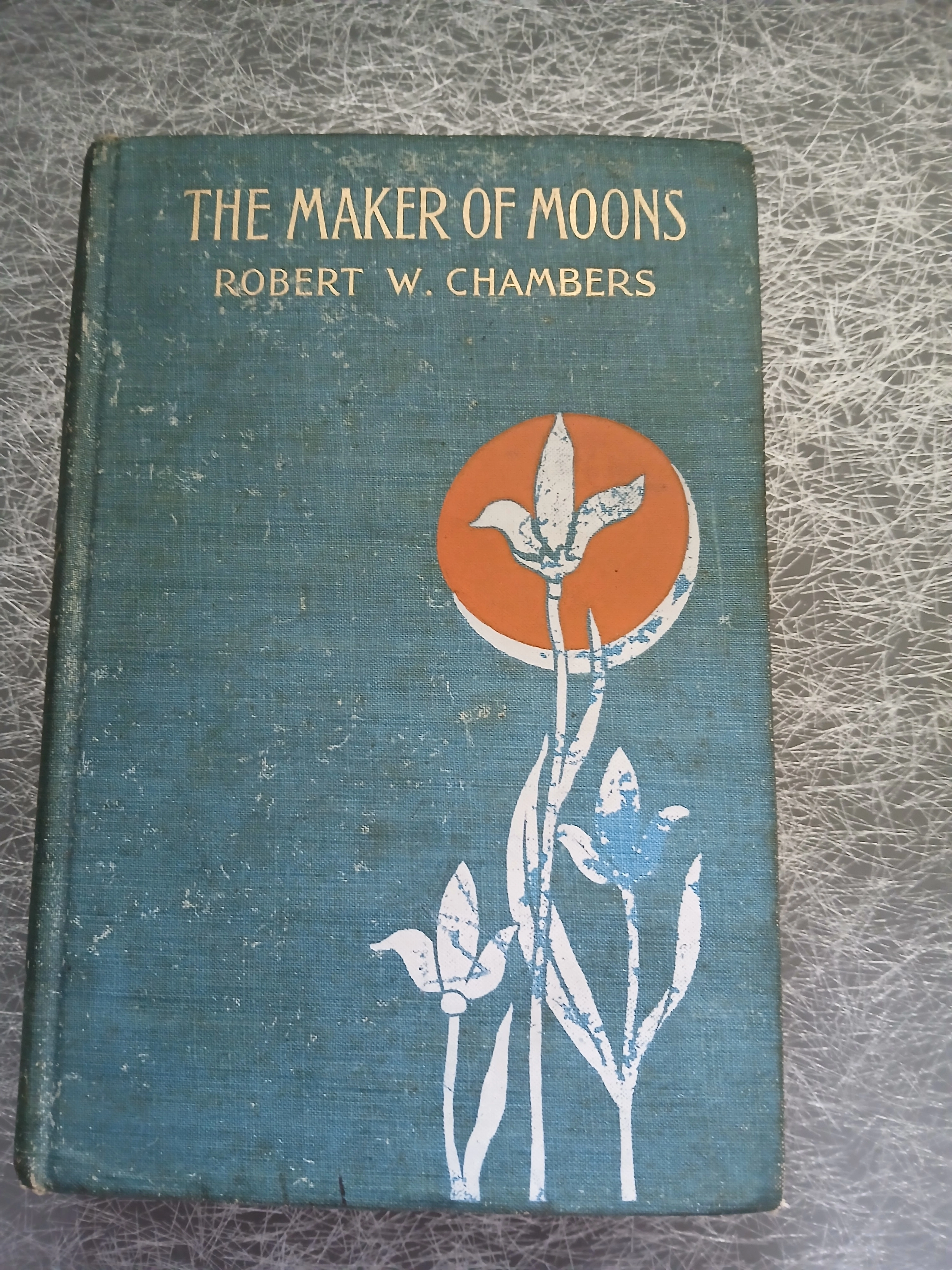
I recently got an antique copy (excellent condition for its age) of The Maker of Moons by Robert W. Chambers.
First off--a little background from Cuckipedia:
The Maker of Moons is an 1896 short story collection by Robert W. Chambers which followed the publication of Chambers' most famous work, The King in Yellow (1895).
It contained eight new stories, including the title story, one of his weird tales, and several romantic Art Nouveau stories, concluding with two more weird tales. These two tales were subsequently incorporated into the episodic novel In Search of the Unknown.
The first three stories are linked by the theme of a dream wife named Ysonde. The weird nature of the first story has echoes in the other two, which feature picturesque animal figures, such as a red ibis and a disagreeable porcupine.
The story "In the Name of the Most High" is set during the American Civil War. The next two stories are humorous romantic tales with a fishing theme and setting. Chambers' love of natural scenery illuminates most of the stories.
The short story was published by Putnam's, in New York and London, in 1896.
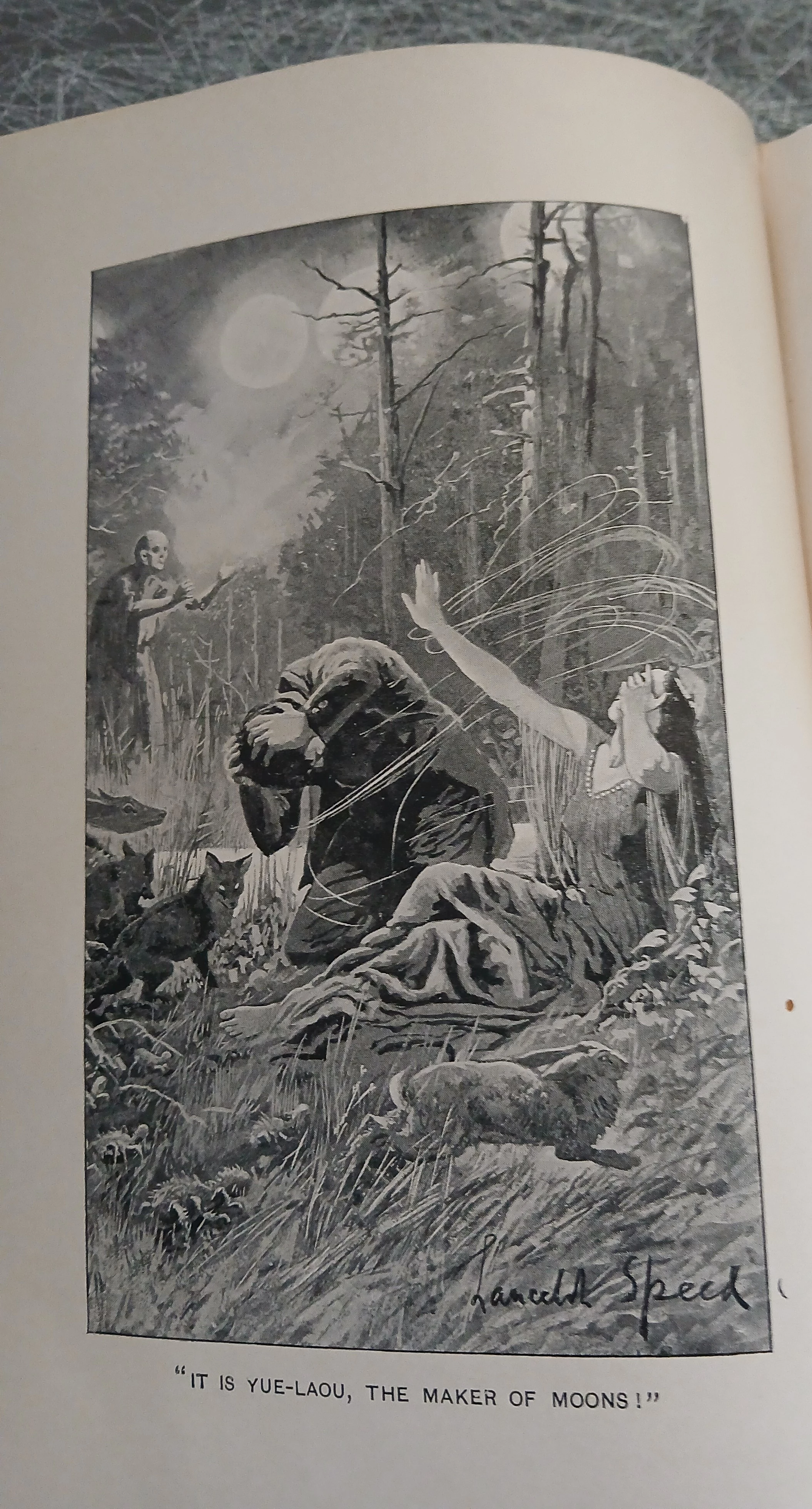
The first edition featured a frontispiece with a black and white illustration by Lancelot Speed.
The book also contains the illustration by Lancelot Speed:
NOTE: The bottom left of the illustration. In The Maker of Moons, there are these mutated lizard-like crab/spider creatures mentioned frequently in the story. These are "products"(?) (Chambers never fully explains) of Yue Laou.
Not much else is said online about this book. But after reading it, I think I stumbled across a real hidden gem of Weird Fiction/Cosmic Horror.
The Maker of Moons, The Silent Land, The Black Water, A Pleasant Evening, and The Man at the Next Table all eerily hint at the King in Yellow and Hastur's influence.
In the Maker of Moons, a "King of Carcosa" is mentioned to the dream wife, Ysonde. Yian is described as a dreamlike city, beautiful and unattainable. In the Silent Land, and The Black Water, reality falls apart for the protagonist in both stories. Both stories revolve around the same dreamlike young woman, Ysonde.
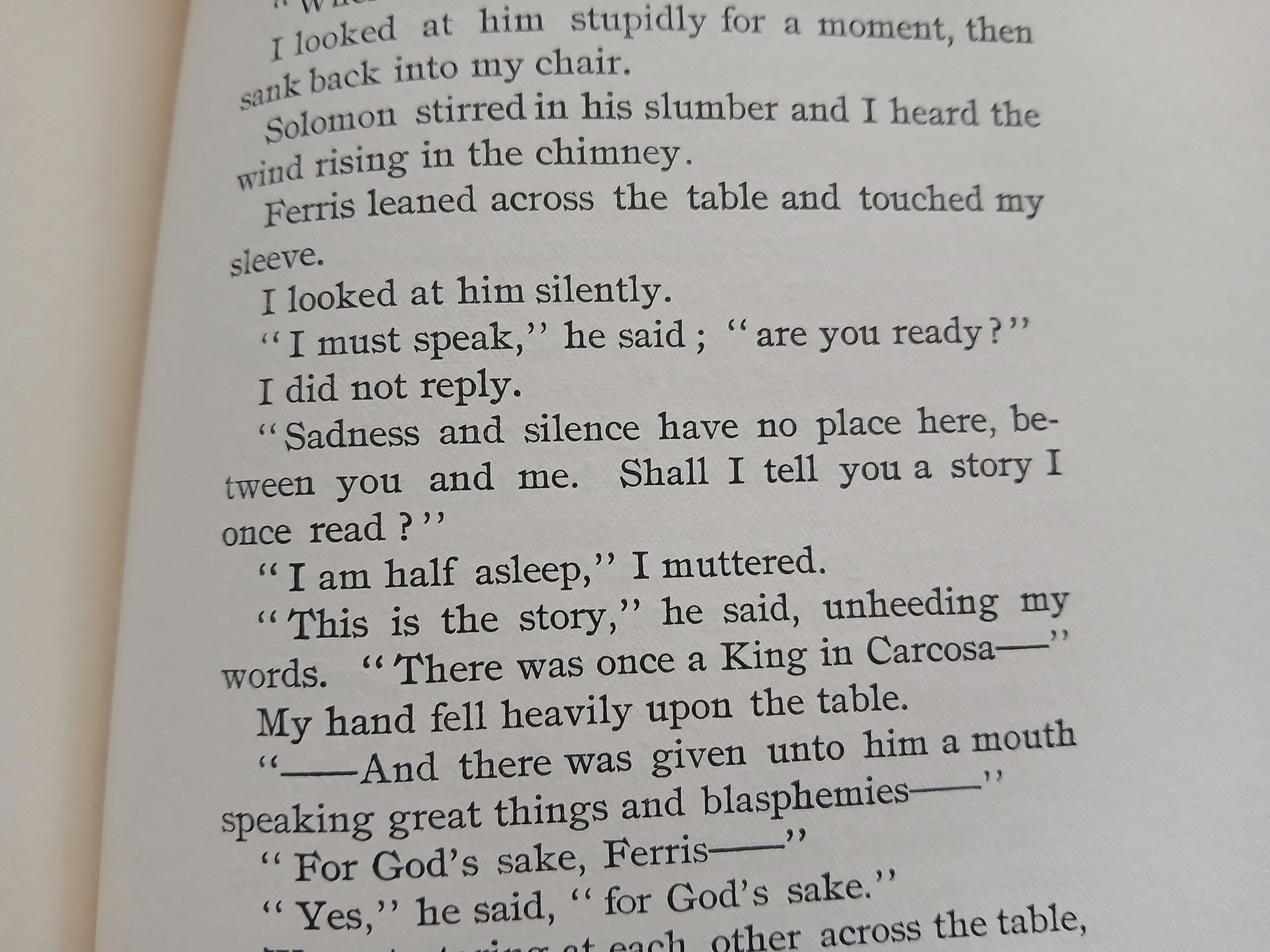
A page from The Silent Land mentioning the King:
In The Man at the Next Table, there is a professor who dogs the protagonist's every step with his daughter in tow. Here, reality breaks down and the professor, wearing a long tasseled (tattered) robe that he ties in knots, also wears a yellow nightcap. Reality seems to shatter with each knot tied in the man's robe. The story is festooned with absurdities like cats following the protagonist, his great aunt dying and transforming into a cat that follows the protagonist, and the yellow capped professor eating catnip and using a flute to play music that brings hoards of cats in to follow the protagonist like the pied piper.
The first three stories end similarly in that the narrator is back in reality. Ysonde is his wife, and it is suggested that he is pulling her strings and telling stories rather than experiencing a breakdown of reality/sanity.
One of the things that really, REALLY sells this book for me was Chambers' mastery of atmospheric writing. BEAUTIFUL. DREAMLIKE. GORGEOUS word paintings describing woodlands, streams, the city of Antwerp...
Then there is the story: In The Name of the Most High.
This is a Civil War Era story. Have you ever watched Glory? Go watch that. Then read In the Name of the Most High. All I will tell you is that the protagonist is fooled by a "young messenger" of the Confederate side.
If you've watched Saving Private Ryan and got CPTSD from the Normandy Beach scenes--then you NEED to read In the Name of the Most High. Hard to believe Chambers was allowed to be so graphic with death and battles like that. And it is an AMAZING story in its own right, though it is NOT a cosmic horror or weird tale.
If you like ghost/spirit/entity horror, read A Pleasant Evening. Another atmospheric tale where the protagonist meets a female spirit/entity. Chambers did not stick to the played out Victorian/Edwardian ghost stories popular in his day. This is not an E.F. Benson spook story, but strange and beautiful and haunting.
Carcosa is specifically mentioned TWICE in this book. Once in The Maker of Moons. The second time in The Silent Land. "There once was a King in Carcosa--" This same sentence is found in both stories.
I wondered, after finishing the book, if ANYONE (in our lifetime) has actually read the book since there's next to nothing online about it. The book is available, both in reprint and antique. There is even another first edition for sale on ebay--MUCH cheaper than a copy of The King in Yellow, which seems to be going for hundreds--or even thousands--for an antique copy.
I do have a reprint copy of The King in Yellow. And it sucks because it contains ONLY the stories mentioning the play. Cassilda's Song is not in this book either. It's irritating that there doesn't seem to be a good, comprehensive, hardcover reprint. It seems that publishers wanted to DECIDE FOR US which of the stories contained in The King in Yellow are relevant for us to read. But I think it should be up to the reader to decide what is relevant. I imagine ALL the stories in that book are somewhat relevant.
As a former teacher, I'm aware of the Gutenberg Project. But I like to read a good old TRADITIONAL book. I have read a few of the King in Yellow stories on the Gutenberg site, but I also think (in light of publishers like Penguin going woke and censoring books like P.G. Wodehouse's Jeeves books) that having, and reading, an original--or decades old--copy is best. All the story. All the context. No woke. No telling you how to feel about something. No politics. Just story and YOUR thoughts, YOUR feelings, and YOUR interpretation.
Anyway, I thought since many of you also love H.P. Lovecraft, you might like to discuss some of Robert Chambers' writings.
First off--a little background from Cuckipedia:
The Maker of Moons is an 1896 short story collection by Robert W. Chambers which followed the publication of Chambers' most famous work, The King in Yellow (1895).
It contained eight new stories, including the title story, one of his weird tales, and several romantic Art Nouveau stories, concluding with two more weird tales. These two tales were subsequently incorporated into the episodic novel In Search of the Unknown.
The first three stories are linked by the theme of a dream wife named Ysonde. The weird nature of the first story has echoes in the other two, which feature picturesque animal figures, such as a red ibis and a disagreeable porcupine.
The story "In the Name of the Most High" is set during the American Civil War. The next two stories are humorous romantic tales with a fishing theme and setting. Chambers' love of natural scenery illuminates most of the stories.
The short story was published by Putnam's, in New York and London, in 1896.
The first edition featured a frontispiece with a black and white illustration by Lancelot Speed.
Contents
- "The Maker of Moons"
- "The Silent Land"
- "The Black Water"
- "In the Name of the Most High"
- "Boy's Sister"
- "The Crime"
- "A Pleasant Evening"
- "The Man At The Next Table"
The book also contains the illustration by Lancelot Speed:
NOTE: The bottom left of the illustration. In The Maker of Moons, there are these mutated lizard-like crab/spider creatures mentioned frequently in the story. These are "products"(?) (Chambers never fully explains) of Yue Laou.
Not much else is said online about this book. But after reading it, I think I stumbled across a real hidden gem of Weird Fiction/Cosmic Horror.
The Maker of Moons, The Silent Land, The Black Water, A Pleasant Evening, and The Man at the Next Table all eerily hint at the King in Yellow and Hastur's influence.
In the Maker of Moons, a "King of Carcosa" is mentioned to the dream wife, Ysonde. Yian is described as a dreamlike city, beautiful and unattainable. In the Silent Land, and The Black Water, reality falls apart for the protagonist in both stories. Both stories revolve around the same dreamlike young woman, Ysonde.
A page from The Silent Land mentioning the King:
In The Man at the Next Table, there is a professor who dogs the protagonist's every step with his daughter in tow. Here, reality breaks down and the professor, wearing a long tasseled (tattered) robe that he ties in knots, also wears a yellow nightcap. Reality seems to shatter with each knot tied in the man's robe. The story is festooned with absurdities like cats following the protagonist, his great aunt dying and transforming into a cat that follows the protagonist, and the yellow capped professor eating catnip and using a flute to play music that brings hoards of cats in to follow the protagonist like the pied piper.
The first three stories end similarly in that the narrator is back in reality. Ysonde is his wife, and it is suggested that he is pulling her strings and telling stories rather than experiencing a breakdown of reality/sanity.
One of the things that really, REALLY sells this book for me was Chambers' mastery of atmospheric writing. BEAUTIFUL. DREAMLIKE. GORGEOUS word paintings describing woodlands, streams, the city of Antwerp...
Then there is the story: In The Name of the Most High.
This is a Civil War Era story. Have you ever watched Glory? Go watch that. Then read In the Name of the Most High. All I will tell you is that the protagonist is fooled by a "young messenger" of the Confederate side.
If you've watched Saving Private Ryan and got CPTSD from the Normandy Beach scenes--then you NEED to read In the Name of the Most High. Hard to believe Chambers was allowed to be so graphic with death and battles like that. And it is an AMAZING story in its own right, though it is NOT a cosmic horror or weird tale.
If you like ghost/spirit/entity horror, read A Pleasant Evening. Another atmospheric tale where the protagonist meets a female spirit/entity. Chambers did not stick to the played out Victorian/Edwardian ghost stories popular in his day. This is not an E.F. Benson spook story, but strange and beautiful and haunting.
Carcosa is specifically mentioned TWICE in this book. Once in The Maker of Moons. The second time in The Silent Land. "There once was a King in Carcosa--" This same sentence is found in both stories.
I wondered, after finishing the book, if ANYONE (in our lifetime) has actually read the book since there's next to nothing online about it. The book is available, both in reprint and antique. There is even another first edition for sale on ebay--MUCH cheaper than a copy of The King in Yellow, which seems to be going for hundreds--or even thousands--for an antique copy.
I do have a reprint copy of The King in Yellow. And it sucks because it contains ONLY the stories mentioning the play. Cassilda's Song is not in this book either. It's irritating that there doesn't seem to be a good, comprehensive, hardcover reprint. It seems that publishers wanted to DECIDE FOR US which of the stories contained in The King in Yellow are relevant for us to read. But I think it should be up to the reader to decide what is relevant. I imagine ALL the stories in that book are somewhat relevant.
As a former teacher, I'm aware of the Gutenberg Project. But I like to read a good old TRADITIONAL book. I have read a few of the King in Yellow stories on the Gutenberg site, but I also think (in light of publishers like Penguin going woke and censoring books like P.G. Wodehouse's Jeeves books) that having, and reading, an original--or decades old--copy is best. All the story. All the context. No woke. No telling you how to feel about something. No politics. Just story and YOUR thoughts, YOUR feelings, and YOUR interpretation.
Anyway, I thought since many of you also love H.P. Lovecraft, you might like to discuss some of Robert Chambers' writings.
Última edición por un moderador:


