Jim Goad died on June 22, 2026, following long-term health problems. Best known as the co-creator of Answer Me! and the author of The Redneck Manifesto, he leaves behind a large, provocative, and unmistakably personal body of work. What follows is a remembrance in his honor.
Jim Goad’s work was a huge influence on me.
I didn’t catch on to ANSWER Me! until it had already been reprinted by AK Press—and it is still wild to remember that AK Press was once cool enough to publish ANSWER Me! The First Three. But when The Redneck Manifesto came out in 1997, I jumped on it immediately. It was an important book to me. As a North Carolinian with relatives who lived in shacks and played clawhammer banjo, I have always been sensitive to the scapegoating of Southern whites, and to how culturally encouraged that contempt is. Jim saw it clearly and said it plainly.

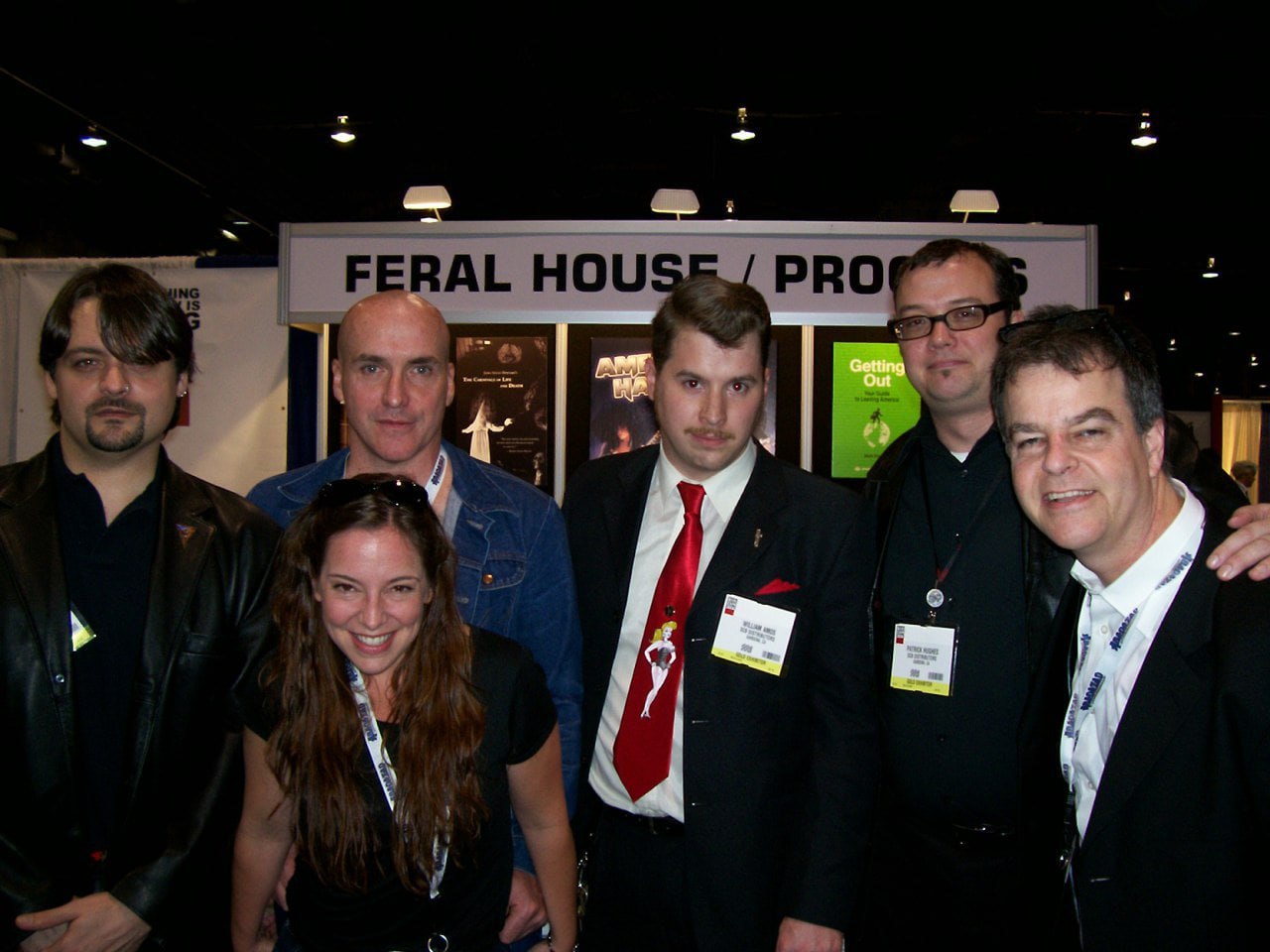
The Feral House / Process booth, BookExpo America, New York, 2007.
I’m in the center of that photograph, in the tie; Jim is the bald man beside me. Scapegoat Publishing, RIP—the imprint I ran with my brother Chris X—still had real book distribution then, and we were there to flog the new edition of ANSWER Me!, The Satanic Scriptures, and Stephen Kasner’s art book. That was one of only two times I got to spend with Adam Parfrey, RIP, who is also in the photo and was also a tremendous influence on me. I’m always quietly flattered when people compare my own work to his—though I know it’s a reach.
I was lucky enough to publish Jim’s work twice. The first was that expanded edition of ANSWER Me! The First Three, through Scapegoat. Years later, through Underworld Amusements, I published GUN FAG MANIFESTO, for which Jim wrote the introduction.
Getting Jim to sign my first-edition hardback of The Redneck Manifesto, decades after I bought it, meant a great deal to me. My wardrobe back then was full of garish thrifted jackets and ties—the tie in the photo has a naked woman on it. He inscribed the book, “To the New Howard Hughes.”
In 2016, when he was writing for Taki’s Magazine, he picked up a coinage I’d mentioned to him and turned it into a whole essay, “Smashing Through the Glass Coffin.” It would be later published in Gender Psychosis (Obnoxious Books, 2020). Jim could take some funny little neologism I had come up with to point out a cultural hypocrisy, hold it up to the light, and make it mean something larger and nastier and truer.
What Jim and I shared, underneath all of it, was a sense of justice without the usual religious scaffolding bolted to it—no creed, no sanctimony, no party line. Neither of us ever felt wholly inside any clique, even the ones that took us in. We worked with people you are not supposed to be seen in a room with, and we worked with people who wore tolerance as a credential. It was the second kind, far more than the first, who could not abide us once they understood we were not true believers.
We were difficult people. We dissented on the wrong topics. I was once asked how I hoped to be described after death, and I said, “intellectually precocious.” Jim, more honestly, called his life a shit magnet. He was more difficult than I was, and far more inclined to ride that tiger.
What we loathed, beyond any single disagreement, was the duplicity beneath it all: people who commit the injustice and parade through it in a cape of righteousness, who do the cruel or dishonest thing and call it virtue. Jim could smell that a mile off. So could I.

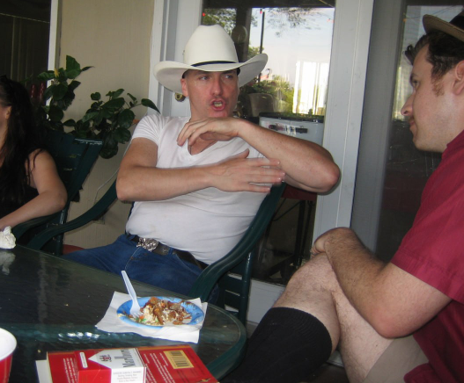
A Fourth of July at a friend’s house in Baltimore, 2007. Jim is in the middle; I’m on the right.
It was a lovely afternoon—good food, old friends, a holiday. I had brought a copy of Luc Sante’s Low Life along with me, because I am the sort of introvert who brings a book to a party. Nothing about the day was political in the slightest. That, apparently, was the problem. A local “alternative” bookseller went home afterward and wrote in his newsletter that “black socks and shorts are the new blackshirt.” He didn’t name me, or the friend who had turned up by pure coincidence in the same unfortunate old-man getup, but the meaning wasn’t subtle. I had a reputation in that town in my own right; Jim seated beside me in a cowboy hat was just the match to the powder. He knew the maneuver in his sleep, of course—it had followed him his whole life. We were both dressed up, anyway: his hat, my guayabera, my pulled-up socks, the whole silly business. The difference was that ours came off at the end of the night. His never did.
Jim and I were not intimate friends, and I don’t want to pretend otherwise. But we were friends, and that friendship mattered to me. He would call every six months or so. I very rarely called him. As a self-admitted fan, I always felt that calling just to talk might be an imposition, and as long as he called once in a while, everything was fine. Most of the time it seemed like he was workshopping material for one of his podcasts, and I didn’t mind. Sometimes it was personal problems. Every once in a while I even complained about my own.
I was so glad when he found his new wife. He had the most glowing things to say about her every time we spoke. I’m grateful he had that love in his life.
The last time we really talked, he told me he was going in for an experimental procedure. After that, the calls stopped. I noticed the silence had run longer than the usual six months, and that it felt different this time, but I kept to our unspoken arrangement and didn’t call. He would call when he was ready. He always had. He had gone quiet before and come back, so I told myself this was only that. I’ve wondered since whether sticking to that default—he’ll call me—was, in the end, an unintentional way of ceasing to be his friend. He called, and I waited. It had always been enough before.
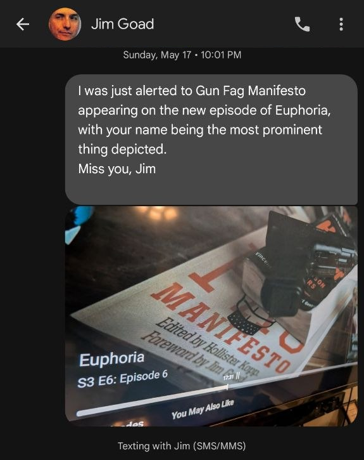
Not long ago, GUN FAG MANIFESTO turned up on an episode of Euphoria, of all things. I texted him about it on May 17. He was dying. I had no idea. It was read, but not answered.
 I am a fan of Jim Goad, and tohttps://counter-currents.com/2026/07/read-but-not-answered/day I am sad.
Jim Goad’s work was a huge influence on me.
I didn’t catch on to ANSWER Me! until it had already been reprinted by AK Press—and it is still wild to remember that AK Press was once cool enough to publish ANSWER Me! The First Three. But when The Redneck Manifesto came out in 1997, I jumped on it immediately. It was an important book to me. As a North Carolinian with relatives who lived in shacks and played clawhammer banjo, I have always been sensitive to the scapegoating of Southern whites, and to how culturally encouraged that contempt is. Jim saw it clearly and said it plainly.
The Feral House / Process booth, BookExpo America, New York, 2007.
I’m in the center of that photograph, in the tie; Jim is the bald man beside me. Scapegoat Publishing, RIP—the imprint I ran with my brother Chris X—still had real book distribution then, and we were there to flog the new edition of ANSWER Me!, The Satanic Scriptures, and Stephen Kasner’s art book. That was one of only two times I got to spend with Adam Parfrey, RIP, who is also in the photo and was also a tremendous influence on me. I’m always quietly flattered when people compare my own work to his—though I know it’s a reach.
I was lucky enough to publish Jim’s work twice. The first was that expanded edition of ANSWER Me! The First Three, through Scapegoat. Years later, through Underworld Amusements, I published GUN FAG MANIFESTO, for which Jim wrote the introduction.
Getting Jim to sign my first-edition hardback of The Redneck Manifesto, decades after I bought it, meant a great deal to me. My wardrobe back then was full of garish thrifted jackets and ties—the tie in the photo has a naked woman on it. He inscribed the book, “To the New Howard Hughes.”
In 2016, when he was writing for Taki’s Magazine, he picked up a coinage I’d mentioned to him and turned it into a whole essay, “Smashing Through the Glass Coffin.” It would be later published in Gender Psychosis (Obnoxious Books, 2020). Jim could take some funny little neologism I had come up with to point out a cultural hypocrisy, hold it up to the light, and make it mean something larger and nastier and truer.
What Jim and I shared, underneath all of it, was a sense of justice without the usual religious scaffolding bolted to it—no creed, no sanctimony, no party line. Neither of us ever felt wholly inside any clique, even the ones that took us in. We worked with people you are not supposed to be seen in a room with, and we worked with people who wore tolerance as a credential. It was the second kind, far more than the first, who could not abide us once they understood we were not true believers.
We were difficult people. We dissented on the wrong topics. I was once asked how I hoped to be described after death, and I said, “intellectually precocious.” Jim, more honestly, called his life a shit magnet. He was more difficult than I was, and far more inclined to ride that tiger.
What we loathed, beyond any single disagreement, was the duplicity beneath it all: people who commit the injustice and parade through it in a cape of righteousness, who do the cruel or dishonest thing and call it virtue. Jim could smell that a mile off. So could I.
A Fourth of July at a friend’s house in Baltimore, 2007. Jim is in the middle; I’m on the right.
It was a lovely afternoon—good food, old friends, a holiday. I had brought a copy of Luc Sante’s Low Life along with me, because I am the sort of introvert who brings a book to a party. Nothing about the day was political in the slightest. That, apparently, was the problem. A local “alternative” bookseller went home afterward and wrote in his newsletter that “black socks and shorts are the new blackshirt.” He didn’t name me, or the friend who had turned up by pure coincidence in the same unfortunate old-man getup, but the meaning wasn’t subtle. I had a reputation in that town in my own right; Jim seated beside me in a cowboy hat was just the match to the powder. He knew the maneuver in his sleep, of course—it had followed him his whole life. We were both dressed up, anyway: his hat, my guayabera, my pulled-up socks, the whole silly business. The difference was that ours came off at the end of the night. His never did.
Jim and I were not intimate friends, and I don’t want to pretend otherwise. But we were friends, and that friendship mattered to me. He would call every six months or so. I very rarely called him. As a self-admitted fan, I always felt that calling just to talk might be an imposition, and as long as he called once in a while, everything was fine. Most of the time it seemed like he was workshopping material for one of his podcasts, and I didn’t mind. Sometimes it was personal problems. Every once in a while I even complained about my own.
I was so glad when he found his new wife. He had the most glowing things to say about her every time we spoke. I’m grateful he had that love in his life.
The last time we really talked, he told me he was going in for an experimental procedure. After that, the calls stopped. I noticed the silence had run longer than the usual six months, and that it felt different this time, but I kept to our unspoken arrangement and didn’t call. He would call when he was ready. He always had. He had gone quiet before and come back, so I told myself this was only that. I’ve wondered since whether sticking to that default—he’ll call me—was, in the end, an unintentional way of ceasing to be his friend. He called, and I waited. It had always been enough before.
Not long ago, GUN FAG MANIFESTO turned up on an episode of Euphoria, of all things. I texted him about it on May 17. He was dying. I had no idea. It was read, but not answered.
 I am a fan of Jim Goad, and tohttps://counter-currents.com/2026/07/read-but-not-answered/day I am sad.


