Estás usando un navegador desactualizado. Es posible que no muestre este u otros sitios web correctamente. Deberías actualizar o usar un navegador alternativo.
DisasterReducing air pollution has triggered something worse that scientists didn't predict - Less pollution leads to more sun hitting the ocean leading rising temperatures. Whoops!
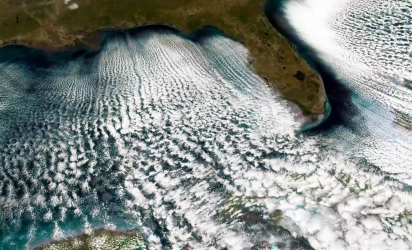
Scientists have determined that “marine cloud reflectivity,” caused by cleaner air, has dropped by roughly 2.8 percent per decade across the North Atlantic and Northeast Pacific.
Together, those regions span about one-seventh of the planet’s surface, making even small changes in brightness significant on a global scale.
In simple terms, fewer air particles produce dimmer clouds, which means less sunlight is reflected into space.
The shortwave energy that used to be reflected by clouds now reaches the sea surface. That, in turn, leads to ocean temperatures rising faster than ever before.
The finding helps explain why recent ocean warming has outpaced many forecasts. It points to a simple cause driven by complex physics.
Fading clouds, warming seas
The study was led by Dr. Knut von Salzen, a senior research scientist at the University of Washington (UW) whose work explores how tiny airborne particles and cloud microphysics shape Earth’s heat balance.
Clouds play a major cooling role by reflecting sunlight back into space – a property known as albedo – the fraction of light a surface reflects. Low clouds over cooler oceans handle much of this job.
But satellite data now reveal a subtle shift. The cloud radiative effect – the net change in energy caused by clouds – has weakened as marine clouds brightened less and covered less area.
The team zeroed in on the Northeast Pacific and North Atlantic, where ocean temperatures have risen rapidly over the past two decades.
Measurements from NASA’s CERES EBAF dataset show a steady drop in reflected shortwave radiation in these regions.
Together, these basins cover roughly 14 percent of Earth’s surface. Even a modest decline in cloud reflectivity can translate into a measurable boost in global warming.
Cleaner air, fewer cloud droplets
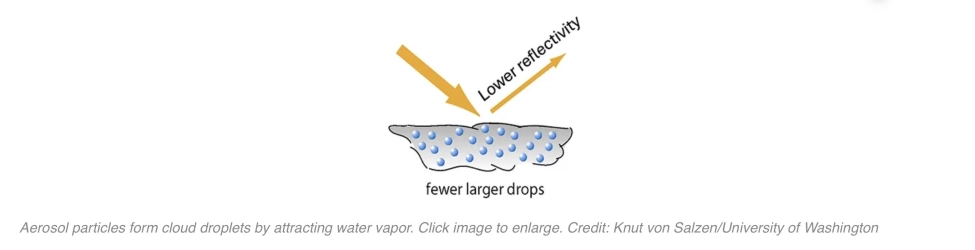
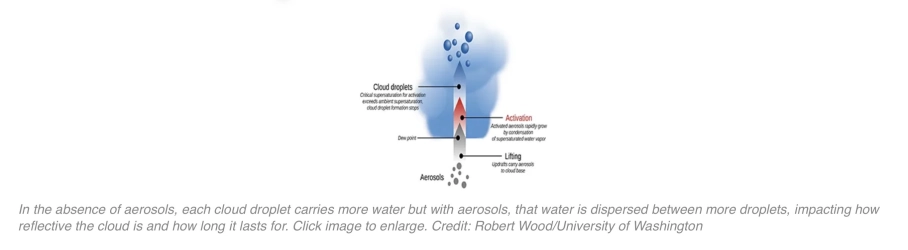
Airborne aerosols, tiny particles that seed cloud droplets, have declined as pollution controls tightened. With fewer particles, droplets grow larger, and clouds lose some brightness and tend to rain out sooner.
“We may be underestimating warming trends because this connection is stronger than we knew,” said Dr. von Salzen.
Two classic processes put numbers to that story. The Twomey effect, more particles make clouds brighter, weakens as air gets cleaner. The Albrecht effect, fewer particles can shorten cloud lifetime, also grows in a cleaner atmosphere.
Many Earth system models have not fully captured the observed changes. The new simulations improved accuracy by refining how particles activate into droplets and how droplet size influences drizzle and cloud cover.
Those improvements allowed the model to reproduce both the magnitude and the geographic footprint of the reflectivity drop. They also linked most of the change to aerosol reductions rather than ocean temperature shifts alone.
Clean Air Paradox
Global aerosol declines didn’t happen by chance. Independent analyses show sharp drops in sulfur dioxide emissions from power plants in China during the 2010s, with similar pollution cuts seen across other nations.
Yet even as the air grew cleaner, heat-trapping gases continued to rise. Long-term measurements from NOAA’s Mauna Loa Observatory show a steady increase in atmospheric carbon dioxide from 2003 to 2022 – adding to the planet’s overall heat gain.
That progress carries a trade-off. Lower particle pollution brings major health benefits but also reduces the number of cloud condensation nuclei (CCN) – the microscopic seeds that water vapor condenses on to form droplets. With fewer particles, clouds become less reflective and dissipate more easily.
“We do not want to go back in time and take away the Clean Air Act,” said Sarah Doherty, senior research scientist at UW. “But we need to understand how cleaner air changes the planet’s energy balance.”
Risky climate shortcut
Satellite observations show a clear trend – fewer shiny droplets, larger droplet sizes, and faster drizzle. Together, those shifts make marine clouds less reflective and expose darker ocean surfaces to more sunlight.
The physics form a positive feedback loop: as oceans warm, low clouds thin, allowing even more shortwave radiation to reach the surface and amplify the initial heating.
In response, some researchers are exploring marine cloud brightening (MCB) – a proposed method to restore reflectivity by spraying fine sea-salt particles into the air to seed brighter clouds.
The concept aims to mimic nature by using salt rather than industrial pollution, but the science is still evolving.
NOAA reviews highlight key unknowns, including how predictable and safe such interventions would be if tested on a large scale.
Cloud clues for future warming
Short-term forecasts may soon need to factor in dimmer clouds in cleaner air. As aerosol emissions continue to fall, the study points to a persistent push toward less reflective marine clouds over the North Atlantic and Northeast Pacific.
That insight doesn’t change the urgency of cutting greenhouse gases. But it does refine climate projections by showing how cleaner air can unmask hidden warming once offset by pollution particles.
Scientists are now watching several key indicators. One is radiative forcing, the energy imbalance that drives warming or cooling. In these ocean basins, reduced aerosols have boosted the sunlight absorbed at the surface, adding regional heat pressure.
Another is the cloud radiative effect, which tracks how much energy clouds reflect or trap. Long-term satellite records help distinguish short-lived variations from lasting changes linked to cleaner air and shifting policy.
So is the end goal of the "we must do something about climate change" narrative just the outright reduction in the human population?
I'm remembering that the covid lockdowns had effects on CO2 production and pollution in general, but I don't hear how that effect (however supposedly great) could be plausibly reached without, y'know, the complete halt of a huge chunk of the world's economy, people's lives, and the discarding of the wellbeing of children's futures for the sake of some cause their parents are on about. Like, what are the hopes here? How do you sustainably stop humanity producing green house gasses, that supposedly we should all be worried about?
Like at some point, regardless of whether manmade climate change is real or anything, the explicit goal of this sort of talk should be explained, and within that, what the people making these legislative/etc. decisions are willing to sacrifice to have it happen.
"We need to switch to plastic bags, paper causes deforestation and extinction of the owls! Oh, wait, plastics mean oil drilling and microplastics in your blood, we need to switch to paper bags to save the ... "
Only question is how many times they can complete this loop in my lifetime.
My mistake, you are correct. I must have misremembered the information. This still indicates that a single volcanic eruption can significantly impact global temperatures. Thus, seeing as we on average output more gaseous waste into the atmosphere per year than volcanic activity, it can be assumed that our industry also affects global temperature.
The assorted threads on this website are a perfect example of how many people there are on our planet that do not deserve to utilize finite resources or output damaging waste. They are themselves a waste. Entire countries and groups can also be labeled as such. For example, the fat content of the US obese population could, through burning, provide gigawatts of power for worthy US populations. Think about it.
The truth is it doesn't matter what "the science™", or even scientific evidence says. There's very few environmentalists who are willing to go without modern conveniences, and even fewer who are willing to let billions of people starve. Assuming that environmental collapse is a given; there's only a few options. Either we just sail off the cliff, we push "net zero" in Western countries while the third world gets a free pass (and then sail off the cliff), or we go full Eco-fascist.
Nobody is going to voluntarily have the march of progress reversed, so it either has to be done top-down, or nature will do it for us.
Either way, billions must die.
The truth is it doesn't matter what "the science™", or even scientific evidence says. There's very few environmentalists who are willing to go without modern conveniences, and even fewer who are willing to let billions of people starve. Assuming that environmental collapse is a given; there's only a few options. Either we just sail off the cliff, we push "net zero" in Western countries while the third world gets a free pass (and then sail off the cliff), or we go full Eco-fascist.
Nobody is going to voluntarily have the march of progress reversed, so it either has to be done top-down, or nature will do it for us.
Either way, billions must die.
We realize the cliff probably isn't there in the first place, what with dire warnings we're about to fall over it for the last 40 years not coming to pass. And we just continue on as we've been doing with, at least in the first world, a healthy average respect for the fact that the trade off for resources is pollution, and we manage that to the best of our abiltiy instead of saying absolutely NONE is acceptable, because that's unreachable.
If you want to strip mine for coal? Put the trees back when you're done.
You can have a little of column "A" and a little of "B"
I do no think this is an unreasonable opinion to have.
It does not follow that anyone who wants us to drill for our own oil in our own reserves on our own land must also be for burning toxic waste in an open pit in front of the school and then force-feeding the ashes to the kids for lunch...... which is where environmentalism has led to, good intentions, wielded like a hammer, by insufferable and ignorant people to make any exploitation of any resource impossible for nothing more than their own vanity.
I don't believe that it is a given, but if you're arguing with people who do, you have to accept, or at least understand their premise.
My personal view is that we should live lightly on the land, and that we should encourage others to do so as well. Reducing pollution is a good thing, whether or not climate change is a real thing. Also, we should execute CEOs if their companies pollute land or water.
Other than that, I agree with everything you said.
My mistake, you are correct. I must have misremembered the information. This still indicates that a single volcanic eruption can significantly impact global temperatures. Thus, seeing as we on average output more gaseous waste into the atmosphere per year than volcanic activity, it can be assumed that our industry also affects global temperature
Those are two different effects, though. Krakatoa emitted a huge amount of SO2 into the atmosphere, which led to cooling. The cooling effect of aerosols is pretty damn strong, whenever SO2 emissions are reduced in some field it leads to noticeable warming once all the SO2 in the atmosphere is gone. Happened when coal power plants got filters, and then when shipping bunker fuels had to have their sulfur reduced.
CO2 on the other hand leads warming due to radiation forcing. Thing is, aerosol shading is directly observable and very controllable. Radiative forcing is much more reliant on simulations. We know CO2 absorbs certain wavelengths and re-radiates that in far IR wavelengths leading to warming. That effect is much harder to directly observe since warming is affected by a lot of different things so we rely on simulations where we kinda estimate the effect and basically fit parameters. That's why it's much easier there for people to mistrust the simulations.
In the midst of all this hubub, everyone is ignoring that the IPCC recently announced that "regulated concentration pathway" (rcp) scenario 8.5, the warming scenario that all these predictions of doom and disaster are based on, has been withdrawn as implausible. This is a tacit admission that they don't actually know what's going on, and that any warming we may cause is not going to have any of the extreme effects activists have been claiming. It's basically a kill shot to the entire global warming movement.
The spin they're trying to run is that renewables have reduced CO2 emissions, but that doesn't track, as they only represent 4% of the entire energy production base and require.spinning backups that are hidden in the figures. Emissions have risen consistently for the last 25 years. Temperatures just haven't followed them.
I agree that pollution should be tackled. However I don't believe climate change is something we can do anything about, the atmosphere and climate have all changed long before man ever picked up a tool.
In the midst of all this hubub, everyone is ignoring that the IPCC recently announced that "regulated concentration pathway" (rcp) scenario 8.5, the warming scenario that all these predictions of doom and disaster are based on, has been withdrawn as implausible.
Oh you mean Representative Concentration Pathway 8.5, the worst-case scenario Pathway first proposed in 2011, has now fifteen years later been declared implausible?
Hm, I wonder what could have happened over fifteen years of trying to lower global emissions that could have caused this.
In what possible way is this a kill-shot you fucking moron?
> "we estimate that if things deteriorate to the worst possible levels, the rats will one day take over the city!!!"
>fifteen years of anti-rat activity occur
>"we now no longer believe that the rats will take over the city!!!"
>anti-rat activists FELTED
You are turning your own brain into slop by trying to make this into a weird black and white good side bad side issue. I understand that you seem to find all of my posts retarded, and I do wonder why you haven't spoken to me about this because I am more than happy to have a discussion, but this shouldn't be a sportsball team 1 vs team 2 fagfest. This doesn't even account for the fact that the latest projected models are still estimating a global increase of 2.1 to 3 degrees Celsius, which while not as bad as RCP 8.5, is still catastrophic to millions of sensitive species on this planet.
EDIT:
I understand you are simplifying, but it's not that fucking simple. Oh my god, it's not that fucking simple. I wish it was that simple. Fuck I really wish. I should evidently start including biologists in the mix when I whine and bemoan about non-physicists and non-chemists speaking about these matters. This one made me actually hold my head in my hands, very good job.
Nothing, as I said. CO2 levels have continued to rise at the same rate as 15, 20, and 25 years ago (in fact slightly faster in the last decade), while temperatures have continued to bump along the bottom of the uncertainty envelope for 4.5, which would be the scenario that required the entire world to implement a crash emissions curtailment programme in the 90s. 8.5 was the pathway that every single catastrophic prognostication was based on. It is no longer plausible because its projections failed.
This was not the result of tiny efforts to cut CO2. Our emissions and the increase in atmospheric co2, as I said, are unchanged.
This is simply not indicated by the evidence that has been gathered for decades.
Shall you address that for both models 4.5 and 8.5, temperatures didn't start to drastically rise and diverge until 2040-2050, as both models were made projecting to 2100? Right now our temperatures are actually following the projected data for both 4.5 and 8.5 very closely, with the exception of 2023 and 2024, which were higher than the models projected.
Turns out water's specific heat of 4.184 J/(g•°C) causes the ocean to be such a massive heatsink that every model accounts for that and our land temperatures don't start to drastically rise until the ocean temperatures do. Meaning land temperatures rise abruptly after several decades of effect on the ocean.
Sounds like we need to kill all dem craKKKas who be cleaning the air n' sheit and have chinks and jeets run the enviroment so they can brown the air and water, respectively.