
- Registrado
- 18 de Oct, 2024
Here's the whole report reformatted to Kiwifarms.

Contents
Contents...............................................................................................................1
Acknowledgements...............................................................................................2
Foreword.............................................................................................................. 3
Introduction.........................................................................................................5
Executive Summary.............................................................................................. 7
Overview of Crimes.............................................................................................11
Victim Testimony............................................................................................... 18
Whistleblower Testimony.................................................................................. 101
Demographics and Culture................................................................................ 106
The Influence of Islam........................................................................................116
Homegrown Enabling Factors............................................................................ 134
Impact on Survivors........................................................................................... 151
Conclusions.......................................................................................................154
Recommendations............................................................................................. 159
Legislative Response..........................................................................................164
All Frontline Response...................................................................................... 169
Next Steps.........................................................................................................179
A Concluding Message from Rupert Lowe MP, Rape Gang Inquiry Chair.......... 180
Appendix I – Non-Hearing Victim Testimony................................................... 181
Appendix II – Survivor Quotations....................................................................192
Appendix III – Institutional Failures................................................................. 203
Appendix IV – List of Areas Gangs Are Known to Have Operated.....................214
1
Every witness who volunteered their testimony – whether survivor, parent, whistleblower, politician or expert – showed courage that made this Inquiry possible. Their contributions have ensured that the truth is now a matter of permanent public record.
Rupert Lowe MP’s energy and commitment ensured that The Rape Gang Inquiry took place. He has been unwavering in his devotion to making sure that this rotting stain on our country’s history has remained firmly in the public eye. Deep gratitude is extended to the entire Inquiry team, led by Sammy Woodhouse. Nat Enderby-Shenton, Marlon West, Debra Sudbury, and Julie Ballan worked tirelessly to bring the evidence together and support every survivor who came forward.
A special thank you is owed to MPs Esther McVey, Nick Timothy, and Carla Lockhart for taking the time to sit on the Inquiry panel. Dr. Mark Durie has been extremely generous in enriching the report that follows with his expert knowledge.
We are also grateful to Charlie Downes, Joshua Ferme, Harrison Pitt, and Graham Smith for their editorial oversight and counsel. Last but not least, we thank the untold thousands across Britain who made all of this possible by donating to ensure that this Inquiry could take place.
Britain doesn’t have a racism problem, it has an immigration problem. Rupert Lowe As is the case with many decent, hard-working Britons, I was unaware of the sheer scale of the evil that has been, and continues to be, perpetrated by chiefly Pakistani Muslim men against vulnerable young white women and girls in communities up and down our country. But a single court transcript from one such horrific case – amplified by Elon Musk early last year – set in motion a long overdue national reckoning on the matter that inspired over 20,000 British patriots to help fund our Rape Gang Inquiry. What follows is a comprehensive report of its findings. It is essential that all related court documents are securely preserved, both for legal and historical reasons. I am grateful to everyone on my team who has contributed to exposing this demonic chapter in Britain’s history. A combination of the paralysing fear of ‘racism’ accusations and the scramble for votes from imported foreign sub-cultures meant that pure evil was allowed to metastasise. Nor is the horrendous ordeal over. The root cause was immigration, beginning with the British Nationality Act 1948 and escalating under Tony Blair from 1997 onwards. Believing proud nations to be responsible for the mid-20th century destruction of Europe, our post-war leaders embraced diversity and multiculturalism as the supposedly civilised alternative. This report establishes beyond any doubt that this ‘open society’ obsession has in fact enabled untold barbarism of its own. Oil and water do not mix and cultural differences, going back centuries, are the genesis of this problem. I urge all Britons to read this report in full. Lessons need to be learned and prosecutions need to follow for the appalling cowardice of those responsible for refusing to resist such horrors. The strongest possible penalties, up to and including death, must also be sought for those yet to be properly punished or indeed punished at all for their vile, unspeakable crimes.
The Rape Gang Inquiry has now concluded the first phase of its work. It was established to examine one of the most horrendous scandals in the long history of our country: the systematic targeting of vulnerable girls, overwhelmingly White British, by predominantly Muslim Pakistani gangs across towns and cities up and down the nation.
The evidence presented throughout the hearings confirmed what had long been known but repeatedly denied by many in the political class. The Inquiry welcomed girls, boys, men, and women of all races and religions to testify to their experiences to gain a complete picture of the rape gang phenomenon. The Casey Report of 2025 stated that disproportionate numbers of men from “Asian ethnic backgrounds” were among the suspects for group-based child sexual exploitation (‘CSE’). Baroness Casey quoted local reports showing that a significant proportion of those convicted were of Pakistani and/or Muslim heritage. The crimes stretch back generations.
The Rape Gang Inquiry was necessary because the state and its institutions have failed catastrophically over decades. Police, social services, schools, the NHS, licensing authorities, and governments allowed these gangs to operate with impunity. There was a demonstrable lack of political will to confront them. The Labour Party initially refused a public inquiry altogether, only relenting under considerable pressure. It will be many years before this inquiry is complete and there is no guarantee that it will adequately address the politically sensitive ethnoreligious nature of the phenomenon. Despite now pushing for an inquiry in opposition, when in government the Conservative Party did very little.
The Rape Gang Inquiry was survivor-led. Every day the panel sat with Sammy Woodhouse, a survivor-turned-activist herself, alongside a variety of experts who attended whenever their specialist subject formed the focus of our efforts to get to the truth. We examined distinct areas of the scandal in turn so that a maximally full picture could be established. Parents and carers described their experiences. Instances of pregnancy, abortion, and children born of rape were laid bare. Whistleblowers who had previously been ignored gave evidence. Policing and justice failures were documented. Social care, NHS services (including sexual health and mental health), education, taxi licensing, demographic trends, cultural and social issues, and ideological obstructions to justice were all scrutinised without restriction. Nothing was off the table. Misguided political correctness and cultural sensitivities played no part in the proceedings. The promise made to every donor was honoured in full: the truth was pursued and justice was our only objective.
Survivors were finally given the platform they had been denied for so long and were central to the Inquiry. The full scale and nature of the crimes can now be placed on the public record. The true horror of what took place is no longer hidden.
Although the Inquiry lacked statutory powers, the response was overwhelming. Politicians, whistleblowers, experts, family members, and many others came forward. Those few in prominent positions who declined to give evidence did so knowing their refusal would be noted.
This report sets out findings and makes clear recommendations for how the problem of rape gangs can be eradicated. The country now knows the full truth. The country has been given the basis for justice. The country has the roadmap to ensure these crimes never happen again.
The Rape Gang Inquiry examined the systematic targeting of vulnerable girls, overwhelmingly White British, by predominantly Muslim Pakistani gangs across towns and cities throughout the United Kingdom. The evidence put to the Inquiry confirms that this scandal constitutes one of the most horrendous failures in the history of the country. Organised networks of perpetrators built coordinated operations that transported victims between locations, supplied them with drugs and alcohol, recorded abuse for distribution and blackmail, and passed girls between multiple adult men. These crimes have been committed for decades, since the 1950s by Pakistanis in particular, and have affected every region of our nation.
The scale of the crimes committed is staggering. It has been previously established that, at the very least, 250,000 young white girls have been subjected to repeated rape, gang rape, trafficking, torture, pregnancy, forced Islamic conversion, and lifelong trauma.(1) The true number is probably higher. The perpetrators bear primary responsibility, yet the institutional failures that enabled them for decades must also be confronted. In court records and official inquiries, around 87% of those convicted in these group-based child sexual exploitation (‘CSE’) cases bore distinctively Muslim names.(2) The vast majority of men involved in these gangs were not convicted. Dr. Taj Hargey, an imam with the Oxford Islamic Congregation, believes the true proportion of gang members who are Muslims to be around 95%.(3) This figure far exceeds the Muslim share of the overall United Kingdom population. The overwhelming majority of the rape gang networks consisted entirely of men from Muslim backgrounds – predominantly of Pakistani heritage, although smaller groups from Somali, Iranian, Syrian, Turkish, and other Muslim origins were also involved.
The Inquiry heard harrowing testimony from survivors and their families. The method used to groom children typically followed the same process. Girls as young as 11 were initially befriended by a young Muslim man who then treated the young child like an adult and would then start providing them with alcohol, drugs, and cigarettes. After a few months the girls would then be collected from school gates, care homes, and streets in taxis. They were taken to houses, flats, restaurants, and hotels where they were raped repeatedly by groups of men, tortured, filmed for blackmail, and told they were “white trash” or “kuffar” who merited punishment. Many became pregnant while still children. Some miscarried under trauma, others endured coerced abortions, and some gave birth to children who were later removed by the state. We found that the same unspeakable crimes occurred in at least 149 local authority districts – close to 40% of all such districts across the United Kingdom (see page 14 for our full map). Survivors described daily rapes, “red rooms” of extreme torture, trafficking between cities, and institutional disbelief that compounded their suffering. Some girls were even trafficked to the Middle East where they would endure Islamic marriage.
The demographic and cultural drivers are clear. Perpetrators from Pakistani Muslim and other Muslim backgrounds operated under an honour- and shame-based clan code that treated non-Muslim girls, especially white working class girls, as property available for sexual use. This pattern was reinforced by eight theological and legal aspects of Islam. These include the doctrine of Muslim superiority drawn from Quranic verses that position Muslims at the top with a duty to correct non-believers. The gang members’ justification for their crimes can be found in the Islamic principles of loyalty and disavowal known as al-walā' wa-l-barā'. It demands enmity towards non-Muslims, the superiority of men over women, forced marriage combined with the absence of any fixed minimum age of consent, the perception of female sexuality as inherently dangerous, a system of sex slavery that authorises sexual relations with non-Muslim captives, and a religiously sanctioned social hierarchy that subjugates conquered non-Muslims. These elements, filtered through clannish immigrant sub-cultures, provided religious justification that enabled the systematic rape and even slaughter of White British girls.
Were Britain functioning effectively, these girls would have received considerable state protection. However, every one of our institutions failed them catastrophically. Police forces ignored repeated reports, criminalised victims instead of perpetrators, destroyed evidence, and allowed known rapists to walk free on bail. Social care services undermined protective parents, placed children in trafficking hubs inside children’s homes, closed cases despite clear indicators of exploitation, and retaliated against whistleblowers. The NHS recorded genital injuries, multiple sexually transmitted infections in children as young as 13, pregnancies caused by rape, and suicide attempts, yet discharged victims back to their abusers without safeguarding referrals or trauma care. Schools observed older men collecting girls at the gates, heard disclosures of rape on school premises, and responded by excluding victims rather than protecting them. Taxi licensing authorities renewed permits for drivers who formed the logistical backbone of the networks and collapsed in the face of organised protests when basic safety measures were proposed.
Political failure lies at the heart of the scandal. Successive governments lacked the will to confront the ethnic and religious patterns. The Labour Party bears particular responsibility. It initially refused a public inquiry and only relented under pressure by ordering a process viewed with widespread scepticism.
Labour-dominated councils and MPs were briefed on the gangs long ago yet later denied knowledge. The party prioritised electoral reliance on Muslim voting blocs and then blocked or watered down inquiries, suppressed ethnicity data, and framed legitimate concerns as ‘far-right’ agitation. When finally forced to act, the Labour government produced a national inquiry whose tightly drawn terms of reference deliberately excluded systematic examination of the demographic, cultural, and religious drivers. The Conservative Party, while in government, continued with Labour’s approach and failed to impose mandatory ethnicity recording or launch a full statutory inquiry despite clear evidence from Rotherham and elsewhere. Scottish political parties have refused a dedicated inquiry and failed to record offender ethnicity. Political correctness, fear of accusations of racism, and fear of losing electoral support from certain demographics have taken precedence over the protection of British children.
Whistleblowers, parents, and survivors who came forward showed extraordinary courage, despite having been met in the past with disbelief and intimidation. The perpetrators operated with impunity because the state enabled them. The evidence now demands immediate and decisive action to eradicate the problem, deliver justice for the victims, and ensure these abhorrent crimes are eradicated from our shores.
We now have a clearer sense of the problem. There are a number of measures necessary to resolve them, up to and including considerable changes to our criminal justice system, the passage of legislation aimed at targeting specifically gang-based CSE, and a great amount of institutional overhaul.
Our detailed list of recommendations includes improved data recording on ethnoreligious patterns among offenders, far stronger sentencing, a comprehensive deportation effort, institutional accountability measures, multi-agency coordination, specialist training, enhanced safeguarding through greater family involvement, and closing the various gaps in British law through which so many victims fell.
Following the publication of this Report, we intend to release the full witness testimonies, gather additional survivor accounts, identify those responsible in Parliament, and begin civil and private legal actions to ensure maximal accountability.
1 Lord Pearson of Rannoch (House of Lords, Hansard Vol. 797) in a debate on Grooming Gangs, 14 May, 2019.
2 See Sacrificing girls to political correctness, Christian Concern, 16 March, 2018.
3 See Fundamentalist ‘Muslims believe if the Prophet’ slept with a nine-year-old ‘what’s wrong with a12-year-old?,’ claims Muslim leader, London Loves Business, 9 January, 2025.
Rape gangs have exploited children systematically across every region of the United Kingdom for decades.
The independent chair of the Centre for Excellence for Children’s Care and Protection Alexis Jay has identified the 1970s as the decade when immigrant rape gangs first began tormenting the girls of Britain.(4) However, the British Newspaper Archive reveals that the first recorded case of specifically Pakistani rape gangs dates back to 1955, when four Bradford-based Pakistanis were charged with raping a 15-year-old girl from Middlesbrough.(5) This was soon after former colonial subjects, from the subcontinent as much as the Caribbean, became eligible to enter the United Kingdom in non-trivial numbers under the British Nationality Act 1948.(6) What began as singular and small-scale instances became systematic and industrial over time.
These horrific crimes have only escalated in recent decades, especially following Tony Blair’s 1997 victory and the start of orchestrated mass immigration. With greater numbers came greater opportunities for abuse. Perpetrators built organised networks that transported victims between towns and cities and passed girls between multiple adult men.
In each of these areas the same tactics were used. Girls as young as 11 were targeted with gifts, alcohol and drugs, collected in taxis from school gates, care homes and streets and taken to houses, flats, restaurants and hotels and then raped repeatedly by groups of men, passed between perpetrators, trafficked across county lines, and in many cases impregnated or forced into abortions. Most victims endured violence, were filmed for blackmail, or told they were “white trash” or “kuffar” who deserved punishment.
The authorities at every level – including the police, social services, health services, schools, licensing bodies, and politicians – knew the patterns, possessed the intelligence, and still failed to protect the country’s children. The evidence establishes that a national scandal of repeated rape, trafficking, torture, pregnancy, forced Islamic conversion, and lifelong trauma enabled by institutional denial, political calculation, and fear of the accusation of racism took place over decades.
The incidents of criminal activities listed in this report are drawn from court records, official and unofficial inquiries across the country, and witness testimony provided to the Inquiry. They confirm that this was never a series of isolated local failures. It was a coordinated, nationwide pattern of organised child sexual exploitation that repeated in town after town, city after city, from the far north to the south coast. The same ethnic and religious profile of the perpetrators was documented throughout almost all of the witnesses who contacted the Inquiry.
The scale of the rape gang phenomenon is endemic across the entirety of Britain. The 250,000 figure originates directly from a statement in the House of Lords by Lord Pearson of Rannoch on 14 May, 2019:
“Do the Government accept that if we extrapolate nationally the Jay report on
Rotherham and other reports from Telford and Oxford, there appear to have been
upwards of 250,000 young white girls raped in this century, very largely by Muslim men,
usually several times a day for years?”
He added that this number “is probably an underestimate.”(7)
This extrapolation now has greater support due to further data that has been collected, derived from scaling the patterns documented in major inquiries:
● Rotherham (Jay Report, 2014): At least 1,400 girls abused between 1997 and 2013, with some updated estimates exceeding this. Perpetrators were overwhelmingly Pakistani Muslim men.
● Telford Inquiry (2022): More than 1,000 children (predominantly girls) over decades, again with the same perpetrator profile.
● National footprint: The grooming gang model has been confirmed in dozens of towns and cities. Our independent Inquiry, led by Rupert Lowe MP, has heard evidence demonstrating coordinated operations extending to all corners of the country, in at least 149 local authority districts (see page 14 for the full map).
When the Rotherham/Telford scale is applied across the documented national distribution, and multiplied by the extreme under-reporting factor accepted by official reviews, the total reaches the 250,000 threshold as a bare minimum. We are far from grasping the full extent of grooming gang criminality in modern Britain. It is reasonable to assume that, since sexual abuse of all kinds tends to be under-reported, this is also true of grooming gangs. The Independent has reported that almost 19,000 children were identified as sexual exploitation victims in England in one year alone, despite the reluctance of state actors to name or tackle the problem of the rape gangs.(8) After decades of abuse, victims must number in the hundreds of thousands. The full scale is not yet known. Every major review has emphasised that recorded statistics severely understate reality:
● Baroness Casey National Audit on Group-Based Child Sexual Exploitation and Abuse (June 2025): The audit explicitly states that the scale, nature, and characteristics of group-based child sexual exploitation remain impossible to quantify precisely due to inconsistent data collection and historical suppression.
● Independent Inquiry into Child Sexual Abuse (IICSA) and multiple local inquiries (2022–2025): “It is simply not possible to know the scale” because ethnicity, group offending, and historical cases were routinely unrecorded or shelved to protect “community cohesion.” Overleaf is a heat map that portrays the various locations in which the Inquiry can be sure the rape gangs operated. It is likely that the true extent is far worse.(9)
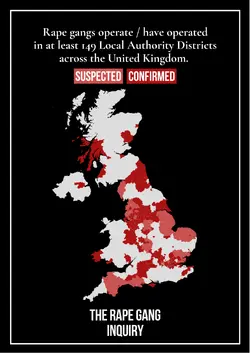
The scale, the tactics, the perpetrator profile, and the systemic inaction were almost always identical everywhere. Britain did not face dozens of separate local scandals. It faced one national scandal that the state allowed to grow for decades.
4 See Alexis Jay OBE, The Report of the Independent Inquiry into Child Sexual Abuse, October 2022.
5 See Bradford Observer, Saturday 27 August, 1955, the British Newspaper Archive.
6 See the British Nationality Act (1948).
7 Lord Pearson of Rannoch (House of Lords, Hansard Vol. 797) in a debate on Grooming Gangs, 14 May, 2019.
8 Lizzie Dearden, Grooming ‘epidemic’ as almost 19,000 children identified as sexual exploitation victims in England, The Independent, 28 December, 2019.
9 See Appendix IV for our name-by-name list of affected areas.
These statements were made despite the Metropolitan Police holding reports of young girls being plied with alcohol and drugs then raped by groups of men in hotels and other locations across the capital. A Daily Express investigation revealed that Khan had direct access to HM Inspectorate of Constabulary documents detailing exactly these patterns of offending. He read the files yet continued to deny the existence of grooming gangs in public.(11)
Shadow Home Secretary Chris Philp MP has accused Khan of facilitating a cover-up and other politicians stated that both the Mayor and the Metropolitan Police had been denying grooming gangs in London. Campaigners, including whistleblower Maggie Oliver and Chris Wild, described the capital as the last bastion of denial and warned that the scale of abuse there was more catastrophic than anywhere else in the country.
The evidence now emerging confirms their warnings. In October 2025, the Metropolitan Police announced a review of 9,000 child sexual exploitation cases. The National Crime Agency launched Operation Beaconport to examine thousands more files nationwide after initial assessments found human errors, missed lines of inquiry, and cases wrongly dropped. London forms a significant part of this backlog. A former Metropolitan Police detective has described industrial-scale child prostitution and grooming in the capital, with authorities aware but opting for inaction due to a mixture of “incompetence, laziness, and corruption.”(12)
London has the largest Muslim population in Britain. Khan relies on significant electoral support from those communities, as well as having an ethno-religious motive to protect the public reputation of Pakistani Muslims in particular. Widespread acknowledgment of organised networks of predominantly Pakistani Muslim men targeting vulnerable white girls would have shattered the narrative of community cohesion that successive London administrations – none more than Khan’s – have promoted. As for others in authority, fear of being labelled ‘racist’ paralysed the Metropolitan Police and City Hall in the same way it did in Rotherham and Rochdale before them. One anonymous whistleblower told us that boys as well as girls are an especially vulnerable target for criminal gangs – typically Albanian, Somali, or Turkish – operating in the capital. Yet the relevant bodies still refuse to collect data on ethnicity, wilfully rendering themselves blind to the very behavioural patterns that are supposed to aid law enforcement in its pursuit of justice.
The Metropolitan Police review, the National Crime Agency operation, and the witness accounts pouring in prove that group-based child sexual exploitation has thrived in our capital city.
This Inquiry records the failure without reservation. Khan and the senior leadership of the Metropolitan Police must answer for their role in this scandal. Until the capital confronts the truth with the same rigour now demanded elsewhere, the children of London remain at risk and the state remains complicit.
10 See Mayor of London Sadiq Khan says grooming gang cases in London are ‘far more complex’, ITV News, 28 October, 2025.
11 Zak Garner-Purkis & Callum Cuddeford, Sadiq Khan grooming gang ‘cover-up’ exposed as new evidence revealed, Daily Express, 19 October, 2025.
12 See Sadiq Khan’s Grooming Gang cover up EXPOSED | Daily Express
There are thousands of survivors who could have provided evidence to our Inquiry team. Below is a summary of some of the testimony provided by our brave witnesses who spoke at the Inquiry hearings. Some of the witnesses have to remain anonymous for their own safety.

Contents
Contents...............................................................................................................1
Acknowledgements...............................................................................................2
Foreword.............................................................................................................. 3
Introduction.........................................................................................................5
Executive Summary.............................................................................................. 7
Overview of Crimes.............................................................................................11
Victim Testimony............................................................................................... 18
Whistleblower Testimony.................................................................................. 101
Demographics and Culture................................................................................ 106
The Influence of Islam........................................................................................116
Homegrown Enabling Factors............................................................................ 134
Impact on Survivors........................................................................................... 151
Conclusions.......................................................................................................154
Recommendations............................................................................................. 159
Legislative Response..........................................................................................164
All Frontline Response...................................................................................... 169
Next Steps.........................................................................................................179
A Concluding Message from Rupert Lowe MP, Rape Gang Inquiry Chair.......... 180
Appendix I – Non-Hearing Victim Testimony................................................... 181
Appendix II – Survivor Quotations....................................................................192
Appendix III – Institutional Failures................................................................. 203
Appendix IV – List of Areas Gangs Are Known to Have Operated.....................214
1
Acknowledgements
Every witness who volunteered their testimony – whether survivor, parent, whistleblower, politician or expert – showed courage that made this Inquiry possible. Their contributions have ensured that the truth is now a matter of permanent public record.Rupert Lowe MP’s energy and commitment ensured that The Rape Gang Inquiry took place. He has been unwavering in his devotion to making sure that this rotting stain on our country’s history has remained firmly in the public eye. Deep gratitude is extended to the entire Inquiry team, led by Sammy Woodhouse. Nat Enderby-Shenton, Marlon West, Debra Sudbury, and Julie Ballan worked tirelessly to bring the evidence together and support every survivor who came forward.
A special thank you is owed to MPs Esther McVey, Nick Timothy, and Carla Lockhart for taking the time to sit on the Inquiry panel. Dr. Mark Durie has been extremely generous in enriching the report that follows with his expert knowledge.
We are also grateful to Charlie Downes, Joshua Ferme, Harrison Pitt, and Graham Smith for their editorial oversight and counsel. Last but not least, we thank the untold thousands across Britain who made all of this possible by donating to ensure that this Inquiry could take place.
Foreword
Britain doesn’t have a racism problem, it has an immigration problem. Rupert Lowe As is the case with many decent, hard-working Britons, I was unaware of the sheer scale of the evil that has been, and continues to be, perpetrated by chiefly Pakistani Muslim men against vulnerable young white women and girls in communities up and down our country. But a single court transcript from one such horrific case – amplified by Elon Musk early last year – set in motion a long overdue national reckoning on the matter that inspired over 20,000 British patriots to help fund our Rape Gang Inquiry. What follows is a comprehensive report of its findings. It is essential that all related court documents are securely preserved, both for legal and historical reasons. I am grateful to everyone on my team who has contributed to exposing this demonic chapter in Britain’s history. A combination of the paralysing fear of ‘racism’ accusations and the scramble for votes from imported foreign sub-cultures meant that pure evil was allowed to metastasise. Nor is the horrendous ordeal over. The root cause was immigration, beginning with the British Nationality Act 1948 and escalating under Tony Blair from 1997 onwards. Believing proud nations to be responsible for the mid-20th century destruction of Europe, our post-war leaders embraced diversity and multiculturalism as the supposedly civilised alternative. This report establishes beyond any doubt that this ‘open society’ obsession has in fact enabled untold barbarism of its own. Oil and water do not mix and cultural differences, going back centuries, are the genesis of this problem. I urge all Britons to read this report in full. Lessons need to be learned and prosecutions need to follow for the appalling cowardice of those responsible for refusing to resist such horrors. The strongest possible penalties, up to and including death, must also be sought for those yet to be properly punished or indeed punished at all for their vile, unspeakable crimes.The world is a dangerous place to live, not because of the people who are evil, but
because of the people who don’t do anything about it.
Albert Einstein
Man is the cruellest animal.
Friedrich Nietzsche
because of the people who don’t do anything about it.
Albert Einstein
Man is the cruellest animal.
Friedrich Nietzsche
Introduction
The Rape Gang Inquiry has now concluded the first phase of its work. It was established to examine one of the most horrendous scandals in the long history of our country: the systematic targeting of vulnerable girls, overwhelmingly White British, by predominantly Muslim Pakistani gangs across towns and cities up and down the nation.The evidence presented throughout the hearings confirmed what had long been known but repeatedly denied by many in the political class. The Inquiry welcomed girls, boys, men, and women of all races and religions to testify to their experiences to gain a complete picture of the rape gang phenomenon. The Casey Report of 2025 stated that disproportionate numbers of men from “Asian ethnic backgrounds” were among the suspects for group-based child sexual exploitation (‘CSE’). Baroness Casey quoted local reports showing that a significant proportion of those convicted were of Pakistani and/or Muslim heritage. The crimes stretch back generations.
The Rape Gang Inquiry was necessary because the state and its institutions have failed catastrophically over decades. Police, social services, schools, the NHS, licensing authorities, and governments allowed these gangs to operate with impunity. There was a demonstrable lack of political will to confront them. The Labour Party initially refused a public inquiry altogether, only relenting under considerable pressure. It will be many years before this inquiry is complete and there is no guarantee that it will adequately address the politically sensitive ethnoreligious nature of the phenomenon. Despite now pushing for an inquiry in opposition, when in government the Conservative Party did very little.
The Rape Gang Inquiry was survivor-led. Every day the panel sat with Sammy Woodhouse, a survivor-turned-activist herself, alongside a variety of experts who attended whenever their specialist subject formed the focus of our efforts to get to the truth. We examined distinct areas of the scandal in turn so that a maximally full picture could be established. Parents and carers described their experiences. Instances of pregnancy, abortion, and children born of rape were laid bare. Whistleblowers who had previously been ignored gave evidence. Policing and justice failures were documented. Social care, NHS services (including sexual health and mental health), education, taxi licensing, demographic trends, cultural and social issues, and ideological obstructions to justice were all scrutinised without restriction. Nothing was off the table. Misguided political correctness and cultural sensitivities played no part in the proceedings. The promise made to every donor was honoured in full: the truth was pursued and justice was our only objective.
Survivors were finally given the platform they had been denied for so long and were central to the Inquiry. The full scale and nature of the crimes can now be placed on the public record. The true horror of what took place is no longer hidden.
Although the Inquiry lacked statutory powers, the response was overwhelming. Politicians, whistleblowers, experts, family members, and many others came forward. Those few in prominent positions who declined to give evidence did so knowing their refusal would be noted.
This report sets out findings and makes clear recommendations for how the problem of rape gangs can be eradicated. The country now knows the full truth. The country has been given the basis for justice. The country has the roadmap to ensure these crimes never happen again.
Executive Summary
The Rape Gang Inquiry examined the systematic targeting of vulnerable girls, overwhelmingly White British, by predominantly Muslim Pakistani gangs across towns and cities throughout the United Kingdom. The evidence put to the Inquiry confirms that this scandal constitutes one of the most horrendous failures in the history of the country. Organised networks of perpetrators built coordinated operations that transported victims between locations, supplied them with drugs and alcohol, recorded abuse for distribution and blackmail, and passed girls between multiple adult men. These crimes have been committed for decades, since the 1950s by Pakistanis in particular, and have affected every region of our nation.The scale of the crimes committed is staggering. It has been previously established that, at the very least, 250,000 young white girls have been subjected to repeated rape, gang rape, trafficking, torture, pregnancy, forced Islamic conversion, and lifelong trauma.(1) The true number is probably higher. The perpetrators bear primary responsibility, yet the institutional failures that enabled them for decades must also be confronted. In court records and official inquiries, around 87% of those convicted in these group-based child sexual exploitation (‘CSE’) cases bore distinctively Muslim names.(2) The vast majority of men involved in these gangs were not convicted. Dr. Taj Hargey, an imam with the Oxford Islamic Congregation, believes the true proportion of gang members who are Muslims to be around 95%.(3) This figure far exceeds the Muslim share of the overall United Kingdom population. The overwhelming majority of the rape gang networks consisted entirely of men from Muslim backgrounds – predominantly of Pakistani heritage, although smaller groups from Somali, Iranian, Syrian, Turkish, and other Muslim origins were also involved.
The Inquiry heard harrowing testimony from survivors and their families. The method used to groom children typically followed the same process. Girls as young as 11 were initially befriended by a young Muslim man who then treated the young child like an adult and would then start providing them with alcohol, drugs, and cigarettes. After a few months the girls would then be collected from school gates, care homes, and streets in taxis. They were taken to houses, flats, restaurants, and hotels where they were raped repeatedly by groups of men, tortured, filmed for blackmail, and told they were “white trash” or “kuffar” who merited punishment. Many became pregnant while still children. Some miscarried under trauma, others endured coerced abortions, and some gave birth to children who were later removed by the state. We found that the same unspeakable crimes occurred in at least 149 local authority districts – close to 40% of all such districts across the United Kingdom (see page 14 for our full map). Survivors described daily rapes, “red rooms” of extreme torture, trafficking between cities, and institutional disbelief that compounded their suffering. Some girls were even trafficked to the Middle East where they would endure Islamic marriage.
The demographic and cultural drivers are clear. Perpetrators from Pakistani Muslim and other Muslim backgrounds operated under an honour- and shame-based clan code that treated non-Muslim girls, especially white working class girls, as property available for sexual use. This pattern was reinforced by eight theological and legal aspects of Islam. These include the doctrine of Muslim superiority drawn from Quranic verses that position Muslims at the top with a duty to correct non-believers. The gang members’ justification for their crimes can be found in the Islamic principles of loyalty and disavowal known as al-walā' wa-l-barā'. It demands enmity towards non-Muslims, the superiority of men over women, forced marriage combined with the absence of any fixed minimum age of consent, the perception of female sexuality as inherently dangerous, a system of sex slavery that authorises sexual relations with non-Muslim captives, and a religiously sanctioned social hierarchy that subjugates conquered non-Muslims. These elements, filtered through clannish immigrant sub-cultures, provided religious justification that enabled the systematic rape and even slaughter of White British girls.
Were Britain functioning effectively, these girls would have received considerable state protection. However, every one of our institutions failed them catastrophically. Police forces ignored repeated reports, criminalised victims instead of perpetrators, destroyed evidence, and allowed known rapists to walk free on bail. Social care services undermined protective parents, placed children in trafficking hubs inside children’s homes, closed cases despite clear indicators of exploitation, and retaliated against whistleblowers. The NHS recorded genital injuries, multiple sexually transmitted infections in children as young as 13, pregnancies caused by rape, and suicide attempts, yet discharged victims back to their abusers without safeguarding referrals or trauma care. Schools observed older men collecting girls at the gates, heard disclosures of rape on school premises, and responded by excluding victims rather than protecting them. Taxi licensing authorities renewed permits for drivers who formed the logistical backbone of the networks and collapsed in the face of organised protests when basic safety measures were proposed.
Political failure lies at the heart of the scandal. Successive governments lacked the will to confront the ethnic and religious patterns. The Labour Party bears particular responsibility. It initially refused a public inquiry and only relented under pressure by ordering a process viewed with widespread scepticism.
Labour-dominated councils and MPs were briefed on the gangs long ago yet later denied knowledge. The party prioritised electoral reliance on Muslim voting blocs and then blocked or watered down inquiries, suppressed ethnicity data, and framed legitimate concerns as ‘far-right’ agitation. When finally forced to act, the Labour government produced a national inquiry whose tightly drawn terms of reference deliberately excluded systematic examination of the demographic, cultural, and religious drivers. The Conservative Party, while in government, continued with Labour’s approach and failed to impose mandatory ethnicity recording or launch a full statutory inquiry despite clear evidence from Rotherham and elsewhere. Scottish political parties have refused a dedicated inquiry and failed to record offender ethnicity. Political correctness, fear of accusations of racism, and fear of losing electoral support from certain demographics have taken precedence over the protection of British children.
Whistleblowers, parents, and survivors who came forward showed extraordinary courage, despite having been met in the past with disbelief and intimidation. The perpetrators operated with impunity because the state enabled them. The evidence now demands immediate and decisive action to eradicate the problem, deliver justice for the victims, and ensure these abhorrent crimes are eradicated from our shores.
We now have a clearer sense of the problem. There are a number of measures necessary to resolve them, up to and including considerable changes to our criminal justice system, the passage of legislation aimed at targeting specifically gang-based CSE, and a great amount of institutional overhaul.
Our detailed list of recommendations includes improved data recording on ethnoreligious patterns among offenders, far stronger sentencing, a comprehensive deportation effort, institutional accountability measures, multi-agency coordination, specialist training, enhanced safeguarding through greater family involvement, and closing the various gaps in British law through which so many victims fell.
Following the publication of this Report, we intend to release the full witness testimonies, gather additional survivor accounts, identify those responsible in Parliament, and begin civil and private legal actions to ensure maximal accountability.
1 Lord Pearson of Rannoch (House of Lords, Hansard Vol. 797) in a debate on Grooming Gangs, 14 May, 2019.
2 See Sacrificing girls to political correctness, Christian Concern, 16 March, 2018.
3 See Fundamentalist ‘Muslims believe if the Prophet’ slept with a nine-year-old ‘what’s wrong with a12-year-old?,’ claims Muslim leader, London Loves Business, 9 January, 2025.
Overview of Crimes
Rape gangs have exploited children systematically across every region of the United Kingdom for decades.The independent chair of the Centre for Excellence for Children’s Care and Protection Alexis Jay has identified the 1970s as the decade when immigrant rape gangs first began tormenting the girls of Britain.(4) However, the British Newspaper Archive reveals that the first recorded case of specifically Pakistani rape gangs dates back to 1955, when four Bradford-based Pakistanis were charged with raping a 15-year-old girl from Middlesbrough.(5) This was soon after former colonial subjects, from the subcontinent as much as the Caribbean, became eligible to enter the United Kingdom in non-trivial numbers under the British Nationality Act 1948.(6) What began as singular and small-scale instances became systematic and industrial over time.
These horrific crimes have only escalated in recent decades, especially following Tony Blair’s 1997 victory and the start of orchestrated mass immigration. With greater numbers came greater opportunities for abuse. Perpetrators built organised networks that transported victims between towns and cities and passed girls between multiple adult men.
In each of these areas the same tactics were used. Girls as young as 11 were targeted with gifts, alcohol and drugs, collected in taxis from school gates, care homes and streets and taken to houses, flats, restaurants and hotels and then raped repeatedly by groups of men, passed between perpetrators, trafficked across county lines, and in many cases impregnated or forced into abortions. Most victims endured violence, were filmed for blackmail, or told they were “white trash” or “kuffar” who deserved punishment.
The authorities at every level – including the police, social services, health services, schools, licensing bodies, and politicians – knew the patterns, possessed the intelligence, and still failed to protect the country’s children. The evidence establishes that a national scandal of repeated rape, trafficking, torture, pregnancy, forced Islamic conversion, and lifelong trauma enabled by institutional denial, political calculation, and fear of the accusation of racism took place over decades.
The incidents of criminal activities listed in this report are drawn from court records, official and unofficial inquiries across the country, and witness testimony provided to the Inquiry. They confirm that this was never a series of isolated local failures. It was a coordinated, nationwide pattern of organised child sexual exploitation that repeated in town after town, city after city, from the far north to the south coast. The same ethnic and religious profile of the perpetrators was documented throughout almost all of the witnesses who contacted the Inquiry.
The scale of the rape gang phenomenon is endemic across the entirety of Britain. The 250,000 figure originates directly from a statement in the House of Lords by Lord Pearson of Rannoch on 14 May, 2019:
“Do the Government accept that if we extrapolate nationally the Jay report on
Rotherham and other reports from Telford and Oxford, there appear to have been
upwards of 250,000 young white girls raped in this century, very largely by Muslim men,
usually several times a day for years?”
He added that this number “is probably an underestimate.”(7)
This extrapolation now has greater support due to further data that has been collected, derived from scaling the patterns documented in major inquiries:
● Rotherham (Jay Report, 2014): At least 1,400 girls abused between 1997 and 2013, with some updated estimates exceeding this. Perpetrators were overwhelmingly Pakistani Muslim men.
● Telford Inquiry (2022): More than 1,000 children (predominantly girls) over decades, again with the same perpetrator profile.
● National footprint: The grooming gang model has been confirmed in dozens of towns and cities. Our independent Inquiry, led by Rupert Lowe MP, has heard evidence demonstrating coordinated operations extending to all corners of the country, in at least 149 local authority districts (see page 14 for the full map).
When the Rotherham/Telford scale is applied across the documented national distribution, and multiplied by the extreme under-reporting factor accepted by official reviews, the total reaches the 250,000 threshold as a bare minimum. We are far from grasping the full extent of grooming gang criminality in modern Britain. It is reasonable to assume that, since sexual abuse of all kinds tends to be under-reported, this is also true of grooming gangs. The Independent has reported that almost 19,000 children were identified as sexual exploitation victims in England in one year alone, despite the reluctance of state actors to name or tackle the problem of the rape gangs.(8) After decades of abuse, victims must number in the hundreds of thousands. The full scale is not yet known. Every major review has emphasised that recorded statistics severely understate reality:
● Baroness Casey National Audit on Group-Based Child Sexual Exploitation and Abuse (June 2025): The audit explicitly states that the scale, nature, and characteristics of group-based child sexual exploitation remain impossible to quantify precisely due to inconsistent data collection and historical suppression.
● Independent Inquiry into Child Sexual Abuse (IICSA) and multiple local inquiries (2022–2025): “It is simply not possible to know the scale” because ethnicity, group offending, and historical cases were routinely unrecorded or shelved to protect “community cohesion.” Overleaf is a heat map that portrays the various locations in which the Inquiry can be sure the rape gangs operated. It is likely that the true extent is far worse.(9)
The scale, the tactics, the perpetrator profile, and the systemic inaction were almost always identical everywhere. Britain did not face dozens of separate local scandals. It faced one national scandal that the state allowed to grow for decades.
4 See Alexis Jay OBE, The Report of the Independent Inquiry into Child Sexual Abuse, October 2022.
5 See Bradford Observer, Saturday 27 August, 1955, the British Newspaper Archive.
6 See the British Nationality Act (1948).
7 Lord Pearson of Rannoch (House of Lords, Hansard Vol. 797) in a debate on Grooming Gangs, 14 May, 2019.
8 Lizzie Dearden, Grooming ‘epidemic’ as almost 19,000 children identified as sexual exploitation victims in England, The Independent, 28 December, 2019.
9 See Appendix IV for our name-by-name list of affected areas.
London
London stands exposed as the epicentre of institutional denial in the grooming gang scandal. While northern towns faced public inquiries after the truth emerged, the capital maintained a wall of silence for years. The Mayor of London, Sadiq Khan, has repeatedly insisted there were no grooming gangs operating in the city. As our inquiry heard from Susan Hall, Leader of the Conservatives in the London Assembly, the rape gang phenomenon is in fact endemic within the capital. After challenging Khan about the presence of such gangs in London, Hall was inundated with calls from women and girls purporting to be victims of their predation. Khan describes evidence from whistleblowers as malicious and politically motivated. He told the London Assembly that the problem was far more complex than in other parts of the country and that young people were being exploited through county lines rather than organised group-based child sexual exploitation.(10)These statements were made despite the Metropolitan Police holding reports of young girls being plied with alcohol and drugs then raped by groups of men in hotels and other locations across the capital. A Daily Express investigation revealed that Khan had direct access to HM Inspectorate of Constabulary documents detailing exactly these patterns of offending. He read the files yet continued to deny the existence of grooming gangs in public.(11)
Shadow Home Secretary Chris Philp MP has accused Khan of facilitating a cover-up and other politicians stated that both the Mayor and the Metropolitan Police had been denying grooming gangs in London. Campaigners, including whistleblower Maggie Oliver and Chris Wild, described the capital as the last bastion of denial and warned that the scale of abuse there was more catastrophic than anywhere else in the country.
The evidence now emerging confirms their warnings. In October 2025, the Metropolitan Police announced a review of 9,000 child sexual exploitation cases. The National Crime Agency launched Operation Beaconport to examine thousands more files nationwide after initial assessments found human errors, missed lines of inquiry, and cases wrongly dropped. London forms a significant part of this backlog. A former Metropolitan Police detective has described industrial-scale child prostitution and grooming in the capital, with authorities aware but opting for inaction due to a mixture of “incompetence, laziness, and corruption.”(12)
London has the largest Muslim population in Britain. Khan relies on significant electoral support from those communities, as well as having an ethno-religious motive to protect the public reputation of Pakistani Muslims in particular. Widespread acknowledgment of organised networks of predominantly Pakistani Muslim men targeting vulnerable white girls would have shattered the narrative of community cohesion that successive London administrations – none more than Khan’s – have promoted. As for others in authority, fear of being labelled ‘racist’ paralysed the Metropolitan Police and City Hall in the same way it did in Rotherham and Rochdale before them. One anonymous whistleblower told us that boys as well as girls are an especially vulnerable target for criminal gangs – typically Albanian, Somali, or Turkish – operating in the capital. Yet the relevant bodies still refuse to collect data on ethnicity, wilfully rendering themselves blind to the very behavioural patterns that are supposed to aid law enforcement in its pursuit of justice.
The Metropolitan Police review, the National Crime Agency operation, and the witness accounts pouring in prove that group-based child sexual exploitation has thrived in our capital city.
This Inquiry records the failure without reservation. Khan and the senior leadership of the Metropolitan Police must answer for their role in this scandal. Until the capital confronts the truth with the same rigour now demanded elsewhere, the children of London remain at risk and the state remains complicit.
10 See Mayor of London Sadiq Khan says grooming gang cases in London are ‘far more complex’, ITV News, 28 October, 2025.
11 Zak Garner-Purkis & Callum Cuddeford, Sadiq Khan grooming gang ‘cover-up’ exposed as new evidence revealed, Daily Express, 19 October, 2025.
12 See Sadiq Khan’s Grooming Gang cover up EXPOSED | Daily Express
Victim Testimony
There are thousands of survivors who could have provided evidence to our Inquiry team. Below is a summary of some of the testimony provided by our brave witnesses who spoke at the Inquiry hearings. Some of the witnesses have to remain anonymous for their own safety.‘Chloe’
Throughout her early childhood, ‘Chloe’ was popular at school, performed well academically, and enjoyed an active social life. Although her parents separated when she was young, she describes her early upbringing as relatively stable. Following the separation, full custody of Chloe and her older brother was awarded to their father, despite his alcoholism. Her mother, on the other hand, was often absent from her life and became homeless following the separation.
Chloe recalls a generally secure and supportive home environment under the care of her father. However, following his sudden death just before her tenth birthday, she moved in with her mother and her mother’s new husband – a man she describes as a “paedophile” by whom she was sexually abused. Chloe’s mother caught her husband assaulting Chloe on many occasions, but did little to stop it. On one occasion, Chloe’s mother caught her husband in the shower with Chloe and instead of intervening, “she closed the door and walked out.” At this time, Chloe was ten years old.
The abuse soon escalated to rape. Chloe’s stepfather supplied her with alcohol and cigarettes “to keep her quiet,” and she began smoking cannabis. Around the same time, Chloe started truanting and spending time in the local town centre with a friend unsupervised. She describes groups of Muslim men, primarily Pakistanis, aged 20 to over 50 showing them attention, including wolf whistling and buying them alcohol. Many were taxi drivers who would take the girls into their cars and drive them around the town. At this stage, there was no sexual abuse, and although the men’s behaviour was clearly inappropriate, Chloe and her friend – then in their final year of primary school – enjoyed being treated like adults.
The grooming soon intensified. The provision of alcohol and takeaways was accompanied by emotional manipulation, with the men – many of whom were related to one another – presenting themselves as sympathetic friends to Chloe. Chloe describes this process as them “mapping out, are you a vulnerable person?” Physical contact, including kisses and massages, became increasingly common. Meanwhile, the abuse by her stepfather at home worsened, and her mother was all but absent as a guardian.
At this time, Chloe had an aunt and uncle who lived nearby, and she often sought refuge with them. She had spent holidays with them during her earlier childhood, and felt that she could trust them. On one occasion, she had visited them while truanting, before returning home and spending the day there while her mother and stepfather were at work. To Chloe’s surprise, her uncle arrived at her house unannounced an hour later, and she invited him inside. After a brief conversation, Chloe’s uncle sexually assaulted her. Chloe resisted, and he relented and left.
She told her mother about the assault, and her mother reported it to the police. The police accused Chloe of lying, and no further action was taken. Until this incident, she had regarded her uncle as “one of the best people in her life” – afterwards, there were no adults left that Chloe could confide in or seek support from. Increasingly isolated, she became more deeply involved with the groups of Muslim men she encountered in the town centre.
One evening, Chloe’s friend suggested that they travel to a nearby town where one of the men had a hotel room. They were picked up by the man – who was drunk and under the influence of drugs – and taken to the hotel. When they arrived, hotel staff saw them but did not intervene. In the room, the girls were given a potent strain of cannabis, which left Chloe – then eleven – “absolutely smashed.” Chloe’s friend was taken into another room by a group of men, and Chloe was groped by the man who remained. Chloe resisted, and he hit her. The man did not attempt to sexually assault her again, and instead threw the girls – both of whom were still intoxicated – out of the hotel and refused to drive them back to their home town. They were forced to walk. It was around midnight. Chloe did not want to go back to her home as she feared her mother would beat her for being out late, so stayed with her friend.
In the early hours of the morning, Chloe was collected from her friend’s house by the police after her mother reported her missing. Chloe lied to the police and her mother about where she had been. Chloe’s mother “grounded” her for a month, meaning she was stuck at home with her predatory stepfather – a period she describes as “torture.”
After the month passed, Chloe arranged to see her friend, who boasted that she had a new boyfriend. Chloe left the house to meet her, and the girls were picked up by the “boyfriend” – who was in fact a 25-year-old Indian man.
Initially, Chloe thought the man was nice – “posher” than the other men she had met in the town centre. He took Chloe and her friend to a shop where he purchased a bottle of vodka before picking up one of his friends and taking the girls to a secluded location. During the journey, the men began pressuring the girls for sex. Chloe refused, stating that she was on her period, but the men replied that it did not matter. Night was falling when they arrived, and the “boyfriend” took Chloe’s friend out of the car, leaving Chloe alone with the other man. He proceeded to rape her on the back seats.
This incident took place in 2003. In 2022, Chloe took the two men to court, but neither were found guilty.
From this moment, Chloe’s life spiralled. At twelve years old, she began drinking heavily, smoking large amounts of cannabis, and taking harder drugs including ecstasy – “anything to block it out of her mind.” She would drink before school “just to get through the day” and her attendance dropped significantly. She and her friend would spend school hours in the town centre, “walking around until somebody picked them up in a car, somebody bought them alcohol or somebody gave them drugs.” There were times when Chloe would be missing for up to three days, during which time she was passed between taxis, drugged, abused, and raped. In every case, the perpetrators were Muslims, and primarily Pakistani.
On one occasion, Chloe was abducted by an abuser – who was driving drunk – and taken to a graveyard. He gave Chloe – still twelve years old – whiskey before forcing himself on her and raping her. He withdrew before ejaculation, and forced the empty whiskey bottle into Chloe’s vagina, where it shattered. Chloe admitted herself to A&E, but no questions were asked about how she had sustained such an injury. She was examined, the glass was removed, and she was discharged.
Chloe was questioned by police due to her absence on a number of occasions. Each time, she was asked where she had been, who she had been with, and what she had been doing. She replied that she had been having sex with adult males in cars. Rather than opening an investigation and pursuing her abusers, the police dismissed Chloe as a prostitute. They asked her whether she was consenting to the sexual activity and, despite Chloe telling them that she did not know the definition of the word “consent,” they reported that she had been.
The police found Chloe, as well as other missing children, in cars with the gang members on multiple occasions, but let the gang members go without so much as questioning them. On one occasion, Chloe was in the town centre and was identified as a missing child by a police officer who questioned where she had been. Chloe told this police officer about the full extent of the abuse, and the response of the police officer was that nothing could be done, and Chloe was let go.
In response to her truancy and deteriorating behaviour, the school regularly placed Chloe in isolation and compelled her to attend additional after-school classes every day. This did little to improve her emotional state, and she continued to spend time with her friend and her friend’s “boyfriend.” This went on for a number of years. The “boyfriend” would supply the girls with alcohol and drugs, as well as introducing them to his friends, who were exclusively South Asian men. On one occasion, he took the girls to his place of work – a textiles factory – where he raped Chloe. Following this incident, Chloe stopped spending time with the friend who, up until this point, had accompanied her throughout her exploitation.
By this time, Chloe had become so accustomed to her “lifestyle” of spending time with the Muslim gangs that she continued to do so without her friend. On one occasion, following another late return home, her mother “grounded” her for two months. Fearing further abuse from her stepfather, Chloe walked to a nearby social services office while her mother was at work and reported him. Chloe was interviewed by the social workers about the abuse, after which her mother and stepfather were arrested and questioned. Both denied that the abuse was taking place, and were released without charge.
Chloe made further appeals to social services and was eventually removed from the house and placed in foster care. She lived with a couple who cared for several other foster children and, though she found them “snobby” and judgemental, found some semblance of stability with them – but it did not last long. She was still living in the same town, so when she went into the town centre – as she often did both alone and with the foster carers – the Muslim gangs would recognise and target her. She remained at the same school, and because she now lived further away, the foster carers paid for taxis to take her there. She would ask the taxi drivers to drop her near the school and, rather than attending, would walk to one of the neighbourhoods where the Muslim gangs spent their time. The gangs would take her into their taxis, ply her with drugs and alcohol, and sexually abuse her.
Around the age of 13, Chloe disclosed to social services that she was being sexually abused by gangs of Muslim men. In response, social services did not intervene, but rather talked to Chloe about contraception and sexual health. One social worker started regularly taking Chloe to a sexual health clinic, where she was diagnosed with chlamydia in her throat and vagina, gonorrhea, genital warts, and pelvic inflammatory disease. Neither the social workers nor the clinic staff questioned or reported this. The police were aware of Chloe’s activities, but instead of targeting those responsible for her abuse, they routinely failed to question them – let alone pursue further action – when Chloe was found in cars and houses with them.
Chloe was soon moved to a different foster placement with a far more protective carer. On one occasion, a gang came to the foster home searching for Chloe, and the carer fought them in the street to protect her.
Around the time Chloe turned 14, a social worker approached her about her ongoing sexual exploitation. This was one of the first times this had happened, and Chloe was relieved that her abuse was finally being addressed. However, rather than offering a solution, the social worker instead told Chloe that the producers of Emmerdale were looking for a young actress to play a victim of child sexual exploitation, and asked whether she would be interested in auditioning for the role given her experience. Following this exchange, Chloe – upset, angry, and in a state of disbelief – ran away from the foster home, and, after being abducted by a Muslim gang, was missing for six months.
Over this period she was trafficked across the length and breadth of Britain. She was taken to “house after house” and raped and abused by “guy after guy after guy after guy.” The men who abused her paid money to the gang, which treated her as little more than a commodity. She was reported missing and her photograph was shown on TV. Her abusers remarked on this – “you’re that girl off the TV that’s missing” – but her whereabouts were never reported to the police. Chloe describes a cycle of grooming, rape, and drug and alcohol abuse – this went on until, eventually, she was located by the police.
When the police found her, she was in a car with a South Asian Muslim man. The man was let go without charge, and she was returned to her mother’s house. Chloe’s relationship with her mother had completely broken down by this point, so she continued to run away and her psychological state deteriorated further. Following another period of grooming and sexual exploitation by a Muslim gang, Chloe was taken into police custody and transported to a secure unit at a children’s home.
She describes the home as being like a prison. Every aspect of her life was controlled and surveilled, and she was routinely subjected to bodily examinations, including full cavity searches. Chloe found the experience highly traumatic. She remained there for 9 months, by which time she was almost 15. Social services determined that she was well enough to be released, and she was placed in foster care not far from where she had been living before. Chloe describes the new carers as a positive and encouraging presence in her life, and – in spite of her proximity to the sites of her abuse and exploitation – Chloe found stability and security living with them. She enrolled in a full-time hairdressing and beauty course at a nearby college, and for the next two years, Chloe describes her life as “fantastic.”
As Chloe approached her 18th birthday, social services notified her that the foster care would soon end. They identified a house for her and, after parting ways with her carer, she moved in and got a retail job to support herself. Despite having little experience taking care of herself, Chloe’s life remained generally stable through this period.
Eventually, Chloe reestablished contact with the friend whom she had been abused with as a young child. She invited her over to her house, and when she arrived, she was accompanied by a group of Muslim men – all of whom remembered Chloe from past abuse.
Immediately, Chloe’s life was thrown back into chaos. The men refused to leave, and – in Chloe’s words – “it was no longer my quiet little house. It was their house.” They smashed windows, kicked in doors, left the house an “absolute wreck,” and sexually abused Chloe. One of the men – a previous abuser – pinned her down, pulled his trousers down, and “sat on her face,” orally raping her on her own sofa as the rest of the gang watched.
Chloe returned to drugs and alcohol to cope. Though she was still working in retail, her ability to work was rapidly declining. During one shift, one of her colleagues – someone she was friends with – jokingly pinched her bottom. Chloe, traumatised by the years of abuse, punched him in the face in the middle of the shop. She was brought before management and tried to argue her case, but was fired. Left with no income, Chloe spiralled further. The Muslim gang was still occupying her house, and, with nowhere else to go and no ability to remove them, she remained there with them. They routinely drugged, abused, and raped her, including with objects including soft drink cans, keys, and a baseball bat.
Before long they started to pay her bills to consolidate their presence in her home. On a number of occasions, they brought young children into Chloe’s house to abuse them. Chloe recalls a number of occasions when boys under the age of 18 from the Muslim community were pressured and bullied by their older friends and relatives into raping her. Chloe was forced to commit crimes, including insurance fraud and the holding of drugs. On one occasion she contacted the police to report an assault that was taking place in her house and, when they arrived, Chloe was threatened with arrest rather than the gang members as the property was registered in her name.
One evening, an associate of the gang from a neighbouring town arrived at the house. A notorious sex trafficker, he soon began taking Chloe to bars and nightclubs in the surrounding area. There, he would spike her with heroin before handing her over to men who sexually assaulted and raped her.
Chloe became addicted to opiates and her health deteriorated rapidly. She became anorexic, weighing just five stone at the age of 18. The use of heroin was a method of control by the gang, as it left her with no ability to defend herself physically. Her daily existence became a relentless cycle of rape, exploitation, and violence.
Eventually, a social worker visited Chloe and was shocked by both her appearance and the conditions in which she was living. Concerned for her welfare, she took Chloe to an addiction clinic, where tests revealed an extremely high concentration of opiates in her system. Chloe was prescribed medication to manage her opioid dependency and gradually weaned herself off the drugs.
Around this time, Chloe reconnected with a childhood friend, and their friendship soon developed into a romantic relationship. Her boyfriend became aware of the ongoing abuse and, with the help of his father, paid off Chloe’s remaining rent and moved her out of her squalid house. Chloe moved in with him, after which she got another job in retail. For a short period, Chloe’s life was relatively stable – but, due to her unresolved trauma, she soon returned to drinking heavily, smoking cannabis, and gambling.
Her workplace was close to her first foster home, and before long she came back into contact with members of the gang that had abused her at that time. The cycle of grooming, exploitation, and abuse soon resumed. Her relationship with her boyfriend broke down, and, out of desperation, she re-established contact with her mother – who had left her predatory husband – and soon moved back in with her.
One night, Chloe was out with members of the gang and drinking heavily. Upon her return to her mother’s house, her mother reported her to the police. The police arrested Chloe while she was changing into her pyjamas, and she was taken to the police station drunk and half-naked. She was kept in a cell until two am the following morning, at which point she was released. They did not provide her with any clothes or transportation back to her mother’s house. She tried to contact her ex-boyfriend, but he did not respond. Chloe, then 19, was left stranded.
She wandered around the neighbourhood for several hours before encountering a gang member who had previously abused her. Cold and desperate, she got into his car, and, for the following weeks, was trafficked across the country.
Eventually, Chloe identified a new house to move into. Despite their dysfunctional relationship, her mother agreed to sign the rental agreement as Chloe’s guarantor, as Chloe – then without income – knew she would not be able to afford the rent. After she moved in, she became aware of the fact that she was the only White British person in her neighbourhood. Every other resident was South Asian. As a result, the gangs discovered where she was living, and once again treated her house as if it was their own. The cycle of abuse continued, and Chloe’s emotional state deteriorated significantly. Chloe was taken to hospital after a suicide attempt, and, while there, she discovered that she was pregnant.
The father of the child – a Pakistani Muslim illegal migrant – moved into Chloe’s home. Chloe was subsequently coerced into converting to Islam and forced into marriage, both to legitimise the pregnancy in the eyes of her abuser and to assist him in securing a visa. Chloe’s behaviour became tightly controlled. She was forced to wear a hijab, she was prohibited from looking out the windows of her home, and, if she misbehaved in the eyes of her “husband,” he would “beat her black and blue” – something that happened “every day.”
Chloe’s child was born with multiple health problems, including a defective kidney, due to the deteriorated condition of Chloe’s womb as a result of the sexual abuse. Nevertheless, becoming a mother gave Chloe a renewed determination to get her life back on track. She reported the father of her child to the police after he assaulted the child, and he was removed from the property. She stopped taking drugs. She was “focused,” and, for the first time, the gangs left her alone.
One evening, she went out with a friend who lived across the road. Chloe, now a mother, did not drink heavily, but her friend became heavily intoxicated. A group of Asian men started speaking to them, and offered to take Chloe and her friend home. Chloe was suspicious of them, but, for the sake of her friend, agreed. Instead of taking them home, however, they were taken to a hotel.
Chloe, who was not drunk, protested, and encouraged her friend – who was “paralytic” – to leave with her. Chloe warned her friend about what she suspected was going to happen, but her friend refused to leave. Chloe, thinking of her daughter and seeking to protect herself, reluctantly left without her. The following day, Chloe’s friend told Chloe that she had been raped by the men.
This incident represented a turning point in Chloe’s life. She decided that she needed to leave her home town for good and “get as far away from these Asian men as possible.” By chance, she reconnected on Facebook with a man she had known in her early childhood – an old colleague of her mother who she describes as “one of the only adult men in my life who never harmed me or treated me badly.” She told him about everything she had been through and her desire to leave. He lived in Scotland and she was invited to visit him for the weekend, which she did.
After returning home, she sought support from Women’s Aid, who managed to secure her a property in Scotland. With nothing but her daughter and a small bag, she left her home town, leaving a lifetime of abuse and exploitation behind, and moved to Scotland, where she resides to this day.
Chloe personally knows at least twenty other girls from her area who were predated on by the Muslim gangs who abused her. The pattern was always the same: grooming, drugging, trafficking, abuse, and rape. Furthermore, Chloe describes being taken into mosques where imams would describe non-Muslims as “infidels” and preach that white women who dressed “inappropriately” were “free game.”
Chloe believes that the local police, social services, NHS, and government were all fully aware of what was happening, including the racialised nature of the crimes, but that they did not intervene for two reasons: because they “could not be bothered with the paperwork,” and because “they did not want to be seen as racist.” Chloe blames these bodies, and their “major push for diversity,” for her abuse.
Chloe says that “if I can save just even one more child, girl or boy, from going through any of this, then I’ve done my job.”

Throughout her early childhood, ‘Chloe’ was popular at school, performed well academically, and enjoyed an active social life. Although her parents separated when she was young, she describes her early upbringing as relatively stable. Following the separation, full custody of Chloe and her older brother was awarded to their father, despite his alcoholism. Her mother, on the other hand, was often absent from her life and became homeless following the separation.
Chloe recalls a generally secure and supportive home environment under the care of her father. However, following his sudden death just before her tenth birthday, she moved in with her mother and her mother’s new husband – a man she describes as a “paedophile” by whom she was sexually abused. Chloe’s mother caught her husband assaulting Chloe on many occasions, but did little to stop it. On one occasion, Chloe’s mother caught her husband in the shower with Chloe and instead of intervening, “she closed the door and walked out.” At this time, Chloe was ten years old.
The abuse soon escalated to rape. Chloe’s stepfather supplied her with alcohol and cigarettes “to keep her quiet,” and she began smoking cannabis. Around the same time, Chloe started truanting and spending time in the local town centre with a friend unsupervised. She describes groups of Muslim men, primarily Pakistanis, aged 20 to over 50 showing them attention, including wolf whistling and buying them alcohol. Many were taxi drivers who would take the girls into their cars and drive them around the town. At this stage, there was no sexual abuse, and although the men’s behaviour was clearly inappropriate, Chloe and her friend – then in their final year of primary school – enjoyed being treated like adults.
The grooming soon intensified. The provision of alcohol and takeaways was accompanied by emotional manipulation, with the men – many of whom were related to one another – presenting themselves as sympathetic friends to Chloe. Chloe describes this process as them “mapping out, are you a vulnerable person?” Physical contact, including kisses and massages, became increasingly common. Meanwhile, the abuse by her stepfather at home worsened, and her mother was all but absent as a guardian.
At this time, Chloe had an aunt and uncle who lived nearby, and she often sought refuge with them. She had spent holidays with them during her earlier childhood, and felt that she could trust them. On one occasion, she had visited them while truanting, before returning home and spending the day there while her mother and stepfather were at work. To Chloe’s surprise, her uncle arrived at her house unannounced an hour later, and she invited him inside. After a brief conversation, Chloe’s uncle sexually assaulted her. Chloe resisted, and he relented and left.
She told her mother about the assault, and her mother reported it to the police. The police accused Chloe of lying, and no further action was taken. Until this incident, she had regarded her uncle as “one of the best people in her life” – afterwards, there were no adults left that Chloe could confide in or seek support from. Increasingly isolated, she became more deeply involved with the groups of Muslim men she encountered in the town centre.
One evening, Chloe’s friend suggested that they travel to a nearby town where one of the men had a hotel room. They were picked up by the man – who was drunk and under the influence of drugs – and taken to the hotel. When they arrived, hotel staff saw them but did not intervene. In the room, the girls were given a potent strain of cannabis, which left Chloe – then eleven – “absolutely smashed.” Chloe’s friend was taken into another room by a group of men, and Chloe was groped by the man who remained. Chloe resisted, and he hit her. The man did not attempt to sexually assault her again, and instead threw the girls – both of whom were still intoxicated – out of the hotel and refused to drive them back to their home town. They were forced to walk. It was around midnight. Chloe did not want to go back to her home as she feared her mother would beat her for being out late, so stayed with her friend.
In the early hours of the morning, Chloe was collected from her friend’s house by the police after her mother reported her missing. Chloe lied to the police and her mother about where she had been. Chloe’s mother “grounded” her for a month, meaning she was stuck at home with her predatory stepfather – a period she describes as “torture.”
After the month passed, Chloe arranged to see her friend, who boasted that she had a new boyfriend. Chloe left the house to meet her, and the girls were picked up by the “boyfriend” – who was in fact a 25-year-old Indian man.
Initially, Chloe thought the man was nice – “posher” than the other men she had met in the town centre. He took Chloe and her friend to a shop where he purchased a bottle of vodka before picking up one of his friends and taking the girls to a secluded location. During the journey, the men began pressuring the girls for sex. Chloe refused, stating that she was on her period, but the men replied that it did not matter. Night was falling when they arrived, and the “boyfriend” took Chloe’s friend out of the car, leaving Chloe alone with the other man. He proceeded to rape her on the back seats.
This incident took place in 2003. In 2022, Chloe took the two men to court, but neither were found guilty.
From this moment, Chloe’s life spiralled. At twelve years old, she began drinking heavily, smoking large amounts of cannabis, and taking harder drugs including ecstasy – “anything to block it out of her mind.” She would drink before school “just to get through the day” and her attendance dropped significantly. She and her friend would spend school hours in the town centre, “walking around until somebody picked them up in a car, somebody bought them alcohol or somebody gave them drugs.” There were times when Chloe would be missing for up to three days, during which time she was passed between taxis, drugged, abused, and raped. In every case, the perpetrators were Muslims, and primarily Pakistani.
On one occasion, Chloe was abducted by an abuser – who was driving drunk – and taken to a graveyard. He gave Chloe – still twelve years old – whiskey before forcing himself on her and raping her. He withdrew before ejaculation, and forced the empty whiskey bottle into Chloe’s vagina, where it shattered. Chloe admitted herself to A&E, but no questions were asked about how she had sustained such an injury. She was examined, the glass was removed, and she was discharged.
Chloe was questioned by police due to her absence on a number of occasions. Each time, she was asked where she had been, who she had been with, and what she had been doing. She replied that she had been having sex with adult males in cars. Rather than opening an investigation and pursuing her abusers, the police dismissed Chloe as a prostitute. They asked her whether she was consenting to the sexual activity and, despite Chloe telling them that she did not know the definition of the word “consent,” they reported that she had been.
The police found Chloe, as well as other missing children, in cars with the gang members on multiple occasions, but let the gang members go without so much as questioning them. On one occasion, Chloe was in the town centre and was identified as a missing child by a police officer who questioned where she had been. Chloe told this police officer about the full extent of the abuse, and the response of the police officer was that nothing could be done, and Chloe was let go.
In response to her truancy and deteriorating behaviour, the school regularly placed Chloe in isolation and compelled her to attend additional after-school classes every day. This did little to improve her emotional state, and she continued to spend time with her friend and her friend’s “boyfriend.” This went on for a number of years. The “boyfriend” would supply the girls with alcohol and drugs, as well as introducing them to his friends, who were exclusively South Asian men. On one occasion, he took the girls to his place of work – a textiles factory – where he raped Chloe. Following this incident, Chloe stopped spending time with the friend who, up until this point, had accompanied her throughout her exploitation.
By this time, Chloe had become so accustomed to her “lifestyle” of spending time with the Muslim gangs that she continued to do so without her friend. On one occasion, following another late return home, her mother “grounded” her for two months. Fearing further abuse from her stepfather, Chloe walked to a nearby social services office while her mother was at work and reported him. Chloe was interviewed by the social workers about the abuse, after which her mother and stepfather were arrested and questioned. Both denied that the abuse was taking place, and were released without charge.
Chloe made further appeals to social services and was eventually removed from the house and placed in foster care. She lived with a couple who cared for several other foster children and, though she found them “snobby” and judgemental, found some semblance of stability with them – but it did not last long. She was still living in the same town, so when she went into the town centre – as she often did both alone and with the foster carers – the Muslim gangs would recognise and target her. She remained at the same school, and because she now lived further away, the foster carers paid for taxis to take her there. She would ask the taxi drivers to drop her near the school and, rather than attending, would walk to one of the neighbourhoods where the Muslim gangs spent their time. The gangs would take her into their taxis, ply her with drugs and alcohol, and sexually abuse her.
Around the age of 13, Chloe disclosed to social services that she was being sexually abused by gangs of Muslim men. In response, social services did not intervene, but rather talked to Chloe about contraception and sexual health. One social worker started regularly taking Chloe to a sexual health clinic, where she was diagnosed with chlamydia in her throat and vagina, gonorrhea, genital warts, and pelvic inflammatory disease. Neither the social workers nor the clinic staff questioned or reported this. The police were aware of Chloe’s activities, but instead of targeting those responsible for her abuse, they routinely failed to question them – let alone pursue further action – when Chloe was found in cars and houses with them.
Chloe was soon moved to a different foster placement with a far more protective carer. On one occasion, a gang came to the foster home searching for Chloe, and the carer fought them in the street to protect her.
Around the time Chloe turned 14, a social worker approached her about her ongoing sexual exploitation. This was one of the first times this had happened, and Chloe was relieved that her abuse was finally being addressed. However, rather than offering a solution, the social worker instead told Chloe that the producers of Emmerdale were looking for a young actress to play a victim of child sexual exploitation, and asked whether she would be interested in auditioning for the role given her experience. Following this exchange, Chloe – upset, angry, and in a state of disbelief – ran away from the foster home, and, after being abducted by a Muslim gang, was missing for six months.
Over this period she was trafficked across the length and breadth of Britain. She was taken to “house after house” and raped and abused by “guy after guy after guy after guy.” The men who abused her paid money to the gang, which treated her as little more than a commodity. She was reported missing and her photograph was shown on TV. Her abusers remarked on this – “you’re that girl off the TV that’s missing” – but her whereabouts were never reported to the police. Chloe describes a cycle of grooming, rape, and drug and alcohol abuse – this went on until, eventually, she was located by the police.
When the police found her, she was in a car with a South Asian Muslim man. The man was let go without charge, and she was returned to her mother’s house. Chloe’s relationship with her mother had completely broken down by this point, so she continued to run away and her psychological state deteriorated further. Following another period of grooming and sexual exploitation by a Muslim gang, Chloe was taken into police custody and transported to a secure unit at a children’s home.
She describes the home as being like a prison. Every aspect of her life was controlled and surveilled, and she was routinely subjected to bodily examinations, including full cavity searches. Chloe found the experience highly traumatic. She remained there for 9 months, by which time she was almost 15. Social services determined that she was well enough to be released, and she was placed in foster care not far from where she had been living before. Chloe describes the new carers as a positive and encouraging presence in her life, and – in spite of her proximity to the sites of her abuse and exploitation – Chloe found stability and security living with them. She enrolled in a full-time hairdressing and beauty course at a nearby college, and for the next two years, Chloe describes her life as “fantastic.”
As Chloe approached her 18th birthday, social services notified her that the foster care would soon end. They identified a house for her and, after parting ways with her carer, she moved in and got a retail job to support herself. Despite having little experience taking care of herself, Chloe’s life remained generally stable through this period.
Eventually, Chloe reestablished contact with the friend whom she had been abused with as a young child. She invited her over to her house, and when she arrived, she was accompanied by a group of Muslim men – all of whom remembered Chloe from past abuse.
Immediately, Chloe’s life was thrown back into chaos. The men refused to leave, and – in Chloe’s words – “it was no longer my quiet little house. It was their house.” They smashed windows, kicked in doors, left the house an “absolute wreck,” and sexually abused Chloe. One of the men – a previous abuser – pinned her down, pulled his trousers down, and “sat on her face,” orally raping her on her own sofa as the rest of the gang watched.
Chloe returned to drugs and alcohol to cope. Though she was still working in retail, her ability to work was rapidly declining. During one shift, one of her colleagues – someone she was friends with – jokingly pinched her bottom. Chloe, traumatised by the years of abuse, punched him in the face in the middle of the shop. She was brought before management and tried to argue her case, but was fired. Left with no income, Chloe spiralled further. The Muslim gang was still occupying her house, and, with nowhere else to go and no ability to remove them, she remained there with them. They routinely drugged, abused, and raped her, including with objects including soft drink cans, keys, and a baseball bat.
Before long they started to pay her bills to consolidate their presence in her home. On a number of occasions, they brought young children into Chloe’s house to abuse them. Chloe recalls a number of occasions when boys under the age of 18 from the Muslim community were pressured and bullied by their older friends and relatives into raping her. Chloe was forced to commit crimes, including insurance fraud and the holding of drugs. On one occasion she contacted the police to report an assault that was taking place in her house and, when they arrived, Chloe was threatened with arrest rather than the gang members as the property was registered in her name.
One evening, an associate of the gang from a neighbouring town arrived at the house. A notorious sex trafficker, he soon began taking Chloe to bars and nightclubs in the surrounding area. There, he would spike her with heroin before handing her over to men who sexually assaulted and raped her.
Chloe became addicted to opiates and her health deteriorated rapidly. She became anorexic, weighing just five stone at the age of 18. The use of heroin was a method of control by the gang, as it left her with no ability to defend herself physically. Her daily existence became a relentless cycle of rape, exploitation, and violence.
Eventually, a social worker visited Chloe and was shocked by both her appearance and the conditions in which she was living. Concerned for her welfare, she took Chloe to an addiction clinic, where tests revealed an extremely high concentration of opiates in her system. Chloe was prescribed medication to manage her opioid dependency and gradually weaned herself off the drugs.
Around this time, Chloe reconnected with a childhood friend, and their friendship soon developed into a romantic relationship. Her boyfriend became aware of the ongoing abuse and, with the help of his father, paid off Chloe’s remaining rent and moved her out of her squalid house. Chloe moved in with him, after which she got another job in retail. For a short period, Chloe’s life was relatively stable – but, due to her unresolved trauma, she soon returned to drinking heavily, smoking cannabis, and gambling.
Her workplace was close to her first foster home, and before long she came back into contact with members of the gang that had abused her at that time. The cycle of grooming, exploitation, and abuse soon resumed. Her relationship with her boyfriend broke down, and, out of desperation, she re-established contact with her mother – who had left her predatory husband – and soon moved back in with her.
One night, Chloe was out with members of the gang and drinking heavily. Upon her return to her mother’s house, her mother reported her to the police. The police arrested Chloe while she was changing into her pyjamas, and she was taken to the police station drunk and half-naked. She was kept in a cell until two am the following morning, at which point she was released. They did not provide her with any clothes or transportation back to her mother’s house. She tried to contact her ex-boyfriend, but he did not respond. Chloe, then 19, was left stranded.
She wandered around the neighbourhood for several hours before encountering a gang member who had previously abused her. Cold and desperate, she got into his car, and, for the following weeks, was trafficked across the country.
Eventually, Chloe identified a new house to move into. Despite their dysfunctional relationship, her mother agreed to sign the rental agreement as Chloe’s guarantor, as Chloe – then without income – knew she would not be able to afford the rent. After she moved in, she became aware of the fact that she was the only White British person in her neighbourhood. Every other resident was South Asian. As a result, the gangs discovered where she was living, and once again treated her house as if it was their own. The cycle of abuse continued, and Chloe’s emotional state deteriorated significantly. Chloe was taken to hospital after a suicide attempt, and, while there, she discovered that she was pregnant.
The father of the child – a Pakistani Muslim illegal migrant – moved into Chloe’s home. Chloe was subsequently coerced into converting to Islam and forced into marriage, both to legitimise the pregnancy in the eyes of her abuser and to assist him in securing a visa. Chloe’s behaviour became tightly controlled. She was forced to wear a hijab, she was prohibited from looking out the windows of her home, and, if she misbehaved in the eyes of her “husband,” he would “beat her black and blue” – something that happened “every day.”
Chloe’s child was born with multiple health problems, including a defective kidney, due to the deteriorated condition of Chloe’s womb as a result of the sexual abuse. Nevertheless, becoming a mother gave Chloe a renewed determination to get her life back on track. She reported the father of her child to the police after he assaulted the child, and he was removed from the property. She stopped taking drugs. She was “focused,” and, for the first time, the gangs left her alone.
One evening, she went out with a friend who lived across the road. Chloe, now a mother, did not drink heavily, but her friend became heavily intoxicated. A group of Asian men started speaking to them, and offered to take Chloe and her friend home. Chloe was suspicious of them, but, for the sake of her friend, agreed. Instead of taking them home, however, they were taken to a hotel.
Chloe, who was not drunk, protested, and encouraged her friend – who was “paralytic” – to leave with her. Chloe warned her friend about what she suspected was going to happen, but her friend refused to leave. Chloe, thinking of her daughter and seeking to protect herself, reluctantly left without her. The following day, Chloe’s friend told Chloe that she had been raped by the men.
This incident represented a turning point in Chloe’s life. She decided that she needed to leave her home town for good and “get as far away from these Asian men as possible.” By chance, she reconnected on Facebook with a man she had known in her early childhood – an old colleague of her mother who she describes as “one of the only adult men in my life who never harmed me or treated me badly.” She told him about everything she had been through and her desire to leave. He lived in Scotland and she was invited to visit him for the weekend, which she did.
After returning home, she sought support from Women’s Aid, who managed to secure her a property in Scotland. With nothing but her daughter and a small bag, she left her home town, leaving a lifetime of abuse and exploitation behind, and moved to Scotland, where she resides to this day.
Chloe personally knows at least twenty other girls from her area who were predated on by the Muslim gangs who abused her. The pattern was always the same: grooming, drugging, trafficking, abuse, and rape. Furthermore, Chloe describes being taken into mosques where imams would describe non-Muslims as “infidels” and preach that white women who dressed “inappropriately” were “free game.”
Chloe believes that the local police, social services, NHS, and government were all fully aware of what was happening, including the racialised nature of the crimes, but that they did not intervene for two reasons: because they “could not be bothered with the paperwork,” and because “they did not want to be seen as racist.” Chloe blames these bodies, and their “major push for diversity,” for her abuse.
Chloe says that “if I can save just even one more child, girl or boy, from going through any of this, then I’ve done my job.”

Archivos adjuntos
Última edición:


