by Matthew Campbell via The Times
Deep in a forest in northeast Poland, Piotr Czuryllo scrapes bark with a knife and coaxes a spark from his flint. Within seconds a fire blazes. “A useful skill,” he says. “There are lots of wolves around here, day and night.”
Khaki-clad, a knife sheathed at his waist, Czuryllo, a handyman and hunter, has spent years learning to live off the land, stashing provisions, building hideouts and hunting deer as well as wild boar. He is a leading figure in Poland’s tens-of-thousands-strong “prepper” movement, honing ways to ride out a potential disaster.
“I’m not talking about a natural disaster,” adds Czuryllo, an affable figure with a silver ponytail and an earring. “Read our history — Russia, Germany, Napoleon, the Swedes. We’ve had to face invaders for centuries.”
After Nato scrambled jets on Wednesday to intercept a brazen Russian incursion by 19 drones into Polish airspace, Donald Tusk, the prime minister, warned that the country is closer to conflict than at any time since the Second World War. Some commentators wondered if the widening conflict would end in World War Three.
Czuryllo’s preparations do not seem extreme. The government has urged households to prepare “evacuation backpacks” — grab-and-go kits stocked with a torch, a radio and spare batteries, ID documents, basic medicines, water and food — as part of a stepped-up civil-preparedness drive. The packing guidance is online, with plans to send printed versions to every household this month.
Czuryllo, for his part, is ready — and he needs to be. He lives with his wife, four children and Nya, their black German shepherd, in an enclave of 12 houses occupied by family and friends on the fringe of Poland’s “lake district” near the village of Biesal — but he did not want their exact location to be disclosed. They are just 47 miles from Kaliningrad, the Russian exclave on the Baltic, and 134 miles from the border with Moscow-allied Belarus.
Their garages are crammed with pickled cucumbers, sleeping bags and fishing rods. Czuryllo says he once spent 58 weeks living alone in the forest and is coy about some preparations for facing Russian invaders, saying only: “We’ve all got guns.”
On military maps the area is especially sensitive. Nato military planners fear that Russia could swiftly punch a “corridor” — the so-called Suwalki Gap — between Belarus and Kaliningrad, cutting off the Baltic states from Poland and other western allies.

(map of the Suwalki corridor, a NATO chokepoint between the borders of Poland and Lithuania)
“We are all afraid of war, of course,” adds Czuryllo, 60, who takes on occasional construction work to fund his activities. “We think the next war will be more cruel than ever. But we are ready.”
His children grew up learning to use bows and arrows, eat raw deer meat and turn herbs into meals. “Did you know you can eat the insides of pine trees?” he asks. “And there are plenty of blackberries at this time of year,” he adds, handing me one.
Wednesday’s drone incursion forced the temporary closure of Warsaw’s Chopin airport and activated Nato’s Article 4, under which member states consult on whether “the territorial integrity, political independence or security of any of the parties is threatened”. Since then, Czuryllo has fielded a flood of calls from men and women of all ages, all wanting to join one of his survival seminars. Topics include how to identify an edible frog, catch a carp and build a simple shelter.
On Friday, as Russia rehearsed an invasion of Nato territory in war games across the border in Belarus, he was handing out jars of preserved vegetables and tinned goods in a village hall down the road. He had secured the supplies from food banks. “It’s the sort of food that keeps — something to get people through an emergency.”
Warsaw viewed the drone incursion as a deliberate provocation. In response, Nato announced steps to strengthen air defences on the alliance’s eastern flank with more air patrols, ground-based interceptors, sensors and heightened surveillance.
“We can only assume Russia is testing us,” says Colonel Lukasz Piatek, an F-16 pilot based at the Deblin Air Force base, about 60 miles southeast of Warsaw. Polish and allied crews shot down three or four of the drones out of a total of 20. Bringing down drones over your own territory is delicate work, says Piatek, adding: “You must avoid harm to people and property and factor in the debris.”
He, too, invoked Poland’s “unpleasant” history with Russia going back centuries. “They will always pose a threat to us,” he said. “That’s why we’re investing so much in defence. We’re enhancing our capabilities.”
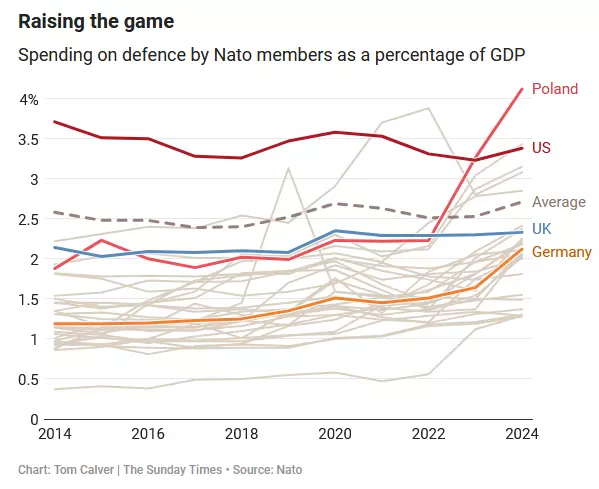
Poland is among the biggest spenders in Europe on defence — just under 5 per cent of its GDP (this is increasing all the time) — and it has built a 210,000-strong army, one of Nato’s largest in Europe.
It has splashed out on American fighters and hundreds of South Korean tanks, while its homegrown defence industry is booming off the back of the war in Ukraine.
“You’re never aware of war until it arrives at your door,” says Marcin Kubica, the managing director of the Polish defence contractor WB Group, as he guides me round a gleaming showroom of drones, including the bestselling FlyEye, a 12kg aircraft with a range of more than 30 miles that, among other things, can help to coordinate artillery strikes on enemy positions. Kubica says: “It’s so successful at the front that Ukrainian soldiers sing songs about it.”
Kubica, who sends a vast majority of the drones he makes to Ukraine, said business is booming. He has just returned from an arms fair in London and says that in the last week, the atmosphere has shifted in Poland. “I saw youngsters in British pubs, laughing, enjoying themselves. Britain is a nation that doesn’t have to worry about Russian drones falling out of the sky.” He added: “In some parts of our country you can hear explosions from Ukraine.”
Others speak of the “historic memory” that Poles have. Silvia Wozniak, 50, a marketing executive at the University of Warsaw, echoes the same sentiment: “I grew up hearing about the horrors of the war from my grandparents,” she says. “We know that the freedoms we have won since emerging from Moscow’s yoke are priceless.”
For Maksymilian Dura, a military analyst, the incursion followed a recent pattern of Russian meddling. “They’ve been at it for a while now — intercepting other countries’ GPS signals, carrying out cyberattacks, hitting undersea infrastructure, and there’s a common thread,” he said. “They’ve been allowed to do it with impunity. They expect no consequences.”
Poles have seen where such impunity leads — and how quickly. Partitioned by Prussia, Austria and Russia, the country vanished from the map for a century, returning only in 1918. Hitler’s forces later killed 250,000 Poles before reducing the capital to rubble, after which Warsaw was “liberated” by the Soviets, who held it in an oppressive grip until 1989. Poland’s membership of the EU and Nato has seemed like insurance since then. But now, with the Kremlin reverting to coercion in neighbouring Ukraine, the coverage looks perilously thin.
“I’d like to have a family, I have a lot of dreams — but I’m worried they might not come true now,” said Justina, 23, a linguistics student I met on a stroll around the University of Warsaw. “The war in Ukraine —we’ve been experiencing it, albeit indirectly, almost every day. But with drones falling from the sky here, the conflict now feels more palpable.”
Her parents have assembled a “survival kit”, with Swiss army knife included. But for Piotr Pieczka, another leading Polish prepper and Czuryllo’s co-author on Survival Is In My Genes, that beloved penknife is nowhere near enough.
“I’m not saying buy a Rambo knife,” he tells me in a Warsaw café. “But it should look serious — serious enough to make an aggressor think twice.”
At home he has supplies to sustain five people for six months. The family also keeps a second house in the forest about 60 miles from Warsaw, stocked for eight to nine months. Along the route he has hidden five days’ worth of food in secret spots. They have even had run drills — walking to the second home to time the journey — and agreed on places where messages can be buried in bottles if they get separated.
Like his co-author, Pieczka, a 53-year-old former cosmetics salesman and theatrical agent, has trained his children for crisis. “From an early age I taught them to strike a match, forage mushrooms and fish,” he says. “We would smoke meat and fish, bake bread in the forest, build shelters. My son could do it when he was six.”
Not only that, he has taught them to drive motorbikes, quad bikes and even lorries. “You never know what sort of escape vehicle you might need to commandeer,” he says.
If Pieczka is preparing to endure, others are getting ready to hold the line. Among them Suzanna Stnaka, 19, a history student. One of her topics is “genocide and German fascism in the 1930s and 1940s”. Vladimir Putin’s Russia, she believes, could be “just as capable of atrocities if nobody stops it”.
She goes on: “We need to arm ourselves and train our troops, it is East versus West. For sure, I will fight for my country. It’s my duty as a Polish citizen to protect my homeland.”
Source: Archive:
Deep in a forest in northeast Poland, Piotr Czuryllo scrapes bark with a knife and coaxes a spark from his flint. Within seconds a fire blazes. “A useful skill,” he says. “There are lots of wolves around here, day and night.”
Khaki-clad, a knife sheathed at his waist, Czuryllo, a handyman and hunter, has spent years learning to live off the land, stashing provisions, building hideouts and hunting deer as well as wild boar. He is a leading figure in Poland’s tens-of-thousands-strong “prepper” movement, honing ways to ride out a potential disaster.
“I’m not talking about a natural disaster,” adds Czuryllo, an affable figure with a silver ponytail and an earring. “Read our history — Russia, Germany, Napoleon, the Swedes. We’ve had to face invaders for centuries.”
After Nato scrambled jets on Wednesday to intercept a brazen Russian incursion by 19 drones into Polish airspace, Donald Tusk, the prime minister, warned that the country is closer to conflict than at any time since the Second World War. Some commentators wondered if the widening conflict would end in World War Three.
Czuryllo’s preparations do not seem extreme. The government has urged households to prepare “evacuation backpacks” — grab-and-go kits stocked with a torch, a radio and spare batteries, ID documents, basic medicines, water and food — as part of a stepped-up civil-preparedness drive. The packing guidance is online, with plans to send printed versions to every household this month.
Czuryllo, for his part, is ready — and he needs to be. He lives with his wife, four children and Nya, their black German shepherd, in an enclave of 12 houses occupied by family and friends on the fringe of Poland’s “lake district” near the village of Biesal — but he did not want their exact location to be disclosed. They are just 47 miles from Kaliningrad, the Russian exclave on the Baltic, and 134 miles from the border with Moscow-allied Belarus.
Their garages are crammed with pickled cucumbers, sleeping bags and fishing rods. Czuryllo says he once spent 58 weeks living alone in the forest and is coy about some preparations for facing Russian invaders, saying only: “We’ve all got guns.”
On military maps the area is especially sensitive. Nato military planners fear that Russia could swiftly punch a “corridor” — the so-called Suwalki Gap — between Belarus and Kaliningrad, cutting off the Baltic states from Poland and other western allies.
(map of the Suwalki corridor, a NATO chokepoint between the borders of Poland and Lithuania)
“We are all afraid of war, of course,” adds Czuryllo, 60, who takes on occasional construction work to fund his activities. “We think the next war will be more cruel than ever. But we are ready.”
His children grew up learning to use bows and arrows, eat raw deer meat and turn herbs into meals. “Did you know you can eat the insides of pine trees?” he asks. “And there are plenty of blackberries at this time of year,” he adds, handing me one.
Wednesday’s drone incursion forced the temporary closure of Warsaw’s Chopin airport and activated Nato’s Article 4, under which member states consult on whether “the territorial integrity, political independence or security of any of the parties is threatened”. Since then, Czuryllo has fielded a flood of calls from men and women of all ages, all wanting to join one of his survival seminars. Topics include how to identify an edible frog, catch a carp and build a simple shelter.
On Friday, as Russia rehearsed an invasion of Nato territory in war games across the border in Belarus, he was handing out jars of preserved vegetables and tinned goods in a village hall down the road. He had secured the supplies from food banks. “It’s the sort of food that keeps — something to get people through an emergency.”
Warsaw viewed the drone incursion as a deliberate provocation. In response, Nato announced steps to strengthen air defences on the alliance’s eastern flank with more air patrols, ground-based interceptors, sensors and heightened surveillance.
“We can only assume Russia is testing us,” says Colonel Lukasz Piatek, an F-16 pilot based at the Deblin Air Force base, about 60 miles southeast of Warsaw. Polish and allied crews shot down three or four of the drones out of a total of 20. Bringing down drones over your own territory is delicate work, says Piatek, adding: “You must avoid harm to people and property and factor in the debris.”
He, too, invoked Poland’s “unpleasant” history with Russia going back centuries. “They will always pose a threat to us,” he said. “That’s why we’re investing so much in defence. We’re enhancing our capabilities.”
Poland is among the biggest spenders in Europe on defence — just under 5 per cent of its GDP (this is increasing all the time) — and it has built a 210,000-strong army, one of Nato’s largest in Europe.
It has splashed out on American fighters and hundreds of South Korean tanks, while its homegrown defence industry is booming off the back of the war in Ukraine.
“You’re never aware of war until it arrives at your door,” says Marcin Kubica, the managing director of the Polish defence contractor WB Group, as he guides me round a gleaming showroom of drones, including the bestselling FlyEye, a 12kg aircraft with a range of more than 30 miles that, among other things, can help to coordinate artillery strikes on enemy positions. Kubica says: “It’s so successful at the front that Ukrainian soldiers sing songs about it.”
Kubica, who sends a vast majority of the drones he makes to Ukraine, said business is booming. He has just returned from an arms fair in London and says that in the last week, the atmosphere has shifted in Poland. “I saw youngsters in British pubs, laughing, enjoying themselves. Britain is a nation that doesn’t have to worry about Russian drones falling out of the sky.” He added: “In some parts of our country you can hear explosions from Ukraine.”
Others speak of the “historic memory” that Poles have. Silvia Wozniak, 50, a marketing executive at the University of Warsaw, echoes the same sentiment: “I grew up hearing about the horrors of the war from my grandparents,” she says. “We know that the freedoms we have won since emerging from Moscow’s yoke are priceless.”
For Maksymilian Dura, a military analyst, the incursion followed a recent pattern of Russian meddling. “They’ve been at it for a while now — intercepting other countries’ GPS signals, carrying out cyberattacks, hitting undersea infrastructure, and there’s a common thread,” he said. “They’ve been allowed to do it with impunity. They expect no consequences.”
Poles have seen where such impunity leads — and how quickly. Partitioned by Prussia, Austria and Russia, the country vanished from the map for a century, returning only in 1918. Hitler’s forces later killed 250,000 Poles before reducing the capital to rubble, after which Warsaw was “liberated” by the Soviets, who held it in an oppressive grip until 1989. Poland’s membership of the EU and Nato has seemed like insurance since then. But now, with the Kremlin reverting to coercion in neighbouring Ukraine, the coverage looks perilously thin.
“I’d like to have a family, I have a lot of dreams — but I’m worried they might not come true now,” said Justina, 23, a linguistics student I met on a stroll around the University of Warsaw. “The war in Ukraine —we’ve been experiencing it, albeit indirectly, almost every day. But with drones falling from the sky here, the conflict now feels more palpable.”
Her parents have assembled a “survival kit”, with Swiss army knife included. But for Piotr Pieczka, another leading Polish prepper and Czuryllo’s co-author on Survival Is In My Genes, that beloved penknife is nowhere near enough.
“I’m not saying buy a Rambo knife,” he tells me in a Warsaw café. “But it should look serious — serious enough to make an aggressor think twice.”
At home he has supplies to sustain five people for six months. The family also keeps a second house in the forest about 60 miles from Warsaw, stocked for eight to nine months. Along the route he has hidden five days’ worth of food in secret spots. They have even had run drills — walking to the second home to time the journey — and agreed on places where messages can be buried in bottles if they get separated.
Like his co-author, Pieczka, a 53-year-old former cosmetics salesman and theatrical agent, has trained his children for crisis. “From an early age I taught them to strike a match, forage mushrooms and fish,” he says. “We would smoke meat and fish, bake bread in the forest, build shelters. My son could do it when he was six.”
Not only that, he has taught them to drive motorbikes, quad bikes and even lorries. “You never know what sort of escape vehicle you might need to commandeer,” he says.
If Pieczka is preparing to endure, others are getting ready to hold the line. Among them Suzanna Stnaka, 19, a history student. One of her topics is “genocide and German fascism in the 1930s and 1940s”. Vladimir Putin’s Russia, she believes, could be “just as capable of atrocities if nobody stops it”.
She goes on: “We need to arm ourselves and train our troops, it is East versus West. For sure, I will fight for my country. It’s my duty as a Polish citizen to protect my homeland.”
Source: Archive:

