L | A
By Michelle Cohn
What does it mean to “normalize” something? Is it acknowledging the importance so consistently that we accept its weight as a fact of life (marriage, divorce, death)?
Is it establishing such widespread support for a topic that the social tide eventually sways towards one opinion over another (bank floats at pride, consulting firms tweeting about International Women’s Day)? Is it making something so banal that it’s hard to imagine it was ever revolutionary (online shopping, cell phones)?
And is there a topic more polarizing in its normalization than the termination of a pregnancy?
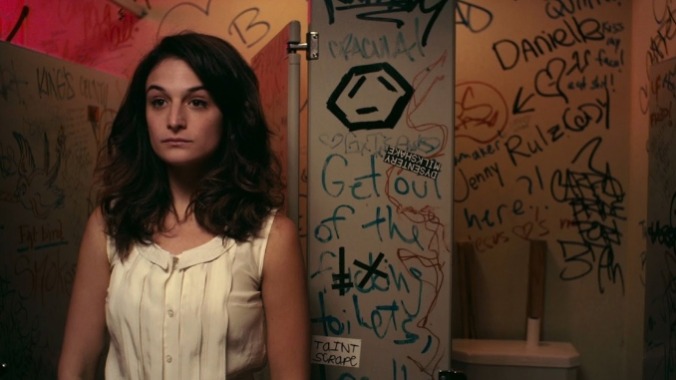
It’s individual human autonomy over our bodies but it’s also a matter of the state and federal government. It’s a straightforward removal of cells but it’s also murdering a child. And to both sides, it feels inconceivable that someone could believe something different. With that conversation in mind, we can talk about the Abortion Film, and one of the most prominent ones, Obvious Child.
Obvious Child premiered at the 2014 Sundance Film Festival, with reviews calling it “fresh and funny and really rather brave” and “groundbreaking.” And now, a decade later, it still does feel kind of groundbreaking.
The early 2000s had no shortage of “women accidentally getting pregnant” plotlines but as Juno and Knocked Up, and even Sex and the City showed us, the women often went through with the pregnancy. Whether or not they briefly considered abortion—viewers of Juno will recall she does go to a clinic, but runs into a classmate protesting outside and decides against it—they do not go through with the procedure.
Abortion proves a particularly hard topic for a film to tackle because it feels like the film has to be everything.
It has to be educational, since we don’t learn about abortion care or access in schools, but it also has to be narratively fulfilling. It has to present it as normal if a character feels emotional about the procedure, but also normal if the character doesn’t feel that emotional at all. It has to be realistic but hopeful, serious but accessible, a blueprint for those who might want one and a validation for those who have had one.
Obvious Child sold for seven figures, showing people (and not unimportantly, film executives) that audiences wanted movies like this.
Since then, we’ve seen abortion plot lines in films like Plan B, Saint Frances, and Unpregnant. We’ve seen abortion plot lines in TV shows like Sex Education, Scandal, and Shrill. There are, in fact, enough movies to create an entire genre of Two Girls Go On A Road Trip To Get An Abortion Because It Is Inaccessible In Their Home State.
The very existence of this trope is somehow both amusing and bleak. (There is, of course, still work to be done. The majority of the films have young white protagonists with no other children, even though a 2018 study from the CDC shows the population who get abortions to be much more diverse).
We’ve come quite a long way from the Hays Code, a set of requirements established in the 1930s that dictated that characters who had abortions should be condemned, and the word “abortion” should never even be said on screen. A lot has changed since even the abortion in Dirty Dancing (1987) where the procedure happens offscreen and is only referenced as “a dirty knife and a folding table”.
In Unpregnant (2020), a medical professional explains in detail what exactly will happen, from the vaginal ultrasound to the type of recovery room Veronica (Haley Lu Richardson) will wake up in after the procedure.
There are, I’m sure, people who say that abortion is too serious to joke about. Women have died. Doctors have been shot through the windows of their own practice. Staring at abortion legislation in this country, it feels like we are precariously close to becoming the world of The Handmaid’s Tale.
But a major driving force of abortion movies is to make it seem less scary. As Kelly O’Sullivan, the writer/star of Saint Frances notes, “We wanted to show the process…so that people can feel seen by it who have had abortions before and that people who might want to seek abortions in the future don’t feel scared.”
In an interview with Democracy Now, Gillian (((Robespierre))) (I wish I was kidding), the writer/director of Obvious Child notes her decision to not show protestors. “I wanted to show this particular story without protestors because not every time you go to Planned Parenthood or a clinic to do anything…you don’t always interact with protestors so I wanted to show that side.”
These are artists who want to reach out to the scared young girl holding a small plastic stick with two lines and tell her that there is a world where she is going to be okay. Hope does not undermine serious topics; it is the undercurrent we need to live. And it’s hope with real weight. A 2021 study found that watching abortions onscreen “significantly improved medication abortion knowledge.”
I’ve referred to Obvious Child as an abortion movie but maybe that’s wrong. It’s about the entire life that happens around an abortion. Maybe that’s what we mean by “normalize”; to acknowledge that something like this could be a big part of our lives but it is not what defines our lives.
We can only hope that if we find ourselves needing to terminate a pregnancy, we have easy access to an abortion clinic, we are surrounded by supportive friends and family, and we have a handsome man nearby who will make us tea while we watch Gone with the Wind.
Later in her interview, Robespierre was asked how her film might impact future films about abortion. She said, “I don’t know what the forecast is for other films, but my hope is that other filmmakers get excited about telling more honest and real stories and that it ignites conversation.” Ten years later, I think it has.
By Michelle Cohn
What does it mean to “normalize” something? Is it acknowledging the importance so consistently that we accept its weight as a fact of life (marriage, divorce, death)?
Is it establishing such widespread support for a topic that the social tide eventually sways towards one opinion over another (bank floats at pride, consulting firms tweeting about International Women’s Day)? Is it making something so banal that it’s hard to imagine it was ever revolutionary (online shopping, cell phones)?
And is there a topic more polarizing in its normalization than the termination of a pregnancy?
It’s individual human autonomy over our bodies but it’s also a matter of the state and federal government. It’s a straightforward removal of cells but it’s also murdering a child. And to both sides, it feels inconceivable that someone could believe something different. With that conversation in mind, we can talk about the Abortion Film, and one of the most prominent ones, Obvious Child.
Obvious Child premiered at the 2014 Sundance Film Festival, with reviews calling it “fresh and funny and really rather brave” and “groundbreaking.” And now, a decade later, it still does feel kind of groundbreaking.
The early 2000s had no shortage of “women accidentally getting pregnant” plotlines but as Juno and Knocked Up, and even Sex and the City showed us, the women often went through with the pregnancy. Whether or not they briefly considered abortion—viewers of Juno will recall she does go to a clinic, but runs into a classmate protesting outside and decides against it—they do not go through with the procedure.
Abortion proves a particularly hard topic for a film to tackle because it feels like the film has to be everything.
It has to be educational, since we don’t learn about abortion care or access in schools, but it also has to be narratively fulfilling. It has to present it as normal if a character feels emotional about the procedure, but also normal if the character doesn’t feel that emotional at all. It has to be realistic but hopeful, serious but accessible, a blueprint for those who might want one and a validation for those who have had one.
Obvious Child sold for seven figures, showing people (and not unimportantly, film executives) that audiences wanted movies like this.
Since then, we’ve seen abortion plot lines in films like Plan B, Saint Frances, and Unpregnant. We’ve seen abortion plot lines in TV shows like Sex Education, Scandal, and Shrill. There are, in fact, enough movies to create an entire genre of Two Girls Go On A Road Trip To Get An Abortion Because It Is Inaccessible In Their Home State.
The very existence of this trope is somehow both amusing and bleak. (There is, of course, still work to be done. The majority of the films have young white protagonists with no other children, even though a 2018 study from the CDC shows the population who get abortions to be much more diverse).
We’ve come quite a long way from the Hays Code, a set of requirements established in the 1930s that dictated that characters who had abortions should be condemned, and the word “abortion” should never even be said on screen. A lot has changed since even the abortion in Dirty Dancing (1987) where the procedure happens offscreen and is only referenced as “a dirty knife and a folding table”.
In Unpregnant (2020), a medical professional explains in detail what exactly will happen, from the vaginal ultrasound to the type of recovery room Veronica (Haley Lu Richardson) will wake up in after the procedure.
There are, I’m sure, people who say that abortion is too serious to joke about. Women have died. Doctors have been shot through the windows of their own practice. Staring at abortion legislation in this country, it feels like we are precariously close to becoming the world of The Handmaid’s Tale.
But a major driving force of abortion movies is to make it seem less scary. As Kelly O’Sullivan, the writer/star of Saint Frances notes, “We wanted to show the process…so that people can feel seen by it who have had abortions before and that people who might want to seek abortions in the future don’t feel scared.”
In an interview with Democracy Now, Gillian (((Robespierre))) (I wish I was kidding), the writer/director of Obvious Child notes her decision to not show protestors. “I wanted to show this particular story without protestors because not every time you go to Planned Parenthood or a clinic to do anything…you don’t always interact with protestors so I wanted to show that side.”
These are artists who want to reach out to the scared young girl holding a small plastic stick with two lines and tell her that there is a world where she is going to be okay. Hope does not undermine serious topics; it is the undercurrent we need to live. And it’s hope with real weight. A 2021 study found that watching abortions onscreen “significantly improved medication abortion knowledge.”
I’ve referred to Obvious Child as an abortion movie but maybe that’s wrong. It’s about the entire life that happens around an abortion. Maybe that’s what we mean by “normalize”; to acknowledge that something like this could be a big part of our lives but it is not what defines our lives.
We can only hope that if we find ourselves needing to terminate a pregnancy, we have easy access to an abortion clinic, we are surrounded by supportive friends and family, and we have a handsome man nearby who will make us tea while we watch Gone with the Wind.
Later in her interview, Robespierre was asked how her film might impact future films about abortion. She said, “I don’t know what the forecast is for other films, but my hope is that other filmmakers get excited about telling more honest and real stories and that it ignites conversation.” Ten years later, I think it has.


