Last year was full of learning experiences for me, mostly mistakes. I haven't posted any updates because no single thing was worthy of mention, but all together, I think it's worth posting now.
From what I gathered, wood is supposed to expel moisture before it is worked. People do this by stacking green wood off the ground so it doesn't soak in ground water, so I bought some cinder blocks on which to place freshly cut logs. This did not go as planned.
This was the first tree I ever cut in my life.
@Greatest Gonger said I'd be a pussy if I used a chainsaw, and a pussy I am. I still have a job because I still need to earn money. It's a physically demanding job, over 10 hours a day for 5 days a week (there was a two-week period of over 70 hours each last year). One thing I learned was how slow collecting logs can be for me. Since I want to rest one day of the week, I only have one day a week to head out to cut logs. Some weeks, I don't feel like doing anything at all. I don't think handsawing is realistic, so forever a pussy I shall be.


One of the reasons I'm slow is my lack of experience, as you can see from the sloppy, splintered hinge here. I also didn't check the tree for infections. What I found was a spongey texture inside this tree. The cavity is where a tinder fungus was growing. It ripped out easily from the tree, but behind it was soft pulp. I stuck a knife in there, and it was tender, ripping like chicken breast with a fork. There is likely no chance this is useable wood, and the trunk was so large, I couldn't move the log on my own to lift onto the cinder blocks anyway. Since it's already waste, I decided to use this, and another infected tree, as beams upon which to place good logs.
Another thing I learned is that removing the bark can be the fastest or slowest part of the process. The first tree I cut had bark that peeled like an orange. I used a draw knife to strip a strip of bark, and to my delight, the rest of it all but fell off the wood. It was easy sticking my hand between the exposed wood and remaining bark, then pulling it off without much force. I attribute that to the sap in the cambium, but the sap was so sticky, I decided to buy a pair of crowbars for this task instead of needing to wash my gloves every time. The sap drew in every sap loving insect from the forest. I should have known that would happen, but it still surprised me. I tasted the sap myself. It was mildly sweet. Maybe in the distant future, I'll tap some of the remaining trees to make birch syrup.
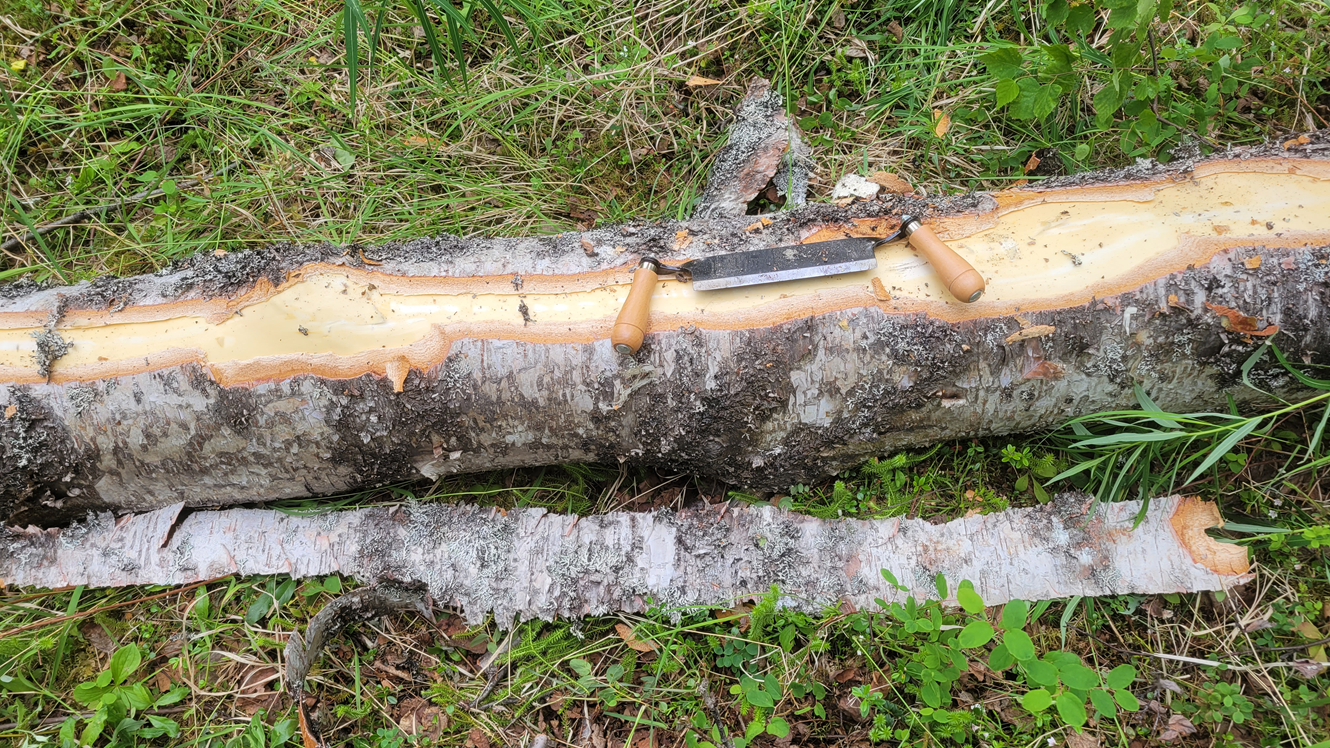
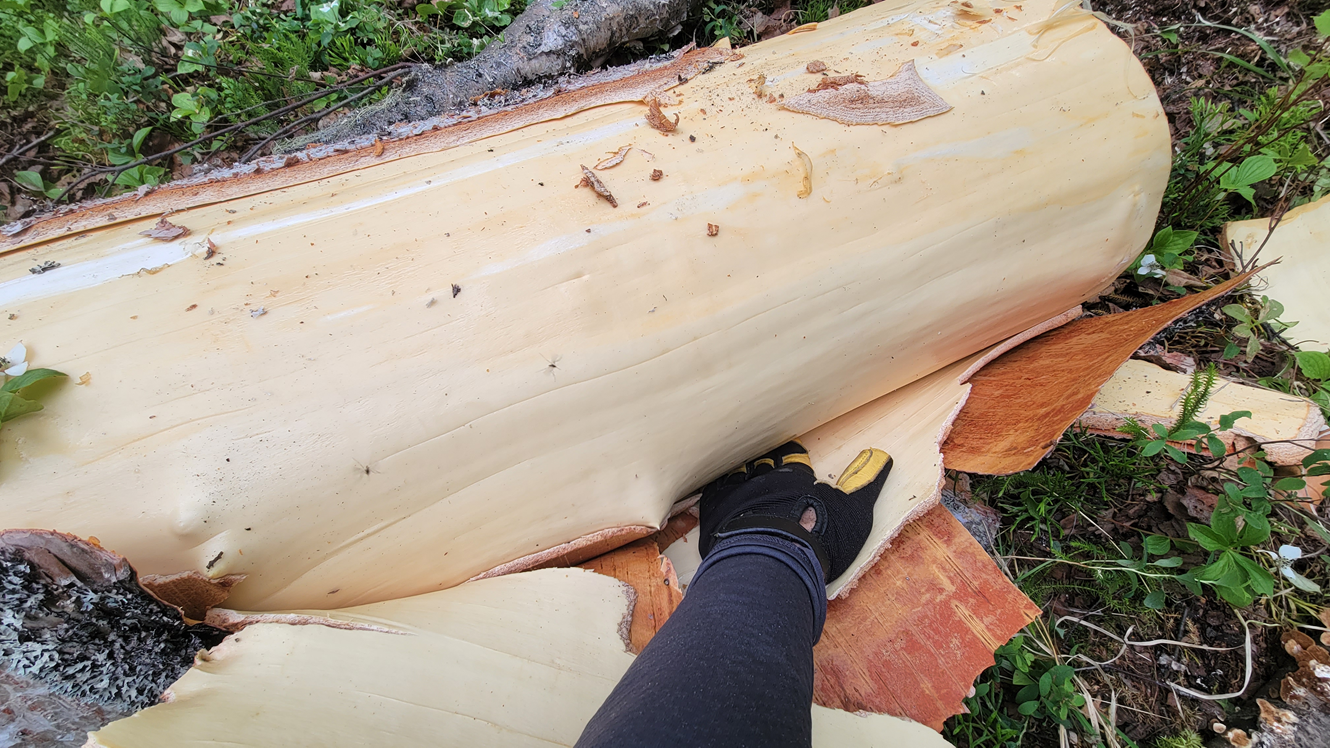
When there's no sap flowing through the tree, the bark peels like an apple. I hate it. I takes hours. I learned that from the second tree I felled. Unlike every other tree, the second one smelled of something between vinegar and wine when stripped. There were even reddish-brown streaks on the sapwood. I suspect this was the tree's immune system fighting off the tinder fungus, or perhaps some other infection. I don't have photos where this tree is the main subject, but it's visible in in the back here.

I made sure to look for trees free of the tinder fungus before I cut anything else. These were some nice ones, thin enough that I could lift them by hand onto my sacrificial logs. I was told by someone with a connection to logging operations to keep my logs on pallets to keep them off the ground. Perhaps they meant plastic pallets, but if wood pallets are just fine, then logs I don't intend on keeping ought to be fine too. The ground is too uneven for pallets or cinder blocks, in any case.
You can also see a difference in the size of the stripped bark, depending on whether or not there was flowing sap. The trees that peeled like oranges leave intact pieces of bark that I can drag out of the way. Trees that peel like apples only leave a mess that I don't want to spend time on clearing. As a bonus, the sap reduces friction, so I can lift one end of new logs onto this makeshift rack, then slide them up the rest of the way to rest nicely with the others. I read online that moisture escapes the fastest from the end grain of wood, but that should be stopped because the ends dry so fast that the wood splits. I applied end grain sealer with a paint brush to the logs at the end of the day.
I was able to amass a small amount of logs like this, and I was feeling very productive. They needed to dry and it wouldn't help if rain resoaked them, so I threw a tarp over my beautiful logs. This was another mistake.

I can't remember if it was one week or two that I left a tarp over these, but look at all that mildew. I felt devastated. I felt stupid. The logs are expelling moisture now that they are dead, so throwing a tarp over them without any ventilation was obviously going to lead to this. However, there was an interesting discovery to be made here, a silver lining. That pungent tree seemed almost unaffected by this. Whatever caused the vinegary-wine smell was likely still in the wood and prevented mildew from growing. I researched mold and mildew killers and found that vinegar is one of them. There were many kinds of remedies for mold and mildew, some natural and some hazardous to nature. I could have used vinegar, but I used a vinegar and salt mixture as an herbicide before, and didn't want to risk harming the soil underneath. Hydrogen peroxide is said to be able to penetrate deep into the wood fibers, then break down into water and gaseous oxygen that would kill mildew at the root.
The Home Depot had 12% peroxide, a spray bottle, and a stiff scrubbing brush. The label on the peroxide provided instructions to dilute it down to the 3% kind you find at the pharmacy. I was unsure if that would deal with the mildew better or not, so I bought 3% peroxide as well. Spraying 12% or 3% wasn't visibly different; both of them effervesced violently upon touching the mildew. Perhaps the 3% was dilute enough that more peroxide could seep deeper before bubbling its cleansing oxygen, but the 12% wasn't any more volatile on cleaner parts. I let it soak for about 10 minutes, then worked on scrubbing the surfaces as well as I could. I did this twice for each log, hoping they could still provide quality wood.

The seven on the left are what they looked like after I treated the mildew. The two one the right were place after that episode. It was August by then, and the sap had run dry. If you look closely, the two on the right are more scuffed than the others because they peeled like apples. You can also see the end grain on one of the logs. There are small splits in it, and some of the others, even though I coated them in sealant. I'm unsure of the cause. I don't know if they need multiple coats, but I read that if relative humidity is too low, wood dies out too fast. You can also see a clean edge where sealant ran over. There is no mildew there. Maybe sealant protects against mildew, but leaves logs laden with their own juices. I learned recently that you can even use exterior house paint as an end grain sealant. If it's cheaper than what I bought, I'll try that when I run out. Honestly, I'm not sure what the right approach is. I left the logs uncovered for a while, and that prevented mildew on the two newest logs. My boss tells me September is rain season up here, so I felt the need to throw a tarp over them again, but with ventilation this time.

I hate how ramshackle this is. I know I don't know what I'm doing, but this makes me feel wholly inadequate. There's a tenth log here. No sap inside the bark really slowed me down when it came to cutting logs, so this is all I have for the year of 2025. The weather quickly getting cold at night, the emotional blow of the mildew, and the slow process took the wind from my sail. I was hoping to have more logs than this, and these might not be suitable for a cabin. I might have zero logs. While this assembly did hold up week after week, I didn't think it would hold up to the weight of snow, so I laid the tarp flat as I did to cause the mildew. Hopefully the frigid air is on my side and preserves what I have.
It's now 2026. The weather is still not suitable for this venture. I wanted to start as soon as the snow melted last year, but logistical hang-ups got in the way. That's straightened out now, so I can start cutting more logs earlier this year. I need to produce way more than 10 logs a year. A rough calculation I made before starting made me think I need 90-100 logs. It'll be 10 years before I can start building at this rate, which is simply unacceptable. I also think I should take the mildewy logs and fashion a more stable support than propped up posts and bungee cords for a canopy. If it holds up and the inside of the wood is mold and mildew-free, then the rest of the logs should be fine. I can't say 2025 was entirely a waste, however. I learned a lot for the future, and I contemplated a lot while working innawoods. This is my plan for this year: as soon as the snow melts and there's budding growth on all the trees, I'm heading back to cut as many logs as I can while the bark is easy to deal with. By August, the water table should be at the lowest, so instead of wasting time on stubborn bark, I'm going to try installing a well. If I succeed, then I'll have a source of water for most, if not the entire time I'm there. I hope I can collect 20-25 logs during that time. Here's to a better, wiser 2026!
Remember these berries?


On the left are bunchberries, the ones that grew all over the ground. The internet was right, they are not appetizing. They aren't disgusting either. The texture was mealy, and there was no flavor. The other two are mooseberries, or highbush cranberies, or whatever they're called. I like these a lot more. They don't taste like soap, at least not to me, so the internet was wrong. Imagine a sour gusher without any of the sugar, and a croonchy seed inside. That's what they're like. Their tartness shocked me, and I didn't like it at first as I had hoped for some sweetness. After the surprise faded, I felt the temptation to eat more, and then some more. I like them enough that, if I actually ever get to homesteading, I want to cultivate more and make a jam from them. The yellow mooseberry was very, very tart. I prefer the red ones.
I didn't see this last year, but it was so odd, I took a photo.

I saw these after sampling the wild berries, but I didn't like how they look. The mooseberries were shiny, reflective, like red pearls or edible gem stones. These look evil and wicked. I'd have called them cthulhu berries, but the age of discovery is long gone. They're rose hips, and they're apparently very good for you (rich in vitamin C and other beneficial compounds), if you don't eat the seeds which have irritating hairs. I'm glad I trusted my initial suspicion. Native peoples have boiled them with wild redcurrants and highbush cranberries to make syrup. Sounds good enough to get over my hesitance, but I'll continue using plant identifiers before I ingest anything.
My contemplations while working had me consider what to do about a foundation.
@Uncle Tom's Condo Mentioned drilling piers or layinge cinder blocks with adjustable mounts. That's not such a bad solution for dealing with frost heave, but the mounts I have seen are built to hold beams. I wanted to notch the logs for a lincoln log cabin, and that requires a sill log at the base to hold the weight of the structure. I still need to keep that sill log off the ground. Another person told me that I could deal with frost heave by building my cabin on gravel, which is a decent idea, I think. It's not entirely solid, but coarse, jagged gravel locks into itself with weight from above. I figure I can remove the top soil, lay down a geotextile, and dump gravel a foot hight around the perimiter. I also thought about putting concrete lego blocks on top of that to tamp and level it. We make huge ones at my job, but my boss said I could use his welder to make forms for smaller ones. They look like this. There are protrusions and recesses that allow them to interlock without mortar. They do a fine job of not falling over while holding the piles of sand and gravel that go into our concrete. I could make a form that allows for a flat top so I can lay logs on top. I could also slot a hole in the sill logs for a 2x6 joist, and place that joist onto the adjustable mount. Again, I don't know which approach is best here.


Of the new logs I processed after the mildew incident, one of them had a 12 inch diameter at one end. Most of the logs on the stack could be lifted from one end by squatting, hugging it, and lifting it onto a sacrificial log. I could then shimmy it into place by lifting one end or another as needed. I was simply not strong enough to do that with the 12 inch mass. This got me thinking about hoists and ramps, as well as cutting the logs into more manageable sizes. Since I want to use some of these logs to create a more rigid structure to hold my tarp, I'll need to get some more wood working tools. I think I can reduce the weight and help myself at the building stage by removing the tops and bottoms of the logs, flattening them in the process. I can also cut shorter logs, but I initially wanted a cabin that was 15'x20'. I was wondering if I could simply lay logs end to end to extend their length in a wall, but some wood working videos taught me about lap joints, and mortise and tenon joints. I could probably cut my logs into asymmetrical lengths, then combine those two styles of joinery to allow the ends of the log to interlock with each other. The asymmetrical lengths would make it so these joints don't sit above each other, alternating joint locations the way bricks do in a wall. An issue I can see arising from this that the pith would comprise the tenon, so I could likely save on labor and reduce risk by simply making it a lap joint and driving some dowels through the overlap. Are there any wood workers here who can advise or warn me on this?

i am so jealous, living the uncle Ted dream
DON'T LET YOUR DREAMS BE MEMES!
There's a small source of affordable land at
billyland.com. As far as I can tell, they auction land, the winning bid is the down payment, and it's seller financed, so no credit check or underwriting required. This isn't how I acquired my land, but it is something extra to look into. They have a few small lots in Florida, as well as a few other states. Anyone who wants to own land but feels like the system is rigged against them can start looking here. The down payments are all 3 or 4 figures, and the monthly payments should be manageable for anyone who isn't brain-dead. This is how generational wealth starts, people.
Buy some land! Buy some land! Fuck spinning rims!
OP,
What are you going to do heat your place? You have wood, but it's green and going to take a year to season.
Burning wood in a stove sounds like the best way to comfymax. Ash is a great resource, too. It can be leeched for lye to make soap, it can fertilize land, and it can be dumped in an outhouse to dessicate and reduce the odor of waste. It'll be a few years before I can move in full-time, so waiting for the wood to season isn't a concern of mine. Since there's so much snow fall and no way to be productive out there in the winter beyond ice fishing, I figured I could bail during the winter the first few years while I figure out my food production. I could look into getting a plow for my truck to make some money during winter, and I want to get another piece of land or small home near the highway to store my vehicles and such, so I could just get away without a heating solution for a long while.
The letters look a bit different. Might be a use of a non-standard font or something. Things get a bit more cramped after the C. That might explain it. May be worth bringing up in your report
@Sperg_rancher!
Ver archivo adjunto 6454642
Edit: If I copy the other user's "Happy" from his profile, he shows up in the @ mentions list, whereas if I just write the name on my keyboard I show up in the list. Don't know if that's it for sure but I think I'm at least on to something with the font theory making the names functionally different while appearing identical.
Sorry about that! I wanted to name myself Happy Homesteader, but I thought that would be lying because I'm still working my way to it. I do enjoy camping on my land, but threw in some ruskirunes for fun. I'll change my name for you so this doesn't become a big problem. Is there a way I can do that?


