
- Registrado
- 15 de Mar, 2023
Got a few hours to kill so let's take a look at Sparkplug's take on history. I'm sure you can guess most of his rewrites, but I think there's a case to be made that he constructed a world view so schizo, Nazi Flying Saucers was a natural outcome. This will be more nit picky on history, but we'll end up decoding hidden messages in Timothy Dalton movies soon enough.
To Sparks, history is a thing to be twisted to his ends. I think the best way to follow his thought process is to also start with his conclusions. Here's the quick version of Spark's Rules for History.
1) The USMC has never done anything
2) The US Army did everything
3) Airborne and light armor always win
4) The Navy can have some credit for ferrying the Army, nothing else
5) Historical figures he likes are flawless
6) Whatever movie or book he watched/read last is a profound insight into history
Let's start with the obvious. Sparks likes mechanized infantry assaults, so there's only one place for a midwit historian to go: Wheraboo-ism. But in his own, stupid, way. It's one thing to stan for the Wehrmacht, but he takes care to make sure he's separated from the unsavory types.. You know, heavy armor fans.

To be fair, Sparks is not a Nazi. In fact, one of his biggest gripes with Neo-Nazis is that they don't appreciate the STuG III enough.

Let's move away from Germany for a second. The Pacific Theater presents a problem for Sparks. It's full of things he hates: Marines, the Navy doing something besides transporting the Army, and aircraft carriers. There's a decisive lack of massed armor and airborne drops. So Sparks is going to have to do some work to rewrite this theater. First off, writing out the USMC.

Using hard hitting research found in an Army recruitment brochure, Sparks insists the Army actually took Guadalcanal, when in reality they cleaned out the last few packets of resistance after the 1st Marine Division, depleted from the brunt of the fighting, were pulled out. There was a federalized National Guard unit that arrived with the 7th Marines and was present for the heavy fighting, but they got along with the Marines and were referred to as the 164th Marines by Vandegrift for their role in clearing out several hardpoints, and we can't have cooperation here.
During the war, the Pacific would be split into three sections, the two important ones being the Southwest and Central Pacific regions. MacArthur and the Army took the south, Navy and Marines took the Central. This should make things simple for Sparks, just write off the Central as pointless and put all the emphasis on MacArthur. But that isn't petty enough for Sparks, so he's gonna make up an interview with a veteran:

This obviously never happened, but reinforces one of Spark's odd assertions, that the USMC would only take beach heads and refuse to move inland, leaving the Army to do the heavy lifting. I have no idea where it comes from, except maybe he's misconstruing Gaudalcanal, where the USMC lacked the man power and supplies to fully clear the island. Well, that's the USMC taken care of, next up is the Navy. Specifically air craft carriers. Most people know the Pacific for proving the fleet carrier over the battleship. But Sparks hates carriers and loves battleships, so let's rewrite how it went. First off, lets look at battle ship loses:


Hitting battleships in port doesn't count because taking out an enemy before they deploy isn't a good thing. The ones that didn't have air cover don't count either. Doesn't that prove the necessity of carriers? No, because it should have been float planes, which would fend off the bombers, shoot down the fighters, and destroy the carriers with only 28 scout planes. So if you just don't count the majority of losses, battleships are still the queens of the sea.
Quick aside on how The Sparkster would have ran the war, he would have ignored the central pacific to island hop from Alaska to the Kuriels. So the same plan but with the Army and with air bases that would be down for weather half the year. Meanwhile, MacArthur would be let loose to march from Malaya all the way through fucking China.
PART TWO: CRAZY TOWN (In which we see disconnected from reality assumptions lead to insane conclusions)
Here's where Sparks hero worship and prejudices get applied to the war as a whole, and lead to insanity. First off, FDR. He loves FDR, but Pearl Harbor happened under FDR. How to square this? Once again, by taking a fringe theory and putting his spin on it. Sparks is a fan of the idea FDR let Pearl Harbor happen to drag America into a unpopular war with Germany. And I do mean a fan. He considers it a brilliant geopolitical move by Roosevelt, who intentionally filled Pearl Harbor with outdated ships to provoke an attack.

Next, Midway. Acknowledging the importance of the battle means acknowledging fleet carriers. Can't have that. How to explain it away? US subs sank 55% of Japanese shipping, mostly running up the score in '44 and '45 against merchants. So actually, we could have lost every single carrier and been fine, because subs and seaplanes would save us.


What was that about Japan wasn't the only country nuked? Let's return to Europe to see his autism synthesize. The Germans favored light armor and assault guns, so they MUST be the strongest and technologically advanced army of the war. Second, the Marines were not in Europe, so the European theater MUST be the only thing that matters. This two lines of thought will combine to the conclusion that Nazi Germany MUST have been the biggest threat to life on Earth ever seen, so that the heroic Army could save the world with no help from Marines. Put this together with Sparks predisposition to conspiracy thinking (Bush broke his brain), and we're going places.


That's right, his heroes Churchill and FDR saved the world from nuclear Armageddon with days to spare. This comes from, or leads him to, a book named 'Reich of the Black Sun', a though look at Nazi super weapons, including a solar Disintegration Ray. This book is so important Sparks hosts the entire thing on his site. And if you know anything about late night History Channel, you know what comes next.

The Nazis escaped to Antarctica in flying saucers, fought off the Americans during Operation Highjump, and were nuked under the cover of nuclear testing. Fairly standard conspiracy. This next one, however, is all Sparks. In 2006, Daniel Craig's first film as James Bond, 'Casino Royale' releases. This would rekindle an autistic obsession with the series in Sparks. By 2011, he's using Dr. No as evidence for his light armor doctrine, even as his writing would move toward paranoid rantings about 9/11 trutherism:

In this mindset of shadowy cabals, false flags, and Fourth Reich UFOs, Sparks would find Ian Fleming's writings spoke more and more to him. Sparks uncovers a hidden truth, one so Earth shattering he must tell the world. Ian Fleming's official biography was a cover, and the James Bond series was a fictionalized story about Fleming's career as a MI6 agent, littered with secret code words that expose the REAL HISTORY and warn us about the Rockerfeller-Illumaniti running the world, for those with eyes to see:
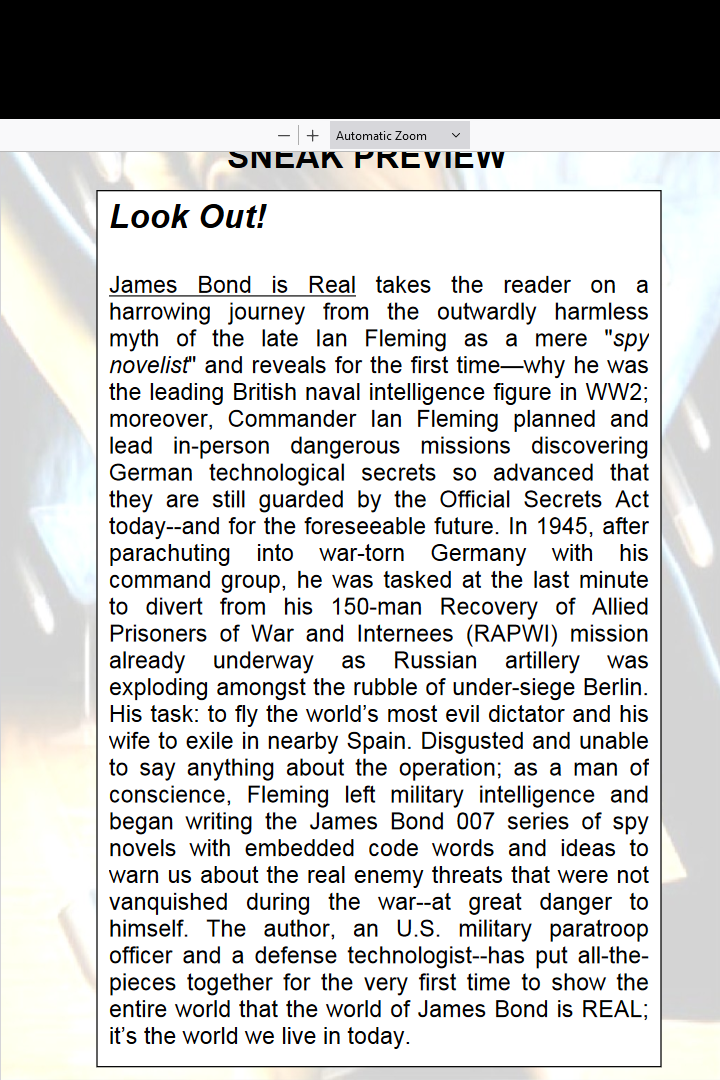
Fleming's exploits include helping Bormann and Hitler escape Berlin, breaking into underground bases to steal Nazi tech still classified, and sending in a crack team to kill Tiger ace Michael Whitmann. Sparks wrote a 650 page book on the subject, released in 2011. It has one review on Amazon and if there's a copy for sale somewhere, I can't find it.
TL;DR: In an effort to reconcile history with his theories, Sparks psyop'd himself into a state of mind where the slightest nudge would send him into full on schizophrenic ranting about hidden codes about the Fourth Reich in James Bond books.
To Sparks, history is a thing to be twisted to his ends. I think the best way to follow his thought process is to also start with his conclusions. Here's the quick version of Spark's Rules for History.
1) The USMC has never done anything
2) The US Army did everything
3) Airborne and light armor always win
4) The Navy can have some credit for ferrying the Army, nothing else
5) Historical figures he likes are flawless
6) Whatever movie or book he watched/read last is a profound insight into history
Let's start with the obvious. Sparks likes mechanized infantry assaults, so there's only one place for a midwit historian to go: Wheraboo-ism. But in his own, stupid, way. It's one thing to stan for the Wehrmacht, but he takes care to make sure he's separated from the unsavory types.. You know, heavy armor fans.
To be fair, Sparks is not a Nazi. In fact, one of his biggest gripes with Neo-Nazis is that they don't appreciate the STuG III enough.
Let's move away from Germany for a second. The Pacific Theater presents a problem for Sparks. It's full of things he hates: Marines, the Navy doing something besides transporting the Army, and aircraft carriers. There's a decisive lack of massed armor and airborne drops. So Sparks is going to have to do some work to rewrite this theater. First off, writing out the USMC.
Using hard hitting research found in an Army recruitment brochure, Sparks insists the Army actually took Guadalcanal, when in reality they cleaned out the last few packets of resistance after the 1st Marine Division, depleted from the brunt of the fighting, were pulled out. There was a federalized National Guard unit that arrived with the 7th Marines and was present for the heavy fighting, but they got along with the Marines and were referred to as the 164th Marines by Vandegrift for their role in clearing out several hardpoints, and we can't have cooperation here.
During the war, the Pacific would be split into three sections, the two important ones being the Southwest and Central Pacific regions. MacArthur and the Army took the south, Navy and Marines took the Central. This should make things simple for Sparks, just write off the Central as pointless and put all the emphasis on MacArthur. But that isn't petty enough for Sparks, so he's gonna make up an interview with a veteran:
This obviously never happened, but reinforces one of Spark's odd assertions, that the USMC would only take beach heads and refuse to move inland, leaving the Army to do the heavy lifting. I have no idea where it comes from, except maybe he's misconstruing Gaudalcanal, where the USMC lacked the man power and supplies to fully clear the island. Well, that's the USMC taken care of, next up is the Navy. Specifically air craft carriers. Most people know the Pacific for proving the fleet carrier over the battleship. But Sparks hates carriers and loves battleships, so let's rewrite how it went. First off, lets look at battle ship loses:
Hitting battleships in port doesn't count because taking out an enemy before they deploy isn't a good thing. The ones that didn't have air cover don't count either. Doesn't that prove the necessity of carriers? No, because it should have been float planes, which would fend off the bombers, shoot down the fighters, and destroy the carriers with only 28 scout planes. So if you just don't count the majority of losses, battleships are still the queens of the sea.
Quick aside on how The Sparkster would have ran the war, he would have ignored the central pacific to island hop from Alaska to the Kuriels. So the same plan but with the Army and with air bases that would be down for weather half the year. Meanwhile, MacArthur would be let loose to march from Malaya all the way through fucking China.
PART TWO: CRAZY TOWN (In which we see disconnected from reality assumptions lead to insane conclusions)
Here's where Sparks hero worship and prejudices get applied to the war as a whole, and lead to insanity. First off, FDR. He loves FDR, but Pearl Harbor happened under FDR. How to square this? Once again, by taking a fringe theory and putting his spin on it. Sparks is a fan of the idea FDR let Pearl Harbor happen to drag America into a unpopular war with Germany. And I do mean a fan. He considers it a brilliant geopolitical move by Roosevelt, who intentionally filled Pearl Harbor with outdated ships to provoke an attack.
Next, Midway. Acknowledging the importance of the battle means acknowledging fleet carriers. Can't have that. How to explain it away? US subs sank 55% of Japanese shipping, mostly running up the score in '44 and '45 against merchants. So actually, we could have lost every single carrier and been fine, because subs and seaplanes would save us.
What was that about Japan wasn't the only country nuked? Let's return to Europe to see his autism synthesize. The Germans favored light armor and assault guns, so they MUST be the strongest and technologically advanced army of the war. Second, the Marines were not in Europe, so the European theater MUST be the only thing that matters. This two lines of thought will combine to the conclusion that Nazi Germany MUST have been the biggest threat to life on Earth ever seen, so that the heroic Army could save the world with no help from Marines. Put this together with Sparks predisposition to conspiracy thinking (Bush broke his brain), and we're going places.
That's right, his heroes Churchill and FDR saved the world from nuclear Armageddon with days to spare. This comes from, or leads him to, a book named 'Reich of the Black Sun', a though look at Nazi super weapons, including a solar Disintegration Ray. This book is so important Sparks hosts the entire thing on his site. And if you know anything about late night History Channel, you know what comes next.
The Nazis escaped to Antarctica in flying saucers, fought off the Americans during Operation Highjump, and were nuked under the cover of nuclear testing. Fairly standard conspiracy. This next one, however, is all Sparks. In 2006, Daniel Craig's first film as James Bond, 'Casino Royale' releases. This would rekindle an autistic obsession with the series in Sparks. By 2011, he's using Dr. No as evidence for his light armor doctrine, even as his writing would move toward paranoid rantings about 9/11 trutherism:
In this mindset of shadowy cabals, false flags, and Fourth Reich UFOs, Sparks would find Ian Fleming's writings spoke more and more to him. Sparks uncovers a hidden truth, one so Earth shattering he must tell the world. Ian Fleming's official biography was a cover, and the James Bond series was a fictionalized story about Fleming's career as a MI6 agent, littered with secret code words that expose the REAL HISTORY and warn us about the Rockerfeller-Illumaniti running the world, for those with eyes to see:
Fleming's exploits include helping Bormann and Hitler escape Berlin, breaking into underground bases to steal Nazi tech still classified, and sending in a crack team to kill Tiger ace Michael Whitmann. Sparks wrote a 650 page book on the subject, released in 2011. It has one review on Amazon and if there's a copy for sale somewhere, I can't find it.
TL;DR: In an effort to reconcile history with his theories, Sparks psyop'd himself into a state of mind where the slightest nudge would send him into full on schizophrenic ranting about hidden codes about the Fourth Reich in James Bond books.


