Source: https://www.refinery29.com/en-us/2022/08/11082731/color-blind-casting-cons-bridgerton-persuasion
Archive: https://archive.ph/0aGOL
By Nylah Burton
Updated Aug. 15, 2022 08:08 PM
When I was a little girl, I buried myself in historical dramas. I devoured TV, movies, books — whatever could transport me from the anxious and lonely child I was into a different world where I could be adventurous, regal, glamorous, and loved. I would slip into the characters, imagining myself in the story. But all the characters — the queens, the princesses, and the peasants — were all white. Despite myself, I’d inevitably imagine myself as a white girl, leading to discomfiting dissociation. These were not my stories, those were not lives I could have ever lived in that era. So, how could I show up fully as myself, even in my own imagination?
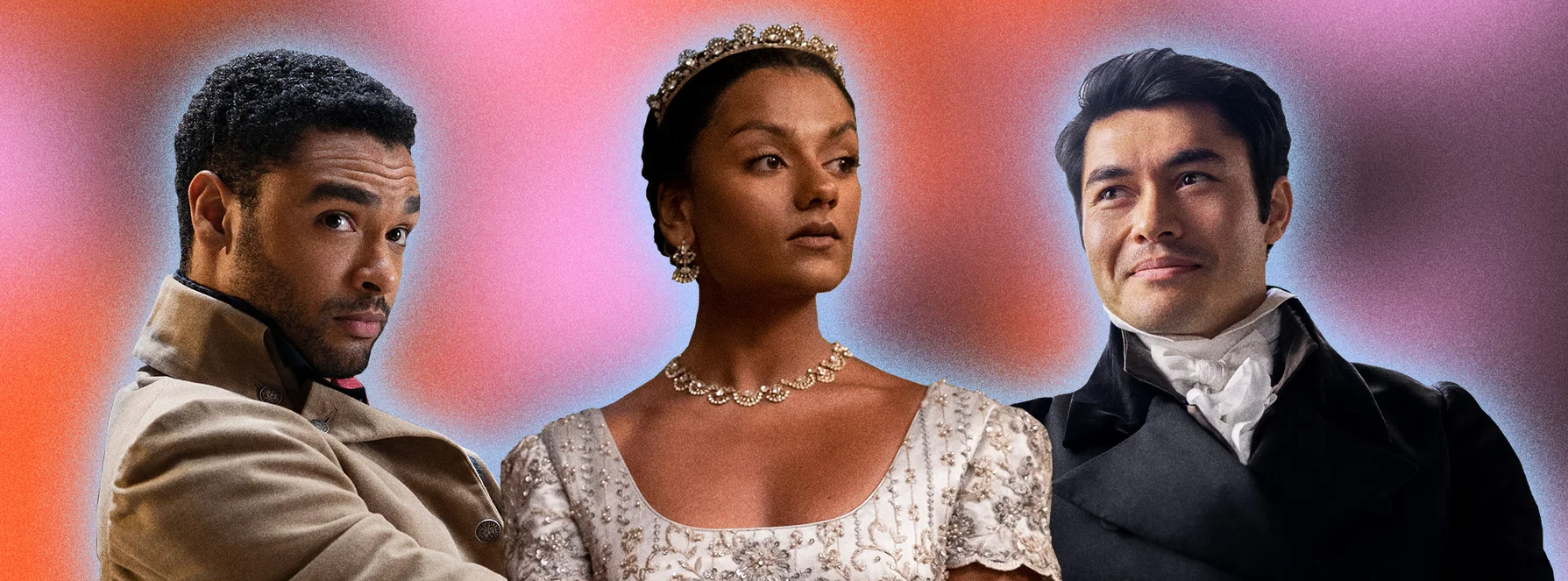
As an adult, when I saw the meteoric popularity of Bridgerton, a Regency-era TV drama with color-blind casting, it intrigued me to see so many Black and brown women praise the escapism the show offered. Persuasion and Mr. Malcolm’s List are two other Regency dramas that have color-blind casting, and portray a partially-utopian Britain, where race has no bearing on one’s ability to move throughout society, or secure wealth and marriages. This rise in color-blind casting has been hailed as a sign of progress. But for me, I’m reminded of that old slippage — the emptiness and confusion that comes with trying on another skin.
In Bridgerton’s world, racism does not exist. The show’s hasty explanation is that it was instantly eliminated by the marriage of the real-life Queen Charlotte — who was rumored to have Black heritage — and King George III, who was reportedly opposed to slavery. Now, viewers are to assume that people who were slaves a decade ago are now sought-after dukes. In the world of Bridgerton, Black men marry white women, Asian men dance with Black women, white men marry Asian women — all seamlessly and without a whiff of racism or prejudice. For many, this is delightful and progressive. For others, it’s a confusing trend with disturbing potential consequences.
It makes sense, though, that Black and brown people would want to see ourselves in Regency-era romances. They are the stories that formed many of our first conceptions of love, mainly because of Jane Austen’s novels. Grusha Singh, who examined the Regency era in her postgraduate studies, tells Unbothered that Austen contributed to the heavy romanticization of the period. “Period dramas in general are romanticized, but Pride and Prejudice is nearly everyone's favorite romance novel,” she says. “Enjoy the fantasy” is a popular response to people of color who push back against Bridgerton’s ahistorical world. But it’s not a fantasy. A world isn’t being invented from scratch. Bridgerton contains real historical events, real historical characters. The history that isn’t discussed is Britain’s brutality, which is not the same thing as fantasy. That is denial.
Singh points out that the British empire isn’t discussed in Bridgerton even though characters are using sugar, drinking tea, and owning ruby mines in the American South. She says that the clear background of slavery and colonialism in the show begs the question, “Are you [creating] a fantasy or are you actually trying to recreate history?” But for Zuva Seven, editor of An Injustice Magazine, colorblind casting is a welcome change, even with the lack of historical accuracy. “I like these shows because they allow me to suspend belief. Giving actors who wouldn’t normally be able to get these roles a shot to act in them makes them that much better,” she says.
While many fans of these adaptations agree with Seven, it’s clear in Bridgerton, and in other regency romances that have used colorblind casting, that trying to juggle a historical drama with racial utopia creates a cascade of inconsistencies and insensitivities.
Race changes context. Consider the emotional reaction viewers had to a particular scene in Bridgerton Season 1 which depicted a sexual assault, but the show doesn’t treat it as one — and many fans and critics refused to acknowledge the reality of the scene. In it, the white heroine Daphne (Phoebe Dynevor) forces her Black husband, the Duke of Hastings (Regé-Jean Page), to ejaculate inside of her despite him repeatedly asking her to stop. Sexual assault is always wrong, but given the history of Black men being falsely accused of rape by white women and those men being sexually assaulted by white women themselves, it seemed egregious to many viewers for the incident to be downplayed by the characters and for the two to ultimately be portrayed as a whirlwind, endgame love story.
In Persuasion (which is a pretty bad movie to begin with) the character of Mary (Mia McKenna-Bruce) is a chronic complainer and generally unpleasant person. But because she is a white woman with a Black husband (Ben Bailey Smith) and Black children (Hardy Yusuf and Jake Siame), her constant verbal declarations of contempt for her family and disinterest in being a mother take on a different form. Another character in Persuasion, Mr. William Elliot (Henry Golding) is an Asian man cast as the antagonist in two white people’s love stories. This, Singh points out, is a common trope in color-blind casting in both fantasies and historical dramas. “People of color are often coincidentally the antagonists, the people who get traumatized the most, or the sidekicks.”
Stacy Lee Kong, a mixed Indo-Caribbean journalist, says she’s always been drawn to romances like Bridgerton because the escapism counteracts the constant consumption of horrible news her job requires. Seven feels similarly. “Real life is awful, so that’s not why I watch these shows. There are plenty of other periodic shows geared towards ‘accurate depictions’. I like that filmmakers are having fun, for better or for worse.” But for Lee Kong, although she enjoys these romances, there are “limits of representation.”
In Season 2 of Bridgerton, viewers got to see two Indian heroines – Kate Sharma (Simone Ashley) and Edwina Sharma (Charithra Chandran). South Asians have some of the lowest rates of representation in Hollywood and both Ashley and Chandran are Tamil, a South Asian group that has faced vehement discrimination. While this was in many ways, a huge win for representation, it was still jarring for me to see two Indian women absorb themselves into British society with what some felt were largely superficial — and regionally inconsistent — mentions of their Indian culture and only passing hints of colonialism. During the Regency era, India’s people and resources were controlled by the merchant organization East India Company, part of the British Empire’s long arm of power. Britain also stationed troops and administrators in India, collected crushing taxes from Indian people and looted Indian treasures (which you can see today, tucked away in the British Museum, along with detailed information on where and who they stole it from). In Bridgerton, this looting and occupation is never explicitly called what it is. But if we have a basic understanding of colonial history, we know there is no other explanation.
There is also a class element. For example, the color-blind casting in Persuasion doesn’t push the boundaries of logic as much as what we see in Bridgerton, because Jane Austen’s characters are usually middle or upper-middle class. And we know that — although it was rare — Black and South Asian people sometimes found relative financial security in Britain, with Black people having the least freedom of social and financial mobility. Born in 1761, Elizabeth Dido Belle, daughter of Black enslaved woman Maria Belle and Captain Sir John Lindsay, is regarded as England’s first Black aristocrat. But the extravagant wealth in Bridgerton and proximity to British royalty combined with a total lack of racial tension, requires a complete suspension of reality.
For Lee Kong, who is from Trinidad, seeing South Asian representation is usually a great thing. But only when it makes sense. “I'm not the kind of person who can turn my brain off like that. You don't need to be a historian to understand that there's something weird about this family coming into British high society and being able to move through these spaces with absolutely no racism levied at them,” she says. Although South Asian people did move in British circles — sometimes amongst the aristocracy — racism was a core part of their experience.
Which is what makes Kate’s character particularly confusing. Besides complaining about England’s “pitiful excuse for tea” and making a vague mention about her teaching her sister to work “twice as hard as everyone else,” Kate seems to have no strong opinions on the current colonization of India, her home country and the place she’s lived her entire life. She seems to be relatively content with anglicizing her and her sister’s names — we learn only in the very last moments of the season that her name is Kathani.
Still, even though it's regionally inconsistent and largely superficial, Bridgerton has more nods to culture than other colorblind Regency dramas. In Mr. Malcolm’s List, Mr. Malcolm (Sope Dirisu) only mentions his culture in passing when he says his family has a saying “where they’re from” and begins speaking Yoruba. The South Asian character of Selina Dalton (Freida Pinto) is never given such a culturally specific moment, nor is the Black character of Julia Thistlewaite (Zawe Ashton) or her East Asian mother (Naoka Mori). The characters are clearly of varying ethnic backgrounds, but this has no impact on their daily lives.
In part by having their characters’ race have little to no impact on their daily lives — or even sometimes, their core identity — these dramas market themselves as presenting a world without racism. And many people of color prefer it this way. One of the biggest objections to including racism in historical period dramas is the desire to push back against “trauma stories.” Seven points out that “Not everything needs to be mentally stimulating or link back to our grim history.”
Defenders of the genre insist that people of color should get to have beautiful love stories without oppression. It’s a valid argument, but it ends up suggesting that there is something shameful about the oppression of people of color, that we did not love or that we did not have joy during these oppressive eras in history as well.
Also, white women have always had the benefit of having their romance stories include explorations of gender-based oppression. In Outlander, a widely popular romance book series and TV adaptation, they explore colonialism. The brutal British occupation of Scotland drives most of the plot for two seasons. When oppression happens to white people, it gives them nobility and purpose. It enhances the romance. When it happens to people of color, it is a shame and a trauma. It detracts from the romance.
Depicting the reality of oppression only detracts from the romance if we let white people’s need for comfort and our own internalized racism tell us that it does. There is beauty in our history, and our stories will not suffer if a character speaks out against the King for colonizing South Asia or if a character is frank about the discrimination he faces as a Black man. This is what makes rich characters, and even richer stories.
Better still would be to create romances that aren’t set in England, as its constant positioning of itself as the center of the world is harmful enough. Singh says she would love to see more “Indian actors in period dramas where Indian people were actually historically present. I just don't know why that's not happening instead of people creating fluffy universes that excuse England from all these problems, just to see Indian people on screen.”
Lee Kong points out that Indo-Caribbean and Caribbean historical romances in general aren’t shown, and she would like to see more of those. “Where are our love stories set in Haiti? Where are our love stories set in Trinidad?”
However, color-blind casting — even with all of its faults — is laying the foundation for these stories to get funding, says Amanda Rae Prescott, a Black and multiracial entertainment journalist who has written about racism in the Jane Austen fandom. "Diverse casting is one way to start. It's basically a way to start changing the way we make period dramas and the way we think about them, so the people in charge make different decisions.”
In the meantime, in exchange for color-blind casting and inclusion, people of color have to deprioritize their own cultures and perspectives. Color-blind casting isn’t colorblind, it’s whitewashed. And it makes the assumption that whiteness is the default, or that England is neutral ground when it’s anything but. Paige B., a 25 year old Black woman, tells Unbothered that colorblind casting in these romances without any context is starting to feel like “an attempt at removing race from cultural topics in the same manner of outrage against critical race theory, but in a more subtle way.”
Yes, it is powerful to see yourself on screen, but this kind of color-blind casting seems to be more to the benefit of white people than people of color. It allows white people to recast their own history and all their complicity into something softer, something that allows them to revel in these eras without guilt. It is also an example of cinematic nationalism, furthering the British myth that it is a less racist society and that its colonization was civilized and gentle.
When I was a little girl, I wanted to see myself as a princess because I had been taught that princesses were beautiful, respected, smart, and loved. But even if I had started to see myself reflected in the princesses on screen, at the end of the day, I would still be wearing someone else's skin. This kind of representation is like biting down on a poppy seed and expecting it to fill you up, when all it can do is starve you. Ultimately, you’re just left wanting more.
Archive: https://archive.ph/0aGOL
Is Color-Blind Casting In Regency-Era Romances Really Progressive? Or Just Delusional?
For some, the rise in color-blind casting is a sign of progress and a welcome change. But for me, a world without racism for the sake of romance isn’t fantasy. It’s denial.By Nylah Burton
Updated Aug. 15, 2022 08:08 PM
When I was a little girl, I buried myself in historical dramas. I devoured TV, movies, books — whatever could transport me from the anxious and lonely child I was into a different world where I could be adventurous, regal, glamorous, and loved. I would slip into the characters, imagining myself in the story. But all the characters — the queens, the princesses, and the peasants — were all white. Despite myself, I’d inevitably imagine myself as a white girl, leading to discomfiting dissociation. These were not my stories, those were not lives I could have ever lived in that era. So, how could I show up fully as myself, even in my own imagination?
As an adult, when I saw the meteoric popularity of Bridgerton, a Regency-era TV drama with color-blind casting, it intrigued me to see so many Black and brown women praise the escapism the show offered. Persuasion and Mr. Malcolm’s List are two other Regency dramas that have color-blind casting, and portray a partially-utopian Britain, where race has no bearing on one’s ability to move throughout society, or secure wealth and marriages. This rise in color-blind casting has been hailed as a sign of progress. But for me, I’m reminded of that old slippage — the emptiness and confusion that comes with trying on another skin.
In Bridgerton’s world, racism does not exist. The show’s hasty explanation is that it was instantly eliminated by the marriage of the real-life Queen Charlotte — who was rumored to have Black heritage — and King George III, who was reportedly opposed to slavery. Now, viewers are to assume that people who were slaves a decade ago are now sought-after dukes. In the world of Bridgerton, Black men marry white women, Asian men dance with Black women, white men marry Asian women — all seamlessly and without a whiff of racism or prejudice. For many, this is delightful and progressive. For others, it’s a confusing trend with disturbing potential consequences.
It makes sense, though, that Black and brown people would want to see ourselves in Regency-era romances. They are the stories that formed many of our first conceptions of love, mainly because of Jane Austen’s novels. Grusha Singh, who examined the Regency era in her postgraduate studies, tells Unbothered that Austen contributed to the heavy romanticization of the period. “Period dramas in general are romanticized, but Pride and Prejudice is nearly everyone's favorite romance novel,” she says. “Enjoy the fantasy” is a popular response to people of color who push back against Bridgerton’s ahistorical world. But it’s not a fantasy. A world isn’t being invented from scratch. Bridgerton contains real historical events, real historical characters. The history that isn’t discussed is Britain’s brutality, which is not the same thing as fantasy. That is denial.
Singh points out that the British empire isn’t discussed in Bridgerton even though characters are using sugar, drinking tea, and owning ruby mines in the American South. She says that the clear background of slavery and colonialism in the show begs the question, “Are you [creating] a fantasy or are you actually trying to recreate history?” But for Zuva Seven, editor of An Injustice Magazine, colorblind casting is a welcome change, even with the lack of historical accuracy. “I like these shows because they allow me to suspend belief. Giving actors who wouldn’t normally be able to get these roles a shot to act in them makes them that much better,” she says.
While many fans of these adaptations agree with Seven, it’s clear in Bridgerton, and in other regency romances that have used colorblind casting, that trying to juggle a historical drama with racial utopia creates a cascade of inconsistencies and insensitivities.
Race changes context. Consider the emotional reaction viewers had to a particular scene in Bridgerton Season 1 which depicted a sexual assault, but the show doesn’t treat it as one — and many fans and critics refused to acknowledge the reality of the scene. In it, the white heroine Daphne (Phoebe Dynevor) forces her Black husband, the Duke of Hastings (Regé-Jean Page), to ejaculate inside of her despite him repeatedly asking her to stop. Sexual assault is always wrong, but given the history of Black men being falsely accused of rape by white women and those men being sexually assaulted by white women themselves, it seemed egregious to many viewers for the incident to be downplayed by the characters and for the two to ultimately be portrayed as a whirlwind, endgame love story.
In Persuasion (which is a pretty bad movie to begin with) the character of Mary (Mia McKenna-Bruce) is a chronic complainer and generally unpleasant person. But because she is a white woman with a Black husband (Ben Bailey Smith) and Black children (Hardy Yusuf and Jake Siame), her constant verbal declarations of contempt for her family and disinterest in being a mother take on a different form. Another character in Persuasion, Mr. William Elliot (Henry Golding) is an Asian man cast as the antagonist in two white people’s love stories. This, Singh points out, is a common trope in color-blind casting in both fantasies and historical dramas. “People of color are often coincidentally the antagonists, the people who get traumatized the most, or the sidekicks.”
Stacy Lee Kong, a mixed Indo-Caribbean journalist, says she’s always been drawn to romances like Bridgerton because the escapism counteracts the constant consumption of horrible news her job requires. Seven feels similarly. “Real life is awful, so that’s not why I watch these shows. There are plenty of other periodic shows geared towards ‘accurate depictions’. I like that filmmakers are having fun, for better or for worse.” But for Lee Kong, although she enjoys these romances, there are “limits of representation.”
In Season 2 of Bridgerton, viewers got to see two Indian heroines – Kate Sharma (Simone Ashley) and Edwina Sharma (Charithra Chandran). South Asians have some of the lowest rates of representation in Hollywood and both Ashley and Chandran are Tamil, a South Asian group that has faced vehement discrimination. While this was in many ways, a huge win for representation, it was still jarring for me to see two Indian women absorb themselves into British society with what some felt were largely superficial — and regionally inconsistent — mentions of their Indian culture and only passing hints of colonialism. During the Regency era, India’s people and resources were controlled by the merchant organization East India Company, part of the British Empire’s long arm of power. Britain also stationed troops and administrators in India, collected crushing taxes from Indian people and looted Indian treasures (which you can see today, tucked away in the British Museum, along with detailed information on where and who they stole it from). In Bridgerton, this looting and occupation is never explicitly called what it is. But if we have a basic understanding of colonial history, we know there is no other explanation.
There is also a class element. For example, the color-blind casting in Persuasion doesn’t push the boundaries of logic as much as what we see in Bridgerton, because Jane Austen’s characters are usually middle or upper-middle class. And we know that — although it was rare — Black and South Asian people sometimes found relative financial security in Britain, with Black people having the least freedom of social and financial mobility. Born in 1761, Elizabeth Dido Belle, daughter of Black enslaved woman Maria Belle and Captain Sir John Lindsay, is regarded as England’s first Black aristocrat. But the extravagant wealth in Bridgerton and proximity to British royalty combined with a total lack of racial tension, requires a complete suspension of reality.
For Lee Kong, who is from Trinidad, seeing South Asian representation is usually a great thing. But only when it makes sense. “I'm not the kind of person who can turn my brain off like that. You don't need to be a historian to understand that there's something weird about this family coming into British high society and being able to move through these spaces with absolutely no racism levied at them,” she says. Although South Asian people did move in British circles — sometimes amongst the aristocracy — racism was a core part of their experience.
Which is what makes Kate’s character particularly confusing. Besides complaining about England’s “pitiful excuse for tea” and making a vague mention about her teaching her sister to work “twice as hard as everyone else,” Kate seems to have no strong opinions on the current colonization of India, her home country and the place she’s lived her entire life. She seems to be relatively content with anglicizing her and her sister’s names — we learn only in the very last moments of the season that her name is Kathani.
Still, even though it's regionally inconsistent and largely superficial, Bridgerton has more nods to culture than other colorblind Regency dramas. In Mr. Malcolm’s List, Mr. Malcolm (Sope Dirisu) only mentions his culture in passing when he says his family has a saying “where they’re from” and begins speaking Yoruba. The South Asian character of Selina Dalton (Freida Pinto) is never given such a culturally specific moment, nor is the Black character of Julia Thistlewaite (Zawe Ashton) or her East Asian mother (Naoka Mori). The characters are clearly of varying ethnic backgrounds, but this has no impact on their daily lives.
In part by having their characters’ race have little to no impact on their daily lives — or even sometimes, their core identity — these dramas market themselves as presenting a world without racism. And many people of color prefer it this way. One of the biggest objections to including racism in historical period dramas is the desire to push back against “trauma stories.” Seven points out that “Not everything needs to be mentally stimulating or link back to our grim history.”
Defenders of the genre insist that people of color should get to have beautiful love stories without oppression. It’s a valid argument, but it ends up suggesting that there is something shameful about the oppression of people of color, that we did not love or that we did not have joy during these oppressive eras in history as well.
Also, white women have always had the benefit of having their romance stories include explorations of gender-based oppression. In Outlander, a widely popular romance book series and TV adaptation, they explore colonialism. The brutal British occupation of Scotland drives most of the plot for two seasons. When oppression happens to white people, it gives them nobility and purpose. It enhances the romance. When it happens to people of color, it is a shame and a trauma. It detracts from the romance.
Depicting the reality of oppression only detracts from the romance if we let white people’s need for comfort and our own internalized racism tell us that it does. There is beauty in our history, and our stories will not suffer if a character speaks out against the King for colonizing South Asia or if a character is frank about the discrimination he faces as a Black man. This is what makes rich characters, and even richer stories.
Better still would be to create romances that aren’t set in England, as its constant positioning of itself as the center of the world is harmful enough. Singh says she would love to see more “Indian actors in period dramas where Indian people were actually historically present. I just don't know why that's not happening instead of people creating fluffy universes that excuse England from all these problems, just to see Indian people on screen.”
Lee Kong points out that Indo-Caribbean and Caribbean historical romances in general aren’t shown, and she would like to see more of those. “Where are our love stories set in Haiti? Where are our love stories set in Trinidad?”
However, color-blind casting — even with all of its faults — is laying the foundation for these stories to get funding, says Amanda Rae Prescott, a Black and multiracial entertainment journalist who has written about racism in the Jane Austen fandom. "Diverse casting is one way to start. It's basically a way to start changing the way we make period dramas and the way we think about them, so the people in charge make different decisions.”
In the meantime, in exchange for color-blind casting and inclusion, people of color have to deprioritize their own cultures and perspectives. Color-blind casting isn’t colorblind, it’s whitewashed. And it makes the assumption that whiteness is the default, or that England is neutral ground when it’s anything but. Paige B., a 25 year old Black woman, tells Unbothered that colorblind casting in these romances without any context is starting to feel like “an attempt at removing race from cultural topics in the same manner of outrage against critical race theory, but in a more subtle way.”
Yes, it is powerful to see yourself on screen, but this kind of color-blind casting seems to be more to the benefit of white people than people of color. It allows white people to recast their own history and all their complicity into something softer, something that allows them to revel in these eras without guilt. It is also an example of cinematic nationalism, furthering the British myth that it is a less racist society and that its colonization was civilized and gentle.
When I was a little girl, I wanted to see myself as a princess because I had been taught that princesses were beautiful, respected, smart, and loved. But even if I had started to see myself reflected in the princesses on screen, at the end of the day, I would still be wearing someone else's skin. This kind of representation is like biting down on a poppy seed and expecting it to fill you up, when all it can do is starve you. Ultimately, you’re just left wanting more.


