In Europe, hate speech isn’t free speech. Some in D.C. hate that.
The Washington Post (archive.ph)
By Karla Adam and Kate Brady
2025-10-16 13:00:26GMT
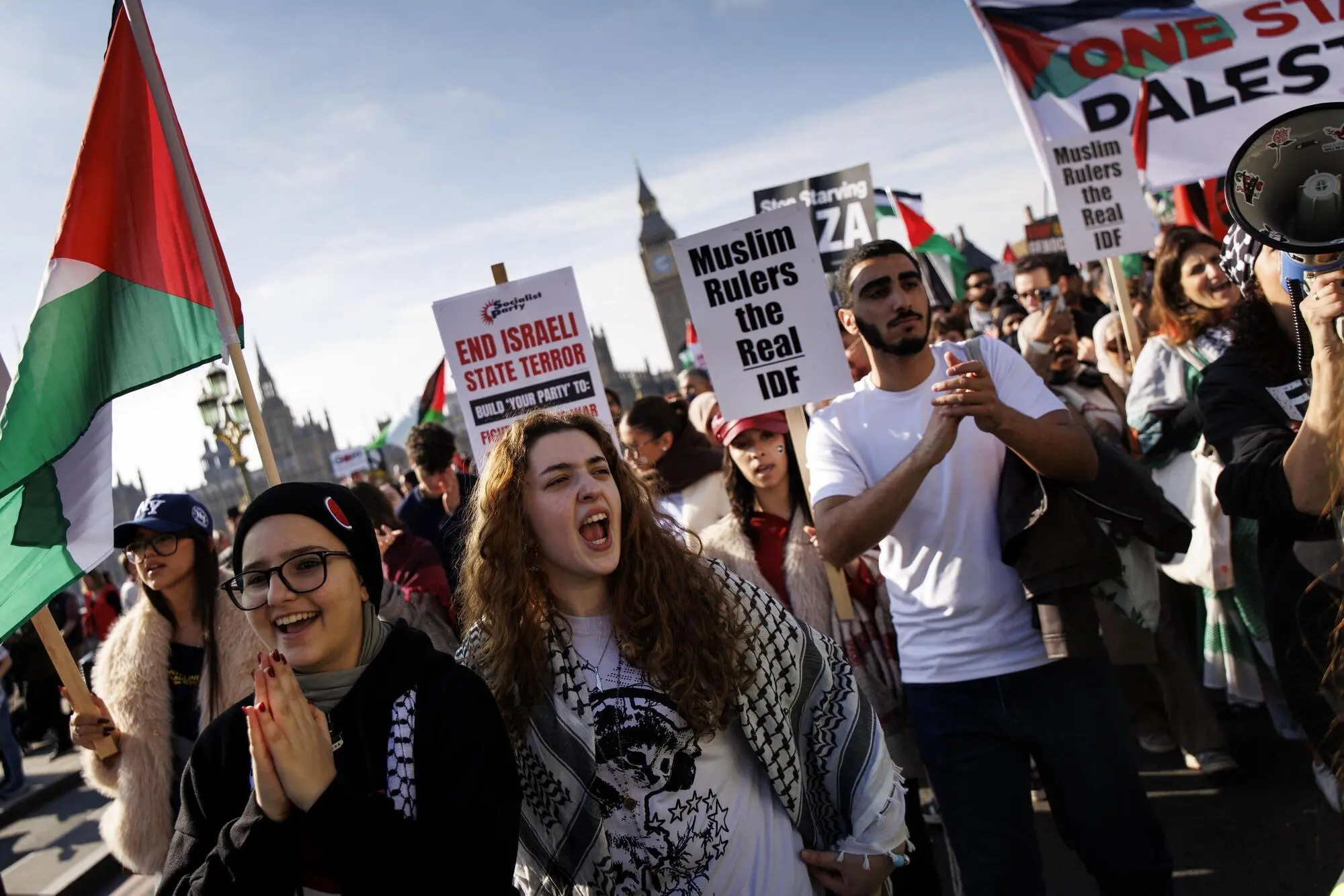
People march across Westminster Bridge in London on Saturday during a pro-Palestinian rally. (Tolga Akmen/EPA/Shutterstock)
LONDON — President Donald Trump claimed that Europeans are losing their “wonderful right of freedom of speech.” Elon Musk told a far-right rally in London that Britons are “scared to exercise their free speech.” And Vice President JD Vance warned that U.S. troops stationed in Germany could be jailed for a “mean tweet.”
Amid such attacks by Trump and his allies, many in Europe scoffed. This is a continent where pluralistic, parliamentary democracy is the norm, rule of law is sacred, human rights are respected deeply, and cherished personal liberties are balanced against society’s broader welfare, including protection of minorities against hate.
The eye-rolling was all the more pronounced given Trump’s apparent hypocrisy — with his glee over Jimmy Kimmel’s temporary suspension, his swiftly dismissed $15 billion defamation suit against the New York Times, and the efforts by his administration to control reporters who cover the Pentagon and to prosecute political foes.
But behind Washington’s finger-pointing lies a difficult debate that is roiling many European countries: Have governments gone too far in curbing free expression when it comes to hate speech and intentional misinformation — including political propaganda and election meddling by foreign adversaries — or have they built more responsible tools to safeguard democracy?
Flash points across Europe
Across Europe, the boundaries of expression are being tested on issues such as Palestine, transgender rights, religion, immigration and more. Social media has supercharged the tension, as have new restrictions on protests.
In Britain, Lucy Connolly, a former home day care provider, was sentenced to 31 months in prison for a social media post during the Southport riots in 2024, when false rumors spread that asylum seekers were responsible for killing three girls. Connolly’s post — “set fire to all the [expletive] hotels full of the bastards” — was viewed more than 300,000 times before deletion. She pleaded guilty to intending to stir up racial hatred, but even some critics of her language said the punishment seemed disproportionate.
Irish comedy writer Graham Linehan was arrested on suspicion of inciting violence after writing that if a transgender woman is in a “female-only space,” then people should “make a scene, call the cops and if all else fails, punch him in the balls.” His arrest, by five officers at Heathrow Airport, sparked a debate over whether the laws need reform or whether police should reduce the resources allocated to nonviolent speech-related offenses.
A freedom of information request by the Times of London found that police in England and Wales made 12,000 arrests in 2023 for online communications — over 30 a day. That same year, 1,119 people were sentenced for such offenses.
Jacob Rowbottom, a free speech expert at Oxford University, said the figures should be treated with caution. With no detail on the communications , arrests could involve anything from nuisance phone calls to abusive WhatsApp messages to violent death threats.
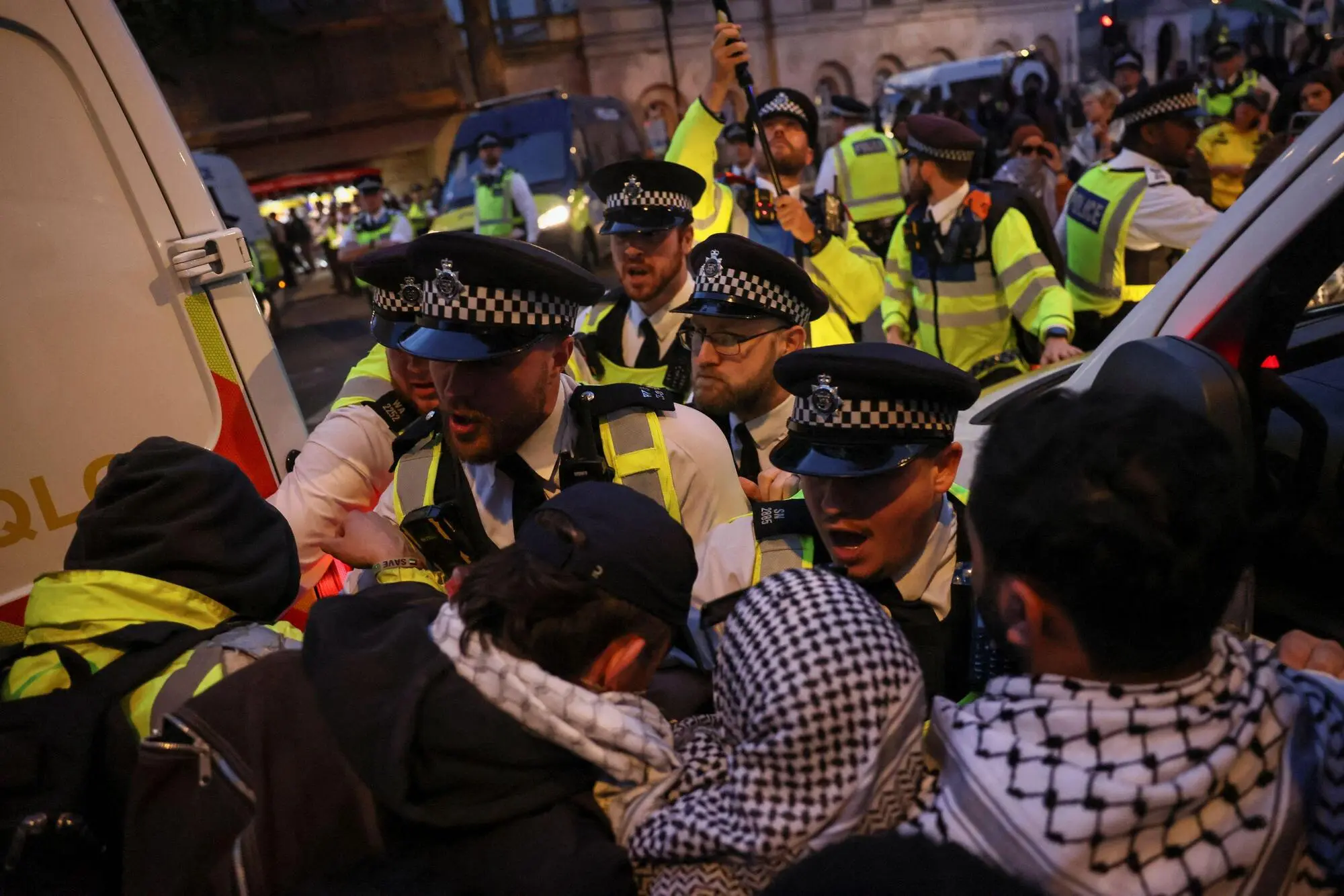
Demonstrators scuffle with police in London on Oct. 2 as they protest the Israeli interception of a Gaza-bound flotilla carrying aid. (Jack Taylor/Reuters)
Unease at protests has been spreading. Since the Israel-Gaza war, more than 1,900 people in the United Kingdom have been arrested at pro-Palestinian events (the majority for supporting an outlawed group). In Berlin, activist Iris Hefets was detained for holding a sign reading: “As a Jew and Israeli, stop the genocide in Gaza.”
Meanwhile, a German regional public broadcaster, NDR, dropped presenter Julia Ruhs after colleagues accused her team of bias in a series focusing on controversial social issues, including migration. Conservatives denounced her removal.
In France, a clash between two of the country’s ideological pillars — liberty and secularity — broke out with burkini bans in 2016, when several French mayors prohibited the full-body swimsuit favored by some Muslim women. The Conseil d’État, France’s top administrative court, struck down the bans, ruling they unjustifiably infringed on fundamental freedoms.
Extremist America
Understanding the divide starts with understanding the law.
Among developed democracies, the United States stands virtually alone in its extreme approach to the protection of free speech. The First Amendment shields even the most hateful or inflammatory statements, unless they directly and intentionally aim to incite imminent violence — a high bar known as the “Brandenburg test” established by the Supreme Court in 1969.
“America is the outlier,” said Gavin Phillipson, a law professor at the University of Bristol. “The First Amendment is a distinctive and unique approach to freedom of speech that isn’t shared by any other liberal democracy.”

People in Chicago's Brighton Park neighborhood on Oct. 4 protest after federal agents shot a woman during immigration enforcement operations. (Joshua Lott/The Washington Post)
Germany, by contrast, emerged from World War II with the opposite impulse. Scarred by its Nazi past, it built safeguards to constrain extremism before it metastasizes. Article 5 of the country’s Basic Law guarantees free expression but limits it when it infringes on others’ rights, such as in defamation or hate speech. Holocaust denial and Nazi propaganda remain criminal offenses.
Ursula Haverbeck, known as the “Nazi grandma,” was fined on multiple occasions and served more than two years in prison before her death last year at the age of 96.
Richard Traunmüller, a political scientist at the University of Mannheim, said Germany’s rules had tightened in recent years, always “based on the desire to combat right-wing extremism.”
Traunmüller pointed out that Germany’s domestic intelligence agency has the far-right Alternative for Germany party, or AfD, under surveillance. He said “there is now also a debate about banning the AfD, which is notable in a democracy.”
“Some of the developments in Germany right now are, in my opinion, no longer liberal,” he said. “It’s already restrictive.”
Other European democracies fall in the middle. The laws of European nations — and the treaties that govern the European Union — allow more balancing between speech and other rights than in the United States. Article 10 of the European Convention on Human Rights protects expression, but it is a “qualified right” with permitted restrictions.
Many European countries outlaw hate speech targeting racial, religious or other groups.
Jeffrey Howard, a free speech scholar at University College London, said the transatlantic differences reflect “reasonable disagreement about exactly how to draw the lines.”
The American view, he noted, is that harmful speech is best countered with more speech. Skeptics argue this ideal breaks down when people are confined to online echo chambers. “These issues are genuinely complicated — it isn’t ‘Americans for’ and ‘Europeans against’ free speech,” Howard said. “They’ve just drawn the lines differently.”
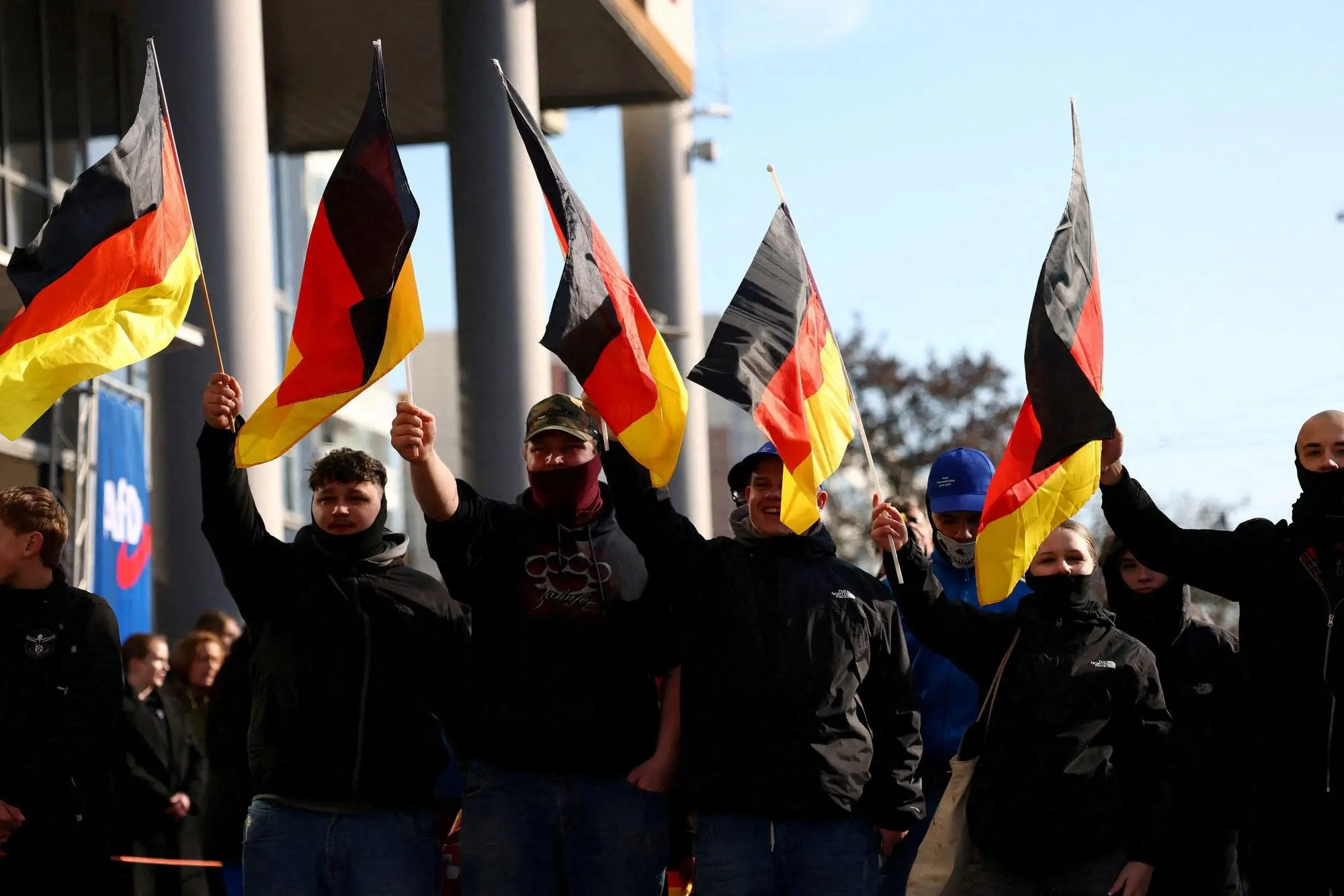
Supporters of the far-right Alternative for Germany party wave flags at a campaign rally in Berlin on Feb. 22. (Christian Mang/Reuters)
Weaponizing speech
Across the continent, populists have turned free speech into a rallying cry. In Britain, Nigel Farage, leader of the Reform UK Party, likened Britain to North Korea during a U.S. congressional hearing on European “threats to U.S. free speech.”
In Italy, Prime Minister Giorgia Meloni casts herself as a defender against “cancel culture.” In Germany, the AfD insists state surveillance amounts to political censorship.
Traunmüller said the unease over expression can help to fuel those very movements. “We know that there are certain issues that citizens feel they can no longer talk about and that’s closely linked to right-wing populism,” he said. “And that issue is immigration.”
Analysts warn that this populist framing is often political tool rather than a principled defense of expression.
In her book “Hate Speech and the European Court of Human Rights,” Natalie Alkiviadou, a researcher affiliated with the Future of Free Speech, a think tank based at Vanderbilt University in Tennessee, argues that Europe’s top human rights court has sent mixed signals on free expression.
Alkiviadou points to the 1976 case Handyside v. United Kingdom, which affirmed that free expression covers ideas that “offend, shock or disturb,” but notes later cases, such as the 2009 Belgian ruling against anti-Islam leaflets, suggest a lower tolerance for offense.
She doesn’t argue for copying America’s First Amendment and instead emphasizes Europe’s distinct historical context; its memory of fascism and genocide has contributed to a lower tolerance for hate speech. But her book urges the court to “recalibrate” its hate-speech rulings around a high threshold of harm. “Only the most harmful expressions,” she wrote, should “fall outside of the protection of Article 10.”
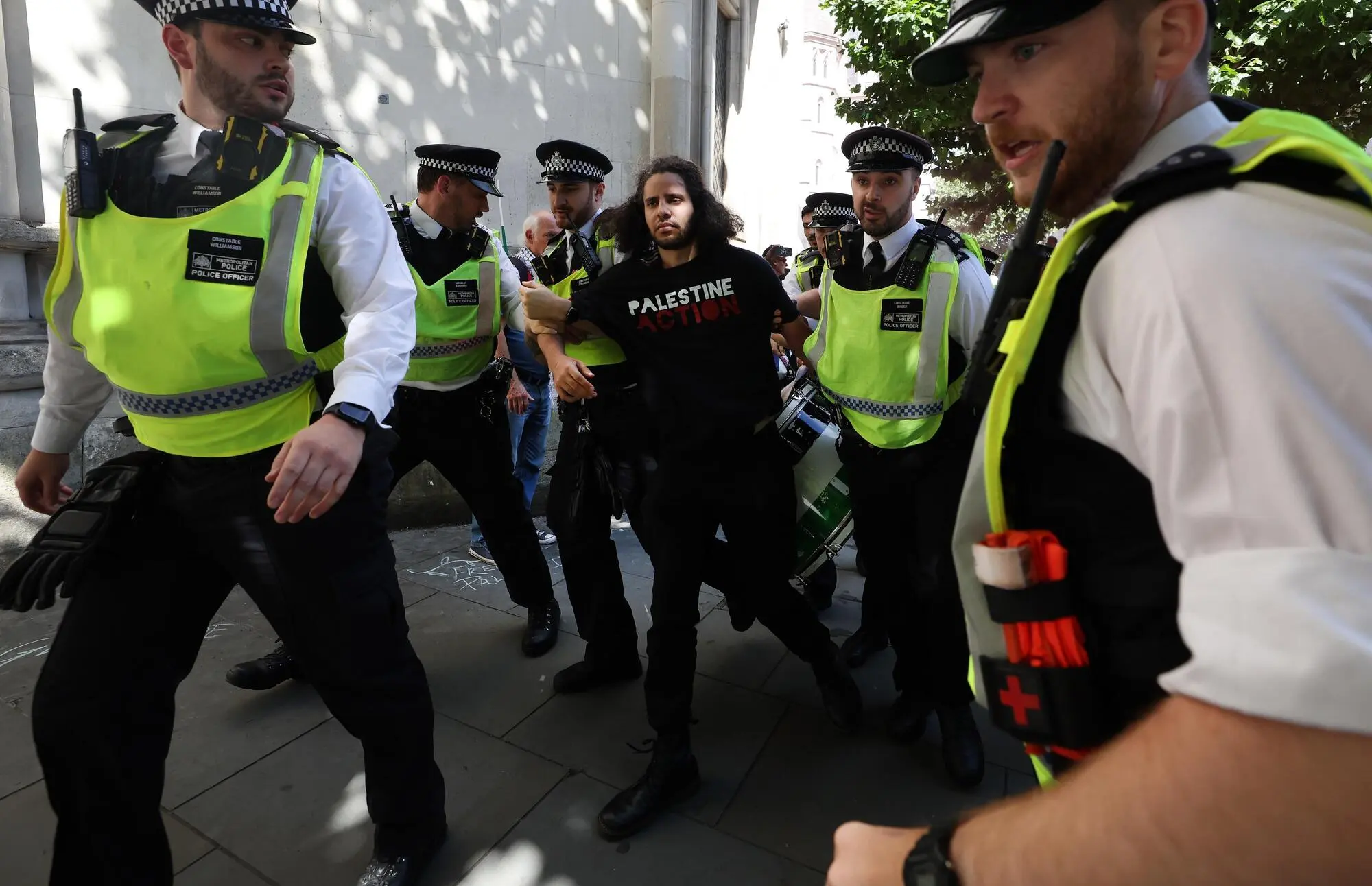
Police arrest a protester outside the High Court in London on July 4. (Andy Rain/EPA/Shutterstock)
Calls for clarity
British scholars, meanwhile, make a similar case for greater precision in speech laws. Section 127 of the 2003 Communications Act makes it a crime to send a “grossly offensive” message — a provision drafted in the age of text messages that critics say is too vague and allows arbitrary enforcement.
Others see a broader shift in online culture. “There’s much more of a free-for-all on X than there used to be,” said Phillipson, referring to the social media platform formerly known as Twitter, which banned Trump after the Jan. 6, 2021, riot at the U.S. Capitol. Musk then purchased it in 2022, pledging to restore Trump’s account.
“That’s how Musk wanted it, a more absolutist approach to free speech,” Phillipson said. “So, more offensive content is sitting there to be seen and reported to police.”
Germany’s Network Enforcement Act, superseded by the E.U.’s Digital Services Act (DSA), required social media companies to remove illegal content — like Holocaust denial — within 24 hours or face fines of up to 50 million euros. While the law targeted platforms, individuals posting illegal content could also be fined or imprisoned on the legal grounds of incitement, for example. Those convicted can face up to five years in prison or hefty fines.
The DSA now provides a broader framework for platform accountability, content moderation, and transparency across the European Union. But, observers say, it leaves gray zones around disinformation and harmful content.
“That lack of clarity could lead to subjective enforcement, where even legitimate opinions risk being restricted,” said Sophie Achermann, director of the Zurich-based Public Discourse Foundation. “The idea is not to ban ‘mean tweets’ or unpopular opinions but to ensure that moderation is fair and proportionate.”
“Protecting freedom of speech means protecting it for opinions we disagree with,” she added.
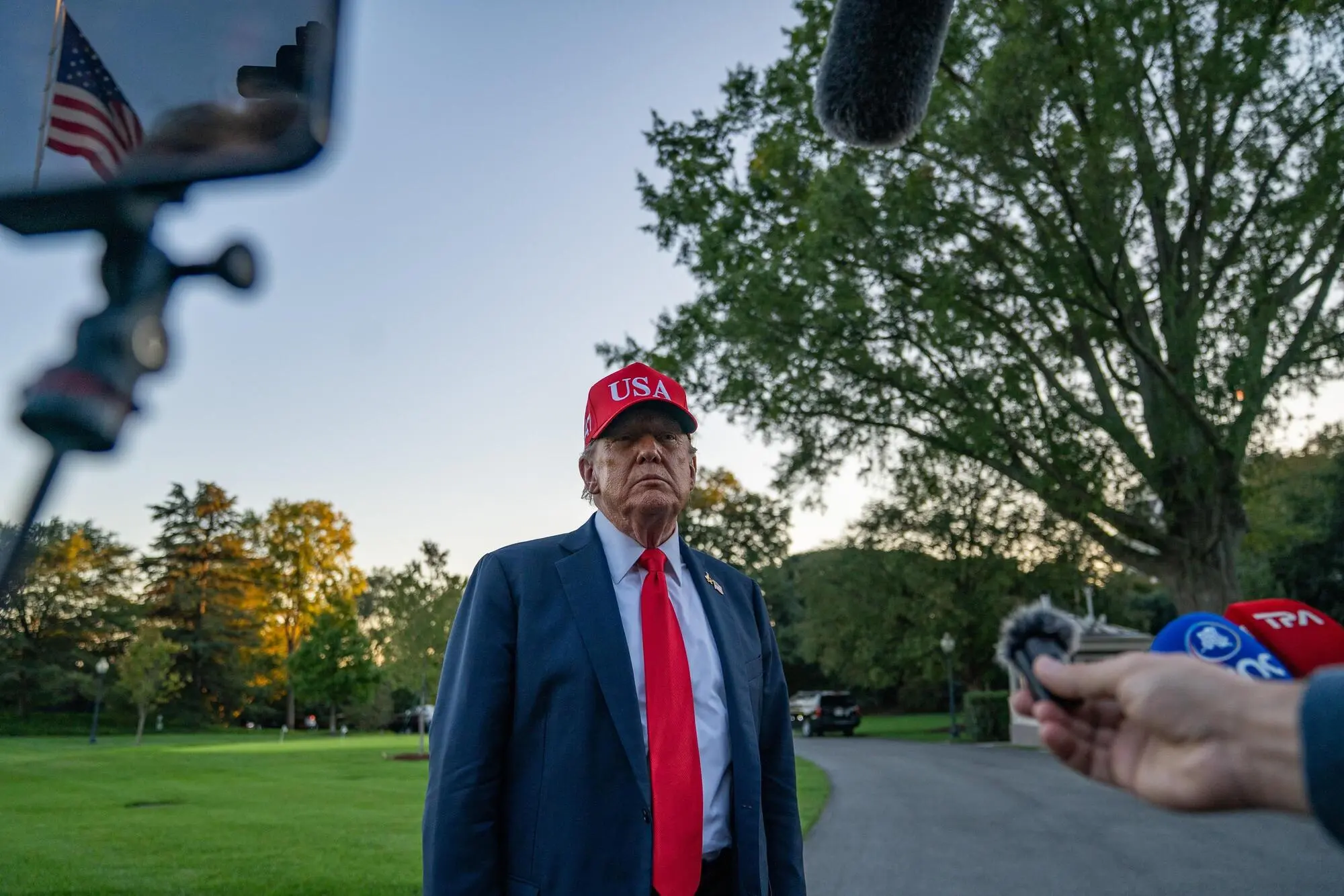
Donald Trump says he defends free speech, but many Europeans say he's a hypocrite with his actions. (Allison Robbert/For The Washington Post)
Trump’s double-talk
For many Europeans, lecturing by Americans, especially Trump, seems hypocritical. From Trump’s defamation suits to his attacks on the press, the U.S. is not seen as a model of tolerance.
“At present, the U.S. no longer seems to be the champion of free speech,” said Denis Friess, a political scientist at Düsseldorf’s Heinrich Heine University.
Friess pointed to high-profile cases in the U.S. — including the Kimmel suspension, which sparked extensive debate about media control and censorship, as well as the exclusion of dissenting voices from news conferences — as signs of an erosion in American norms.
“I find that far more problematic than having general rules about what can and cannot be said,” Friess said. “In that sense, I’d actually say Germany is on a better path.”
Eric Heinze, a free speech expert at Queen Mary University of London, said Europe has its faults but some critiques from America ring hallow. “Certainly, there are problems” in Europe, he said. “But calling on people to inform on their colleagues if they said anything amiss about Charlie Kirk? That is not the stance of someone who values free speech. Far from it.”
The Washington Post (archive.ph)
By Karla Adam and Kate Brady
2025-10-16 13:00:26GMT
People march across Westminster Bridge in London on Saturday during a pro-Palestinian rally. (Tolga Akmen/EPA/Shutterstock)
LONDON — President Donald Trump claimed that Europeans are losing their “wonderful right of freedom of speech.” Elon Musk told a far-right rally in London that Britons are “scared to exercise their free speech.” And Vice President JD Vance warned that U.S. troops stationed in Germany could be jailed for a “mean tweet.”
Amid such attacks by Trump and his allies, many in Europe scoffed. This is a continent where pluralistic, parliamentary democracy is the norm, rule of law is sacred, human rights are respected deeply, and cherished personal liberties are balanced against society’s broader welfare, including protection of minorities against hate.
The eye-rolling was all the more pronounced given Trump’s apparent hypocrisy — with his glee over Jimmy Kimmel’s temporary suspension, his swiftly dismissed $15 billion defamation suit against the New York Times, and the efforts by his administration to control reporters who cover the Pentagon and to prosecute political foes.
But behind Washington’s finger-pointing lies a difficult debate that is roiling many European countries: Have governments gone too far in curbing free expression when it comes to hate speech and intentional misinformation — including political propaganda and election meddling by foreign adversaries — or have they built more responsible tools to safeguard democracy?
Flash points across Europe
Across Europe, the boundaries of expression are being tested on issues such as Palestine, transgender rights, religion, immigration and more. Social media has supercharged the tension, as have new restrictions on protests.
In Britain, Lucy Connolly, a former home day care provider, was sentenced to 31 months in prison for a social media post during the Southport riots in 2024, when false rumors spread that asylum seekers were responsible for killing three girls. Connolly’s post — “set fire to all the [expletive] hotels full of the bastards” — was viewed more than 300,000 times before deletion. She pleaded guilty to intending to stir up racial hatred, but even some critics of her language said the punishment seemed disproportionate.
Irish comedy writer Graham Linehan was arrested on suspicion of inciting violence after writing that if a transgender woman is in a “female-only space,” then people should “make a scene, call the cops and if all else fails, punch him in the balls.” His arrest, by five officers at Heathrow Airport, sparked a debate over whether the laws need reform or whether police should reduce the resources allocated to nonviolent speech-related offenses.
A freedom of information request by the Times of London found that police in England and Wales made 12,000 arrests in 2023 for online communications — over 30 a day. That same year, 1,119 people were sentenced for such offenses.
Jacob Rowbottom, a free speech expert at Oxford University, said the figures should be treated with caution. With no detail on the communications , arrests could involve anything from nuisance phone calls to abusive WhatsApp messages to violent death threats.
Demonstrators scuffle with police in London on Oct. 2 as they protest the Israeli interception of a Gaza-bound flotilla carrying aid. (Jack Taylor/Reuters)
Unease at protests has been spreading. Since the Israel-Gaza war, more than 1,900 people in the United Kingdom have been arrested at pro-Palestinian events (the majority for supporting an outlawed group). In Berlin, activist Iris Hefets was detained for holding a sign reading: “As a Jew and Israeli, stop the genocide in Gaza.”
Meanwhile, a German regional public broadcaster, NDR, dropped presenter Julia Ruhs after colleagues accused her team of bias in a series focusing on controversial social issues, including migration. Conservatives denounced her removal.
In France, a clash between two of the country’s ideological pillars — liberty and secularity — broke out with burkini bans in 2016, when several French mayors prohibited the full-body swimsuit favored by some Muslim women. The Conseil d’État, France’s top administrative court, struck down the bans, ruling they unjustifiably infringed on fundamental freedoms.
Extremist America
Understanding the divide starts with understanding the law.
Among developed democracies, the United States stands virtually alone in its extreme approach to the protection of free speech. The First Amendment shields even the most hateful or inflammatory statements, unless they directly and intentionally aim to incite imminent violence — a high bar known as the “Brandenburg test” established by the Supreme Court in 1969.
“America is the outlier,” said Gavin Phillipson, a law professor at the University of Bristol. “The First Amendment is a distinctive and unique approach to freedom of speech that isn’t shared by any other liberal democracy.”
People in Chicago's Brighton Park neighborhood on Oct. 4 protest after federal agents shot a woman during immigration enforcement operations. (Joshua Lott/The Washington Post)
Germany, by contrast, emerged from World War II with the opposite impulse. Scarred by its Nazi past, it built safeguards to constrain extremism before it metastasizes. Article 5 of the country’s Basic Law guarantees free expression but limits it when it infringes on others’ rights, such as in defamation or hate speech. Holocaust denial and Nazi propaganda remain criminal offenses.
Ursula Haverbeck, known as the “Nazi grandma,” was fined on multiple occasions and served more than two years in prison before her death last year at the age of 96.
Richard Traunmüller, a political scientist at the University of Mannheim, said Germany’s rules had tightened in recent years, always “based on the desire to combat right-wing extremism.”
Traunmüller pointed out that Germany’s domestic intelligence agency has the far-right Alternative for Germany party, or AfD, under surveillance. He said “there is now also a debate about banning the AfD, which is notable in a democracy.”
“Some of the developments in Germany right now are, in my opinion, no longer liberal,” he said. “It’s already restrictive.”
Other European democracies fall in the middle. The laws of European nations — and the treaties that govern the European Union — allow more balancing between speech and other rights than in the United States. Article 10 of the European Convention on Human Rights protects expression, but it is a “qualified right” with permitted restrictions.
Many European countries outlaw hate speech targeting racial, religious or other groups.
Jeffrey Howard, a free speech scholar at University College London, said the transatlantic differences reflect “reasonable disagreement about exactly how to draw the lines.”
The American view, he noted, is that harmful speech is best countered with more speech. Skeptics argue this ideal breaks down when people are confined to online echo chambers. “These issues are genuinely complicated — it isn’t ‘Americans for’ and ‘Europeans against’ free speech,” Howard said. “They’ve just drawn the lines differently.”
Supporters of the far-right Alternative for Germany party wave flags at a campaign rally in Berlin on Feb. 22. (Christian Mang/Reuters)
Weaponizing speech
Across the continent, populists have turned free speech into a rallying cry. In Britain, Nigel Farage, leader of the Reform UK Party, likened Britain to North Korea during a U.S. congressional hearing on European “threats to U.S. free speech.”
In Italy, Prime Minister Giorgia Meloni casts herself as a defender against “cancel culture.” In Germany, the AfD insists state surveillance amounts to political censorship.
Traunmüller said the unease over expression can help to fuel those very movements. “We know that there are certain issues that citizens feel they can no longer talk about and that’s closely linked to right-wing populism,” he said. “And that issue is immigration.”
Analysts warn that this populist framing is often political tool rather than a principled defense of expression.
In her book “Hate Speech and the European Court of Human Rights,” Natalie Alkiviadou, a researcher affiliated with the Future of Free Speech, a think tank based at Vanderbilt University in Tennessee, argues that Europe’s top human rights court has sent mixed signals on free expression.
Alkiviadou points to the 1976 case Handyside v. United Kingdom, which affirmed that free expression covers ideas that “offend, shock or disturb,” but notes later cases, such as the 2009 Belgian ruling against anti-Islam leaflets, suggest a lower tolerance for offense.
She doesn’t argue for copying America’s First Amendment and instead emphasizes Europe’s distinct historical context; its memory of fascism and genocide has contributed to a lower tolerance for hate speech. But her book urges the court to “recalibrate” its hate-speech rulings around a high threshold of harm. “Only the most harmful expressions,” she wrote, should “fall outside of the protection of Article 10.”
Police arrest a protester outside the High Court in London on July 4. (Andy Rain/EPA/Shutterstock)
Calls for clarity
British scholars, meanwhile, make a similar case for greater precision in speech laws. Section 127 of the 2003 Communications Act makes it a crime to send a “grossly offensive” message — a provision drafted in the age of text messages that critics say is too vague and allows arbitrary enforcement.
Others see a broader shift in online culture. “There’s much more of a free-for-all on X than there used to be,” said Phillipson, referring to the social media platform formerly known as Twitter, which banned Trump after the Jan. 6, 2021, riot at the U.S. Capitol. Musk then purchased it in 2022, pledging to restore Trump’s account.
“That’s how Musk wanted it, a more absolutist approach to free speech,” Phillipson said. “So, more offensive content is sitting there to be seen and reported to police.”
Germany’s Network Enforcement Act, superseded by the E.U.’s Digital Services Act (DSA), required social media companies to remove illegal content — like Holocaust denial — within 24 hours or face fines of up to 50 million euros. While the law targeted platforms, individuals posting illegal content could also be fined or imprisoned on the legal grounds of incitement, for example. Those convicted can face up to five years in prison or hefty fines.
The DSA now provides a broader framework for platform accountability, content moderation, and transparency across the European Union. But, observers say, it leaves gray zones around disinformation and harmful content.
“That lack of clarity could lead to subjective enforcement, where even legitimate opinions risk being restricted,” said Sophie Achermann, director of the Zurich-based Public Discourse Foundation. “The idea is not to ban ‘mean tweets’ or unpopular opinions but to ensure that moderation is fair and proportionate.”
“Protecting freedom of speech means protecting it for opinions we disagree with,” she added.
Donald Trump says he defends free speech, but many Europeans say he's a hypocrite with his actions. (Allison Robbert/For The Washington Post)
Trump’s double-talk
For many Europeans, lecturing by Americans, especially Trump, seems hypocritical. From Trump’s defamation suits to his attacks on the press, the U.S. is not seen as a model of tolerance.
“At present, the U.S. no longer seems to be the champion of free speech,” said Denis Friess, a political scientist at Düsseldorf’s Heinrich Heine University.
Friess pointed to high-profile cases in the U.S. — including the Kimmel suspension, which sparked extensive debate about media control and censorship, as well as the exclusion of dissenting voices from news conferences — as signs of an erosion in American norms.
“I find that far more problematic than having general rules about what can and cannot be said,” Friess said. “In that sense, I’d actually say Germany is on a better path.”
Eric Heinze, a free speech expert at Queen Mary University of London, said Europe has its faults but some critiques from America ring hallow. “Certainly, there are problems” in Europe, he said. “But calling on people to inform on their colleagues if they said anything amiss about Charlie Kirk? That is not the stance of someone who values free speech. Far from it.”


