Secret language used by gays and convicts discussed in article.
Article
Archive
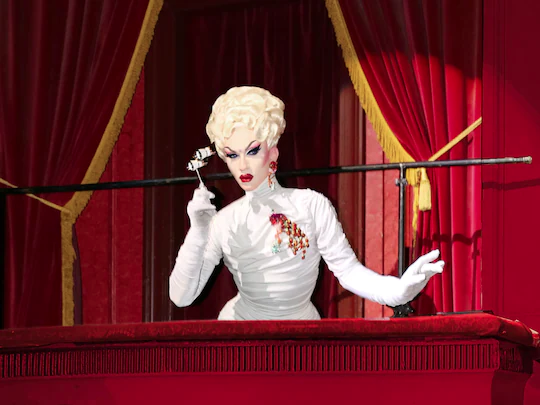
Sasha Velour is the winner of “RuPaul’s Drag Race” Season 9 and author of the forthcoming book “The Big Reveal: An Illustrated Manifesto of Drag.”
Drag might seem as if it’s about deception. You dress up as a gender different from yours, and in a way that’s not quite real. Men dress up as women, women as men, people who are neither as either or something else. Even the word “drag” emerged from a hidden language. It was called Polari, a code of sorts used by gay people, convicts and traveling entertainers to help them make community in the 18th and 19th centuries. The first queer and transgender pioneers to “put on the drag” lived their lives in the shadows, at a time when queerness was criminalized and police assaults common.
Just as those forebears were living and making art as authentically as they could, so, too, are today’s drag artists. Our art has never really been about deception. Drag is about self-expression without shame, and free thinking about others — about showing respect and care for everyone and for all the ways we present ourselves. It’s at once illuminating and not particularly serious; in drag, we playfully reject our assumptions about how a man or a woman “should” act so we can find our own ways of being. And drag, certainly, is nothing dangerous.
The critics who cry otherwise do so because they don’t understand drag. They don’t want to. Right-wing politicians such as Florida Gov. Ron DeSantis, Rep. Marjorie Taylor Greene of Georgia and Arizona state Sen. Vince Leach aren’t trying to inform the public of any real threat when they condemn drag acts. Their inflammatory speech and scare tactics have one goal only: recirculating deeply homophobic stereotypes about “grooming” to defend their campaign against queer and trans existence.
If these conservatives knew anything about queer history, they would know that despite the pain they might cause us, their demonization of queer people and our culture will never actually make us disappear.
We’ve seen a sad pendulum swing many times over the past century of drag in America: The greater our visibility, the fiercer their backlash. It happened with the popular Rockland Palace balls in Harlem in the 1920s, and the ensuing nationwide Pansy Craze of the ’30s, surges of raucous drag parties and queer life. It happened again with the boom of “female impersonator” shows in the ’60s and ’70s, and in the ’90s with New York’s Wigstock generation and Club Kids. Now, we are in the middle of a “Drag Race”-fueled resurgence. Each time drag has broken through to mass audiences, the uninformed have tried to shove us back to the margins.
It’s telling that conservatives have centered the drag debate on children. Drag is no less appropriate than other forms of entertainment. While most of our shows in bars and clubs are designed for adults, like any artists, we edit our performances to be squeaky-clean for family-friendly audiences. Whether the queer community’s opponents know this or not, they do know prejudice has to be taught, and taught early. Drafting laws to ban children from our performances is much less about the imagined sexual dangers of a drag show than the imagined dangers of failing to indoctrinate children with fear and shame around queerness from an early age.
Drag is, more than anything, an antidote to that fear and shame. A child who sees queens and kings onstage twirling in costume, acting absurd and authentic before all of society, is bound to develop empathy and tolerance. I think that’s healthy! Yet these are threatening traits in the eyes of many powerful people who want to stamp out true gender equality.
Of course, if spiteful politicians were to drive us from the public libraries and our (popular!) kids’ book readings there, we would still have our bars. And if we were driven from our bars, we would have our parties and our parks, our bodies and lives. Part of drag’s history is how we have always found ways to transform the world around us to make room for our lives. But haven’t we progressed beyond being criminalized and feared just for who we are?
Queer people are real, even in the face of injustice and discrimination. We deserve to be treated equally, whether or not you like our genders, our art or our clothes. Just get to know us. Let your children get to know us; the next generation ought to be introduced to the world in as full and honest a way as they can be, so they can figure out exactly where they fit in it — and celebrate where others fit in, too.
Drag can be that introduction, as much for kids as for anyone with enough wonder left in them to open their heart to something new. The people pushing hateful lies about this art form are the dangerous, deceitful ones. Under all the wigs, and the makeup, and the false lashes — and perhaps a bit because of them — we are telling something true.
Article
Archive
I’m a drag queen. Here’s what my art really is.
By Sasha VelourSasha Velour is the winner of “RuPaul’s Drag Race” Season 9 and author of the forthcoming book “The Big Reveal: An Illustrated Manifesto of Drag.”
Drag might seem as if it’s about deception. You dress up as a gender different from yours, and in a way that’s not quite real. Men dress up as women, women as men, people who are neither as either or something else. Even the word “drag” emerged from a hidden language. It was called Polari, a code of sorts used by gay people, convicts and traveling entertainers to help them make community in the 18th and 19th centuries. The first queer and transgender pioneers to “put on the drag” lived their lives in the shadows, at a time when queerness was criminalized and police assaults common.
Just as those forebears were living and making art as authentically as they could, so, too, are today’s drag artists. Our art has never really been about deception. Drag is about self-expression without shame, and free thinking about others — about showing respect and care for everyone and for all the ways we present ourselves. It’s at once illuminating and not particularly serious; in drag, we playfully reject our assumptions about how a man or a woman “should” act so we can find our own ways of being. And drag, certainly, is nothing dangerous.
The critics who cry otherwise do so because they don’t understand drag. They don’t want to. Right-wing politicians such as Florida Gov. Ron DeSantis, Rep. Marjorie Taylor Greene of Georgia and Arizona state Sen. Vince Leach aren’t trying to inform the public of any real threat when they condemn drag acts. Their inflammatory speech and scare tactics have one goal only: recirculating deeply homophobic stereotypes about “grooming” to defend their campaign against queer and trans existence.
If these conservatives knew anything about queer history, they would know that despite the pain they might cause us, their demonization of queer people and our culture will never actually make us disappear.
We’ve seen a sad pendulum swing many times over the past century of drag in America: The greater our visibility, the fiercer their backlash. It happened with the popular Rockland Palace balls in Harlem in the 1920s, and the ensuing nationwide Pansy Craze of the ’30s, surges of raucous drag parties and queer life. It happened again with the boom of “female impersonator” shows in the ’60s and ’70s, and in the ’90s with New York’s Wigstock generation and Club Kids. Now, we are in the middle of a “Drag Race”-fueled resurgence. Each time drag has broken through to mass audiences, the uninformed have tried to shove us back to the margins.
It’s telling that conservatives have centered the drag debate on children. Drag is no less appropriate than other forms of entertainment. While most of our shows in bars and clubs are designed for adults, like any artists, we edit our performances to be squeaky-clean for family-friendly audiences. Whether the queer community’s opponents know this or not, they do know prejudice has to be taught, and taught early. Drafting laws to ban children from our performances is much less about the imagined sexual dangers of a drag show than the imagined dangers of failing to indoctrinate children with fear and shame around queerness from an early age.
Drag is, more than anything, an antidote to that fear and shame. A child who sees queens and kings onstage twirling in costume, acting absurd and authentic before all of society, is bound to develop empathy and tolerance. I think that’s healthy! Yet these are threatening traits in the eyes of many powerful people who want to stamp out true gender equality.
Of course, if spiteful politicians were to drive us from the public libraries and our (popular!) kids’ book readings there, we would still have our bars. And if we were driven from our bars, we would have our parties and our parks, our bodies and lives. Part of drag’s history is how we have always found ways to transform the world around us to make room for our lives. But haven’t we progressed beyond being criminalized and feared just for who we are?
Queer people are real, even in the face of injustice and discrimination. We deserve to be treated equally, whether or not you like our genders, our art or our clothes. Just get to know us. Let your children get to know us; the next generation ought to be introduced to the world in as full and honest a way as they can be, so they can figure out exactly where they fit in it — and celebrate where others fit in, too.
Drag can be that introduction, as much for kids as for anyone with enough wonder left in them to open their heart to something new. The people pushing hateful lies about this art form are the dangerous, deceitful ones. Under all the wigs, and the makeup, and the false lashes — and perhaps a bit because of them — we are telling something true.


