The invasive northern snakehead, which has recently been appearing in Missouri and other states, must be eradicated, officials say.


A northern snakehead. You know what to do.Credit...Ryan Hagerty/USFWS
By Victor Mather
April 10, 2025, 2:39 p.m. ET
The northern snakehead — a sharp-toothed fish that looks like a horrifying hybrid of fish and snake — is spreading throughout the waters of the United States. That’s not good. But if you fish, you can help. It’s easy: Just kill that sucker.
The snakehead is not a fish you especially want to meet when spending a peaceful day on the lake. Aside from everything else, snakeheads — gulp — can breathe air.
And they don’t just look scary. Left unchecked, northern snakeheads can also threaten native species.
“Because they’re out of their natural environment, where they evolved in a food web that has checks and balances between predator and prey, they often grow and reproduce and spread really rapidly,” said Angela Sokolowski, the invasive species coordinator at the Missouri Department of Conservation. “They could outcompete the natives. They essentially are the bigger player, without good competition, and they become resource hogs.”
And it’s not just fish. Snakeheads will happily dine on crustaceans like crayfish as well.
Ms. Sokolowski and officials in other states have been calling on residents to join the fight against the northern snakehead as angler season gets underway.
The northern snakehead is native to Asia. It was first found in the United States in a Maryland pond in 2002, the U.S. Fish and Wildlife Service said. From there to the Potomac River, rivers in Pennsylvania and onward.
There are two ways an Asian fish might have made it to the United States, Ms. Sokolowski said. One is through the fish market trade. The snakehead is edible; it was imported to the United States, and some people began to raise it to sell in the live fish market. Snakeheads have also been sold as a captive species in the aquarium trade.
At some point some of these snakeheads made it to open waters. And then they started spreading.
Missouri is the latest state to ask anglers to do their part to eradicate the scourge of the snakehead. The species has been seen in the southeast portion of the state since 2019.
Before you demonize this creepy fish too much, know that it has at least one good quality: It cares for its offspring.
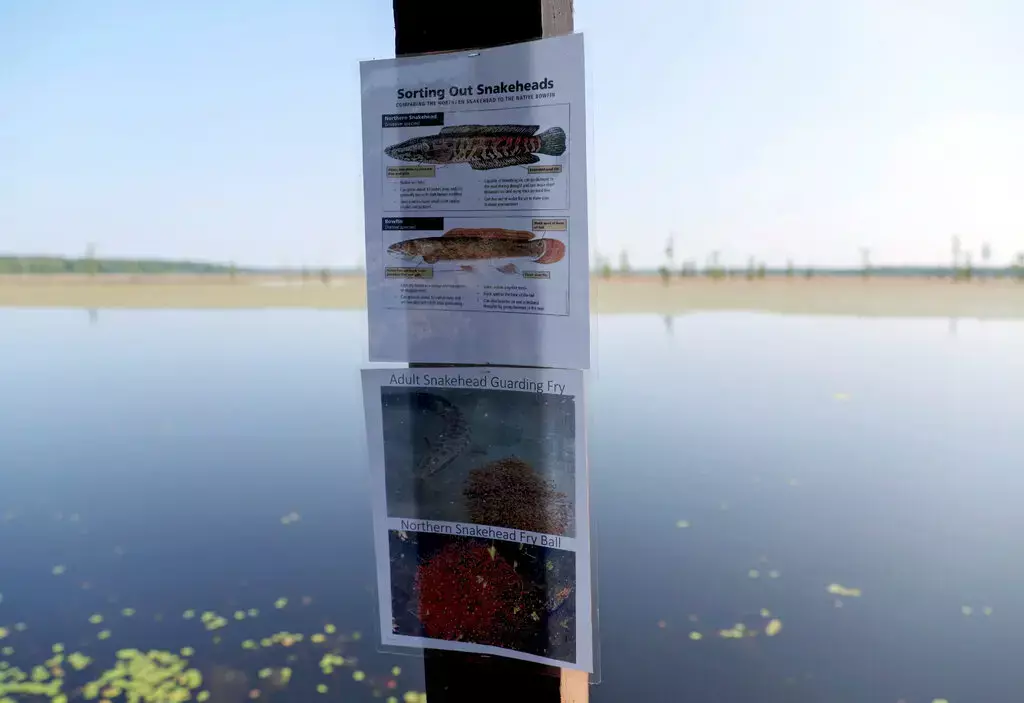

A sign in southeast Missouri informs visitors of the differences between the northern snakehead, top, and the native bowfin.Credit...Christine Tannous/St. Louis Post-Dispatch, via Associated Press
This time of year is particularly prime for snakehead spottings. “I believe this is one of the times when the snakehead is guarding their young,” Ms. Sokolowski said. “One of the characteristics of this species is it provides a lot of parental care to its young. Both the male and the female will guard the very young fish, called fry. They keep them corralled like a herd, and it looks like a ball of baby fish. We call that a fry ball.”
She added, “They are pretty aggressive with anything that approaches that group of young.”
When anglers cast their bait, they catch snakeheads, which “aggressively attack anything that could be coming after their fry ball,” she said.
Anglers idling away an afternoon in search of bass, bluegill or perch may not always be aware of it, but they are on the front lines of the battle against the snakehead. And make no mistake — officials want them to do away with the invasive fish if they catch it.
And since snakeheads can breathe air, just sticking those guys on ice isn’t going to do the job.
Because of their breathing abilities, they can survive out of water much longer than other fish. Anglers normally expect that chucking a fish in a cooler full of ice is plenty to seal the deal. Not so with the snakehead.
“These fish can live on a cooler of ice for days,” Ms. Sokolowski warned darkly, “so we ask anglers to actively kill them so that they don’t accidentally think that those fish could be dead and then accidentally get released somewhere else.”
Breathing air gives northern snakeheads a real advantage. They can live in shallow, mucky water, where other fish can’t breathe well. “They can hide in muddy, vegetative wetlands, even when we’re trying to find them, and remain out of sight,” Ms. Sokolowski said. “Which is why it’s hard for us to have a good sense of where they are and how many there are.”
So what is best practice for killing and disposing of a snakehead? You can disembowel it or cut off its head. Or put it in a sealed plastic bag and throw it in the trash. “I guess it’s personal preference,” Ms. Sokolowski said.
(But be careful, the Missouri Department of Conservation warns: “Make sure it’s a snakehead. Northern snakeheads can be confused with the native bowfin. Snakeheads have a snakelike appearance with a much longer anal fin than the bowfin.”)
New Yorkers, don’t be smug and think you are safe.
The northern snakehead was spotted in the Harlem Meer in Central Park as far back as 2008 as well as in lakes in Flushing Meadows Corona Park.
An air-breathing fish with the head of a snake in New York City? Sleep well!
L | A
A northern snakehead. You know what to do.Credit...Ryan Hagerty/USFWS
By Victor Mather
April 10, 2025, 2:39 p.m. ET
The northern snakehead — a sharp-toothed fish that looks like a horrifying hybrid of fish and snake — is spreading throughout the waters of the United States. That’s not good. But if you fish, you can help. It’s easy: Just kill that sucker.
The snakehead is not a fish you especially want to meet when spending a peaceful day on the lake. Aside from everything else, snakeheads — gulp — can breathe air.
And they don’t just look scary. Left unchecked, northern snakeheads can also threaten native species.
“Because they’re out of their natural environment, where they evolved in a food web that has checks and balances between predator and prey, they often grow and reproduce and spread really rapidly,” said Angela Sokolowski, the invasive species coordinator at the Missouri Department of Conservation. “They could outcompete the natives. They essentially are the bigger player, without good competition, and they become resource hogs.”
And it’s not just fish. Snakeheads will happily dine on crustaceans like crayfish as well.
Ms. Sokolowski and officials in other states have been calling on residents to join the fight against the northern snakehead as angler season gets underway.
The northern snakehead is native to Asia. It was first found in the United States in a Maryland pond in 2002, the U.S. Fish and Wildlife Service said. From there to the Potomac River, rivers in Pennsylvania and onward.
There are two ways an Asian fish might have made it to the United States, Ms. Sokolowski said. One is through the fish market trade. The snakehead is edible; it was imported to the United States, and some people began to raise it to sell in the live fish market. Snakeheads have also been sold as a captive species in the aquarium trade.
At some point some of these snakeheads made it to open waters. And then they started spreading.
Missouri is the latest state to ask anglers to do their part to eradicate the scourge of the snakehead. The species has been seen in the southeast portion of the state since 2019.
Before you demonize this creepy fish too much, know that it has at least one good quality: It cares for its offspring.
A sign in southeast Missouri informs visitors of the differences between the northern snakehead, top, and the native bowfin.Credit...Christine Tannous/St. Louis Post-Dispatch, via Associated Press
This time of year is particularly prime for snakehead spottings. “I believe this is one of the times when the snakehead is guarding their young,” Ms. Sokolowski said. “One of the characteristics of this species is it provides a lot of parental care to its young. Both the male and the female will guard the very young fish, called fry. They keep them corralled like a herd, and it looks like a ball of baby fish. We call that a fry ball.”
She added, “They are pretty aggressive with anything that approaches that group of young.”
When anglers cast their bait, they catch snakeheads, which “aggressively attack anything that could be coming after their fry ball,” she said.
Anglers idling away an afternoon in search of bass, bluegill or perch may not always be aware of it, but they are on the front lines of the battle against the snakehead. And make no mistake — officials want them to do away with the invasive fish if they catch it.
And since snakeheads can breathe air, just sticking those guys on ice isn’t going to do the job.
Because of their breathing abilities, they can survive out of water much longer than other fish. Anglers normally expect that chucking a fish in a cooler full of ice is plenty to seal the deal. Not so with the snakehead.
Editors’ Picks
Why Cameras Are Popping Up in Eldercare Facilities
A New Thomas Pynchon Novel Is Coming This Fall
They Scoured the Northeast for a Space They Could Live and Work In
“These fish can live on a cooler of ice for days,” Ms. Sokolowski warned darkly, “so we ask anglers to actively kill them so that they don’t accidentally think that those fish could be dead and then accidentally get released somewhere else.”
Breathing air gives northern snakeheads a real advantage. They can live in shallow, mucky water, where other fish can’t breathe well. “They can hide in muddy, vegetative wetlands, even when we’re trying to find them, and remain out of sight,” Ms. Sokolowski said. “Which is why it’s hard for us to have a good sense of where they are and how many there are.”
So what is best practice for killing and disposing of a snakehead? You can disembowel it or cut off its head. Or put it in a sealed plastic bag and throw it in the trash. “I guess it’s personal preference,” Ms. Sokolowski said.
(But be careful, the Missouri Department of Conservation warns: “Make sure it’s a snakehead. Northern snakeheads can be confused with the native bowfin. Snakeheads have a snakelike appearance with a much longer anal fin than the bowfin.”)
New Yorkers, don’t be smug and think you are safe.
The northern snakehead was spotted in the Harlem Meer in Central Park as far back as 2008 as well as in lakes in Flushing Meadows Corona Park.
An air-breathing fish with the head of a snake in New York City? Sleep well!
L | A


