WARWICK, R.I. — Holly Barchie and Kiel Strong are skilled workers, who had lived in a stable home with their young children for more than three years. In 2021, they earned almost $80,000 from her job as a customer service specialist and his full-time job as a roofer. Her job came with benefits, and it was remote, so she could still care for their four kids.
But less than a year later, Barchie was homeless, standing in the dirt in the middle of the woods — sweaty, dusty, and exhausted — spoon-feeding her 1-year-old by the light of her cellphone’s flashlight.
“I’ve never lived like this. I never thought my kids would be forced to,” said Barchie. “I use to drive down the highway and see tent cities in Providence and not think anything of it. I was blind to it.”
Both Barchie, 38, and Strong, 40, grew up in Rhode Island. Barchie earned her GED and attended classes at the Community College of Rhode Island. Strong didn’t graduate from high school, but has worked in the trades for much of his adult life. Both are hard workers, self-sufficient, and proud of it.
“We did nothing wrong. We’re not asking for a handout,” she added. “We’re asking for someone who has an apartment to rent to us. . . . How is it that hard?”
It shouldn’t be, but too often is. This is a story about how quickly in this dicey economy the known world can implode, how a family doing fairly well can find themselves out of options and out of a home.
The Strong family could afford the house in Warwick they’d been living in because they had a federal housing voucher, which helped pay their rent. It had two bedrooms, so it was tight living, but they had made it work.
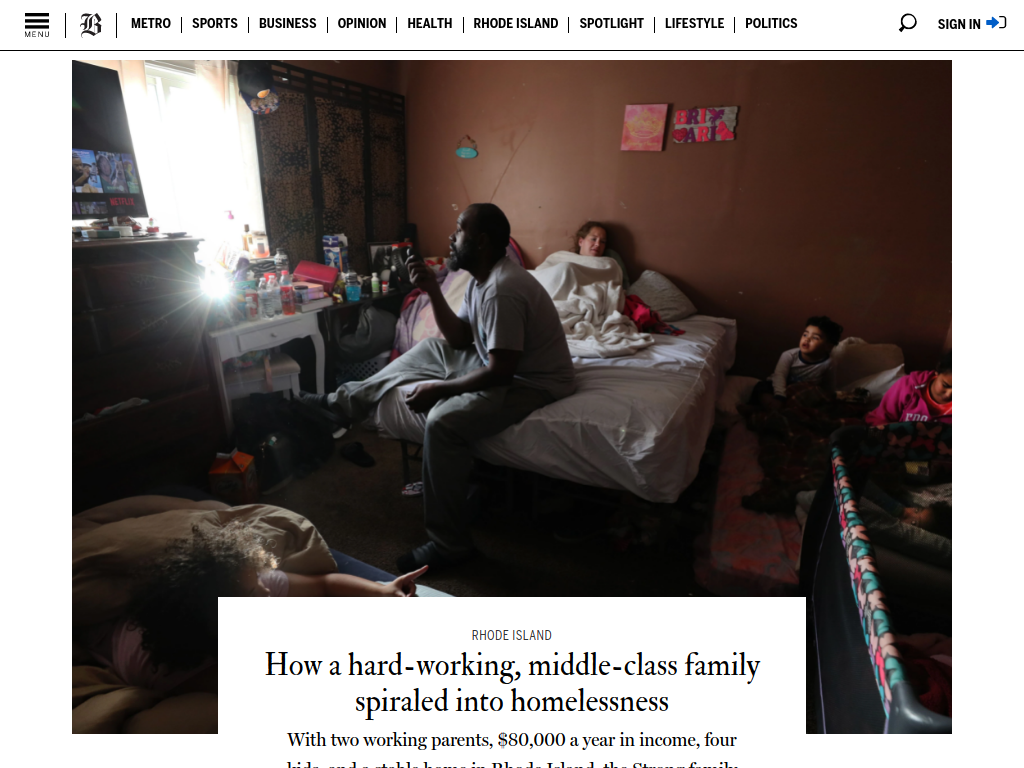
Kiel Jr. and Briella were not allowed outside the hotel room. There are rats and discarded needles surrounding the grounds of the hotel.
The last evening in a hotel room and the children, Andrea, Ariana, Kiel Jr., and Briella, kept busy as their parents planned for their move to the campground the next day.
But in August 2021, their landlord told them he wanted them to vacate the rental, even though the family did not owe any back rent. He said a relative of his would be moving into the unit and he needed them to move out. Barchie had given birth to their fourth child, Andrea, just a few months before. Their toddler, Kiel Jr., was not even 3. Ariana, 10, and Briella, 7, were about to be homeschooled after a year of struggling with distance learning. They didn’t technically have a lease, so the landlord legally only had to give them 30 days’ notice to vacate. Barchie’s housing voucher didn’t expire until after the new year, so she told the landlord they’d try to find a new place.
The family searched, but they were unable to find another landlord who would rent to them or had an apartment they could afford. Rhode Island’s rental market is highly competitive. Strong said their credit score “needs building.” Many landlords told them that an available apartment was “too small” for a family with four young children. Desperate to find a place, they increased their budget to around $2,100, maybe $2,500 if all utilities are included. But that would mean they would spend more than 37 percent of their income on housing, which would make them housing cost burdened, according to Housing Works RI at Roger Williams University. They had nowhere else to go and no one who could help them, so they stayed in the Warwick house and continued paying rent until they were legally forced to leave.
Ariana, 10, has lived in six different motels in the past six months. She played with her collection of key cards as the family prepared to move again.
Holly Barchie got her youngest in the car seat of her mother’s car as they loaded up a van with their belongings because they can no longer afford to stay in the hotel.
The eviction notice came in early January, a permanent red flag on their record, possibly making it more difficult for them to find a place to live, even though a judge had given them a letter saying that their case “should not be considered an eviction.” They were finally forced out of their home in March.
It’s expensive to struggle at the economy’s edge. The Strong family kept applying for apartments, spending anywhere from $11 to $100 per application. Some landlords charged a fee for each adult who is named on the application. Some didn’t charge at all. From August 2021 to mid-September 2022, the Strongs spent more than $5,000 in application fees alone. Once they left their home, they crowded into a hotel room so their children would have somewhere safe to sleep.
Jumping from hotel to hotel
Refuge in a shelter was not an option. Across Rhode Island, shelters for the homeless have been at capacity since the pandemic began. The few shelter beds designated for families have been full for years. The level of need has resulted in people staying at shelters, which are meant to be a temporary or emergency housing option, for several months and, in some cases, more than a year instead of just two or so weeks, according to providers. This has led to longer wait times for those in need of shelter, and forced hundreds of people, including children, to sleep in places considered by the state to be “unfit” for habitation, including cars or outside. There are only 45 shelter units for families across the state, but none in Kent County, which is where the Strongs live and work.
So the family jumped from one hotel to the next: a several-month stay at the Springhill Suites in West Warwick, the Best Western in West Greenwich, the Welcome Inn in North Kingstown, a short stint at the Comfort Inn Suites in West Warwick. They couch surfed in her mother’s one-bedroom apartment, and ultimately ended up at the Motel 6 in Warwick. They hunkered down in each hotel for as long as the prices stayed low. When rates increased due to demand or holiday weekends, they would move on to the next.
From March to September they spent nearly $40,000 on hotel rooms — much more than the nearly $8,000 they would have paid in rent during that same time. They spent their savings, as well as most of each week’s paycheck. They continued to search for an apartment, offering to pay more than what the landlords were asking, as they became desperate for some stability for their family.
Their car stopped working, and they couldn’t afford to take it to a proper repair shop since they were trying to save money for an apartment. A friend took a look at it, but there was no ready fix. The family couldn’t afford another car. A co-worker who lives nearby now gives Kiel Strong a ride to work every day, so he can keep his job as a roofer.
When they lost their home, they also lost their reliable, private, secure Internet connection, which meant that Barchie had to give up her remote job and the family lost its health insurance. The company said they’d rehire her when she could return with a suitable and private Web connection. She had no way of knowing how long that would be.
Keeping food on the table proved the next challenge. The only stores that sell food within walking distance of the Motel 6 are in rundown-looking gas stations, where groceries cost much more than at a regular market and that offered no fresh produce or meat. One night, Barchie bought two cans of beef and vegetable soup to serve her kids. She paid $18.
The motel room had a microwave and a mini-fridge, but the motel’s owner told the Strongs they’d be kicked out if they used a slow cooker in their room. For most of the two weeks they were there, the kids ate cereal for breakfast and microwavable macaroni and cheese for lunch and dinner. Barchie would often skip meals herself.
“I was never the cereal mom. I always made a hot breakfast,” said Barchie, wiping away tears as she held Andrea, 1, in her arms.
There are other concerns — syringes scattered in the grass outside their motel room window, and people fighting in the hallways. “There’s nothing good for us here,” she said. “It’s dangerous for my kids, who are forced to stay inside. This isn’t safe. This isn’t right.”
Each time Barchie thought they had hit bottom, it kept getting worse.
Living outdoors to qualify for shelter
After working a full day as a roofer, Kiel Strong broke down the family sleeping tent and moved it to a different campsite at the back of the campground to make room for incoming RVs.
Two solid days of rain kept the children stuck inside their family’s tent with only Kiel’s cellphone to entertain them. The tent was dark and loud with the hard rain pelting the tarp.
People in nearby RVs gave Holly Barchie and Kiel Strong extra tarps to keep their children dry. “It was the best thing for my family to get the help we could get, but I hate being outside. I absolutely hate the outdoors,” said Holly.
The US Department of Housing and Urban Development defines individuals and families as “literally homeless” if they lack a fixed, regular, and adequate nighttime residence. The state follows this definition to determine which Rhode Islanders are placed on the shelter priority list. So although they were moving from one hotel to another and conditions may have been unsafe for the children, the Strong family technically had a nighttime residence they were paying for, which meant they weren’t qualified for shelter.
By contrast, neighboring Massachusetts has, since 1983, had a mandate for the state to provide temporary emergency shelter to families who are eligible for services every night there is “no feasible alternative housing available” for them.
The Strongs’ housing specialist from Tri-County Community Action Agency advised them that they would not qualify for shelter if they continued paying for hotels.
“We’ve been told the only way to get help and get on the priority list for shelter is to go sleep outside,” said Barchie. “I can sleep in the woods anywhere. But what about my kids?”
It was scary to contemplate, but that’s what they did.
They got a tent. A campground in West Greenwich had a space for them to stay, but to deter homeless campers they only allowed guests with tents to stay for two weeks. As each day passed, the Strong family knew they’d have to figure out what would come next.
Holly Barchie put sunscreen on Ariana at the campground pool. “They had more fun in the last week than they had all summer. . . . We were stuck in a hotel room.”
While Barchie could finally cook again using a slow cooker hooked to extension cords, she was limited by what she could buy without a car and where she could store groceries without electricity. The late summer heat melted the ice in a cooler within hours. Meat went bad quickly. Their belongings — a pack-and-play for the baby, some clothing, and essentials — were piled on the ground. The owners of the campground asked them to hide the pile. They got another tent.
The McKinney-Vento Act defines a child as homeless if they do not have a regular and adequate nighttime residence. During the 2020-2021 school year, Rhode Island public school personnel identified more than 1,100 children as homeless. Of those, 66 percent “doubled up” with other families, 19 percent lived in shelters, 14 percent lived in hotels, and 1 percent were completely unsheltered.
Under the McKinney-Vento Act, the Strong children had been counted among the homeless, with all the troubles that can come with that.
The family headed back to the campsite in the dark from the bathroom. “My kids don’t want to be here.” There are ”more bug bites than ever, and snakes. They are crying to leave,” Holly said. “This was fun the first few days but we will never go camping again.”
Holly Barchie and the kids laughed when 1-year-old Andrea tried to use the deodorant. Every night the family used the communal bathroom to bathe. Most nights, the drain is slow and dirty water backs up into the shower. “I don’t even feel clean when I shower anymore,” Holly said.
Holly Barchie made her family's favorite homemade dish, meatballs and pasta, as the dark descended and Kiel helped her serve the children. “Mommy, this is so good. Thank you,” said Ariana after eating around the fire pit.
Holly Barchie served Kiel Jr. and Briella breakfast. Holly hated giving her kids a cold breakfast – before they landed in hotels and tents she always made her kids a hot meal in the morning. Feeding her family without a refrigerator for two weeks has been hard. Several times the ice has melted and milk and meat have spoiled.
Ariana, 10, and Briella, 7, could not start school in September, since they were living in a campground without a permanent address or access to transportation. Thanks to the pandemic, Briella had not yet set foot in a classroom in her life.
One day at the campground, Ariana turned to her mother and said, “I could go live somewhere else.” Then maybe, the fifth-grade girl said, there would be room for “all of you” to go somewhere.
They were all living in hope that shelter space would open up. But by the time they had to pack up and leave the campground, the call still hadn’t come.
Kiel Strong and Holly Barchie rise by 4:30 to have breakfast, pack lunch, and walk to the entrance of the camp ground where Kiel is picked by his co-worker. Kiel only missed two days of work during the two weeks he and his family were living in the camp ground. He could not go to work the days after hard rains soaked their tents.
Housing advocates call it ‘a crisis.’ The state calls it ‘a mismatch.’
More than half of Rhode Island’s lowest-income renters spend more than half of their income on housing alone, and are at risk of homelessness, according to “The Gap” report, which looks at the shortage of affordable homes across the country. According to the report, there are 49,032 extremely low-income households in Rhode Island and a shortage of 24,050 affordable and available rental homes.
Housing advocates call it a crisis. But in an interview in December, Rhode Island housing secretary Josh Saal told the Globe that people across the country face the same housing pressure that Rhode Islanders do. The problem, he said, isn’t that Rhode Island is short thousands of affordable housing units, but that people are paying too much in rent.
“There’s a mismatch between the price of housing and the incomes people make. It doesn’t mean 24,000 units are missing. In other [states], it might be more,” said Saal, the state’s first officially designated housing secretary. “The governor said multiple times that everything we should be doing should look at how we raise household incomes, which will . . . lower that cost burden.”
When the Strongs’ situation was described to Saal in November, he said didn’t understand how a family of six could be evicted through no cause.
“These stories are heart-wrenching,” said Saal. He told the Globe he plans to look into reexamining how certain housing programs are implemented. “These aren’t just numbers. These are families and individuals.”
Andrea huddled in misery against her mother’s leg. She and her brother have been struggling with many viruses, making it impossible for Holly Barchie to start her training for her remote work.
According to the Out of Reach report by the National Low Income Housing Coalition, Rhode Islanders in 2022 need to earn a minimum of $24.32 per hour to afford an average two-bedroom apartment at fair market rate. The report puts that rate at about $1,264 a month, but reality is quite different: prices for a two-bedroom in Kent County ranged from $1,300 to more than $2,000 a month in December. Barchie and Strong each earn more than $20 an hour when they are working.
Saal said the state won’t be able to simply construct enough housing to get itself out of a housing crisis.
Barchie is having none of it. “There’s all these empty buildings all around Rhode Island, but it’s impossible for us to find an apartment,” she said. “Shelters don’t have space for my family, my children. . . . How is that not a crisis?”
Holly Barchie cried on the phone with her mother as she asked her for a loan of $665. They had until 6 p.m. to pay the storage unit holding all their belongings, including family photos, or it would go to auction. Kiel Jr., 3, was with her.
It was a stressful race against the clock to get all their belongings out of their storage unit. By midafternoon, about half of their belongings were cleared. Holly carried bags of the kids' clothes into the house where they were sharing one room. In the last hour before they lost their belongings, Kiel found his Playstation and games, got a ride to a pawn shop, and sold it for the $160 they needed to rent a van.
Andrea waited for her father to come home from work. She was sick with RSV and later in the evening, Holly took her to the crowded ER when her fever spiked and she struggled to breathe.
When they were forced out of their apartment in March, the Strong family had put many of their belongings in a storage unit, which cost about $170 per month at the time. But that cost went up to $300 by June, and they fell behind on their payments. In late September, they had to decide: give up everything they had in the storage unit — including much-needed school clothes, their beds, and family photos — or pay about $665 and take everything out of the unit immediately.
They scrambled through the storage unit to find the PlayStation, which they pawned for $160. It gave them just enough money to cover the cost of renting a van to get their belongings. Barchie’s mother lent her about $600 to pay off the storage unit. Now, most of their belongings are sitting outside on a family member’s deck, partially covered by a canopy. Some items are exposed to the elements. The wind has scattered some of their things across the small, fenced-in yard.
Holly Barchie thanked FCCP housing specialist Ehren Hunt of the Tri-County Community Action Agency for bringing two truckloads of their belongings from storage. Nearly half of their belongings remained in the unit.
Finally, in late September, the Strong family found a temporary place to stay, at Kiel Strong’s cousin’s home in Warwick. They pay about $800 each month for rent, plus $80 for Internet. At first, all six of them were crammed into one room; now they share two. Several other family members were also staying there and in a house next door, most of them one family to a bedroom.
Barchie now has private and secure Wi-Fi to get her job back, but it’s been difficult to work. The children need so much of her attention. The older girls are struggling with school. One has to repeat a grade. And illness spreads quickly in such close quarters. The youngest two got RSV. For Kiel Jr., it turned into pneumonia. When she brought him to the hospital in early November, Hasbro Children’s had reached over 100 percent capacity. She arrived at the emergency room at 5 p.m. one weekday night and waited until 9 a.m. the following morning for her toddler to be seen. Barchie ended up contracting pneumonia herself in early December. She had to wait until payday to buy the medicine she needed.
With so many people living in the same house, tensions run high. But if the Strong family has to leave, they have nowhere else to go. So they try to keep the kids quiet, and make do as best they can.
Barchie was holding Andrea on her hip one recent day, while stirring a single package of ramen noodles in a sauce pot on the stove to feed three people. She was waiting for Strong to come home from work. Meanwhile, their quest for a home continues. She had toured four apartments the week before. No one has called her back yet.
“Everything we’ve been through over the last year would break other people,” said Barchie. “Yet here, Kiel and I know we are all we and our children have.”
Kiel Strong’s cousin invited him and his family to rent one room at her home. Finally Andrea has a place to nap that is not in a sweltering tent. "It's not a permanent solution," said Holly. “To get any type of help I have to literally be homeless, like sleep outside in a car. That’s not fair to my family. . . . We didn’t even want financial help, we just wanted help to find a house.”

 www.bostonglobe.com
 archive.ph
But less than a year later, Barchie was homeless, standing in the dirt in the middle of the woods — sweaty, dusty, and exhausted — spoon-feeding her 1-year-old by the light of her cellphone’s flashlight.
“I’ve never lived like this. I never thought my kids would be forced to,” said Barchie. “I use to drive down the highway and see tent cities in Providence and not think anything of it. I was blind to it.”
Both Barchie, 38, and Strong, 40, grew up in Rhode Island. Barchie earned her GED and attended classes at the Community College of Rhode Island. Strong didn’t graduate from high school, but has worked in the trades for much of his adult life. Both are hard workers, self-sufficient, and proud of it.
“We did nothing wrong. We’re not asking for a handout,” she added. “We’re asking for someone who has an apartment to rent to us. . . . How is it that hard?”
It shouldn’t be, but too often is. This is a story about how quickly in this dicey economy the known world can implode, how a family doing fairly well can find themselves out of options and out of a home.
The Strong family could afford the house in Warwick they’d been living in because they had a federal housing voucher, which helped pay their rent. It had two bedrooms, so it was tight living, but they had made it work.
Kiel Jr. and Briella were not allowed outside the hotel room. There are rats and discarded needles surrounding the grounds of the hotel.
The last evening in a hotel room and the children, Andrea, Ariana, Kiel Jr., and Briella, kept busy as their parents planned for their move to the campground the next day.
But in August 2021, their landlord told them he wanted them to vacate the rental, even though the family did not owe any back rent. He said a relative of his would be moving into the unit and he needed them to move out. Barchie had given birth to their fourth child, Andrea, just a few months before. Their toddler, Kiel Jr., was not even 3. Ariana, 10, and Briella, 7, were about to be homeschooled after a year of struggling with distance learning. They didn’t technically have a lease, so the landlord legally only had to give them 30 days’ notice to vacate. Barchie’s housing voucher didn’t expire until after the new year, so she told the landlord they’d try to find a new place.
The family searched, but they were unable to find another landlord who would rent to them or had an apartment they could afford. Rhode Island’s rental market is highly competitive. Strong said their credit score “needs building.” Many landlords told them that an available apartment was “too small” for a family with four young children. Desperate to find a place, they increased their budget to around $2,100, maybe $2,500 if all utilities are included. But that would mean they would spend more than 37 percent of their income on housing, which would make them housing cost burdened, according to Housing Works RI at Roger Williams University. They had nowhere else to go and no one who could help them, so they stayed in the Warwick house and continued paying rent until they were legally forced to leave.
Ariana, 10, has lived in six different motels in the past six months. She played with her collection of key cards as the family prepared to move again.
Holly Barchie got her youngest in the car seat of her mother’s car as they loaded up a van with their belongings because they can no longer afford to stay in the hotel.
The eviction notice came in early January, a permanent red flag on their record, possibly making it more difficult for them to find a place to live, even though a judge had given them a letter saying that their case “should not be considered an eviction.” They were finally forced out of their home in March.
It’s expensive to struggle at the economy’s edge. The Strong family kept applying for apartments, spending anywhere from $11 to $100 per application. Some landlords charged a fee for each adult who is named on the application. Some didn’t charge at all. From August 2021 to mid-September 2022, the Strongs spent more than $5,000 in application fees alone. Once they left their home, they crowded into a hotel room so their children would have somewhere safe to sleep.
Jumping from hotel to hotel
Refuge in a shelter was not an option. Across Rhode Island, shelters for the homeless have been at capacity since the pandemic began. The few shelter beds designated for families have been full for years. The level of need has resulted in people staying at shelters, which are meant to be a temporary or emergency housing option, for several months and, in some cases, more than a year instead of just two or so weeks, according to providers. This has led to longer wait times for those in need of shelter, and forced hundreds of people, including children, to sleep in places considered by the state to be “unfit” for habitation, including cars or outside. There are only 45 shelter units for families across the state, but none in Kent County, which is where the Strongs live and work.
So the family jumped from one hotel to the next: a several-month stay at the Springhill Suites in West Warwick, the Best Western in West Greenwich, the Welcome Inn in North Kingstown, a short stint at the Comfort Inn Suites in West Warwick. They couch surfed in her mother’s one-bedroom apartment, and ultimately ended up at the Motel 6 in Warwick. They hunkered down in each hotel for as long as the prices stayed low. When rates increased due to demand or holiday weekends, they would move on to the next.
From March to September they spent nearly $40,000 on hotel rooms — much more than the nearly $8,000 they would have paid in rent during that same time. They spent their savings, as well as most of each week’s paycheck. They continued to search for an apartment, offering to pay more than what the landlords were asking, as they became desperate for some stability for their family.
Their car stopped working, and they couldn’t afford to take it to a proper repair shop since they were trying to save money for an apartment. A friend took a look at it, but there was no ready fix. The family couldn’t afford another car. A co-worker who lives nearby now gives Kiel Strong a ride to work every day, so he can keep his job as a roofer.
When they lost their home, they also lost their reliable, private, secure Internet connection, which meant that Barchie had to give up her remote job and the family lost its health insurance. The company said they’d rehire her when she could return with a suitable and private Web connection. She had no way of knowing how long that would be.
Keeping food on the table proved the next challenge. The only stores that sell food within walking distance of the Motel 6 are in rundown-looking gas stations, where groceries cost much more than at a regular market and that offered no fresh produce or meat. One night, Barchie bought two cans of beef and vegetable soup to serve her kids. She paid $18.
The motel room had a microwave and a mini-fridge, but the motel’s owner told the Strongs they’d be kicked out if they used a slow cooker in their room. For most of the two weeks they were there, the kids ate cereal for breakfast and microwavable macaroni and cheese for lunch and dinner. Barchie would often skip meals herself.
“I was never the cereal mom. I always made a hot breakfast,” said Barchie, wiping away tears as she held Andrea, 1, in her arms.
There are other concerns — syringes scattered in the grass outside their motel room window, and people fighting in the hallways. “There’s nothing good for us here,” she said. “It’s dangerous for my kids, who are forced to stay inside. This isn’t safe. This isn’t right.”
Each time Barchie thought they had hit bottom, it kept getting worse.
Living outdoors to qualify for shelter
After working a full day as a roofer, Kiel Strong broke down the family sleeping tent and moved it to a different campsite at the back of the campground to make room for incoming RVs.
Two solid days of rain kept the children stuck inside their family’s tent with only Kiel’s cellphone to entertain them. The tent was dark and loud with the hard rain pelting the tarp.
People in nearby RVs gave Holly Barchie and Kiel Strong extra tarps to keep their children dry. “It was the best thing for my family to get the help we could get, but I hate being outside. I absolutely hate the outdoors,” said Holly.
The US Department of Housing and Urban Development defines individuals and families as “literally homeless” if they lack a fixed, regular, and adequate nighttime residence. The state follows this definition to determine which Rhode Islanders are placed on the shelter priority list. So although they were moving from one hotel to another and conditions may have been unsafe for the children, the Strong family technically had a nighttime residence they were paying for, which meant they weren’t qualified for shelter.
By contrast, neighboring Massachusetts has, since 1983, had a mandate for the state to provide temporary emergency shelter to families who are eligible for services every night there is “no feasible alternative housing available” for them.
The Strongs’ housing specialist from Tri-County Community Action Agency advised them that they would not qualify for shelter if they continued paying for hotels.
“We’ve been told the only way to get help and get on the priority list for shelter is to go sleep outside,” said Barchie. “I can sleep in the woods anywhere. But what about my kids?”
It was scary to contemplate, but that’s what they did.
They got a tent. A campground in West Greenwich had a space for them to stay, but to deter homeless campers they only allowed guests with tents to stay for two weeks. As each day passed, the Strong family knew they’d have to figure out what would come next.
Holly Barchie put sunscreen on Ariana at the campground pool. “They had more fun in the last week than they had all summer. . . . We were stuck in a hotel room.”
While Barchie could finally cook again using a slow cooker hooked to extension cords, she was limited by what she could buy without a car and where she could store groceries without electricity. The late summer heat melted the ice in a cooler within hours. Meat went bad quickly. Their belongings — a pack-and-play for the baby, some clothing, and essentials — were piled on the ground. The owners of the campground asked them to hide the pile. They got another tent.
The McKinney-Vento Act defines a child as homeless if they do not have a regular and adequate nighttime residence. During the 2020-2021 school year, Rhode Island public school personnel identified more than 1,100 children as homeless. Of those, 66 percent “doubled up” with other families, 19 percent lived in shelters, 14 percent lived in hotels, and 1 percent were completely unsheltered.
Under the McKinney-Vento Act, the Strong children had been counted among the homeless, with all the troubles that can come with that.
The family headed back to the campsite in the dark from the bathroom. “My kids don’t want to be here.” There are ”more bug bites than ever, and snakes. They are crying to leave,” Holly said. “This was fun the first few days but we will never go camping again.”
Holly Barchie and the kids laughed when 1-year-old Andrea tried to use the deodorant. Every night the family used the communal bathroom to bathe. Most nights, the drain is slow and dirty water backs up into the shower. “I don’t even feel clean when I shower anymore,” Holly said.
Holly Barchie made her family's favorite homemade dish, meatballs and pasta, as the dark descended and Kiel helped her serve the children. “Mommy, this is so good. Thank you,” said Ariana after eating around the fire pit.
Holly Barchie served Kiel Jr. and Briella breakfast. Holly hated giving her kids a cold breakfast – before they landed in hotels and tents she always made her kids a hot meal in the morning. Feeding her family without a refrigerator for two weeks has been hard. Several times the ice has melted and milk and meat have spoiled.
Ariana, 10, and Briella, 7, could not start school in September, since they were living in a campground without a permanent address or access to transportation. Thanks to the pandemic, Briella had not yet set foot in a classroom in her life.
One day at the campground, Ariana turned to her mother and said, “I could go live somewhere else.” Then maybe, the fifth-grade girl said, there would be room for “all of you” to go somewhere.
They were all living in hope that shelter space would open up. But by the time they had to pack up and leave the campground, the call still hadn’t come.
Kiel Strong and Holly Barchie rise by 4:30 to have breakfast, pack lunch, and walk to the entrance of the camp ground where Kiel is picked by his co-worker. Kiel only missed two days of work during the two weeks he and his family were living in the camp ground. He could not go to work the days after hard rains soaked their tents.
Housing advocates call it ‘a crisis.’ The state calls it ‘a mismatch.’
More than half of Rhode Island’s lowest-income renters spend more than half of their income on housing alone, and are at risk of homelessness, according to “The Gap” report, which looks at the shortage of affordable homes across the country. According to the report, there are 49,032 extremely low-income households in Rhode Island and a shortage of 24,050 affordable and available rental homes.
Housing advocates call it a crisis. But in an interview in December, Rhode Island housing secretary Josh Saal told the Globe that people across the country face the same housing pressure that Rhode Islanders do. The problem, he said, isn’t that Rhode Island is short thousands of affordable housing units, but that people are paying too much in rent.
“There’s a mismatch between the price of housing and the incomes people make. It doesn’t mean 24,000 units are missing. In other [states], it might be more,” said Saal, the state’s first officially designated housing secretary. “The governor said multiple times that everything we should be doing should look at how we raise household incomes, which will . . . lower that cost burden.”
When the Strongs’ situation was described to Saal in November, he said didn’t understand how a family of six could be evicted through no cause.
“These stories are heart-wrenching,” said Saal. He told the Globe he plans to look into reexamining how certain housing programs are implemented. “These aren’t just numbers. These are families and individuals.”
Andrea huddled in misery against her mother’s leg. She and her brother have been struggling with many viruses, making it impossible for Holly Barchie to start her training for her remote work.
According to the Out of Reach report by the National Low Income Housing Coalition, Rhode Islanders in 2022 need to earn a minimum of $24.32 per hour to afford an average two-bedroom apartment at fair market rate. The report puts that rate at about $1,264 a month, but reality is quite different: prices for a two-bedroom in Kent County ranged from $1,300 to more than $2,000 a month in December. Barchie and Strong each earn more than $20 an hour when they are working.
Saal said the state won’t be able to simply construct enough housing to get itself out of a housing crisis.
Barchie is having none of it. “There’s all these empty buildings all around Rhode Island, but it’s impossible for us to find an apartment,” she said. “Shelters don’t have space for my family, my children. . . . How is that not a crisis?”
Holly Barchie cried on the phone with her mother as she asked her for a loan of $665. They had until 6 p.m. to pay the storage unit holding all their belongings, including family photos, or it would go to auction. Kiel Jr., 3, was with her.
It was a stressful race against the clock to get all their belongings out of their storage unit. By midafternoon, about half of their belongings were cleared. Holly carried bags of the kids' clothes into the house where they were sharing one room. In the last hour before they lost their belongings, Kiel found his Playstation and games, got a ride to a pawn shop, and sold it for the $160 they needed to rent a van.
Andrea waited for her father to come home from work. She was sick with RSV and later in the evening, Holly took her to the crowded ER when her fever spiked and she struggled to breathe.
When they were forced out of their apartment in March, the Strong family had put many of their belongings in a storage unit, which cost about $170 per month at the time. But that cost went up to $300 by June, and they fell behind on their payments. In late September, they had to decide: give up everything they had in the storage unit — including much-needed school clothes, their beds, and family photos — or pay about $665 and take everything out of the unit immediately.
They scrambled through the storage unit to find the PlayStation, which they pawned for $160. It gave them just enough money to cover the cost of renting a van to get their belongings. Barchie’s mother lent her about $600 to pay off the storage unit. Now, most of their belongings are sitting outside on a family member’s deck, partially covered by a canopy. Some items are exposed to the elements. The wind has scattered some of their things across the small, fenced-in yard.
Holly Barchie thanked FCCP housing specialist Ehren Hunt of the Tri-County Community Action Agency for bringing two truckloads of their belongings from storage. Nearly half of their belongings remained in the unit.
Finally, in late September, the Strong family found a temporary place to stay, at Kiel Strong’s cousin’s home in Warwick. They pay about $800 each month for rent, plus $80 for Internet. At first, all six of them were crammed into one room; now they share two. Several other family members were also staying there and in a house next door, most of them one family to a bedroom.
Barchie now has private and secure Wi-Fi to get her job back, but it’s been difficult to work. The children need so much of her attention. The older girls are struggling with school. One has to repeat a grade. And illness spreads quickly in such close quarters. The youngest two got RSV. For Kiel Jr., it turned into pneumonia. When she brought him to the hospital in early November, Hasbro Children’s had reached over 100 percent capacity. She arrived at the emergency room at 5 p.m. one weekday night and waited until 9 a.m. the following morning for her toddler to be seen. Barchie ended up contracting pneumonia herself in early December. She had to wait until payday to buy the medicine she needed.
With so many people living in the same house, tensions run high. But if the Strong family has to leave, they have nowhere else to go. So they try to keep the kids quiet, and make do as best they can.
Barchie was holding Andrea on her hip one recent day, while stirring a single package of ramen noodles in a sauce pot on the stove to feed three people. She was waiting for Strong to come home from work. Meanwhile, their quest for a home continues. She had toured four apartments the week before. No one has called her back yet.
“Everything we’ve been through over the last year would break other people,” said Barchie. “Yet here, Kiel and I know we are all we and our children have.”
Kiel Strong’s cousin invited him and his family to rent one room at her home. Finally Andrea has a place to nap that is not in a sweltering tent. "It's not a permanent solution," said Holly. “To get any type of help I have to literally be homeless, like sleep outside in a car. That’s not fair to my family. . . . We didn’t even want financial help, we just wanted help to find a house.”
How a hard-working, middle-class family spiraled into homelessness - The Boston Globe
With two working parents, $80,000 a year in income, four kids, and a stable home in Rhode Island, the Strong family was living the American dream. Then they were evicted. And the nightmare began.
www.bostonglobe.com
How a hard-working, middle-class family spiraled into homelessness - …
archived 18 Dec 2022 06:49:41 UTC


