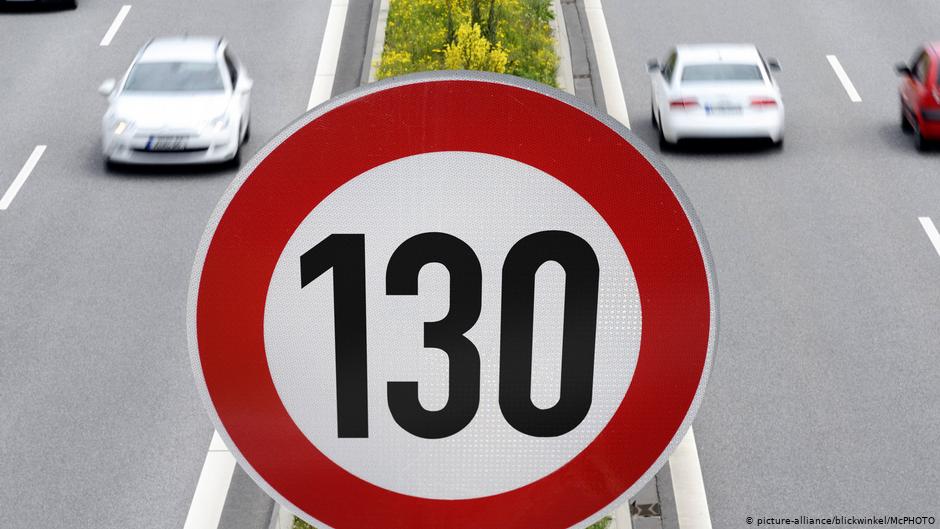
Law Green push for autobahn speed limit fails in Bundestag - German ministers have overwhelmingly voted against a Greens proposal to impose speed limits on the country's highways


1571621762122.png


Germany's parliament, the Bundestag, has voted against a bill proposed by the Greens that would have introduced a speed limit of 130 kilometers per hour (80 miles per hour) on the nation's highways.

Out of the 631 votes cast on Thursday, 498 voted against the proposal. All members of the far-right AfD and the business-friendly FDP parties rejected the bill, and just two members from each of the center-left Social Democrats (SPD) and conservative parties voted for the proposal. There were only a handful of abstentions.

"You're defending a transport policy from the day before yesterday," said Cem Özdemir, Green party member and chair of the Committee on Transport, to Transport Minister Andreas Scheuer, a prominent speed limit opponent.

The proposal from the opposition Greens triggered a heated debate in Germany, which is known for its network of speed limit-free motorways.

Greens lawmaker Anton Hofreiter said speed restrictions were "long overdue" and would help prevent fatal accidents, bring down costs for motorists and reduce noise pollution and climate emissions.

"Those who want to make motorways safer and the traffic flow more smoothly must back a speed limit," he told the German press agency dpa.

Government rejects limits

The federal government, a coalition of Chancellor Angela Merkel's conservative CDU/CSU bloc and the SPD, ruled out an autobahn speed limit during talks on how to curb emissions in January. At the time, the Environment Ministry said the measure would do little to shrink Germany's carbon footprint.

Scheuer has also previously said the idea of imposing limits "defies all common sense."

Germany is the only country in Europe with no official speed limit on highways. Neighboring countries Austria, Denmark, the Netherlands, France and the Czech Republic all have a 130 kilometers per hour limit (80 miles per hour). In Belgium and Switzerland, a 120 kph limit is in place.

Özdemir told public broadcaster ARD ahead of the vote that he didn't expect it to pass, but "as is so often the case with Greens proposals, we present them, and eventually there'll be a majority behind them."

Despite the rejection of the proposal and widespread perception that all Germany's highways are without speed limits, around 30% of motorways in Germany have a fixed speed limit some or all of the time, mainly in and around cities, according to Germany's largest automobile club, the ADAC. Stricter speed limits are enforced at areas where roadworks are in progress.

---


Good. Greens BTFO, stay out of the Autobahn.
 
I'd love to see the data that shows going 150kph for an hour produces less emissions than going 100kph for an hour and a half... I'm assuming that none is forthcoming though.
Absolutely, they're talking out of their asses. Unless I'm mistaken, Germans take pride in their Autobahn and how much safer and conscious German drivers are, getting a driver's license is, as far as I've read, practically like going to the university for a couple months, unlike the US where it's laughably easy. They take their driving seriously, it's why euro-spec cars don't have cupholders, since drinking and driving is a distraction.

Driving is a privilege, not a right, and I think theirs is the best approach. German policemen make sure no one is slowing down the left lane; it's either foot to the floor or GTFO of the lane.


It's one of the main reasons why, as a car guy, prefer German car culture over 'murican car culture.
 
Última edición:
Reminds me of something I read once, about bicycle helmets laws actually increasing accidents due to a disproportionate sense of security.

Makes sense that not having a speed limit would make German drivers more alert, similar to how open carry states and stand your ground states make other... "people" more alert.
 
I really want to drive on the autobahn one of these days. I hate how congested American highway traffic is.

THE LEFT LANE ISN'T FOR CASUAL DRIVING YOU STUPID NIGGERS, IT'S FOR PASSING SLOW TRAFFIC, NOT FOR BEING SLOW TRAFFIC
 
Absolutely, they're talking out of their asses. Unless I'm mistaken, Germans take pride in their Autobahn and how much safer and conscious German drivers are, getting a driver's license is, as far as I've read, practically like going to the university for a couple months, unlike the US where it's laughably easy. They take their driving seriously, it's why euro-spec cars don't have cupholders, since drinking and driving is a distraction.

Driving is a privilege, not a right, and I think theirs is the best approach. German policemen make sure no one is slowing down the left lane; it's either foot to the floor or GTFO of the lane.

https://youtube.com/watch?v=EBnA2K8cTdI
It's one of the main reasons why, as a car guy, prefer German car culture over 'murican car culture.
Prefer German car models and brands, their cars feel as if they have more "weight" to them. Doors are heavier and it feels overall more sturdy. I've seen and had relatives who have German cars get into car collisions, where the car comes off with far less damage than the other. Other cars, especially Japanese made (Toyotas, for example) feel like they are tin cans, slight bump and it has a dent.

Edit: This is an example I could find between a Merc and a Chevrolet Malibu as a test. Both times the Malibu just seems to come off worse.
 
Última edición:
Prefer German car models and brands, their cars feel as if they have more "weight" to them. Doors are heavier and it feels overall more sturdy. I've seen and had relatives who have German cars get into car collisions, where the car comes off with far less damage than the other. Other cars, especially Japanese made (Toyotas, for example) feel like they are tin cans, slight bump and it has a dent.

Edit: This is an example I could find between a Merc and a Chevrolet Malibu as a test. Both times the Malibu just seems to come off worse.
https://youtube.com/watch?v=kZKG2wqs9_Y
Toyotas are somewhat infamous for failing the moose tests... check this out:


I like all cars above the brands, but deep down I'm a Merc fanboy, they make some of my favorite cars.
 
Prefer German car models and brands, their cars feel as if they have more "weight" to them. Doors are heavier and it feels overall more sturdy. I've seen and had relatives who have German cars get into car collisions, where the car comes off with far less damage than the other. Other cars, especially Japanese made (Toyotas, for example) feel like they are tin cans, slight bump and it has a dent.

As someone that spent a good number of years tearing all makes of cars apart to get at the sweet and juicy meat morsels trapped inside, the legend of German cars is somewhat true, and somewhat a myth. Mercedes by and large are as good as their rep. Volkswagons are not. With the added benefit that they seem to like catching fire. Often before they crash. BMW's are likewise grossly overrated. The top end sedan is probably pretty safe, but the smaller models are nothing special. Also do not equate exterior damage the car takes, to crash safety. They actually work against each other. Yeah Honda's and Toyota's will take a huge amount of expensive damage at lower speeds than a Mercedes will. But that is in part by design. Most modern car designs are meant to bleed off the energy of the crash via crumple zones that are meant to pass the energy around the passenger compartment. You can stage a head on collision between a 68 Chevy and a modern Camry. The Camry would be destroyed and the Chevy would have a slight ding in one fender. But the squishy meatsacks inside the Chevy would experience all of the force of the crash, whereas the Camry's passengers would be somewhat shielded from the full brunt of the kinetic energy.

Honestly, when it comes to Sedans price does in fact more often than not directly relate to crash safety. The bigger heavier sedans are more survivable, be it a Mercedes, A Cadillac a Buick or a Lexus. The same with Trucks and SUV's. The only place the rule falls apart is with Performance Sports cars. Which are really just coffins on wheels. (Fiberglass Body Corvette's were especially spectacular at this. ) The real determining factor isn't so much things like individual door panels as it is gross vehicle weight. It's why you should always look with suspicion on anyone seeking to demand higher "CAFE" standards in cars. Every 1 point increase in Miles Per Gallon standards directly equates to an extra 1000 highway deaths annually. At this point the only way to increase mileage is to decrease gross vehicle weight. Which increases fatalities tremendously. And this isn't random sensationalist made up statistics. This is very well documented by the NTSB. All the science and math is well proven.
 
I'd love to see the data that shows going 150kph for an hour produces less emissions than going 100kph for an hour and a half... I'm assuming that none is forthcoming though.
That's a real thing though. Manufacturers optimize engine efficiency for certain speeds, and friction impact on the change in the rate of acceleration means that the relationship won't ever be linear either.

fueleconomy.gov cites the below paper in arguing that the average American consumer (across all vehicles) can expect a roughly 7% increase per 5 mph over 50 mph. More gas burned, more emissions.

 
I really want to drive on the autobahn one of these days. I hate how congested American highway traffic is.

THE LEFT LANE ISN'T FOR CASUAL DRIVING YOU STUPID NIGGERS, IT'S FOR PASSING SLOW TRAFFIC, NOT FOR BEING SLOW TRAFFIC
its even more congested. I was over there last march to visit family and the village has a strange plexiglass cutout from the regular noise barrier. One day, i remember seeing a yellow truck and another vehicle there on a particular slow day. 3 hours later, those same 2 trucks were still there, not having moved more than 30 feet. The only time ive ever seen anyone go over 80 on the autobahn was at 3AM on new years.
Volkswagons are not. With the added benefit that they seem to like catching fire. Often before they crash.
I was haunted for a long time as a kid seeing a VW Golf on the side of the autobahn just in flames, with no one around. I was so scared thinking that the people were still inside.
 
I really want to drive on the autobahn one of these days. I hate how congested American highway traffic is.

THE LEFT LANE ISN'T FOR CASUAL DRIVING YOU STUPID NIGGERS, IT'S FOR PASSING SLOW TRAFFIC, NOT FOR BEING SLOW TRAFFIC

Never drove, but I've been a passenger on it. It's really strange hitting those sorts of speeds after coming from a place that has nothing like it. 180kph in the rain, then 220 after we passed it. Though I'm sure some German users here have put that to shame.

I'm surprised there aren't more accidents on American highways. Congested isn't the word, and people are constantly weaving through the lanes to beat the person ahead of them.
 
That's a real thing though. Manufacturers optimize engine efficiency for certain speeds, and friction impact on the change in the rate of acceleration means that the relationship won't ever be linear either.

fueleconomy.gov cites the below paper in arguing that the average American consumer (across all vehicles) can expect a roughly 7% increase per 5 mph over 50 mph. More gas burned, more emissions.

While that's true, those same car manufacturers are capable of building sport sedans that can sustain speeds of 250km/h (155mph) more efficiently every year... I mean ffs, they're already downsizing their engines, that's the quickest way to make them more efficient. Audi, Mercedes and BMW sedans are well known for being "Autobahn missiles", they have it down to a science.

Additionally, it's my understanding that most of German freeways have a 130km/h (80mph) speed limit and only certain sections are unrestricted, as long as the traffic and weather allows.
 
Never drove, but I've been a passenger on it. It's really strange hitting those sorts of speeds after coming from a place that has nothing like it. 180kph in the rain, then 220 after we passed it. Though I'm sure some German users here have put that to shame.

I'm surprised there aren't more accidents on American highways. Congested isn't the word, and people are constantly weaving through the lanes to beat the person ahead of them.

American Highways are an example of Darwin at work. At least around the heavy traffic cities. Those who cannot drive in a pack are quickly eliminated from the motor and often the gene pool. Whereas America does have some Autobahn equivalents out in places less frequented. Doesn't Montana still have "Any Reasonable Speed" as the limit out on the Interstates?
 
Additionally, it's my understanding that most of German freeways have a 130km/h (80mph) speed limit and only certain sections are unrestricted, as long as the traffic and weather allows.
there is no general speed limit. some parts have one, but thats because of a sharp turn, problems when wet, or because people are living close by.
sometimes its 130, sometimes its 100, sometimes 80.

the vote also prevented a civil war in germany.
 
Wait, they want to "make traffic flow more smoothly" by imposing a speed limit? How's that supposed to work exactly?

Because leftists believe conformity is the essence of safety.....

it's more important that everyone does "THIS" than what the "THIS" actually accomplishes.... and to them, the people who don't wish to conform their every move to some declared set of standards are the ionizing radiation of society: tearing it to bits from the inside out and making things worse for us all!

It's why they can't see that censorship is always a negative, fundamentally, conformity of any kind, even of opinion, makes everything BETTER.
 
Última edición:
I'd love to see the data that shows going 150kph for an hour produces less emissions than going 100kph for an hour and a half... I'm assuming that none is forthcoming though.

On paper they're correct even assuming the engine of a car maintains the same efficiency at all speeds. Any car will experience some turbulent flow which will be proportional to the square of its velocity. This will reduce its fuel efficiency at high speeds by making the engine work harder to travel the same distance.

In practice its probably bullshit since there will be more congestion causing more cars to spend time idling their engines.
 
Atrás
Top Abajo