Thousands of Delta Air Lines workers have suffered hair loss, skin rashes, nose bleeds and other symptoms from toxic chemicals in their work uniforms, according to a class action lawsuit filed on December 31.
The now-infamous “Passport Plum” uniforms were purchased from Lands’ End, an American clothing retailer. They were issued to tens of thousands of employees, who were required to wear them after May 29, 2018.
The uniforms were treated with a toxic cocktail of chemical additives and finishes that were designed to make them “high stretch, wrinkle and stain resistant, waterproof, anti-static, and deodorizing,” according to the lawsuit. This combination of additives and finishes caused skin rashes, headaches and other health problems among many workers.
“I am confident that these uniforms are affecting many thousands of people,” attorney Bruce A. Maxwell said in an interview with the World Socialist Web Site. “My office has fielded in excess of 2,000 calls.” A closed Facebook page for flight attendants, he said, already has around 6,500 participants.
Maxwell, of the Jacksonville, Florida law firm Terrell Hogan, is the lead attorney on the case. More than 500 workers have joined the lawsuit already, he said, adding that he would soon be amending the complaint to increase that number to around a thousand workers.
“These uniforms were issued to 64,000 employees,” Maxwell says, of which 24,000 are flight attendants. The remaining 40,000 are customer service workers, ramp and gate agents, Sky Club workers, as well as cargo, maintenance and technical workers.
In this latter category, which is numerically larger, relatively fewer workers have come forward so far, which Maxwell attributes to fear of being fired. “I’m hoping the more attention is brought to this matter, the more will come out.”
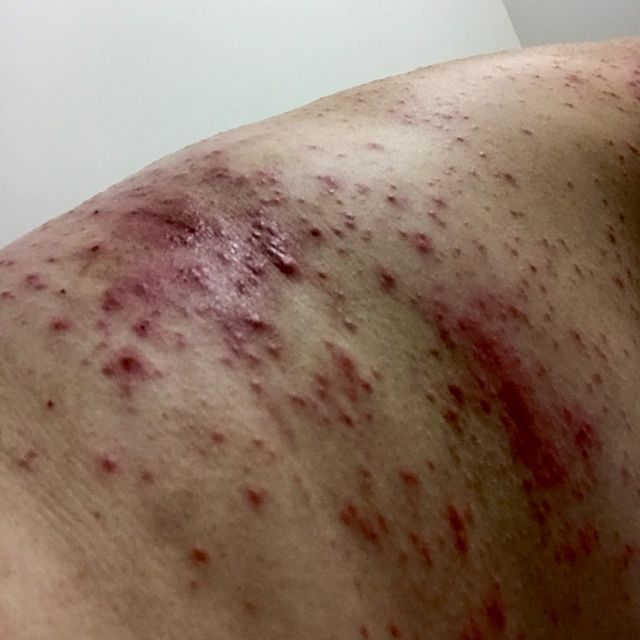
A Delta worker's skin after wearing the work uniform
While images of skin rashes and boils are gruesome, Maxwell emphasized that the damage extends beyond the skin. “The external is only part of this,” he says. “There is also the internal.”
According to the lawsuit, the health problems reported by affected workers, which have persisted in many cases long term, include a wide range of respiratory problems, including severe respiratory distress, vocal cord dysfunction, breathing difficulties, shortness of breath, coughing and tightness of chest. In addition, effects on the skin have included “contact dermatitis, skin blisters, skin rashes, boils, hives, bruising, eczema, scarring, hair loss, [and] hair follicle inflammation.”
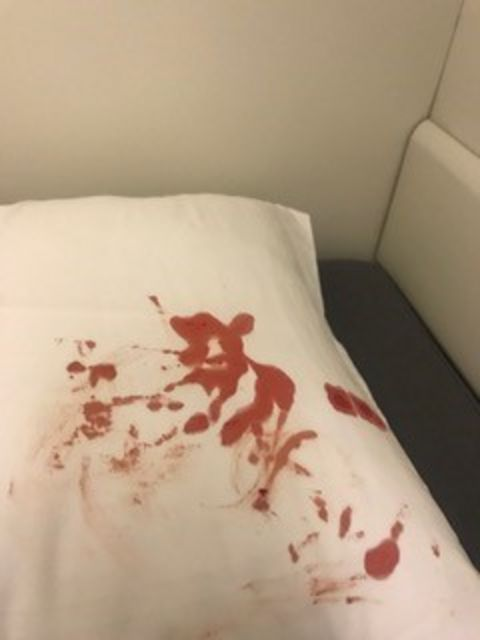
A Delta worker woke up bleeding profusely from the nose
Workers have also reported blurred vision, dry eyes, nosebleeds, ringing ears, sinus problems, migraines, headaches, fatigue, muscle weakness, anxiety, swollen lymph nodes, anaphylactic type symptoms (severe allergic reactions) and auto-immune conditions.
Among Maxwell’s clients are flight attendants who were previously in good physical shape, including workers who would regularly run for exercise. “They can’t run anymore. Their breathing difficulties are such that they can’t do it.” He described speaking to one worker whose hair was falling out in “chunks.” He described another worker waking up from a nap to discover “blood everywhere,” having bled profusely from the nose.
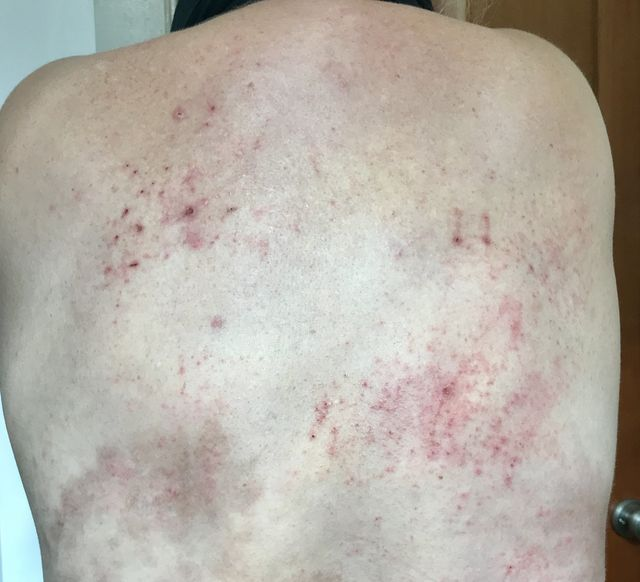
A Delta worker's back after wearing the work uniforms
Delta’s employee absence level, recorded as “call-ins” for calling in sick, spiked after the introduction of the uniforms.
The lawsuit details the individual ordeals of numerous workers who were poisoned by the uniforms. For example, flight attendant Stephanie Andrews of Murray, Utah suffered “from asthma, vocal cord dysfunction, breathing difficulties, shortness of breath, coughing, tightness of chest, contact dermatitis, skin rashes, hives, hair loss, heart palpitations, fatigue, and auto-immune conditions.” Flight attendant Janelle Austin of Atlanta, Georgia suffered from “hair loss, skin irritation, rashes, itchiness, difficulty breathing, fatigue, headaches, eye irritation, and sinus irritation.” Flight attendant Phyllis Heffeldinger of Londonville, Ohio suffered from chest pain and difficulty breathing.
After the uniforms were implemented in May, by the end of August Delta itself had acknowledged that around 1,900 out of 64,000 employees had reported “some type of concern” with the uniforms. By November, the number had risen 3,000.

A Delta worker photographed this clump of hair that had fallen out
The lawsuit alleges that the uniforms pose “ongoing, unreasonable risks of harm” to the workers who are wearing them, asking the judge to order Lands’ End to recall the uniforms and to establish a monitoring program over the adverse health effects of the uniforms.
According to the lawsuit, testing performed on behalf of the workers has revealed “the presence of chemicals and heavy metals far in excess of industry-accepted safe levels for garments,” including:
Maxwell pointed out, as an additional concern, that after exposure to toxic chemicals and metals, a person can become “sensitized.” If that happens, “your auto-immune system shuts down, and you become unable to fend off future exposures to that chemical.” Workers have reported that even if they are no longer wearing the uniform, they can have adverse reactions simply to sitting next to someone who is wearing the uniform. This phenomenon is the result of “off-gassing,” or the release of airborne particles from the contaminated fabric.
The lawsuit, which was filed against Lands’ End but not Delta itself, alleges that the uniforms were defective, that Lands’ End failed to provide appropriate and necessary warnings, and that Lands’ End was negligent in designing, testing and inspecting the uniforms.
American Airlines workers reported similar issues with Twin Hill uniforms, which were distributed to 70,000 airline employees in September 2016. Workers interviewed by the WSWS in June of last year reported body rashes, burning throat and eyes, coughing and headaches. After the scandal over the Twin Hill uniforms, American Airlines attempted to reassure workers by promising to switch to Lands’ End.
“We are the new radium girls,” flight attendant and author Heather Poole said at the time, referring to thousands of female workers at paint factories who were exposed to the radioactive element in the early 20th century. “It took them years to get sick, so the company would deny responsibility.”
Delta Airlines is also notorious among flight attendants for its workers’ compensation regime, which systematically denies adequate healthcare even for crippling workplace injuries. The airline’s third-party administrator, Sedgwick, is also the claims administrator for Amazon, where it is widely hated for its ruthlessness. A number of injured flight attendants spoke to the World Socialist Web Site about their experiences last year.
After the Delta workers’ lawsuit was filed against Lands’ End, American Airlines claimed to workers that the new Lands’ End uniforms for American Airlines are safe, notwithstanding the lawsuit. “I hope they’re sure about that,” Maxwell says drily.
Alaska Airlines and Southwest Airlines workers have also reported health problems resulting from their work uniforms.
A recent Harvard study published in the peer-reviewed journal BMC Public Health, titled “Symptoms related to new flight attendant uniforms,” found a correlation between health problems among 684 Alaska Airlines workers and their uniforms. When the uniforms were introduced in 2011, health problems increased, and after the uniforms were recalled in 2014, the study showed a decrease. The study concluded: “This study found a relationship between health complaints and the introduction of new uniforms in this longitudinal occupational cohort.”
Formaldehyde-releasing textile resins, in particular, constitute a cheap means for employers to limit wrinkles on employee uniforms, keeping employees looking “neat.”
While the companies insist that the level of each toxic chemical and metal in the uniforms is limited to a “safe” level, it appears likely that the effects of the chemicals and metals are aggravated in combination with each other.
“We don’t have any standards anymore in the US,” Maxwell said. He pointed to the Toxic Substances Control Act of 1976, which gives the Environmental Protection Agency authority to regulate the industrial chemicals such as those to which Delta workers were exposed.
“This law is on the books,” Maxwell said. “Apparently, our government is not acting as a regulatory force on this law. I don’t see where that is being enforced in the garment industry.”
Maxwell also pointed to Occupational Safety and Health Administration, which has promulgated limits on exposure to toxic metals in the workplace. Delta workers were exposed to quantities that are “way above that.”
Maxwell continued, “I don’t understand why that’s not being applied or looked at because, my goodness, that’s in the workplace.”
Article (archive)
Truly, a triumph for late-stage capitalism.
The now-infamous “Passport Plum” uniforms were purchased from Lands’ End, an American clothing retailer. They were issued to tens of thousands of employees, who were required to wear them after May 29, 2018.
The uniforms were treated with a toxic cocktail of chemical additives and finishes that were designed to make them “high stretch, wrinkle and stain resistant, waterproof, anti-static, and deodorizing,” according to the lawsuit. This combination of additives and finishes caused skin rashes, headaches and other health problems among many workers.
“I am confident that these uniforms are affecting many thousands of people,” attorney Bruce A. Maxwell said in an interview with the World Socialist Web Site. “My office has fielded in excess of 2,000 calls.” A closed Facebook page for flight attendants, he said, already has around 6,500 participants.
Maxwell, of the Jacksonville, Florida law firm Terrell Hogan, is the lead attorney on the case. More than 500 workers have joined the lawsuit already, he said, adding that he would soon be amending the complaint to increase that number to around a thousand workers.
“These uniforms were issued to 64,000 employees,” Maxwell says, of which 24,000 are flight attendants. The remaining 40,000 are customer service workers, ramp and gate agents, Sky Club workers, as well as cargo, maintenance and technical workers.
In this latter category, which is numerically larger, relatively fewer workers have come forward so far, which Maxwell attributes to fear of being fired. “I’m hoping the more attention is brought to this matter, the more will come out.”
A Delta worker's skin after wearing the work uniform
While images of skin rashes and boils are gruesome, Maxwell emphasized that the damage extends beyond the skin. “The external is only part of this,” he says. “There is also the internal.”
According to the lawsuit, the health problems reported by affected workers, which have persisted in many cases long term, include a wide range of respiratory problems, including severe respiratory distress, vocal cord dysfunction, breathing difficulties, shortness of breath, coughing and tightness of chest. In addition, effects on the skin have included “contact dermatitis, skin blisters, skin rashes, boils, hives, bruising, eczema, scarring, hair loss, [and] hair follicle inflammation.”
A Delta worker woke up bleeding profusely from the nose
Workers have also reported blurred vision, dry eyes, nosebleeds, ringing ears, sinus problems, migraines, headaches, fatigue, muscle weakness, anxiety, swollen lymph nodes, anaphylactic type symptoms (severe allergic reactions) and auto-immune conditions.
Among Maxwell’s clients are flight attendants who were previously in good physical shape, including workers who would regularly run for exercise. “They can’t run anymore. Their breathing difficulties are such that they can’t do it.” He described speaking to one worker whose hair was falling out in “chunks.” He described another worker waking up from a nap to discover “blood everywhere,” having bled profusely from the nose.
A Delta worker's back after wearing the work uniforms
Delta’s employee absence level, recorded as “call-ins” for calling in sick, spiked after the introduction of the uniforms.
The lawsuit details the individual ordeals of numerous workers who were poisoned by the uniforms. For example, flight attendant Stephanie Andrews of Murray, Utah suffered “from asthma, vocal cord dysfunction, breathing difficulties, shortness of breath, coughing, tightness of chest, contact dermatitis, skin rashes, hives, hair loss, heart palpitations, fatigue, and auto-immune conditions.” Flight attendant Janelle Austin of Atlanta, Georgia suffered from “hair loss, skin irritation, rashes, itchiness, difficulty breathing, fatigue, headaches, eye irritation, and sinus irritation.” Flight attendant Phyllis Heffeldinger of Londonville, Ohio suffered from chest pain and difficulty breathing.
After the uniforms were implemented in May, by the end of August Delta itself had acknowledged that around 1,900 out of 64,000 employees had reported “some type of concern” with the uniforms. By November, the number had risen 3,000.
A Delta worker photographed this clump of hair that had fallen out
The lawsuit alleges that the uniforms pose “ongoing, unreasonable risks of harm” to the workers who are wearing them, asking the judge to order Lands’ End to recall the uniforms and to establish a monitoring program over the adverse health effects of the uniforms.
According to the lawsuit, testing performed on behalf of the workers has revealed “the presence of chemicals and heavy metals far in excess of industry-accepted safe levels for garments,” including:
- Chromium — harmful to the skin, eyes, blood, and respiratory system;
- Antimony — harmful to the eyes and skin; causes hair loss; used to make flame-proofing materials;
- Mercury — at high vapor concentrations, it can cause quick and severe lung damage; at low vapor concentrations over an extended period of time, it can cause neurological disturbances, memory problems, skin rash and kidney abnormalities; mercury can pass from a mother to her baby through the placenta during pregnancy and through breast milk after birth;
- Formaldehyde — skin, throat, lungs and eye irritant; repeated exposure can cause cancer;
- Fluorine — eye irritant; harmful to kidneys, teeth, bones, nerves and muscles; used as a stain repellant; and
- Bromine — skin, mucous membrane, and tissue irritant; used as a fire retardant.
Maxwell pointed out, as an additional concern, that after exposure to toxic chemicals and metals, a person can become “sensitized.” If that happens, “your auto-immune system shuts down, and you become unable to fend off future exposures to that chemical.” Workers have reported that even if they are no longer wearing the uniform, they can have adverse reactions simply to sitting next to someone who is wearing the uniform. This phenomenon is the result of “off-gassing,” or the release of airborne particles from the contaminated fabric.
The lawsuit, which was filed against Lands’ End but not Delta itself, alleges that the uniforms were defective, that Lands’ End failed to provide appropriate and necessary warnings, and that Lands’ End was negligent in designing, testing and inspecting the uniforms.
American Airlines workers reported similar issues with Twin Hill uniforms, which were distributed to 70,000 airline employees in September 2016. Workers interviewed by the WSWS in June of last year reported body rashes, burning throat and eyes, coughing and headaches. After the scandal over the Twin Hill uniforms, American Airlines attempted to reassure workers by promising to switch to Lands’ End.
“We are the new radium girls,” flight attendant and author Heather Poole said at the time, referring to thousands of female workers at paint factories who were exposed to the radioactive element in the early 20th century. “It took them years to get sick, so the company would deny responsibility.”
Delta Airlines is also notorious among flight attendants for its workers’ compensation regime, which systematically denies adequate healthcare even for crippling workplace injuries. The airline’s third-party administrator, Sedgwick, is also the claims administrator for Amazon, where it is widely hated for its ruthlessness. A number of injured flight attendants spoke to the World Socialist Web Site about their experiences last year.
After the Delta workers’ lawsuit was filed against Lands’ End, American Airlines claimed to workers that the new Lands’ End uniforms for American Airlines are safe, notwithstanding the lawsuit. “I hope they’re sure about that,” Maxwell says drily.
Alaska Airlines and Southwest Airlines workers have also reported health problems resulting from their work uniforms.
A recent Harvard study published in the peer-reviewed journal BMC Public Health, titled “Symptoms related to new flight attendant uniforms,” found a correlation between health problems among 684 Alaska Airlines workers and their uniforms. When the uniforms were introduced in 2011, health problems increased, and after the uniforms were recalled in 2014, the study showed a decrease. The study concluded: “This study found a relationship between health complaints and the introduction of new uniforms in this longitudinal occupational cohort.”
Formaldehyde-releasing textile resins, in particular, constitute a cheap means for employers to limit wrinkles on employee uniforms, keeping employees looking “neat.”
While the companies insist that the level of each toxic chemical and metal in the uniforms is limited to a “safe” level, it appears likely that the effects of the chemicals and metals are aggravated in combination with each other.
“We don’t have any standards anymore in the US,” Maxwell said. He pointed to the Toxic Substances Control Act of 1976, which gives the Environmental Protection Agency authority to regulate the industrial chemicals such as those to which Delta workers were exposed.
“This law is on the books,” Maxwell said. “Apparently, our government is not acting as a regulatory force on this law. I don’t see where that is being enforced in the garment industry.”
Maxwell also pointed to Occupational Safety and Health Administration, which has promulgated limits on exposure to toxic metals in the workplace. Delta workers were exposed to quantities that are “way above that.”
Maxwell continued, “I don’t understand why that’s not being applied or looked at because, my goodness, that’s in the workplace.”
Article (archive)
Truly, a triumph for late-stage capitalism.


