Estás usando un navegador desactualizado. Es posible que no muestre este u otros sitios web correctamente. Deberías actualizar o usar un navegador alternativo.
UKBelfast after the ‘beheading’ - Old hatreds gave way to new grievances
Sheltering from the rain in a bus stop on East Belfast’s Protestant Newtownards Road, a location whose growing trendiness sits uneasily with its active UVF paramilitarism, an elderly couple looked up from their cigarettes to ask a passing fireman when they could go home. “It won’t be for a few hours yet, I’m sorry,” he told them, warning them that the exposed gas mains were a worry and the street was still unsafe.
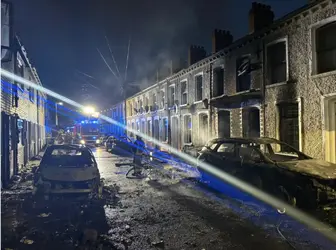
A good portion of their narrow terraced street, which had, until that evening, housed non-European migrants, had been burned out. The migrants had been escorted away in armored Police Service of Northern Ireland (PSNI) Landrovers earlier; the houses, and cars outside, were now blackened shells. Taking a photo of the devastation, eerily lit by the blue lights of the emergency services, I tried to persuade a local woman, on promise of anonymity, to grant me an interview. Two burly men, overhearing me, ushered me into a dark corner where they demanded to search my phone’s camera roll, to ensure I had not captured any local faces. Once they were satisfied, the larger of the two men warned me, “with no animosity, like, don’t be asking any more questions. We don’t want any journalists down here.” I understand, I said, but it’s my job. “In this country?” replied his more excitable colleague, “Are you fucking daft? Fuck away off and get on home before you get kneecapped.”
There was, perhaps, no arguing the point. Hostility to journalists was ubiquitous, at least on the Loyalist side. Over the course of the day, in which protests had been announced on social media in a bewildering variety of locations across Northern Ireland, a constant theme had been that no cameras, and no phones, were to be allowed. Protesters had been advised to dress in all-dark clothes, and to mask up: rather than hosting the carnival of livestreamers accompanying many such anti-migrant events in England and the Irish Republic, tonight was to be serious business. What violence there was, rather than aimlessly directed at the police, was to be coldly and carefully targeted against individual migrant homes. Coming home to Belfast from London that afternoon, I had returned to a place of ghostly quietness, where confused tourists wandered past the shuttered shops and bars of the deserted city center. The horrifying attempted beheading of a North Belfast man by a Sudanese migrant, captured on video, would have been incendiary enough in a mainland Britain increasingly host to such horrors; in hitherto untouched Belfast, the assumption was that tonight’s response would be a historic event.
What gave the atrocity its added political piquancy was that it took place in a firmly Catholic, Nationalist area. The symbolism of the attacker being beaten off with a hurling stick, a symbol of Irish cultural nationalism — by a local man named Maitiu Mág Tighearnán — was quickly taken up by new Irish Republican factions firmly set against mass migration. Until now, the governing rule of thumb was that anti-migrant riots are, in Northern Ireland, a purely Loyalist affair, which Catholic Nationalists regard with detached dismissal. But it is increasingly common to hear grumblings against mass migration from working-class Catholics, grumblings entirely absent from their community’s social media and journalistic commentators. Indeed, the locally influential Irish Republican Socialist Party (IRSP), which claims not to be the political wing of the Irish National Liberation Army (INLA), has recently begun to make its veiled criticisms of mass migration explicit, seeking to capture the turning mood and turn it against their politically dominant rivals Sinn Féin. In its statement delivered on the night of the attack, the IRSP declared its support for a residents’ group protesting the siting of a migrant hostel in West Belfast’s Republican Glen Road, and warned against the silencing of “legitimate working class concerns about immigration” within “communities, who, with zero consultation, have never seen such demographic shifts in their lifetime”.
Northern Irish Republicanism has, until now, been insulated by the country’s post-peace process political system — guaranteeing an increasingly socially liberal Sinn Féin a role in government — from the anti-migration disturbances that have roiled the Irish Republic in recent years. The long-expected moment when that would change appears to be slowly dawning, accelerated by the violent horror of this attack, deep within the Republican inner sanctum. “You wouldn’t expect this happening here, not since the days of the Troubles,” one Catholic woman, smoking a cigarette on the doorstep of her neatly-presented terraced house, told me of the attack sparking the night’s events. “As a mother of young boys you worry what might happen to them, it’s shocking, just shocking is what it is.”
Yet in North Belfast, a patchwork of jealously guarded sectarian enclaves and exclaves, which makes a map of the Holy Roman Empire look manageable, the traditional ethnic conflict is of far greater relevance than whatever new politics is being formed by the decisions of Whitehall officials, who have rapidly turned Belfast into one of the United Kingdom’s prime destinations for asylum resettlement. On North Queen Street, one of North Belfast’s many euphemistically termed “interface areas”, where the two communities abut each other, Catholic Nationalists cheerily watched masked Protestant youths, masked and dressed in black, set barriers alight and fill petrol bombs, the two sides observing each other from a healthy distance. On the Catholic side, commanding-looking men in expensive black SUVs sat overseeing the events, occasionally nodding at messages whispered to them through their car windows.
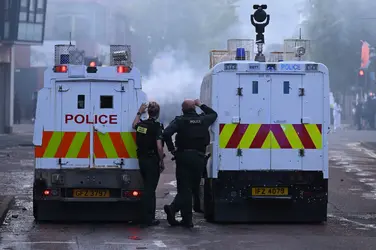
On the Protestant side, where older women held up placards saying “Women and Children Not Safe In This Area” behind a screen of intimidating masked teenagers, a woman laughed at a police patrol car making a rapid about-turn from the area. “Look at them doughnuts he’s doing,” she said to her friend, “He’s from Divis [a notorious West Belfast Catholic housing estate] flying about like that.” One older man, who appeared to be drunk, angrily tried to pull the bemused driver of a rental lorry, with Southern plates, from his cab, following his awkward and failed attempt to negotiate the unexpected and blazing barricade. No doubt in the new spirit of cross-community co-operation, other Protestants intervened, leading their errant colleague away and giving the driver alternative directions to his destination with a kind of exaggerated politeness rare to Belfast. Unlike previous anti-immigration riots, where the PSNI came under furious and sustained assault, this time round the police were markedly absent, occasionally sending officers in patrol cars to pull burning bins away from traffic intersections, and instead leaving the two hostile communities they are normally at such costly pains to separate to explore each others’ unmediated proximity.
“It’s an excuse for them [Loyalists] to come out, build their numbers and then they’ll attack our community, it happens all the time,” one Catholic man from the fiercely Republican New Lodge told me, while grinding weed for a joint. “We’re all just standing here so, you can see, and they’re all covered up, covered up to their teeth, all black as your boot. Don’t you be going down that side,” he warned me, “they’re a lot more aggressive down there, even though their side supports Britain, you know.” Even still, he added, tonight was something new. “It’s about both sides, you know, the Green and the Orange coming together.” An older Catholic man from the New Lodge, watching the Protestant rioters with his Southern-accented female companion, agreed. “They [migrants] shouldn’t be allowed in this country,” he told me. “We’re keeping our distance there at the minute,” he added, nodding at the rioting Protestants, “but by right we should all be coming together here. They shouldn’t be in this country.” His grey-haired male friend, shaking his head angrily, walked away saying “I don’t agree with you there, mate.” I asked the first man what he thought of his Sinn Féin elected representatives. “Arseholes,” he replied.
Walking down, past burning barricades on the Clifton Circus roundabout overseen by a thin garrison of teenage sentries, I went to a different burning barricade on the staunchly Loyalist Shankill Road, where I met Amanda, a 60-year old woman shouting “Leftie scum!” at an ITV news crew. Though telling me that I “looked like a Leftie”, she agreed to talk to me. “We’re feeling very, very angry, we’re just tired,” she told me. “It just goes from one thing to the next thing, and they’re just all horrible situations. We’ve just come out of the horrible situation of Henry Nowak, and now, this week, we’ll have the young man almost decapitated up on the Antrim Road.” Smoke rose from a new development of executive apartments under construction over the road, which were locally controversial. Indians were buying up all the new flats on the Shankill, which locals can’t afford, she told me, and turning them into Airbnbs. “We don’t want them here,” she added, telling me of her appreciation for Rupert Lowe — an extremely rare cut-through of English politics in Northern Ireland’s insular political universe — and distrust of the insufficiently staunch Nigel Farage. As for the Catholics, she told me, “You know, we fought each other, ever since I was so high,” indicating a point a little off the sidewalk with her hand, “but we’ve had to come together because there’s a new threat from outside the country. When you start bringing in another threat from outside, well, the people are obviously going to have to unite, because we’re being invaded by illegal migrants and immigrants on this side of the community, and they’re being equally affected with the same situation. So, what else are we going to do?”
The idea of Catholics and Protestants uniting against mass immigration is, overwhelmingly, one pushed more by Loyalists than by Nationalists, with the former observing both the rabid hostility displayed by Loyalist activists to expressions of cultural identity like the Irish language, and the frequent violent intimidation of Catholics living in working-class Protestant areas as far more of an immediate and existential threat. Indeed, even Nationalists hostile to mass immigration view any coordination with Loyalists as a strategic catastrophe, gifting ammunition to their pro-immigration enemies within Irish Republicanism. But in the aftermath of the North Belfast atrocity, there has for the very first time begun, though certainly not an alliance, then the first glimmerings of a tentative and distrustful rapprochement. The nightmare scenario for Sinn Féin would have been Catholics rioting against immigrants. That did not happen: instead, working-class Catholics merely turned out to watch their Protestant neighbors riot with an anthropological detachment newly devoid of open contempt. I have never until now heard working-class Catholics, from devoutly Republican areas, talking about the coming together of the “Orange and the Green” with anything other than derision. At Ardoyne Roundabout, one of North Belfast’s most volatile sectarian interface areas, protestors from both communities shook hands and declared amity in scenes that were genuinely startling.
But this is, ultimately, Northern Ireland, where the age-old ethnic conflict is as perennial and inescapable as the soaking rain that drew the night’s events to a close. It is, probably, doubtful that anything will come of the cautious street flirtation, and as July’s marching and bonfire season draws close, we can no doubt expect a reversion to the old ways rather than the ungainly new dalliances of 2026. But, nonetheless, there was something novel and unexpected about the occasion: the working-class communities of both sides, accustomed to hating each other, and increasingly estranged from their political leaders in Stormont, for the first time eyeing each other up, from a distance, like awkward teenagers at a disco. Northern Ireland is an extremely dysfunctional country, though very charming and livable for it: it is entirely unique for both communities to find common cause in blaming Westminster for introducing an unexpected source of random, violent dysfunction to unsettle their old and comforting, formalized one.
This is one of the most pretentious pieces that I've seen in quite some time. This clown spent 2,000 words to spin his wheels in a self-therapy session others are forced to sit through where he had no apparent developing point, focusing instead on stroking himself to a thesaurus. Absolutely atrocious.
This is the perfect summary of how redditors and "academics" in general write. They force you to write in this way in college and normies/NPCs never break out of it. College doesn't just not teach anything, it teaches you wrong so you have to spend time unlearning it half the time.
It seems like flooding Northern Ireland with literal terrorists (the attempted beheader was reportedly a Janjaweed who have been raping, pillaging, and murdering their way through Darfur for decades) was an own goal given that the Troubles are still within living memory. Northern Irish are comfortable using political violence to get what they want, and trying to crack down on them is likely to backfire hard.
Who is "they"?
The British voters continuously vote for an end to this and the government simply ignores it.
The only "they" respondsible for this are the politicians and if this keeps going, those politicians will face some real violent consequences.
Can we start sinking migrant boats again? I genuinely don't care about them, they aren't really human beings in the classic Western sense of the word and 90% of them are militant muslims that believe its their duty to kill non-muslims so they can conquer the world.
So yeah, lets start shooting up those migrant boats. Don't worry, after you sink 3-5 of them word will spread and they'll stop sailing on over to civilization from their shitholes.
From where I'm sitting, Reform and Restore seem like the only two decent-sized parties worth a damn over there (even though I'm a bit tentative about Reform on account of my niggling feeling that Nigel Farage could be controlled opposition).
From where I'm sitting, Reform and Restore seem like the only two decent-sized parties worth a damn over there (even though I'm a bit tentative about Reform on account of my niggling feeling that Nigel Farage could be controlled opposition).
You know things are bad in the UK when even the native-born browns are suffering from migrant fatigue. That doesn't change the fact that when compared to the other options open to the UK electorate, Reform appears to be one of the least worst.
Given that the Tories have been in a pissing contest with Labour over the past couple of decades to see who can run the UK into the ground the fastest, I'm not surprised those who still actually give a fuck have bailed.
I have never until now heard working-class Catholics, from devoutly Republican areas, talking about the coming together of the “Orange and the Green” with anything other than derision. At Ardoyne Roundabout, one of North Belfast’s most volatile sectarian interface areas, protestors from both communities shook hands and declared amity in scenes that were genuinely startling.
They don’t need to be burning down residential homes and migrant hostels. They need to be burning down politicians’ offices and homes. As Sam Hyde said, “these people have homes and addresses”.
The defectors are the ones who perpetuated everything. They set the policies that Labour are continuing, like the migrant hotels (jenrick, immigration minister, boasted about opening so many) and asylum policy (braverman, home secretary when the beheader was granted asylum).
They don’t need to be burning down residential homes and migrant hostels. They need to be burning down politicians’ offices and homes. As Sam Hyde said, “these people have homes and addresses”.
Cops will start using live ammo once they do. Besides, burning down the migrants stuff is the right move as they are the immediate threat and sends a strong message to politicians. Even if they do threaten politicians into submissions by burning down their homes they still move at the speed of goverment. Why wait for them to close the migrant shelters when you can do it immediately as a community bonding activity?