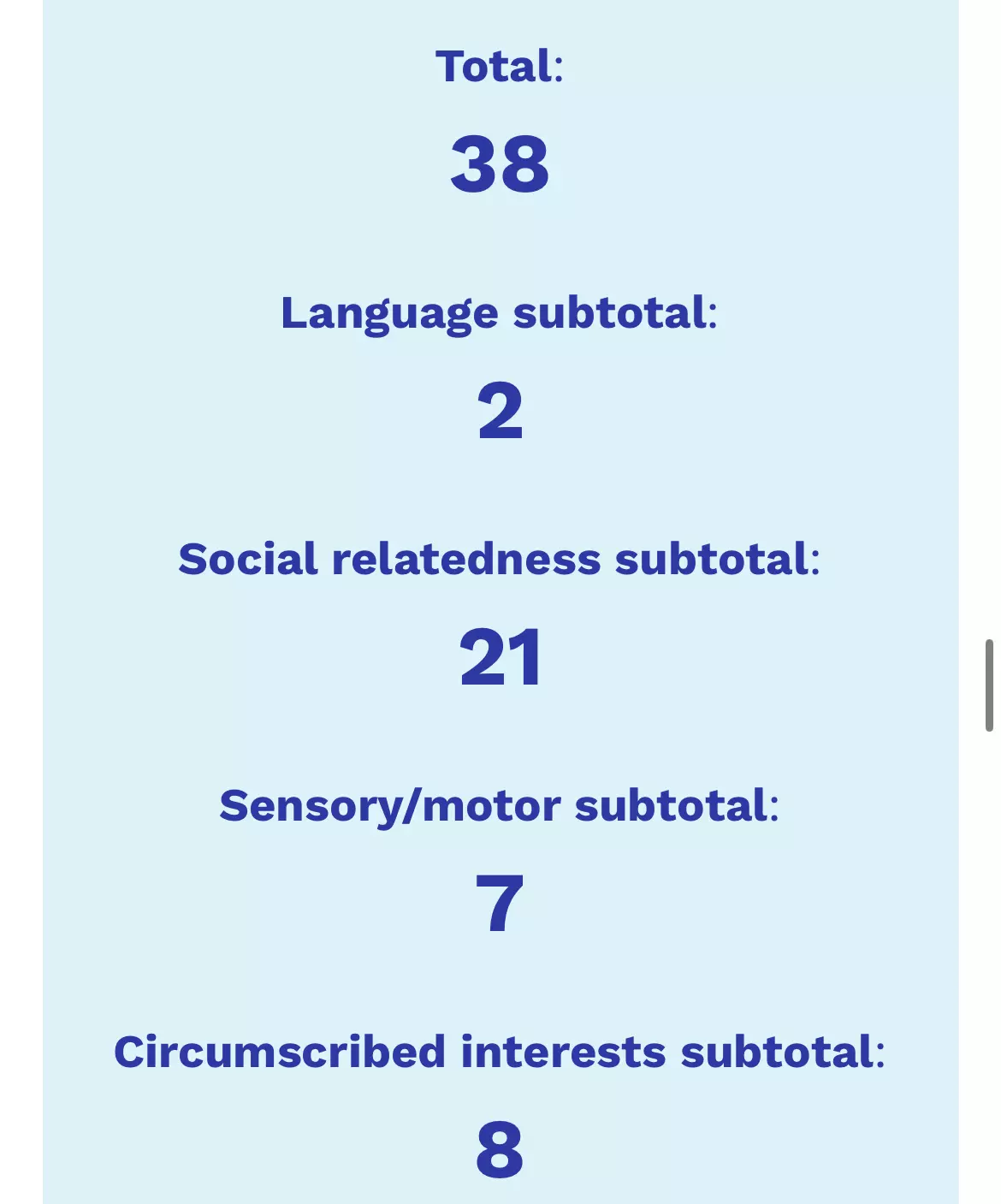
I hate nigger tests with absolute value nigger questions and answers like "I am often surprised when others tell me I have been rude." or "I don't like to be hugged or held." and you can only say "Yes" and "NEVER EVER!"
Useless.
WHERE IS THE SOMETIMES?
WHERE IS THE ONLY UNDER SPECIFIC CIRCUMSTANCES?
The binary yes/no setup is awful but even a "Always/Often/Sometimes/Rarely/Never" scale is faulty since there's also no baseline for what counts as often or rarely, so it's very likely for an autist taking the test to have no idea whether their experience counts as unusual or if it's just a normal thing everyone goes through occasionally.
A statement like "I'm a social person who seeks the company of others" could result in a thought process like "Hmm, I don't like 300 person parties and gotta have my own space too after hanging with my friends all day, so I must be a turbo introvert," or like "Well sometimes I feel sad that I have literally zero friends and would like to talk to another human being from time to time, so yeah I'm social." Both attitudes indicate a misguided answer due to a poor grasp on what's typical but the psych reviewing the answers won't see any of that. If your test is literally targeted at people who fundamentally do not understand social norms to a pathological level then it is really stupid to ask them to broadly evaluate if they are socially normal in some aspect without providing the benchmark.
The piss poor phrasing of the tests is likely why a lot of kinda quirky/awkward but still socially successful spergs are latching onto self-dx in droves while bigger spergs gloss over the concept of autism and latch onto weird, sometimes idiosyncratic conspiracy theories about why they're socially unsuccessful. E.g., while Chris has always been aware of his autism, his old tinfoiling about "Virginia is for Virgins" and his school being out to get him indicates a lack of understanding of how his autism isn't just some arbitrary yellow badge marking him as the punching bag of the world, but involves abnormal behavior (like holding a sign soliciting a girlfriend) that result in his abnormal experiences (like getting banned from the mall).
Questions like "Do you miss social cues" or "Do you not notice when people flirt" are also very evidently counterproductive since how are you supposed to know if you don't know something? A normie can likely recall a bunch of times they realized something stupid in hindsight but an autist is more likely to be completely unaware that anything happened and to only recognize a few major screw ups, not the thousands of micro-fails.
Also, some of the questions are too specific instead of too vague—hand flapping and repeating movie quotes are stereotypical behaviors but autists can be fixated on any unique thing that they make up. I'm sure there is some autist out there who proudly answered with a no because they only repeatedly flex their right ankle and only repeat mundane phrases copied from shampoo bottles and power saw instructional manuals.
Some might also say no because they understand from experience to cut back on their autistic behaviors in public even though they're still getting the urges and doing them in private, since they are focusing on their learned knowledge of acceptable social behavior and not the presence of atypical urges; normies aren't just experts at restraining themselves, they simply aren't getting the urge to do those behaviors to begin with.
Obviously 1-on-1 screening with a psych is vastly superior in identifying if and how someone is a sperg, but even then there are lots of practitioners who miss or misunderstand traits because they do not grasp the level of social disconnection that their patient experiences and much autism-related documentation is unhelpfully stereotyped (e.g., from the 20th century, small sample size, only involves kids, only involves boys, only involves whites, only involves the most severe cases). It takes a lot of experience and insight for someone to be truly good at working with autism but lots of therapists slap autism along with 30 other alleged "specialties" and "areas of expertise" on their Psychology Today profile because they took one neurodevelopmental disorders course in their undergrad, despite not having the first clue in how to identify or treat autists in reality, so that muddies the water and results in dumb misdiagnoses (either missing autism or misassigning autism).
tl;dr: Autism tests are severely autistic and so am I