Source : https://www.nytimes.com/2023/09/11/business/apple-iphone-17.html?searchResultPosition=1
As Smartphone Industry Sputters, the iPhone Expands Its Dominance
Apple, which is set to release a new iPhone on Tuesday, has increased its share of smartphone sales by converting Android customers and adding teenagers.
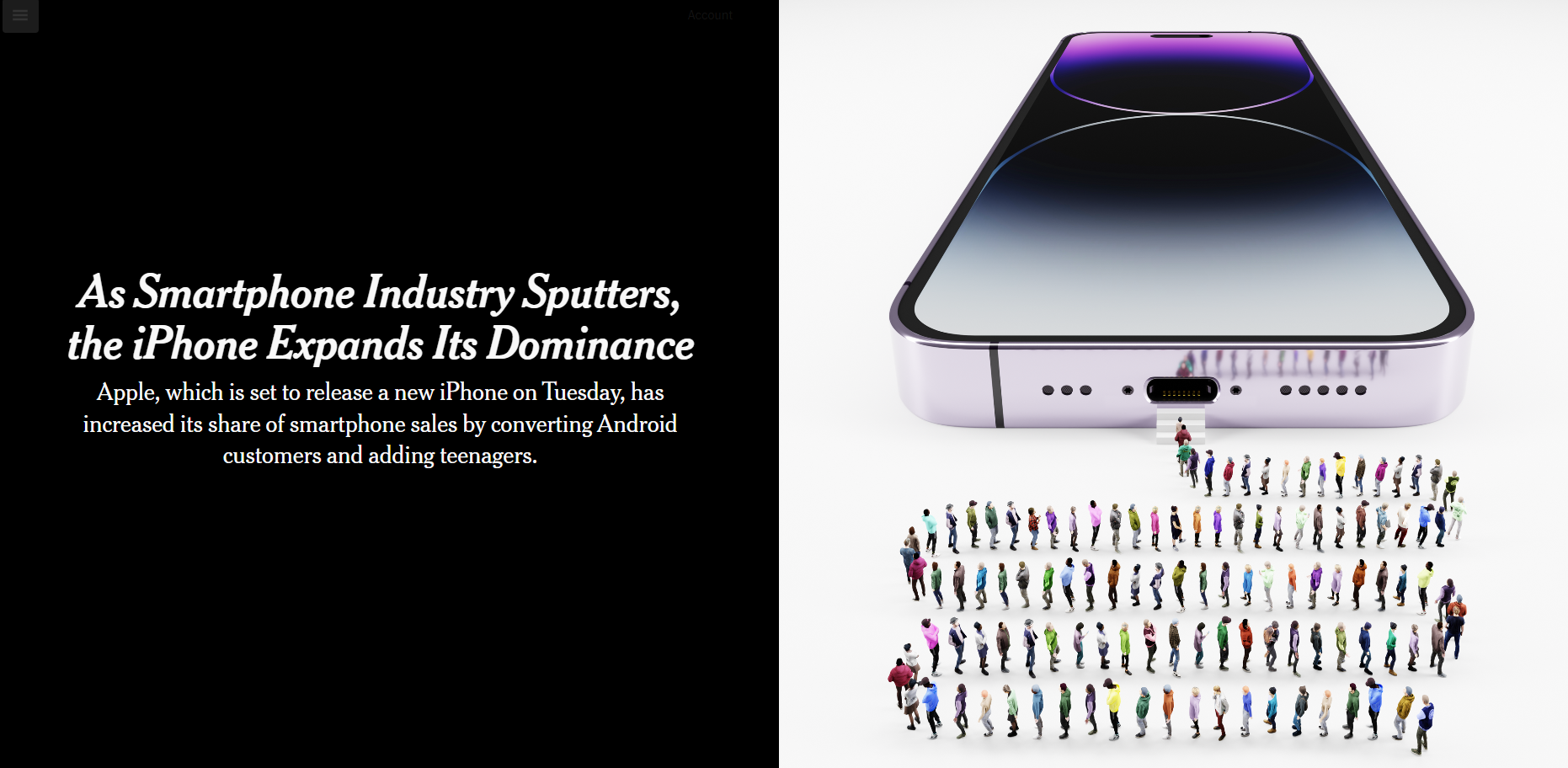
Credit...Guillem Casasus
By Tripp Mickle
Tripp Mickle has reported on Apple for seven years and will cover his fifth iPhone unveiling on Tuesday.
Sept. 11, 2023
There’s a general rule about consumer electronics: The older a device becomes, the more competitors appear and prices fall. This was true for televisions, personal computers and portable music players.
It was supposed to happen with smartphones. But the iPhone has defied gravity.
On Tuesday, Apple will unveil the 17th iteration of its flagship product. Remarkably, at an age in which most consumer devices have lost some of their appeal to users, Apple has increased its share of smartphone sales over less expensive rivals.
Over the past five years, the iPhone has increased its percentage of total smartphones sold around the world while expanding its share of sales in four of the world’s largest regions: China, Japan, Europe and India.
In the United States, the iPhone’s largest market, the device now accounts for more than 50 percent of smartphones sold, up from 41 percent in 2018, according to Counterpoint Research, a technology firm. The gains have helped it claim about a fifth of the world’s smartphone sales, up from a low of 13 percent in 2019.
Apple has expanded its smartphone empire as the broader industry has faltered. Over the past two years, sales of Android smartphones have plummeted, but the iPhone has suffered only modest declines because it’s been winning new customers. It has done so despite being the industry’s priciest device.
Apple has overcome price sensitivity by creating a business that is reminiscent of U.S. car sales. Like a car, iPhones last for years and can be resold to offset the purchase of a new one. Wireless providers, much like auto dealers, offer discounts and monthly payment plans that make it more affordable to buy the latest model. And customers, like brand-loyal car buyers, are more likely to buy another iPhone than switch to Google’s Android operating system.
Apple has also been lucky. Two of its biggest challengers, Samsung and Huawei, have stumbled in recent years. Samsung faltered in 2016 when the batteries in its flagship smartphone spontaneously combusted. Huawei, which was popular in China, floundered in 2020 after the Trump administration blocked it from buying U.S. technology.
The iPhone has avoided wobbles with a reliable blueprint: Apple annually updates the iPhone’s spare but sleek design and reliable software, and brings it to the masses with an operations machine that assembles 200 million flawless iPhones a year with military precision.
In the United States, the iPhone’s popularity is expected to widen in the years ahead. Nearly 90 percent of teenagers own an iPhone, according to Piper Sandler, an investment bank.
For young people, iPhones equal inclusion. Many choose it over Android because Apple’s messaging service, iMessage, will turn the color of messages from its default blue to green if a non-iPhone user is in a messaging group. The stigma associated with having green text messages is so pronounced that when it came time for Dave Storrs’s 14-year-old son to get his first smartphone, the teenager told his father that he wanted an iPhone or no phone at all.
“It’s a status thing,” said Mr. Storrs, an Army retiree who lives in El Paso. “They don’t want to be treated differently.”
Mr. Storrs, who is 49, has been subjected to the same pressure. For more than a decade, he took pride in being what he called an “Android renegade.” He owned a series of LG and Motorola phones, even as his son and other family members pressed him to buy an iPhone. He gave in this year after his family gave him a $99 pair of Apple’s wireless AirPod earbuds.
Each time he wanted to use the AirPods on his Android phone, he had to manually sync them. The laborious process inspired him to buy an iPhone 13, which connects the AirPods instantaneously. After years of using a free Android phone, he now pays $11 a month for the iPhone. But he says that he’ll never go back to Android because he likes that he can wear AirPods and take phone calls while walking his Catahoula leopard dog, Teddy.
“It’s just convenient,” he said.
New buyers like Mr. Storrs illustrate how Apple is gaining customers. The gap between the two major operating systems is tilted in Apple’s favor. About 94 percent of iPhone customers are likely to buy another iPhone, while 91 percent of Android customers are likely to buy another Android, according to Consumer Intelligence Research Partners, a technology research firm.
The migration from Android to Apple has accelerated as promotional discounts, financing plans and trade-in offers make higher iPhone prices less of a barrier. Wireless carriers sweetened their offers as they scrambled to gain or keep customers after T-Mobile merged with Sprint in 2020. When the combined company, the new T-Mobile, offered the iPhone 12 free with a 30-month contract, AT&T countered with a similar deal, said Cliff Maldonado of BayStreet Research, a smartphone research firm. It made switching priceless.
Around the same time, Apple and wireless carriers began more aggressively promoting monthly payment plans. The plans have reduced the cost of a new iPhone to less than $40 a month from the $800 to $1,200 that customers had to pay upfront. The prices are lower for people who trade in used devices. The old iPhones, which could fetch up to $640, have been auctioned to buyers in Asia, who resell them at a markup, Mr. Maldonado said.
“The phone market is like the housing market,” he said. “You get equity, and pay over time.”
In China, the second-most important country to Apple’s business, the iPhone has become the default choice for people who want a premium smartphone. Samsung was squeezed out of the market several years ago, and Huawei has been unable to make a phone with the latest wireless technology. The lack of competition has helped to make the iPhone the country’s best-selling smartphone in recent quarters.
But new challenges threaten Apple’s lead. Last month, Huawei unveiled a new premium smartphone, the Mate 60 Pro, its first to feature chips capable of running on 5G cellular networks. Beijing also directed employees of national government agencies not to use iPhones for work. Instead, they have been encouraged to use domestic smartphone brands, raising the possibility that nationalist momentum undercuts future iPhone sales. The news was first reported by The Wall Street Journal.
Apple didn’t respond to requests for comment.
Apple may be able to offset a dip in China with growth in India. The company now claims 5 percent of sales in the world’s fastest-growing smartphone nation, up from 1 percent in 2019. Counterpoint Research predicts that Apple could double its share to 10 percent next year.
The iPhone’s gains in India have been years in the making. In 2017, Apple began working with government officials to start manufacturing iPhones locally, a move that has improved affordability by avoiding import tariffs. It has also opened stores in New Delhi and Mumbai.
The new flagship iPhones that Apple is set to unveil this week will feature speedier processors, more sophisticated cameras and titanium rather than stainless steel cases, according to supply chain analysts. The changes are expected to come with a $100 to $200 price increase, bringing the cost of an iPhone Pro to $1,100 and the Pro Max to $1,200.
But analysts predict that iPhone loyalists will shrug off higher prices. The increases would be less than $5 a month for people on monthly plans and even less for those who trade in old iPhones.
“The economy is doing pretty well, and everything costs more,” said Michael Levin, a co-founder of Consumer Intelligence Research Partners. “People are desensitized to increases right now.”
Tripp Mickle covers technology from San Francisco, including Apple and other companies. Previously, he spent eight years at The Wall Street Journal reporting on Apple, Google, bourbon and beer. More about Tripp Mickle
As Smartphone Industry Sputters, the iPhone Expands Its Dominance
Apple, which is set to release a new iPhone on Tuesday, has increased its share of smartphone sales by converting Android customers and adding teenagers.
Credit...Guillem Casasus
By Tripp Mickle
Tripp Mickle has reported on Apple for seven years and will cover his fifth iPhone unveiling on Tuesday.
Sept. 11, 2023
There’s a general rule about consumer electronics: The older a device becomes, the more competitors appear and prices fall. This was true for televisions, personal computers and portable music players.
It was supposed to happen with smartphones. But the iPhone has defied gravity.
On Tuesday, Apple will unveil the 17th iteration of its flagship product. Remarkably, at an age in which most consumer devices have lost some of their appeal to users, Apple has increased its share of smartphone sales over less expensive rivals.
Over the past five years, the iPhone has increased its percentage of total smartphones sold around the world while expanding its share of sales in four of the world’s largest regions: China, Japan, Europe and India.
In the United States, the iPhone’s largest market, the device now accounts for more than 50 percent of smartphones sold, up from 41 percent in 2018, according to Counterpoint Research, a technology firm. The gains have helped it claim about a fifth of the world’s smartphone sales, up from a low of 13 percent in 2019.
Apple has expanded its smartphone empire as the broader industry has faltered. Over the past two years, sales of Android smartphones have plummeted, but the iPhone has suffered only modest declines because it’s been winning new customers. It has done so despite being the industry’s priciest device.
Apple has overcome price sensitivity by creating a business that is reminiscent of U.S. car sales. Like a car, iPhones last for years and can be resold to offset the purchase of a new one. Wireless providers, much like auto dealers, offer discounts and monthly payment plans that make it more affordable to buy the latest model. And customers, like brand-loyal car buyers, are more likely to buy another iPhone than switch to Google’s Android operating system.
Apple has also been lucky. Two of its biggest challengers, Samsung and Huawei, have stumbled in recent years. Samsung faltered in 2016 when the batteries in its flagship smartphone spontaneously combusted. Huawei, which was popular in China, floundered in 2020 after the Trump administration blocked it from buying U.S. technology.
The iPhone has avoided wobbles with a reliable blueprint: Apple annually updates the iPhone’s spare but sleek design and reliable software, and brings it to the masses with an operations machine that assembles 200 million flawless iPhones a year with military precision.
In the United States, the iPhone’s popularity is expected to widen in the years ahead. Nearly 90 percent of teenagers own an iPhone, according to Piper Sandler, an investment bank.
For young people, iPhones equal inclusion. Many choose it over Android because Apple’s messaging service, iMessage, will turn the color of messages from its default blue to green if a non-iPhone user is in a messaging group. The stigma associated with having green text messages is so pronounced that when it came time for Dave Storrs’s 14-year-old son to get his first smartphone, the teenager told his father that he wanted an iPhone or no phone at all.
“It’s a status thing,” said Mr. Storrs, an Army retiree who lives in El Paso. “They don’t want to be treated differently.”
Mr. Storrs, who is 49, has been subjected to the same pressure. For more than a decade, he took pride in being what he called an “Android renegade.” He owned a series of LG and Motorola phones, even as his son and other family members pressed him to buy an iPhone. He gave in this year after his family gave him a $99 pair of Apple’s wireless AirPod earbuds.
Each time he wanted to use the AirPods on his Android phone, he had to manually sync them. The laborious process inspired him to buy an iPhone 13, which connects the AirPods instantaneously. After years of using a free Android phone, he now pays $11 a month for the iPhone. But he says that he’ll never go back to Android because he likes that he can wear AirPods and take phone calls while walking his Catahoula leopard dog, Teddy.
“It’s just convenient,” he said.
New buyers like Mr. Storrs illustrate how Apple is gaining customers. The gap between the two major operating systems is tilted in Apple’s favor. About 94 percent of iPhone customers are likely to buy another iPhone, while 91 percent of Android customers are likely to buy another Android, according to Consumer Intelligence Research Partners, a technology research firm.
The migration from Android to Apple has accelerated as promotional discounts, financing plans and trade-in offers make higher iPhone prices less of a barrier. Wireless carriers sweetened their offers as they scrambled to gain or keep customers after T-Mobile merged with Sprint in 2020. When the combined company, the new T-Mobile, offered the iPhone 12 free with a 30-month contract, AT&T countered with a similar deal, said Cliff Maldonado of BayStreet Research, a smartphone research firm. It made switching priceless.
Around the same time, Apple and wireless carriers began more aggressively promoting monthly payment plans. The plans have reduced the cost of a new iPhone to less than $40 a month from the $800 to $1,200 that customers had to pay upfront. The prices are lower for people who trade in used devices. The old iPhones, which could fetch up to $640, have been auctioned to buyers in Asia, who resell them at a markup, Mr. Maldonado said.
“The phone market is like the housing market,” he said. “You get equity, and pay over time.”
In China, the second-most important country to Apple’s business, the iPhone has become the default choice for people who want a premium smartphone. Samsung was squeezed out of the market several years ago, and Huawei has been unable to make a phone with the latest wireless technology. The lack of competition has helped to make the iPhone the country’s best-selling smartphone in recent quarters.
But new challenges threaten Apple’s lead. Last month, Huawei unveiled a new premium smartphone, the Mate 60 Pro, its first to feature chips capable of running on 5G cellular networks. Beijing also directed employees of national government agencies not to use iPhones for work. Instead, they have been encouraged to use domestic smartphone brands, raising the possibility that nationalist momentum undercuts future iPhone sales. The news was first reported by The Wall Street Journal.
Apple didn’t respond to requests for comment.
Apple may be able to offset a dip in China with growth in India. The company now claims 5 percent of sales in the world’s fastest-growing smartphone nation, up from 1 percent in 2019. Counterpoint Research predicts that Apple could double its share to 10 percent next year.
The iPhone’s gains in India have been years in the making. In 2017, Apple began working with government officials to start manufacturing iPhones locally, a move that has improved affordability by avoiding import tariffs. It has also opened stores in New Delhi and Mumbai.
The new flagship iPhones that Apple is set to unveil this week will feature speedier processors, more sophisticated cameras and titanium rather than stainless steel cases, according to supply chain analysts. The changes are expected to come with a $100 to $200 price increase, bringing the cost of an iPhone Pro to $1,100 and the Pro Max to $1,200.
But analysts predict that iPhone loyalists will shrug off higher prices. The increases would be less than $5 a month for people on monthly plans and even less for those who trade in old iPhones.
“The economy is doing pretty well, and everything costs more,” said Michael Levin, a co-founder of Consumer Intelligence Research Partners. “People are desensitized to increases right now.”
Tripp Mickle covers technology from San Francisco, including Apple and other companies. Previously, he spent eight years at The Wall Street Journal reporting on Apple, Google, bourbon and beer. More about Tripp Mickle


