Estás usando un navegador desactualizado. Es posible que no muestre este u otros sitios web correctamente. Deberías actualizar o usar un navegador alternativo.
UKArgos faces backlash over ‘influencer kit’ for toddlers - perfect for mummy's youngest onlyfans slag
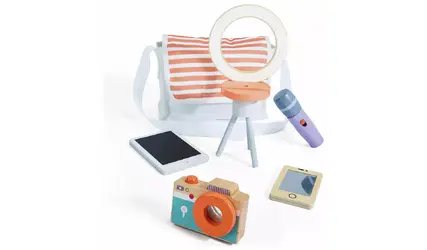
ArticleArchive The toy includes a tripod stand, a miniature camera with an adjustable aperture lens, a smartphone model, a tablet, and a microphone. Photograph: argos.co.uk
Argos has ignited a debate among parents and child development campaigners after promoting a wooden “influencer kit” aimed at toddlers.
Critics have warned that the play set could normalise the precarious world of digital labour and prematurely expose children to the pressures of online visibility.
The toy, designed for children aged two and over, is made entirely from wood and includes a tripod stand, a miniature camera with an adjustable aperture lens, a smartphone model, a tablet, and a microphone. All the items can be stored in a carrying pouch.
Argos currently advertises the £15 product on its website as a tool designed to “cultivate children’s storytelling skills and creativity through career role-play”.
However, the decision to position the potential of social media stardom on the same level as more traditional role-play has drawn criticism from advocacy groups. Daisy Greenwell, Englishwoman
Daisy Greenwell, co-founder and director of the advocacy group Smartphone Free Childhood, said: “The best play is about real life – mud kitchens, toy ovens, doctor kits – children copying the world around them and making sense of it.”
She added: “There’s something a bit off about dressing up a very adult, very performative world as a wholesome wooden toy. Influencing is all about chasing attention, so we have to ask what we’re teaching children to value, if that’s the world we’re inviting them to copy.”
The brand Rini has previously been heavily criticised for marketing cosmetic face masks specifically to young children, a move dermatologists described as dystopian, warning that the beauty industry is now expanding its reach from teenagers to toddlers.
Dr Francis Rees, an expert in childhood and digital culture from the University of Essex, said: “While it may be tempting to dismiss this as simply another example of questionable children’s toys, I think it’s more useful to see it as part of a broader shift in how childhood is being imagined.”
She said: “Toys have long reflected adult roles, with doctor sets, kitchens, and toolkits being normal parts of growing up. With ‘influencer’ now ranking highest in surveys of children’s future career aspirations, this product is not entirely surprising.”
However, Rees warned that influencer culture was not just another profession to be mimicked. “It is built around visibility, performance, and the monetisation of everyday life,” she noted. “What toys like this normalise is the idea that children are not only participants in play, but also potential objects of attention, as individuals who are watched, followed, and engaged with as ‘content’.”
According to Rees, whose research focuses on digital risks, this increased normalisation of visibility can expose children to significant dangers concerning privacy, digital permanence, and identity formation – concerns directly reflected in the Unicef Industry Toolkit on Children’s Rights and Digital Marketing. “So, while this toy may well function as imaginative play, it also reflects a wider cultural moment in which forms of highly visible, and often precarious, digital labour are becoming normalised from an early age,” Rees said.
“The question is not simply whether children should play at being influencers, but what kinds of risks we are comfortable with taking in the process, and what career expectations we are preparing them for.”
An Argos spokesperson said: “We offer a broad selection of toy sets that encourage imaginative and creative play. This product is part of that wider range, which includes items such as our Chad Valley Tool Box, Wooden Toaster and Pizza Counter sets, designed to help children have fun.”
Quoting part of the article about the children's skin masque that the link above references:
Actor Shay Mitchell, who has 35.2 million followers and is famous for her role in the American mystery teen drama series Pretty Little Liars, has released a hydrogel skincare mask for children, saying it was “inspired” by her daughters. She said she wanted to create something “fun, gentle and safe”.
Teenage girls’ TikTok skincare regimes offer little to no benefit, research shows
The co-founders of Rini, who include Esther Song and Matte Babel, describe the brand as “where skincare meets play”, with a mission to nurture “healthy habits, spark confidence, and make thoughtfully crafted daily care essentials and play products accessible to every family”.
However, the trend has met a backlash from dermatologists and commenters online. Dr Emma Wedgeworth, consultant dermatologist at 55 Harley Street, central London, described it as “ridiculous”. She said: “I think these products are completely unnecessary. When we look at what we put on children’s skin, we must weigh up benefits and risks, and in this case there are no real benefits, yet we expose children to unnecessary risks.
“It’s important that we set a good example for young people in how to maintain healthy skin, without drawing too much attention to appearance or creating scrutiny around how their skin looks. At this age, skincare should be purely functional: gentle cleansing, moisturising if the skin is dry and sun protection. A melting cleanser or fragranced products do not support the skin barrier in any meaningful way.”
‘Kardashian children are sharing skincare routines’: experts on gen Z’s ageing fixation
She added that very young children are naturally unselfconscious, and “we don’t want to encourage them to focus on appearance or create anxiety about how their skin looks”. She said children’s skin is more sensitive, “and exposing them to multiple unnecessary chemicals increases the risk of irritation and sensitisation later on”.
This - and the "influencer kit" - are clearly both meant as an attempt towards normalizing the type of image-first mentality that drives people to think of themselves and their bodies as commodities rather than vessels to be respected, along the same lines as marketing thong underwear to children.
Critics have warned that the play set could normalise the precarious world of digital labour and prematurely expose children to the pressures of online visibility.
"Influencer" is really just newspeak for "celebrity".
But obviously saying that you want to be a celebrity when you grow up would be laughed at.
I remember 15 years ago when everyone suddenly wanted to be an "entrepreneur", which really was just a new way to say that they wanted to be rich fast without having a real career.
Everybody who is upset at this is retarded. All the toys in this set wouldn't make a fuss if marketed individually. The kid isn't going to look at it and think "influencer" they are going to play with them like any toy. Pretend to take pictures with their camera, sing into the microphone, or play on the tablet or phone mimicing their parents. I don't see how buying this toyset will lead to your kid growing up wanting to livestream their taint online.
The "image-first mentality" has already been normalized. Young girls go on the online and watch "skincare routines" for whores and want to do it. The "skincare for children" garbage is meant to capture that market and sell allegedly harmless shit to parents of these girls, so that instead of botulism, they might only get a rash or blotches.
This shit shouldn't exist because "influencers" should be brutally and publicly executed en-masse after brief show trials. Then kids can go back to having acceptable dream jobs like:
Astronaut
Train driver
Fighter pilot
Shopkeeper
Contract killer
Fireman
Nurse
My worry is that momfluencers and family vloggers would use it to groom their kids into thinking it's normal and okay to be in their "content" before they know wtf is going on. Fortunately it's less popular as a genre now but it's still creepy. Though that's a problem with the parents rather than the toy itself.
Matte Babel (Archive)
- Canadian
- Mulatto/Quadroon, likely Greek extraction, birth name Matt Alexandros Babel
- Confirmed Christian
The popular Canadian TV personality, Matte Babel took birth to his parents on Monday, October 13, 1980, in Toronto, Ontario, Canada. According to the sources, his real birth name is ‘Matt Alexandros Babel’. He belongs to the Christian religion.
Esther Song (Archive)
- "Jewrean" maybe???
- Esther is an incredibly common Jewish name, while sometimes used by Christians it is less popular.
- Song is 100% Korean and surprisingly there's multiple Esther Songs out there, however, this one is the only Esther Song with a beak like that.
- Dilution of Korean blood in this manner greatly displeases General Secretary Kim