“Space is a very cold place!” -
is this true?
In many scifi movies, space is mentioned as being very cold, a freezing environment that will turn you into a crispy icicle quickly.
But is this correct? How warm or cold is outer space?
In order to answer this question, we must gain some clarity on what temperature actually is.
Temperature is a measure of diffuse energy: It is a property of very large ensembles of particles, such as macroscopic bodies with their many many molecules, and tells us what the average energy of the random motions of these particles is. It is not possible to attribute a temperature to a single particle or a small group. By its very definition it always applies to a very large group of particles, quantifying their average energy statistically.
The energy that is stored in the random motions of a large set of particles is called heat. Heat is not the same as temperature, though if the kind of particles is known, it can be calculated from temperature. The heat of a hot body can be converted into macroscopic ordered kinetic energy (such as rotation of a wheel), though only partially. There must always a colder body be present as a heat sink. Part of the heat of the hot body can then be converted into ordered kinetic energy (also called work), another part will be transferred to the colder body. It is in principle impossible to convert heat into work completely.
That’s why all machines (motors, power stations etc.) have heat sinks: Cooling towers, cooling ponds, cooling fins etc.
There is a number of temperature scales. In physics the Kelvin (K) scale is used. It is not defined by any secondary effect, such as expansion of a mercury column, but directly from the maximum amount of work that can be extracted from a body of a certain temperature. It can be shown that there is a temperature point of absolute zero T = 0 K. It is impossible in our universe to achieve lower temperatures - in fact, absoulte zero can be approached only asymptotically, it is not even possible to actually reach it. T = 0 K corresponds to -273.15 degrees centigrade. The step size of the Kelvin scale is arbitrarily choosen to be the same as that of the centigrade scale.
In modern literature, there is no “degree Kelvin”, the unit is just Kelvin (K). This is because it is derived from the basics of thermodynamic theory and not via some secondary effect.
How many Kelvin does outer space have? The first, simplistic answer would be:
none at all! If by “space” we mean an absolute vacuum with no particles of any kind in it, then there wouldn’t be any particles to carry energy, and it wouldn’t make sense to attribute a temperature to it.
But space is not completely empty. It contains a number of different particle types though at very low densities: Photons, molecules, atoms, neutrinos, the not-yet-identified dark matter particles.
Note that the property temperature isn’t limited to baryonic particles, a photon gas has a temperature too (as an average energy can be attributed to the photons).
If we go away from all luminous celestial bodies, into deep space between the galaxies, we would be left with the cosmic background radiation, a diffuse microwave flux left over from the big bang. It has a temperature of 3 K - quite cold!
But as soon as we come near any stars, things get a lot hotter. Supernovas hurl fontains of very thin gas out of galaxies, with a temperature of billions of K! The solar wind streaming away from ordinary stars can still have temperatures ranging from several hundreds of thousands up to millions of K. The dense gas/dust clouds in the galactic plane that make up nebulae are naturally quite colder, the densest and darkest spots where new stars begin to form have only a few K.
But let’s suppose we put some large object, such as a commode or a satellite or an astronaut in space. What will be its/his/her temperature?
It is interesting in this respect to consider that no temperature sensor can actually measure the temperature of its surroundings. It can only measure its own temperature which it acquires by interaction with its surroundings.
The temperature of a body in space is governed by the balance between the radiation it receives and that which it sends out (all bodies radiate away energy, as can be seen from the glow of cigarettes, hot iron in a foundry, the sun and other stars etc.).
So how hot something in space will actually get depends on its material’s properties. If it is a dark object, that is good at absorbing light, it can get pretty hot when subjected to the sun’s radiation in the solar system. The surface of the moon is very hot: around 110 degrees centigrade.
But when in shadow, it will cool down rather severely, as there is no atmosphere to store heat: The night side of the moon has less than -100 degrees centigrade. Quite some temperature extremes on our night sky lamp!
This is why carbon dioxide emissions from burning fossil fuels tend to make the earth hotter: The gas doesn’t change the absorption capabilities of the earth in the visible spectrum, but it lowers the planet’s emissivity in the infrared spectrum! Therefore the same amount of energy is absorbed, but less radiated back to space - ergo, it gets hotter.
NASA spacesuits are internally equipped with a network of tubes through which water of human-friendly temperature is pumped, thus saving the astronaut from getting grilled on his/her side in the sunlight and freezing on the shadow side.
Why doesn’t the very hot solar wind heat up bodies in space? It is just too thin! There are too few particles per volume in it to efficiently transfer energy to bodies. In space, heat transport almost exclusively takes place by radiation.
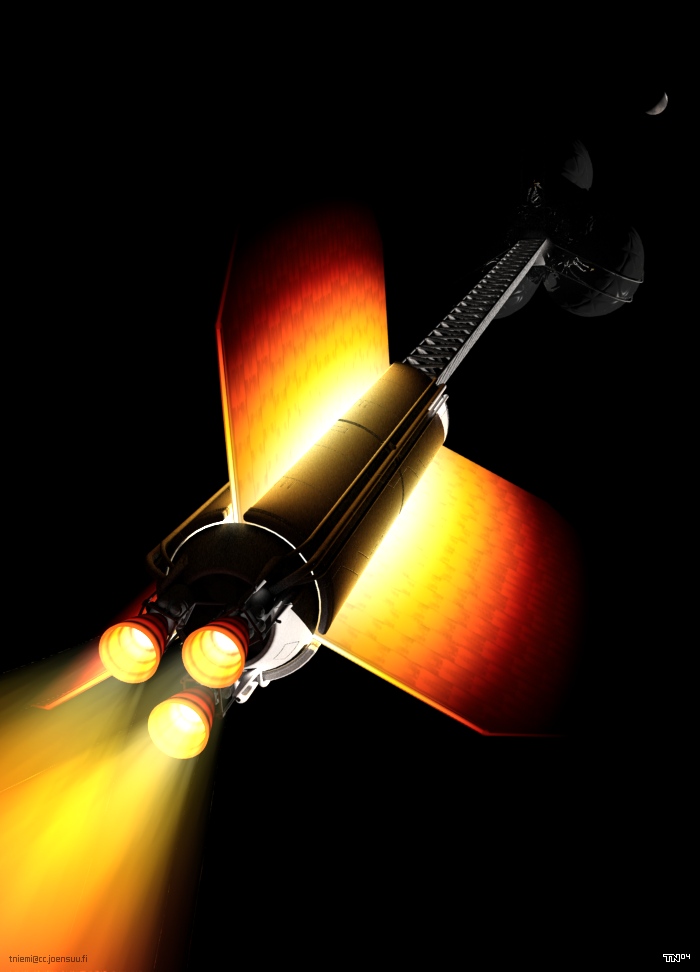
This will be an engineering challenge for future rockets which use nuclear reactors to heat a propellant. They will need some sort of heat sink, but in space you can’t construct a cooling tower! The heat will have to be radiated away. These spaceships will therefore need
big radiators.
The other elementary particle types present in space - neutrinos, dark matter - also have a temperature. Neutrino temperature is very low, a few K. That of dark matter, is, naturally, not yet known for sure. Many scientists suspect there may be several components of dark matter of different temperature - hot dark matter and cold dark matter!
So, will space fry you or freeze you? It depends on where you are in it and on your emission/absorption properties. If you are far away from stars, you will cool down until you are in equilibrium with the background radiation at 3 K. When you are close to a star, in a solar system, you can get rather hot if your optical properties are such that you can absorp sufficient energy - but only on your lit side. The other one which is in the shadow will still cool down to uncomfortably low temperatures (unless you rotate rapidly, then some equilibrium will be reached).
If you want to go into space, make sure to wear one of NASA’s or Roscosmos’s fine isothermal space suits. It will keep you evenly and pleasantly temperated.