https://www.wsj.com/arts-culture/fi...ps-explain-our-conspiracy-minded-era-f9ef6237 (a)

An image from a film released in 1967 that has for decades been held up as evidence of Bigfoot's existence.
Nearly 60 years ago, a cowboy rode on horseback into the Northern California wilderness with a 16mm camera. He returned with a snippet of film documenting one of the most notorious cryptid sightings in history—a fleeting, jittery glimpse of a hairy figure crossing a riverbank.
In the ensuing decades, this Bigfoot film shot in 1967 by Roger Patterson became a piece of Americana shared by skeptics and believers alike. One image—frame 352 showing the figure caught mid-stride, said to be a female creature later dubbed “Patty”—was enshrined in pop culture across bumper stickers and on “The Simpsons.”
Now a new documentary about the Bigfoot film—which many believers still defend as bulletproof evidence—reveals its legacy to be surprisingly raw.
As an X-file from an earlier era, when fringe theories about UFOs, crop circles or the Loch Ness monster were quarantined as tabloid fodder, the lore around the wilderness footage seems quaint by today’s standards. But its long tail also shows that once the Pandora’s box of conspiracy has been opened, it has the power to destroy lives.
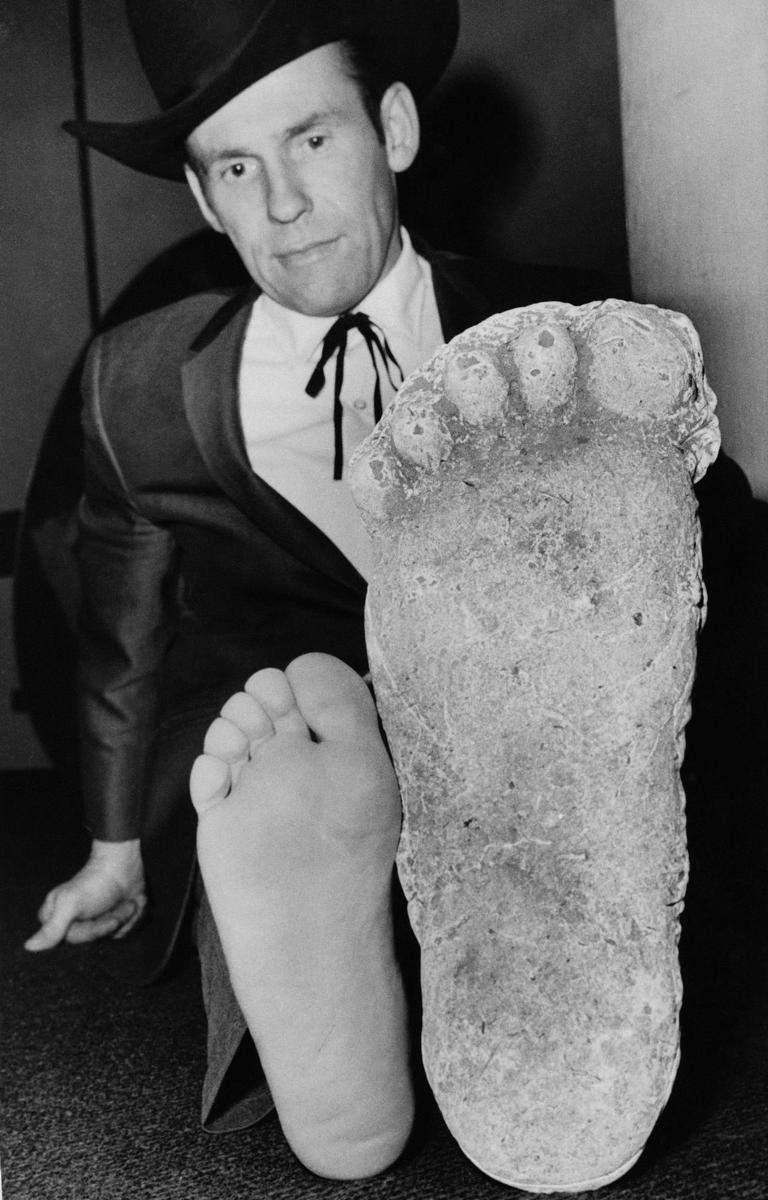
Roger Patterson compares his own foot to a cast he said he made of Bigfoot’s.
The trail of damage from Patterson’s pet project includes money fights, family estrangement and bitter fallouts as friends turned on each other amid efforts to debunk or defend the footage over the years. Beyond that, at a time when internet rumors, disinformation bots and AI-powered deception have made viral conspiracies a daily scourge, the shaky film clip seems like a prequel to the confusion that has engulfed our era and eroded confidence in the very idea of truth.
“Capturing Bigfoot,” premiering this week at the South By Southwest film festival, builds to a big reveal: freshly surfaced film that appears to show a woodsy dress rehearsal for one of the world’s most enduring hoaxes. In the new footage—from a Kodak reel dating to 1966—Patterson’s camera tracks a man in costume, his brother-in-law, moving in a similar fashion to the figure in the 1967 shoot, which featured a different location and a bigger man with a more distinctive stride, according to the documentary.
The test-run footage “is the work of a director with a vision,” says “Capturing Bigfoot” director Marq Evans.
He says the reel was given to him by a colleague at Olympic College in Bremerton, Wash., where Evans runs a documentary film program. The colleague found the film in a safe that belonged to her late father, who worked in a Boeing film lab and could have developed film discreetly.
With the long-buried footage in hand, Evans set out to explore the ripple effects from the Bigfoot film. Patterson, who died in 1972, hailed from the same region of Washington as Evans; the documentarian discovered that the hardscrabble cowboy had also been a gifted craftsman and artist. Patterson illustrated a self-published book, “Do Abominable Snowmen of America Really Exist?”, and set out to make a wildlife movie that would feature the ultimate trophy footage. He and his collaborators inadvertently helped spawn “this massive culture and industry” around the Bigfoot legend, Evans says.
One of the central subjects in “Capturing Bigfoot” is Clint Patterson, Roger’s son, who was 12 when his father died. In the documentary, he recalls a childhood of hero worship, having watched his dad search the mountains for Sasquatch, interview eyewitnesses and discuss his plan to capture one of the creatures—alive—using a tranquilizer gun and a cage.
“He believed that they were out there, 100%, and he was gonna prove that,” Clint said in a recent interview. His father succeeded in a sense: “He built something that, you know, fooled everybody.”
Roger Paterson presented his footage to America in a traveling show that crisscrossed the nation and climaxed with the hyped Bigfoot sequence on screen.
The money poured in, leading to resentment among cohorts who felt they’d been shortchanged, none more so than Bob Gimlin, Patterson’s wingman in the field during the infamous shoot. After years of silence, Gimlin later emerged as a hero to the Bigfoot community, testifying to the film’s veracity at gatherings.
The Patterson-Gimlin film, as it became known, has its own IMDb page (“A short film of what appears to be the first captured footage of Bigfoot”) and has been licensed countless times for programs that revisit the legend. The “Capturing Bigfoot” filmmakers, too, paid a $30,000 licensing fee, Evans says.
Clint Patterson says his mother privately confirmed his suspicions that the family’s claim to fame was bogus, but he kept quiet to protect their financial stream. About 10 years ago, when he first wanted to go public with the truth, his mother disowned him.
That rift is laid bare in the documentary, along with Clint’s hurt over being deceived as a boy. “‘We got one on film,’” Clint says, recalling his dad’s words upon returning from the 1967 expedition, “and when he said it, he turned his head from me and he never looked me in the eye. It’s been a chip on my shoulder.”
Clint Patterson had been planning a book exposé when the “Capturing Bigfoot” team approached him, he says. The documentary includes other notable figures from the Bigfoot community (including the recently deceased Jeffrey Meldrum, who brought scientific discipline to the field) along with their reactions to the newly surfaced footage.
Evans knows his documentary won’t dissuade the true believers. Among their supporting evidence, captured in broad daylight in the Patterson-Gimlin film, are the swinging breasts of the female Bigfoot, limb ratios that aren’t human, rippling muscles and other uncanny anatomy that they say even elite costumers in Hollywood couldn’t pull off in the ’60s.

Bob Gimlin (left), who accompanied Roger Patterson on the infamous 1967 Bigfoot expedition, and Roger’s son, Clint, both appear in the documentary.
The exhaustively analyzed snippet remains “up there among the top three” pieces of recorded evidence of the elusive hominids, says Matt Moneymaker, whose Bigfoot Field Researchers Organization catalogs audio recordings, thermal imagery, eyewitness testimonials and more.
When informed of a documentary presenting a new claim that the Patterson-Gimlin film was faked, Moneymaker dismissed it. “This sort of chicanery has been going on since at least the ’90s,” he says. “The film itself debunks any attempts to debunk it.”
And so the alpha of American legends lives on.
Here it is, stabilized for your viewing pleasure.
An image from a film released in 1967 that has for decades been held up as evidence of Bigfoot's existence.
Nearly 60 years ago, a cowboy rode on horseback into the Northern California wilderness with a 16mm camera. He returned with a snippet of film documenting one of the most notorious cryptid sightings in history—a fleeting, jittery glimpse of a hairy figure crossing a riverbank.
In the ensuing decades, this Bigfoot film shot in 1967 by Roger Patterson became a piece of Americana shared by skeptics and believers alike. One image—frame 352 showing the figure caught mid-stride, said to be a female creature later dubbed “Patty”—was enshrined in pop culture across bumper stickers and on “The Simpsons.”
Now a new documentary about the Bigfoot film—which many believers still defend as bulletproof evidence—reveals its legacy to be surprisingly raw.
As an X-file from an earlier era, when fringe theories about UFOs, crop circles or the Loch Ness monster were quarantined as tabloid fodder, the lore around the wilderness footage seems quaint by today’s standards. But its long tail also shows that once the Pandora’s box of conspiracy has been opened, it has the power to destroy lives.
Roger Patterson compares his own foot to a cast he said he made of Bigfoot’s.
The trail of damage from Patterson’s pet project includes money fights, family estrangement and bitter fallouts as friends turned on each other amid efforts to debunk or defend the footage over the years. Beyond that, at a time when internet rumors, disinformation bots and AI-powered deception have made viral conspiracies a daily scourge, the shaky film clip seems like a prequel to the confusion that has engulfed our era and eroded confidence in the very idea of truth.
“Capturing Bigfoot,” premiering this week at the South By Southwest film festival, builds to a big reveal: freshly surfaced film that appears to show a woodsy dress rehearsal for one of the world’s most enduring hoaxes. In the new footage—from a Kodak reel dating to 1966—Patterson’s camera tracks a man in costume, his brother-in-law, moving in a similar fashion to the figure in the 1967 shoot, which featured a different location and a bigger man with a more distinctive stride, according to the documentary.
The test-run footage “is the work of a director with a vision,” says “Capturing Bigfoot” director Marq Evans.
He says the reel was given to him by a colleague at Olympic College in Bremerton, Wash., where Evans runs a documentary film program. The colleague found the film in a safe that belonged to her late father, who worked in a Boeing film lab and could have developed film discreetly.
With the long-buried footage in hand, Evans set out to explore the ripple effects from the Bigfoot film. Patterson, who died in 1972, hailed from the same region of Washington as Evans; the documentarian discovered that the hardscrabble cowboy had also been a gifted craftsman and artist. Patterson illustrated a self-published book, “Do Abominable Snowmen of America Really Exist?”, and set out to make a wildlife movie that would feature the ultimate trophy footage. He and his collaborators inadvertently helped spawn “this massive culture and industry” around the Bigfoot legend, Evans says.
One of the central subjects in “Capturing Bigfoot” is Clint Patterson, Roger’s son, who was 12 when his father died. In the documentary, he recalls a childhood of hero worship, having watched his dad search the mountains for Sasquatch, interview eyewitnesses and discuss his plan to capture one of the creatures—alive—using a tranquilizer gun and a cage.
“He believed that they were out there, 100%, and he was gonna prove that,” Clint said in a recent interview. His father succeeded in a sense: “He built something that, you know, fooled everybody.”
Roger Paterson presented his footage to America in a traveling show that crisscrossed the nation and climaxed with the hyped Bigfoot sequence on screen.
The money poured in, leading to resentment among cohorts who felt they’d been shortchanged, none more so than Bob Gimlin, Patterson’s wingman in the field during the infamous shoot. After years of silence, Gimlin later emerged as a hero to the Bigfoot community, testifying to the film’s veracity at gatherings.
The Patterson-Gimlin film, as it became known, has its own IMDb page (“A short film of what appears to be the first captured footage of Bigfoot”) and has been licensed countless times for programs that revisit the legend. The “Capturing Bigfoot” filmmakers, too, paid a $30,000 licensing fee, Evans says.
Clint Patterson says his mother privately confirmed his suspicions that the family’s claim to fame was bogus, but he kept quiet to protect their financial stream. About 10 years ago, when he first wanted to go public with the truth, his mother disowned him.
That rift is laid bare in the documentary, along with Clint’s hurt over being deceived as a boy. “‘We got one on film,’” Clint says, recalling his dad’s words upon returning from the 1967 expedition, “and when he said it, he turned his head from me and he never looked me in the eye. It’s been a chip on my shoulder.”
Clint Patterson had been planning a book exposé when the “Capturing Bigfoot” team approached him, he says. The documentary includes other notable figures from the Bigfoot community (including the recently deceased Jeffrey Meldrum, who brought scientific discipline to the field) along with their reactions to the newly surfaced footage.
Evans knows his documentary won’t dissuade the true believers. Among their supporting evidence, captured in broad daylight in the Patterson-Gimlin film, are the swinging breasts of the female Bigfoot, limb ratios that aren’t human, rippling muscles and other uncanny anatomy that they say even elite costumers in Hollywood couldn’t pull off in the ’60s.
Bob Gimlin (left), who accompanied Roger Patterson on the infamous 1967 Bigfoot expedition, and Roger’s son, Clint, both appear in the documentary.
The exhaustively analyzed snippet remains “up there among the top three” pieces of recorded evidence of the elusive hominids, says Matt Moneymaker, whose Bigfoot Field Researchers Organization catalogs audio recordings, thermal imagery, eyewitness testimonials and more.
When informed of a documentary presenting a new claim that the Patterson-Gimlin film was faked, Moneymaker dismissed it. “This sort of chicanery has been going on since at least the ’90s,” he says. “The film itself debunks any attempts to debunk it.”
And so the alpha of American legends lives on.
Here it is, stabilized for your viewing pleasure.


