Science 1 in 7 scientific papers is fake, suggests study - that author calls ‘wildly nonsystematic’

Article (Archive)
cropped-Heathers_James_linderpix-NEU-52067-high-res-1024x614.jpg
James Heathers
In 2009, a now highly-cited study found an average of around 2% of scientists admit to have falsified, fabricated, or modified data at least once in their career.

Fifteen years on, a new analysis tried to quantify how much science is fake – but the real number may remain elusive, some observers said.

The analysis, published before peer review on the Open Science Framework on September 24, found one in seven scientific papers may be at least partly fake. The author, James Heathers, a long-standing scientific sleuth, arrived at that figure by averaging data from 12 existing studies — collectively containing a sample of around 75,000 studies — that estimate the volume of problematic scientific output.

“I have been reading for years and still continue to read this 2% figure which is ubiquitous,” Heathers, an affiliated researcher in psychology at Linnaeus University in Vaxjo, Sweden, said. “The only minor problem with it is that it’s 20 years out of date,” he added, noting that the last dataset that went into the 2009 study was from 2005.

So Heathers tried to come up with a more up-to-date estimate of scholarly literature containing signs of irregularities. “A lot has changed in 20 years,” he said. “It’s been a persistent irritant to me for a period of years now to see this figure cited over and over and over again.”

Past studies predominantly focussed on asking researchers directly if they had engaged in dishonest research practices, Heathers said, “which I think is a very bad approach to being able to do this.” But he noted that it was probably the only method available to use when the research was conducted.

“I think it’s pretty naive to ask people who are faking research whether or not they’ll honestly answer the question that they were dishonest previously,” Heathers said.

Heathers’ study pulls data from 12 different analyses from the social sciences, medicine, biology, and other fields of research. All those studies have one thing in common: The authors of each used various online tools to estimate the amount of fakery taking place in a set of papers.

“There’s a really persistent commonality to them,” Heathers said. “The rough approximation for where we end up is that one in seven research papers are fake.”

Heathers said he decided to conduct his study as a meta-analysis because his figures are “far flung.”

“They are a little bit from everywhere; it’s wildly nonsystematic as a piece of work,” he said.

Daniele Fanelli, a metascientist at Heriot-Watt University in Edinburgh, Scotland who authored the 2009 study, is not convinced by the new analysis. “Metascience research is sometimes not metascientific,” he says, arguing that the study falsely labels studies with some problem as definitely being a fake and incorrectly lumps together different studies measuring different phenomena.

“The papers are all different, they’re all over the place in highlighting all sorts of different problems in all sorts of different contexts using all sorts of different methods,” Fanelli says. “That’s not a rigorous way to get an estimate of anything.”

Fanelli said the study will draw unnecessary negative media attention: “It’s not the kind of attention that science either deserves or will benefit from.”

“I don’t think it’s entirely wrong but I think that it can be slightly misleading,” said Gowri Gopalakrishna, an epidemiologist at the Maastricht University in the Netherlands who co-authored a 2021 study that found 8% of researchers in a survey of nearly 7,000 scientists in the Netherlands confessed to falsifying or fabricating data at least once between 2017 and 2020.

Gopalakrishna said fabrication and falsification may be more prevalent in some fields than others so grouping them together may not be helpful. “If you want to get the attention of the government and try to shake things up, putting them all together and saying look how big the problem is probably useful in that way but I really do think that it’s important to drill down,” she said.

Heathers acknowledged those limitations but argued that he had to conduct the analysis with the data that exist. “If we waited for the resources necessary to be able to do really big systematic treatments of a problem like this within a specific area, I think we’d be waiting far too long,” he said. “This is crucially underfunded.”

Heathers said he decided to pursue coming up with a figure for the average percentage of fakery in science because few such estimates are available. “Even if you do something that’s an incredibly systematic review in a very formal sense, I strongly suspect you’ll get the same estimate that I’ve got,” he said.
 
Its been like this forever. Corporations use their money to influence scientific studies to support what they want. And then use their money to kill or discredit papers that is actual science but goes against the corporation. See cigarettes, seed oils, corn, sugar. the list goes on.
 
I was about to ask if there could be, maybe a branch of government that funds private research groups (like grants) specifically for replication purposes would be a better way to review studies. I think we're on the same trolley either way.
The way I’d do it is that the first year of your PhD is spent learning lab techniques, attending basic courses on statistics and analysis and theory, coming up with a prospective project for yourself and you must try to replicate a piece in your field. Doesn’t matter if you can or can’t get it to work, only that you meticulously follow their method and publish your results. This would:
1. Stop malicious spamming of ‘it’s shit/great’ because it’s tied to a real life group.
2. Teach students how to be skeptical
3. Encourage methods sections to be better and more detailed, because you’d then have an incentive to make sure others can replicate your work.
4. Allow students to do a mini project, possibly in conjuring others for larger pieces, where they learn but there’s no danger of going down a blind alley for their own project.
I’d have some kind of system where there’s open publication, and each time the work is replicated, there’s some kind of metric to ‘fade’ or reinforce the worth of it. So if you publish something, and twenty people can’t replicate it, you have some confidence it’s crap. If others can, it solidifies.
 
2. Teach students how to be skeptical
3. Encourage methods sections to be better and more detailed, because you’d then have an incentive to make sure others can replicate your work.
This sort of critical thinking should really be taught in undergrad, but definitely in grad school. One of my professors would deliberately give us papers to present about in seminar that looked alright from a distance, if you had a surface level knowledge of the subject, but were deeply flawed in their execution or rigor or whatever. We then had to break down the problems, the sus way they were presented, and ways to improve the experimental design, data visualization, etc. Great professor, still on my Christmas card list. These were all from well-regarded, peer reviewed journals with impact scores greater than 5 as well, not pay-to-play journals. It really drove home the need to analyze a paper rather than skimming it for keywords.

As to the method sections, if the info could at least go in the supplemental info, that would be helpful too. Instead, I've tried to replicate instrumental parameters which are actually impossible as written and wondered how the reviewers missed something so obvious. Realistically speaking, all the journal cartels like ACS or Elsevier care about are whether or not your university is contracted with them and then they'll publish any drek you piss out. (Am I bitter? YES.)

ETA: Never forget
t bars.png
 
Última edición:
There was a massive scandal in the neurology sphere back in 2022 when a neuroscientist discovered that the research paper the medical field had cited thousands of times and was using as a foundation for understanding how Alzheimer’s develops was actually doctored up and fraudulent, basically undoing 16 years of research into cures for the disease. Makes you wonder how often this is actually happening.
What pisses me off is that despite this big reveal, my retarded neuroprofessor still shills for it. I complained that the NIH was still wasting money on this plaque shit when 1. there have been countless studies that showed rat models with huge amounts of amyloid b plaques don't have any signs of cognitive issues but rats without many still develop them. Much like in real life where most people have some amyloid b plaques without signs of dementia, and 2. a study recently came out showing that it wasn't the formation of insoluble plaques that caused dementia symptoms but the lack of soluble amyloid b that did. It makes me livid the NIH is still funding insoluble plaque research DESPITE IT ALL BEING BASED ON FRADULENT RESULTS.

He was like "they must know there's something worthwhile there to keep funding it" shut the FUCK UP you probably believe trannies belong in sports too
 
One of my professors would deliberately give us papers to present about in seminar that looked alright from a distance, if you had a surface level knowledge of the subject, but were deeply flawed in their execution or rigor or whatever.
I had one of those too. I guess slight PL, but it really really bothered me that basically nobody actually keyed in on what he was doing. This was a major specific course, but still nobody bothered to read the papers other than basically skimming it to have 1 or 2 things to say when their turn came up, if even that. I hate people that do that kind of thing, and the system doesn't punish them at all. In fact they end up better off because instead of spending time reading a paper they can use that time to study for some other class (also doing the bare minimum). Of course just skimming the papers also plays into the general public's perception that if something is in a published research paper (moreover one that a professor is having you read as course material) then it must be absolutely true.
I recall one specific paper, can't remember the title or journal of course though. The premise though was that a site in China, somewhere near the Terracotta Army if I recall, was claiming to have found evidence of really really early and basic stone tools in China. I mean like suspiciously early. Of course if you actually read into the paper and also did your own digging you could tell that the site was at the bottom of a really big and rocky hill. Basically what you were supposed to get out of it was that these weren't stone tools at all, just rocks randomly tumbling down the hill and smashing into each other. Of course the Chinese archaeologists claimed these were stone tools, though they obviously should have known better. The idea was to teach that just because something looks like a tool, it doesn't mean it is, and that just because something is in a published paper, you shouldn't just take it as gospel.
 
Category 2 is a huge problem. The usual p value in my line of work is 0.05, which means that even if honestly done, one in twenty papers would be false. We have a replication crisis.
That's a gross underestimation because it assumes an equal proportion of false and true hypothesis in a field and that all null results, true or otherwise, are published. Using some reasonable numbers (90% of hypothesis in a field being wrong, p = 0.05, a statistical power of 80% and 10%-30% of published literature being null results), Veritasium calculated that roughly a third of papers are wrong even if the system is working as intended. Add some p-hacking, wrong methodologies, publish and perish, sketchy datasets and political biases and you get the modern day scientific landscape.
 
Then you have the loonies, like those that mistake pseudofossils for real organisms and make up crackpot theories about there being huge mushrooms rainforests on earth during the Cambrian-Ordovician (before mosses even appeared), but somehow still publish very professional-looking papers that a lot of people fall for. Get fucked Retallack wtf is this
Don't you dare destroy my hope that Morrowind was real at some point. I'll be very sad.
 
What do you mean fake? Their foreheads had to be that big to accommodate all the info the Archangel Michael was directly beaming into their frontal lobes.

I love my BogdanBots!
I'd never besmerch their legacy, it was probably a trick on academia. After all they:
-Rothschilds bow to Bogdanoffs
-In contact with aliens
-Possess psychic-like abilities
-Control france with an iron but fair fist
-Own castles & banks globally
-Direct descendants of the ancient royal blood line
-Will bankroll the first cities on Mars (Bogdangrad will be be the first city)
-Own 99% of DNA editing research facilities on Earth
-First designer babies will in all likelihood be Bogdanoff babies
-both brothers said to have 215+ IQ, such intelligence on Earth has only existed deep in Tibetan monasteries & Area 51
-Ancient Indian scriptures tell of two angels who will descend upon Earth and will bring an era of enlightenment and unprecedented technological progress with them
-They own Nanobot R&D labs around the world
-You likely have Bogdabots inside you right now
-The Bogdanoffs are in regular communication with the Archangels Michael and Gabriel, forwarding the word of God to the Orthodox Church. Who do you think set up the meeting between the pope & the Orthodox high command (First meeting between the two organisations in over 1000 years) and arranged the Orthodox leader's first trip to Antarctica in history literally a few days later to the Bogdanoff bunker in Wilkes land?
-They learned fluent French in under a week
-Nation states entrust their gold reserves with the twins. There's no gold in Ft. Knox, only Ft. Bogdanoff
-The twins are about 7 decades old, from the space-time reference point of the base human currently accepted by our society
-In reality, they are timeless beings existing in all points of time and space from the big bang to the end of the universe. We don't know their ultimate plans yet. We hope they're benevolent beings.
 
I know of a person who pushes the idea that science should be considered more social (as "historical" versus hypothesis testing). This person was asking a group of researchers about their definitions of science. One person in the group mentioned that a consensus must be reached (via peer review), to which I countered with Semmelweis and how his idea of surgeons washing their hands was rejected by the vast majority of academia - he later died in disgrace. I could have mentioned Alfred Wegener who was correct about the continents moving apart - the only thing he couldn't accurately explain was how - he also died in disgrace in a polar expedition in 1930. Today, there are scientists who present evidence contrary to "popular thought" and they are run through the mud. Either way, the person running the discussion seemed to get incredibly upset that I mentioned Semmelweis and a counter to the idea that science must be socially acceptable and adherent to popular social consensus.

A controversial topic that can destroy your reputation is the Kensington Runestone - detailed geological analysis of the walls of the runes shows the same degree of weathering as on the exterior of the runestone, and analysis of the tree roots (along with repeated tries to replicate planting a tree on top of a similar rock which have all failed) shows that a tree would have to grow around the Runestone to replicate those marks. Analysis of the runes themselves revealed that (then) modern linguists and rune experts didn't realize the runes were real - some were (re-)discovered in the years after the discovery of the Runestone. I asked an archaeologist who specialized in arrowheads about Alice Kehoe and her understanding of the Runestone, and the archaeologist replied with the idea that Alice Kehoe, although brilliant in other areas, was insane to think the Runestone was real.

I just wanted to say that, even though there's a "scientitifc consensus" on a topic, that "consensus" may just be based on bullshit (or money). This is still the funniest fucking meme and the truest one involving certain scientists:
1727542735890.png

There's also a huge issue with people not digging back to the earliest cited example of a concept or method. Most papers will only cite papers from the past thirty years (if that). They won't look at a referenced paper in another paper to make sure that paper is accurate or out-of-date.

I once had a paper sent back for adjustment. Not rejected, just ‘fix this figure.’ The problem was that the western blot was a bit wobbly, but clear enough, the figure showed plainly what I asserted it did. Sometimes blots get a bit wonky with impurity in the gel for example.
They told me basically to use photoshop on it to increase the contrast. I refused, and sent them the twenty or so replications I’d done, all of which showed the same thing and they picked a different shot of it. But it was an eye opener, a small thing for sure but the journal basically telling me to shoop the figures. Wish I’d kept the emails tbh.

Peer review is a crap way to do it. They should publish everything and then have some kind of metric whereby the number of replications or failure to replicate fades/pushes it in terms of reputation.
"Jesus fucking Christ" to the first part, and yes to the last. This can be applied to theoretical models too (i.e. paleontology) if the data used for those models are produced and the origins for those data are explained.
I don't find that surprising. If anything it seems low. I still remember this ecology teacher I had bragging about how his thesis was pretty much just made up bullshit and his models didn't match reality so he just decided to fuck around with the data he was feeding the model until he got.the results he wanted. This was after.3 years of being taught to rigorously follow the scientific method.
I hate that people have been encouraged to cheapen their chosen disciplines with bullshit.

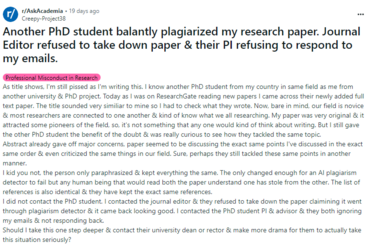
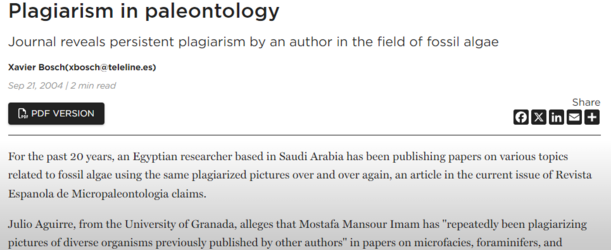
1727544730886.png1727544766230.png
1727544840459.png1727544933567.png
1727544974124.png1727545093636.png

1727545144789.png1727545357407.png1727545528026.png1727545254418.png1727545301186.png

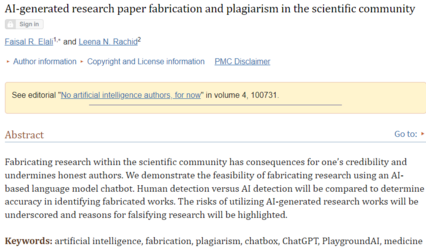
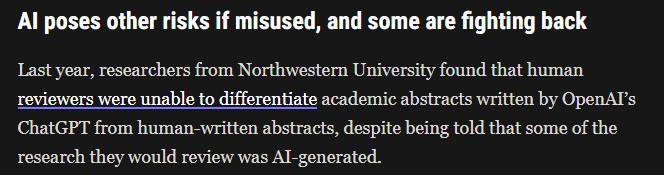
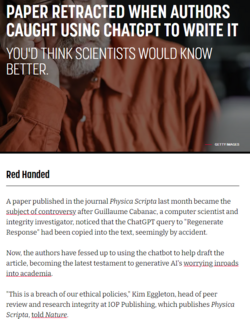
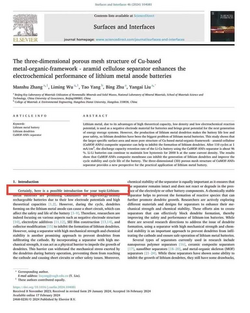
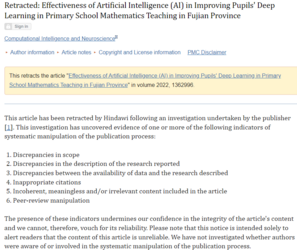
Here's a paper on AI retracted likely because of AI: 1727545201054.png
Another paper retracted because the authors were a little too cozy with the reviewers: 1727545431590.png

tl;dr The main problems with science are that: 1) scientists can be clique-y or strongly loyal to the funding, 2) no one reads anymore, and 3) no one wants to do the work or no one knows how to do the work.
 
Última edición:
I’d never heard of this. If it’s real or not I have no idea but Europeans definitely were in the new world very early. L’anse aux meadows is well over a thousand years old, and there are carvings of new world plants in Rosslyn chapel which dates from 1450s.
You'd be shocked at how many archaeologists and experts in runes and languages virulently loathe anyone who talks about the Kensington Runestone.

Here's a book about Alice Kehoe's take on the Runestone: https://www.waveland.com/browse.php?t=117&pgtitle=Alice Beck Kehoe

There's a book out there wherein a dendrologist took it upon himself to wrestle the roots of young and older trees to wrap around stones like the Runestone. He couldn't do it - he concluded that the tree had to grow around the stone over several years.

I read a geologist's take (that it's a fake) on the weathering of the Runestone - he compared New England's weathering rate of limestone tombstones to Minnesota's weathering rate of greywacke (the material that comprises the Runestone), and he claimed that the greywacke hadn't weathered as much as the limestone. This is the most illogical point I've read against the Runestone being real: included here are annual precipitation rates betweeen two eastern states versus Minnesota.
1727549501435.png
Not to mention that limestone weathers away much more easily than greywacke since greywacke is made of sandstone which is physically and chemically much more resistant. Rainwater tends to be more acidic in the eastern US as compared to Minnesota as well: 1727549801606.png

So yes, limestone gravestones in the eastern US would weather more readily wih more acidic rainwater than greywacke (read: quartz) stones in Minnesota. This is not evidence to suggest that the greywacke Runestone is younger than those gravestones. Especially if the Runestone was buried after a while.

People like to talk about how the runes are fake, but they never managed to explain how an illiterate farmer (Olaf Ohman) knew about one rune (discovered by researchers in the 1930s - way after the Runestone) that was only found on a church in Gotland, Sweden.
 
Atrás
Top Abajo