Tony’s home, parents
Tony is born in Manhattan in 1977 (Johnson 1994: 29).
I propose that Tony is born on November 13th, based on intertextual evidence, but will discuss my reasoning in a future installment.
I assume Anthony is his birth name, though we are right to treat every statement made by Tony with suspicion.
Tony’s publisher acknowledges that names were changed for publication, to protect the privacy of people featured in the memoir, as well as to protect Tony from his alleged stalkers (a point we shall return to).
In an essay about his experience with Tony (to be discussed further), memoirist Paul Monette acknowledges these alterations extend to locations as well (Monette 1994: 235).
Tony’s middle name appears to have "originally" been Robert.
In August 1991, Anthony Robert Johnson writes a fan letter to Paul Monette, singing off "Your friend, Tony" (Friend 2001: 88 | UCLA Paul Monette Collection
link).
His middle name Godby references his friend and counselor Jack L. Godby, who writes the introduction for the memoir.
His original surname is unknown, as
Johnson is the name of his adoptive parents.
Tony grows up on the Upper West Side of Manhattan.
He cites his home as a 4-room, 10th floor apartment on W. 85th St. S. (Johnson 1994: 36).
Given the area, it’s likely the floor plan looked much like this:

The difference would be that Tony places his parents’ bedroom at the front of the apartment rather than in the back (Johnson 1994: 37).
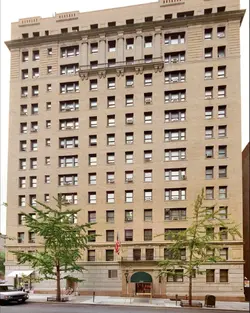
For context, here are two examples of apartment buildings that (roughly) match Tony's (generic) description/location:

In an essay published in 1997, 4 years after the memoir, Tony instead places the family’s apartment on the 9th floor.
In the memoir, Tony claims his father is a civil servant but makes no mention of his mother’s employment (Johnson 1994: 33).
Tony later specifies that his father is a police officer with the NYPD (Friend 2001: 95).
In a
USA Today article during the lead-up to the memoir’s publication, it’s suggested both parents work “middle-class jobs” (Painter 1993: 2D).
Sue Vice states Tony’s parents are “well-to-do” (2014: 44).
There is nothing in the memoir to directly support this claim, though it may follow from subsequent statements by Tony.
It may also simply be this particular neighborhood or the Upper West Side generally.
By the time Tony is in elementary school, at least one neighboring apartment building is “going co-op” (Johnson 1994: 92).
Tony later claims that his parents are Jewish (Friend 2001: 94).
In the memoir, however, Tony makes no mention of the family being Jewish as either a religious or (secular) cultural identity.
Tony describes himself as blond-haired, blue-eyed, “All-American” (Johnson 1994: 74).
Both in the memoir and in the later 1997 essay, Tony uses this self-descriptor to contrast his appearance with others, whether his Blatino best friend David or his peers at his initial elementary school.
While not impossible, it also forms an interesting contrast with later claims of Jewish ethnicity, as well as with pictures of Tony (rather, Steve Tarabokija) sent to admirers.
The description also crops up in initial reviews, emphasizing the shocking nature of Tony’s experiences
(that could have been YOUR child!)
Tony cites relentless physical, emotional, and sexual abuse by his parents and their associates.
Tony says he is forced to sleep on the floor in a “closet-sized back bedroom” and that his clothes are “usually the throwaways of other tenants” (Johnson 1994: 36).
He is not permitted on the furniture, expected to keep the home clean, and fed only intermittently, food being treated as a privilege to be earned, with the father’s goal being to “make a man out of [Tony]” or failing that, to “kill [him]” (Johnson 1994: 37).
He is routinely beaten, which eventually result sin “54 unhealed bones,” discovered when Tony is X-rayed after his rescue (Johnson 1994: 57).
Even Tony’s basic health needs are neglected, with his toothbrush provided only due to a giveaway from the school as part of a dental-care program (Johnson 1994: 37).
Winter clothing comes, again, from items left behind by former tenants or, later, the efforts of his best friend David (Johnson 1994: 33).
Tony cites two main sources of relief during this period.
The first is Fred Rogers’ program
Mr. Rogers’ Neighborhood. Tony describes Rogers’ emphasis on the value of the individual as a vital counterpoint to his parents’ claims of Tony’s inherent worthlessness (Johnson 1994: 44-45).
Rogers later writes the afterword for Tony’s memoir, praising Tony’s “unselfish love” (Johnson 1994: 304).
The second source of relief is reading, despite his father’s assertion that “only sissies read” (36) and that Tony is a “faggot” for enjoying reading (Johnson 1994: 162).
Early intervention
At age 5, while in kindergarten, Tony is sent to speech therapy to correct a stutter and a lisp.
The therapist recommends Tony be placed in a “special” education program, believing the impediments beyond correction and presumably reflecting a delayed intellect (Johnson 1994: 138).
(NB: Later, Tony claims to have been unable to articulate “the sounds for
l and
r” (Johnson 1997). He makes no mention of a lisp.)
Interestingly, Tony does not note the lisp as stereotype of the homosexual male.
I note this due to Tony’s repeated assertions of his father’s virulent homophobia.
Tony claims to then enter a period of muteness, following his father’s assertion (as well as a beating) that if Tony is unable to speak correctly, he “shouldn’t talk at all” (138).
Following intervention from a caring principal, Tony improves his speech over the course of 6 months and is promoted to first grade, due to his advanced reading and writing skills (Johnson 1994: 139).
There is however something suspicious about Tony’s claim.
In the 1997 essay, Tony describes his experience in first grade.
Here, his speech impediments have not been corrected. There is no mention of Tony’s having been in speech therapy nor of a caring principal, nor of his having been promoted.
He cites his teacher as Mrs. Feeney. In the memoir, she is Mrs. McNeil (Johnson 1994: 43), though their characterization is otherwise the same.
(There is also the possibility that Tony continues to anonymize people from his life, for his own security.)
The bigger issue comes with Tony’s claim that his speech improves over six months and that he is advanced to the first grade.
If we follow the implication that Tony is promoted following his improvement (which would contradict the 1997 essay), Tony would be entering first grade three-quarters of the way through the school year, which seems unlikely.
On the other hand, if we treat the two events - speech therapy and promotion - as distinct, then it’s possible Tony advances to the first grade while continuing to correct his speech.
Per his own words, he is promoted based on his reading and writing abilities.
As for the principal, Tony claims he is subsequently fired for being HIV-positive (per the gossips, due to having “gotten mixed up in ‘the wrong lifestyle’”) and dies alone “in a hospice, with a priest reading prayers to him” (Johnson 1994: 140).
(One wonders how Tony would know of the principal's last days; presumably, he overheard additional gossip.)
We’ll see a very consistent pattern in Tony’s narrative, wherein Tony introduces people who provide him with some important life lesson (e.g., empathy, the joy of reading, compassion), and upon providing the lesson are dispensed with - often through death.
Tony’s principal, having served his narrative function, is removed to hospice.
A male teacher, who introduces Tony to the pleasures of 19th C. literature, is similarly dispensed with.
In this case, fired when his homosexuality is discovered (Johnson 1994: 162-163).
By the time he's writing the memoir, Tony has lost two friends - including his best friend - to overdoses.
A mutual friend sinks into a depressive torpor and turns to cocaine for comfort.
Another classmate is institutionalized.
Several classmates prostitute themselves in Times Square, or sell drugs, whether for necessities or luxuries.
Another friend ends up homeless in the subways, with one leg amputated by the time Tony randomly encounters him.
Each time, however, Tony is able to learn some lesson from a peer's example: to be hopeful without being naive, to be clear-eyed without being cynical.
Above all, to
survive.
These lessons make up most of the memoir, though are neglected in favor of Tony's relationship with his parents, both biological and adoptive.
(These stories also highlight the challenge of Tony's timeline, so I'm weaving them into the narrative.)
Tony provides some internal evidence of where his elementary school is located.
He claims the school is eight blocks from the family’s apartment on W. 85th St. S (35):

This raises the interesting question of why he was not attending, say, PS 009 Sarah Anderson, located a block over on W. 84th St. S.:

En route to his elementary school, he passes an apartment where his friend Zeke lives, one block south on W. 84th St. S. (Johnson 1994: 89).
That is, the same block as PS 009 Sarah Anderson.
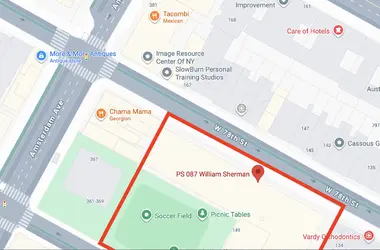
It’s possible then that Tony’s purported elementary school is PS 087 William Sherman, located on W. 78th:
For 4th grade - likely Fall 1985 - Tony transfers to a progressive school for “gifted” students where he remains enrolled until running away from home in late 1989 (Johnson 1994: 63, 74).
He identifies his advanced school as being across the street from a “special-ed facility… [for] students with problems ranging from Down’s syndrome to cerebral palsy” (Johnson 1994: 171).
As
Newsweek observes, however, during an initial investigation into Tony’s memoir, “No school in Manhattan could be found to match that description” (Newsweek 21 June 1993: 14).
In response, Tony's mentor Paul Monette - cited above - claims that locations were changed to protect Tony’s privacy, along with names (1994: 235).
(This does, of course, raise the troubling question of how much may be altered before a memoir ceases to be non-fiction...)
While Tony’s academic life is flourishing, however, his home life is rapidly deteriorating.
Jake
Around 1986, at age 8, Tony’s mother “pimps” him out to a family friend.
It is unclear whether this is the first time Tony is trafficked, though Tony describes trafficking as “not very unusual in their circle of acquaintances… [trading] one another’s children around to participate in bizarre rituals” (Johnson 1994: 40).
Tony never qualifies these “bizarre rituals.”
It is important to note though that Tony’s memoir comes during the waning years of the Satanic Panic.
Figures like Lawrence Pazder and his patient/muse (later wife) Michelle Smith asserted that Satanic cults were targeting children for use in physically and sexually abusive rituals.
Given Tony’s later claim of Jewish heritage, there is also perhaps a touch of blood libel to the narrative.
On this occasion in 1986, Tony is at least given the veneer of volition, though.
Following a showing of
The Muppet Movie at his school, Tony’s mother finds him humming “The Rainbow Connection” and offers to purchase a cassette recording for him, provided he “do something for her,” which is “allow her friend Jake” to rape him (Johnson 1994: 40).
Tony suggests his father is present during the assault, the two men “doubled over with laughter” RE: Tony’s injured body after the assault (Johnson 1994: 168).
Alternatively –
not that it’s better – the two may have simply laughed about the incident at some point afterwards, as part of a broader pattern of sex-based humiliation.
Tony does, however, assert having been sexually abused by his father, “sexual activity between two or more men, or between men and young boys [being] quite common” among the group, despite the men involved being otherwise robustly homophobic (Johnson 1994: 161-162).
Nor is there much affection
within the group.
Tony claims that several weeks after the encounter, the group jokes about Jake having AIDS (Johnson 1994: 64).
At some point later, his parents find themselves laughing again, as Jake does eventually die of AIDS (Karsten 1997).
Following his own diagnosis, Tony suspects that he was infected with HIV by Jake during one of their “sessions” (Johnson 1994: 64).
The day after Tony’s rape, his mother denies having promised to purchase the cassette tape, and to do as he is told, when instructed to do so, without question (Johnson 1994: 41).
And he is beaten, of course.
Tony later claims that his trafficking becomes routine, Tony being purchased “for an hour at a time, sometimes two, sometimes for a night” (
About Us).
Which is not to say Jake is the
only purchaser.
Tony later claims also that other men in the group were police officers like his father, which contributes to the danger of him being “outed.”
To the trafficking ring he also adds singer Sammy Davis, Jr. and then-NYC mayor Ed Koch (Friend 2001: 91—92).
Escape
By late 1989, Tony – now 11 – finds his situation untenable (Johnson 1994: 265).
Following another beating, Tony resolves to kill himself by “walking in front of a bus… stepping off into the subway tracks… or cutting his wrists” (Johnson 1994: 45-46).
Tony subsequently describes the experience (along with his experiences with trafficking) in the 1997 television special
About Us: The Dignity of Children:
Disembarking from a subway car, he resolves to throw himself in front of the next train as it arrives.
Instead, he calls a “nationwide hotline,” the result of which leads to his rescue (Johnson 1994: 46).
(Suicidal ideation is a running theme throughout the memoir, with Tony learning to manage it.)
According to Tony, he calls the “crisis” line from a phone booth at the corner of 85th St. and Amsterdam Ave. (Johnson 1994: 47).
Later, this number is described explicitly as a suicide prevention hotline (Painter 1993: 2D).
The man provides Tony with phone numbers for area resources, and the one he calls puts him in touch with Vicki.
Journalist Tad Friend claims the number Tony is given to call is for a “child-welfare service in Manhattan” (2001: 90).
The memoir makes no claim of Vicki’s relationship with the hotline, simply that hers is “a referral number” (Johnson 1994: 48).
At a coffee shop on 54th and Broadway, Vicki convinces Tony that he needs immediate medical attention, and he allows her to take him to the hospital (Johnson 1994: (48-51),
Thus, Tony is led to immediate safety, which turns out to be permanent when Vicki - along with her new husband - adopt Tony.