https://mic.com/articles/180888/eri...te-harassment-abuse-gaming-culture#.vEhG2v9C7
“There are very few female developers who are public figures nowadays, especially in key creative roles like lead designer, and there are also very few female reviewers in any venue where they are being heard rather than just ‘seen.' Whereas when I started working in this business, it was not so rare to see women as designers and as powerful reviewers. The question in my mind is, what changed, and why?” — Writer Arinn Dembo, 2010
Jade Raymond was, in some sense, the first casualty.
As producer of Ubisoft's Assassin’s Creed, Raymond seemed omnipresent in 2007. Creed marked the beginning of an exciting new gaming franchise with a woman in its driver’s seat, and the industry became obsessed with both. Then a comic circulated on the infamous forum SomethingAwful, a haven of internet and gamer culture at the time, that depicted Raymond in a series of degrading, pornographic situations.
A dream, or maybe just a delusion, died in that moment. Looking back, you can see it happen in MTV's 2007 interview with designer Brenda Romero (formerly Brathwaite), during which she learns mid-conversation about the Raymond comic. Up to that point, she's upbeat about the treatment of women in the industry, which she calls “a fairly liberal, hip place” wherein gender is mostly irrelevant.
After hearing Raymond's story, Romero is clearly shaken. She starts to recall the many, smaller instances of gamer culture's mistreatment of women. She starts to watch her words, self-conscious that her comments could spark “some sort of horrible comic.” Romero has been active in games longer than most other women in the public eye (she started on Wizardry in 1981), but here she encounters something new. Later, she pauses to add, “I'm still really shocked by that comic. That's still just amazing.”
That December, Wired’s Earnest Cavalli verbalized the feelings of many in the industry. “I’d like to think the internet isn’t comprised almost entirely of 14-year-old misanthropes,” he wrote, “but based on the unmentionable events surrounding [Assassin’s Creed], I could be wrong.”
Inventing the internet
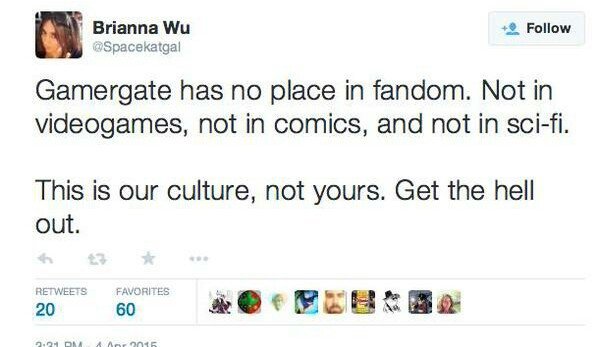
In the aftermath of Gamergate — a coordinated harassment campaign disguised as a crusade for “ethics in gaming journalism” — it’s tempting to see the treatment of Jade Raymond, and that of so many women since, as the industry's norm. Maybe women were never welcome in gaming. Maybe being visible always meant being in danger.
The start of this problem is more recent than you might imagine.
Today, most people probably aren’t familiar with Old Man Murray, a gaming and humor website that ran from 1997 to 2002. Its writers and founders may ring a bell, though, as the creative minds behind some of the industry's most critically acclaimed games. Erik Wolpaw was a writer for Psychonauts, Portal 1, and Portal 2. Chet Faliszek was a writer on Left 4 Dead and Portal 1-2. Together, they “invented the internet,” as Scott Pilgrim author Bryan Lee O’Malley put it.
His statement comes from a 2011 feature in UK-based gaming blog Rock, Paper, Shotgun about Old Man Murray. Senior editor John Walker brought together a who's-who list of industry luminaries in praise of Wolpaw's and Faliszek's work. Gabe Newell, co-founder and president of video game developer and distributor the Valve corporation, compares the duo to the Velvet Underground. Author and journalist Kieron Gillen notes that “anyone in a generation of writers worth giving a fuck about worshipped them.” That's only the beginning. Everyone present respects them, and most agree that Old Man Murray (or, more commonly, OMM) helped create the caustic, sarcastic, irreverent soul of gamer and internet culture.
From this praise, OMM may sound like just another Penny Arcade, the long-running (and controversial) gamer comic by Jerry Holkins and Mike Krahulik. That isn’t exactly accurate. For example, in 2000, Erik Wolpaw wrote this for the site:
"Weeks and weeks ago — just after the first photos of me hit the internet thanks to famous state and federal job retraining candidate Paul Steed — a concerned female reader wrote in and declared, 'I thought you'd be better looking.' Of course, my sympathies go out to her, her family, the men who pay her for sexand her smelly dried-up fucking abortion vent."
That line was standard fare for Wolpaw and Faliszek, whose brand of “comedy” was horrendous misbehavior thinly veiled as irony — a tactic now commonly associated with the fever swamps of 4chan, Gamergate and the alt-right.
Old Man Murray popularized the anything-goes nihilism of internet culture, as several in the Rock, Paper, Shotgun piece attest. Search the site's archives, which are still live, and you’ll find a sea of “ironic” Nazi humor (“this way to the gas chamber, retardeds!”), porn, wild-eyed anarchism, disability jokes (like creating a flashing webpage for “the little epileptic Japanese boy or girl inside us all”), racial slurs “I’m Chet and this is my partner and 4-life nigga erik”) and cracks about child abuse. None of this even scratches the surface. Look for yourself, if you're curious.
Of it all, though, the “ironic” misogyny is perhaps most startling. Upon learning in 1999 that Stevie Case, the famous cyberathlete, would be doing a Playboyshoot, Wolpaw (around 32 years old at the time) offered this suggestion:
"Since Stevie's obviously aware that 'Playboy' is primarily a masturbation tool for men, I hope she won't feel any less empowered when I respectfully request she include a few shots of her ass. And if she could make sure that her ass is glistening with sweat or water from a hose, that would be great."
After a string of paragraphs more obscene than this one, Wolpaw included a pornographic image with Case's face digitally edited onto it.
Online anarchists
Old Man Murray’s influence is a rare link between ourselves and the internet of the 1990s.
Wolpaw and Faliszek were idolized by SomethingAwful, 4chan and the other dark reaches of the web. As Joel Johnson of Kotaku put it in 2011, the duo's “willful, ironic troglodytism was aped by internet idiots for years, but without the brilliance.” (Where or what the brilliance was remains a mystery.)
Through OMM and its notorious offshoot shock site Portal of Evil (which Faliszek managed until 2011, and which can be seen as the template for later ridicule boards like /r/fatpeoplehate), the pair pioneered internet shock-jockery, reveling in and spreading the most disgusting, heinous content possible. Under the guise of irony, they built an online culture that would later, without any involvement from them, produce the Raymond comic at SomethingAwful — an echo of OMM’s own “satirical” abuse of Stevie Case and others.
In Twitter's plague of frog-avatar trolls, and even in popular YouTube bigotry artists like JonTron, we can see this culture continuing today. The goal has always been offense. Those offended are simply “too sensitive,” and any attempt made to improve the discourse is “censorship.”
And yet, in all my research for this article and all my years online, I have never come across anyone who hated Old Man Murray. In gaming, it is the most sacred of sacred cows, the still-beating heart of the industry's culture. Many of its fans are today clean-cut and respectable, but OMM remains present as background noise in their work.
In 2016, gaming personality Justin McElroy called OMM the best gaming site of all time. Revered game designer Jonathan Blow has hailed it as the “premier voice for game criticism.” John Walker said in 2011, “Every time I read the archives I’m reminded how poor a job I’m doing, and what it is I should be striving for.” And so on.
The site’s core appeal was its populism. Earlier game journalism, particularly in America, “tended to take a slightly clinical, Consumer Reports approach to reviews,” as writer Shamus Young once put it. This fit uneasily with the informal, aggressive culture slowly beginning to form around more violent games like Quake (1996). Young, echoing many in the Rock, Paper, Shotgun feature, argued that Old Man Murray “more closely reflected how players actually felt” than the so-called professional reviewers had managed.
We have the benefit of hindsight: we know how populism ends. If Walker and the rest are Old Man Murray’s respectable descendants, Gamergate is more akin to the site’s acid reflux. The misanthropic 15-year-olds who devoured Grand Theft Auto III when it launched — that game being an artifact of Old Man Murray (and British lad) culture — are 31 now. The angry, entitled “Chocolate Milk Kids” of the early 2000s are grown adults in 2017.
Such people have spent their lives in a gamer culture rallied and given shape by Old Man Murray, and it contains only two rules: anything goes and nothing matters.
They're forever Internet anarchists, railing to this day against stand-ins for Mom and Dad — and still demanding another hour of Soldier of Fortune 2 or some other blood-soaked shooter.
I reached out to both Faliszek and Wolpaw in preparation for this article. When I asked Faliszek about his take on Old Man Murray’s impact on gamer culture, he responded, “We don’t really talk about it much anymore. It’s a bit of history on its own at this point.” To my follow-up questions — regarding the way his site cut a path for Gamergate, and whether he had come to regret OMM’s influence — he offered no reply. Wolpaw did not respond to requests for comment by press time.
The (better) old days
It’s important to remember that there's a reason Raymond's harassment surprised Brenda Romero in 2007. The culture I've described above was, more than anything, an attack on a pre-existing order within computer games.
In the ’80s and early ’90s, one of the best-known and best-loved game designers was Roberta Williams, creator of King's Quest. The undisputed top critic in gaming was a woman writing under the pseudonym Scorpia. In Britain, Anita Sinclair's company Magnetic Scrolls was a household name; in France, Muriel Tramis rewrote the book on what games could be.
Countless examples exist of women's enormous involvement during this period. Williams and Scorpia and others, many years later, said they’d never faced any kind of discrimination back then: jobs weren't denied to them. There were no pornographic comics about them in circulation. There was no equivalent to Old Man Murray or Gamergate. It wasn’t perfect, but it was better.
At that time, the biggest computer games weren't Call of Duty sequels and other first-person-shooters. They were flight simulators, adventures, strategy titles, roleplaying games and management games. Doritos-and-Dew misogynists — such a familiar sight for us — were unknown to the game industry. Even as violent shooters like Quake and Doom (1993) and their many transgressive offspring began to attract a new crowd, “edgy” titles were vastly outsold by games like Microsoft Flight Simulator and classic adventure puzzle game Myst. Four years after its release in 1993, Myst still beat Quake’s 1997 sales by more than three to one in the United States.
Old Man Murray hated this old order, and the site’s biggest target was (famously) Roberta Williams herself.
In a post that took just 70 words to cross the line from irony into abject cruelty, Wolpaw once called Williams a “pompous fucking bitch” and “the woman who invented human suffering.” He then speculated that she was mentally ill and openly hoped she'd commit suicide. The site gave voice and power to the Quakecrowd, at the time labeled “casual gamers” by many in the old guard. Williams made a similar point in a 1999 interview, and it enraged OMM.
The full details of this older era, and the reasons why it came about, will have to be saved for the follow-up story in this series.
For now, suffice it to say that things were better before the writers of Portal 2inspired Gamergate.