León Krauze
January 9, 2025
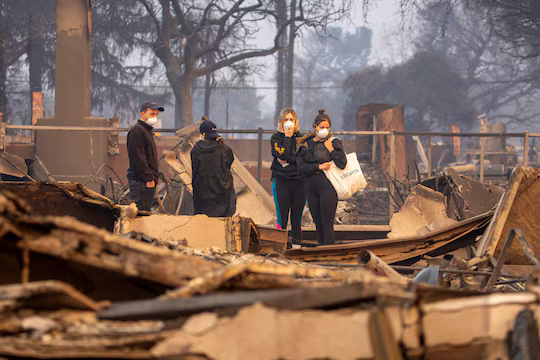
People return to their home after it was burned down by wildfires in Altadena, California, on Thursday. (Ringo Chiu/Reuters)
Watching the fires raze Los Angeles, a city I called home for years, has been devastating. Santa Ana winds, blowing through the mountains at speeds exceeding 80 mph, have caused catastrophic damage. The west side of the city is barely recognizable. The Pacific Coast Highway, one of the most iconic stretches of the American landscape, lies in ruins. The surrounding area, home to the equally renowned Sunset Boulevard — celebrated in countless dreams and a witness to innumerable Californian sunsets — has been reduced to ashes.
The full scale of the devastation will be hard to tally for some time. What is clear, however, is the immense challenge that reconstruction will pose. This wildfire is already among the most destructive in the region’s history. Rebuilding will be a monumental task fraught with uncertainty. Building in Los Angeles is notoriously difficult because of complicated permitting and regulations. The city will have to untangle a bunch of its bureaucratic knots — and quickly.
One thing, however, is certain: the rebuilding of Los Angeles will rely heavily on immigrants.
A significant proportion of the region’s construction workforce consists of immigrants. According to a 2020 report by the American Immigration Council, 43 percent of construction workers in California are immigrants. Among these, a majority are of Mexican origin, reflecting a long history of Mexican labor contributing to the city’s development.
“Immigrants are the engine of construction in Los Angeles,” Santiago Ortiz, a local designer and building consultant told me. “Without immigrants working the most critical trades in the industry, we won’t be able to rebuild what we have lost over the last three days.”
Immigrant labor has already been vital in the recovery of other U.S. cities devastated by natural disasters. For example, after Hurricane Harvey struck Houston in 2017, more than half of the construction workers involved in rebuilding efforts were immigrants. Thousands of undocumented immigrants worked long hours under grueling conditions, often without proper safety protections, and some were even exploited through wage theft. Despite the challenges, immigrants alleviated a labor shortage in Houston, allowing it to recover more rapidly than anticipated.
Similarly, immigrant workers were instrumental in rebuilding Florida after Hurricane Ian hit in 2022. In Southwest Florida, which suffered extensive damage, immigrants made up a large part of the cleanup and construction workforce. Their efforts were particularly significant in areas such as Fort Myers Beach, where entire neighborhoods were leveled. Without immigrant labor, the rebuilding timeline would have been significantly delayed, leaving more residents displaced for longer periods.
Immigrant construction workers are not just vital in emergencies. In California alone, immigrants make up 40 percent of the state’s overall construction workforce. The entire U.S. construction industry depends on their labor year-round. According to the National Association of Home Builders, 31 percent of workers in construction trades nationwide are foreign born. Most plasterers, ceiling tile professionals and most roofers are immigrants. About 23 percent of those workers are undocumented. Almost 40 percent of drywall installers, for example, lacks a permanent legal status in the country.
Immigrants will be the ones bringing Los Angeles back from the ashes. Without them, the city will struggle to recover.
As Trump takes power, vowing to implement punitive immigration policies to vigorously go after the undocumented, it is crucial to acknowledge who truly builds America. It will be a moral failure that as immigrants work to get Southern California back on its feet — cleaning up mountains of debris, erecting wooden beams, installing drywall and wiring electrical systems — they will be doing so under threat of family separation. Their children will be going to school terrified that their parents could disappear at any moment.
As during the covid-19 pandemic, the United States is asking its immigrant workforce to perform essential tasks. The least it can do in return is to grant them peace and security instead of subjecting them to persecution and discrimination.
Source (Archive)
January 9, 2025
People return to their home after it was burned down by wildfires in Altadena, California, on Thursday. (Ringo Chiu/Reuters)
Watching the fires raze Los Angeles, a city I called home for years, has been devastating. Santa Ana winds, blowing through the mountains at speeds exceeding 80 mph, have caused catastrophic damage. The west side of the city is barely recognizable. The Pacific Coast Highway, one of the most iconic stretches of the American landscape, lies in ruins. The surrounding area, home to the equally renowned Sunset Boulevard — celebrated in countless dreams and a witness to innumerable Californian sunsets — has been reduced to ashes.
The full scale of the devastation will be hard to tally for some time. What is clear, however, is the immense challenge that reconstruction will pose. This wildfire is already among the most destructive in the region’s history. Rebuilding will be a monumental task fraught with uncertainty. Building in Los Angeles is notoriously difficult because of complicated permitting and regulations. The city will have to untangle a bunch of its bureaucratic knots — and quickly.
One thing, however, is certain: the rebuilding of Los Angeles will rely heavily on immigrants.
A significant proportion of the region’s construction workforce consists of immigrants. According to a 2020 report by the American Immigration Council, 43 percent of construction workers in California are immigrants. Among these, a majority are of Mexican origin, reflecting a long history of Mexican labor contributing to the city’s development.
“Immigrants are the engine of construction in Los Angeles,” Santiago Ortiz, a local designer and building consultant told me. “Without immigrants working the most critical trades in the industry, we won’t be able to rebuild what we have lost over the last three days.”
Immigrant labor has already been vital in the recovery of other U.S. cities devastated by natural disasters. For example, after Hurricane Harvey struck Houston in 2017, more than half of the construction workers involved in rebuilding efforts were immigrants. Thousands of undocumented immigrants worked long hours under grueling conditions, often without proper safety protections, and some were even exploited through wage theft. Despite the challenges, immigrants alleviated a labor shortage in Houston, allowing it to recover more rapidly than anticipated.
Similarly, immigrant workers were instrumental in rebuilding Florida after Hurricane Ian hit in 2022. In Southwest Florida, which suffered extensive damage, immigrants made up a large part of the cleanup and construction workforce. Their efforts were particularly significant in areas such as Fort Myers Beach, where entire neighborhoods were leveled. Without immigrant labor, the rebuilding timeline would have been significantly delayed, leaving more residents displaced for longer periods.
Immigrant construction workers are not just vital in emergencies. In California alone, immigrants make up 40 percent of the state’s overall construction workforce. The entire U.S. construction industry depends on their labor year-round. According to the National Association of Home Builders, 31 percent of workers in construction trades nationwide are foreign born. Most plasterers, ceiling tile professionals and most roofers are immigrants. About 23 percent of those workers are undocumented. Almost 40 percent of drywall installers, for example, lacks a permanent legal status in the country.
Immigrants will be the ones bringing Los Angeles back from the ashes. Without them, the city will struggle to recover.
As Trump takes power, vowing to implement punitive immigration policies to vigorously go after the undocumented, it is crucial to acknowledge who truly builds America. It will be a moral failure that as immigrants work to get Southern California back on its feet — cleaning up mountains of debris, erecting wooden beams, installing drywall and wiring electrical systems — they will be doing so under threat of family separation. Their children will be going to school terrified that their parents could disappear at any moment.
As during the covid-19 pandemic, the United States is asking its immigrant workforce to perform essential tasks. The least it can do in return is to grant them peace and security instead of subjecting them to persecution and discrimination.
Source (Archive)


