Navy cancels ship briefings after damning internal report
Politico (archive.ph)
By Paul McLeary, Connor O'Brien, and Lee Hudson
2024-04-07 11:00:00GMT
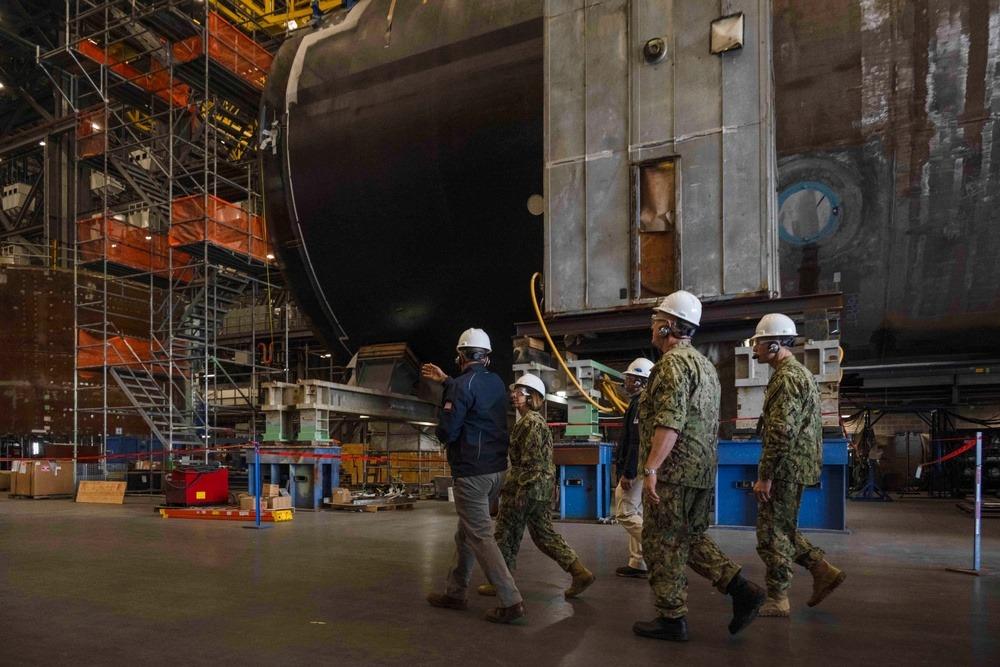
Then-Vice Chief of Naval Operations Adm. Lisa Franchetti meets with leadership from General Dynamics Electric Boat while touring the facility in Quonset Point, Rhode Island, on Oct. 19, 2023. | Amanda R. Gray/U.S. Navy
As the Navy’s largest U.S. trade show gets underway on Monday, officers in charge of the service’s marquee shipbuilding programs won’t offer the usual briefings with reporters and analysts about them.
That break from the tradition of sharing program updates at the Navy’s Sea-Air-Space Exposition comes just days after the Navy announced that four of its most critical shipbuilding programs are years behind schedule.
The Navy’s top admiral and civilian secretary have still not responded to questions about a damning Navy report released Tuesday outlining the sweeping failure of the Navy and its industrial partners to make expected progress on two submarine programs, an aircraft carrier and a new class of frigates.
“Our nation should be incredibly frustrated to see such systemic delays to our marquee shipbuilding programs,” Rep. Rob Wittman, (R-Va.) said.
The delays, from one to three years each depending on the program, come as the Navy and Pentagon pour billions into modernizing and upgrading shipyards in an attempt to build and repair ships more quickly and keep pace with China. Beijing’s navy has already surpassed the U.S. in size.
But supply chain issues caused by Covid and the Navy’s insistence on changing the design of its ships even as workers build them have thrown the service’s plans into uncertainty.
Aware of the issues for years, the Navy is still unsure how to fix them.
“We don’t have detailed plans of action, milestones, initiatives — we are identifying and deeply looking into where we are now in a ‘get real, get better’ approach,” Nickolas Guertin, the Navy’s senior acquisition executive, told reporters at the Pentagon on Tuesday after unveiling the results of the Navy-ordered 45-day study.
“We found that we have issues that need to be resolved,” he said. “But we don’t have all those things completely nailed down yet.”
Usually at the trade show at National Harbor, Maryland, Navy program managers provide updates of their shipbuilding programs, giving industry executives and reporters the opportunity to ask questions about their multibillion-dollar projects.
The briefings cover the Navy’s most important programs — with new classes of submarines and aircraft carriers always being the most critical. Reporters and other analysts use the briefings and interviews with Navy officers running them to chart progress the service is, or isn’t, making in order to get them out to sea.
Two people familiar with the issue say Navy leaders instructed the program managers not to hold their public briefings because the conference came too close to the release of the shipbuilding study, which is already sure to dominate the three-day event.
The list of programs cuts to the very heart of the kind of fleet that the Pentagon says it needs in the Pacific to counter China, and to replace aging ships that are experiencing extended deployments due to the lack of available replacements.
The revelations came in a one-page fact sheet the Navy put together outlining the findings of Navy Secretary Carlos Del Toro’s 45-day shipbuilding study which he ordered in January. Neither Del Toro or the service’s top officer, Adm. Lisa Franchetti, released a statement or commented on the report, which shows a total of 11 years worth of delays across the affected programs.
Two classes of nuclear-powered submarines lead the list of delays, one of which will be the main carrier of the nation’s sea-based nuclear missiles.
That submarine, the first of 12 planned Columbia-class boats built by General Dynamics Electric Boat and HII, is projected to be 12 to 16 months late, pushing it from an original 2027 delivery date to some time in late 2028 or 2029. The Navy has for years called the program its No. 1 priority and has cut budgets in other areas in order to try to keep it on schedule. The Columbia subs will replace the Ohio-class nuclear subs that Department of Defense will start retiring this decade.
Also delayed are two modernized versions of the workhorse Virginia-class submarine, also built by Electric Boat and HII, will be two and three years late, respectively.
The third Gerald R. Ford-class aircraft carrier Enterprise, built by HII, will also be as much as two years late, and the first Constellation-class frigate being built by Fincantieri Marinette Marine is three years behind schedule. That’s a huge slide form the projected one-year delay announced in January.
The delays in so many programs critical to how the U.S. projects power across the globe is virtually unprecedented, and is the result of decades of underinvestment in shipyards and relying on a shrinking number of shipbuilders to build the nation’s fleet.
“The delays we see today across these programs will have real ramifications for our national defense as we seek to deter adversaries like China, Russia and Iran,” said Wittman, whose home state of Virginia includes HII shipyards where the carriers and submarines are built.
Navy and Pentagon leadership point to the Covid supply chain disruptions as one reason for the delays, but there are also self-inflicted wounds that have slowed production.
Case in point is the Navy’s new frigate program, envisioned as a small, fast ship that the Navy would be able to build relatively quickly because it’s based on an Italian design already in use by several European countries.
When the contract was awarded to Fincantieri Marinette Marine in April 2020, the Navy was looking to keep 85 percent of the ship as-is and avoid including too many new technologies, thereby decreasing costs and reducing risk.
But today, the version being built at a shipyard in Wisconsin shares only 15 percent commonality with the original design, according to one person familiar with the planning, and the Navy isn’t done yet. The person, like others in this story, was granted anonymity to discuss changes to the ship design that are not public.
The Navy changed speed and survivability requirements from the original design, according to a second person familiar with the planning.
Speaking with reporters Tuesday at the Pentagon, Vice Adm. James Downey, head of the Naval Sea Systems Command, said the service was still making changes to the design despite the fact that construction on the first ship began in August 2022. “We’re working to finalize [plans] over this year,” he said.
Those constant and continuing changes have led to delays and increased costs. So much has changed, despite the Navy’s promises to keep the process simple, that “it’s like a new hull, we might as well start from scratch,” said Bryan Clark, a retired Navy submarine officer.
“The Navy just keeps larding new requirements on the ships,” said Clark, who is now at the Hudson Institute. “And each new generation is so much more sophisticated than the predecessor that inevitably you’re going to get to the point where you’re just asking too much of the shipbuilding industry to punch out the ships on quick timeliness.”
The delays have caught the eye of Defense Secretary Lloyd Austin.
“The secretary is focused on increasing the capability and capacity of our shipbuilding industrial base,” Pentagon spokesperson Maj. Gen. Pat Ryder said in a statement. “He continues to engage with Navy leadership and with industry to drive solutions that will mitigate scheduling risk and meet our national security requirements.”
Ryder noted the investments the Pentagon is pouring into shipyards to modernize their operations and make sure supply chains are well funded.
The Pentagon has spent billions on modernizing shipyards over the past several years, and $3.4 billion for the submarine industrial base remains mired in the supplemental bill that Republicans continue to block in the House after it passed the Senate.
The news isn’t sitting well with lawmakers who have already criticized Navy plans to grow the fleet as too slow from the start. They’re almost certain to press the issue with Navy brass when they visit Capitol Hill to defend their budget proposal starting this month.
The top Democrat on the House Armed Services Seapower panel, Rep. Joe Courtney, said the review by the Navy “lacks specifics on the source of program delays across all surface and submarine programs, which Congress needs in order to determine the path forward.”
The Connecticut Democrat, whose district is home to the General Dynamics Electric Boat shipyard that builds submarines, also dinged the service for seeking to purchase fewer ships, notably one less attack sub, in its most recent budget.
“Cutting procurement as proposed by the Navy’s 2025 shipbuilding plan arguably compounds [the] delay rather than solves it,” Courtney said.
Christopher Kastner, HII’s president and CEO, told reporters Thursday at his office in Arlington, Virginia, that he agrees funding to buy materials in advance for the Virginia-class submarine must stay on track.
“That can’t be delayed,” he said. A delay “puts you behind the eight ball, and it’s a risk that we can’t deal with.”
He also argues industry needs $1 billion in fiscal 2025 for Virginia-class submarine suppliers.
One of the major impediments to getting the ships done on time has been worker shortages at many of the nation’s shipyards. The Wisconsin yard building the frigate, which also built one of the two versions of the littoral combat ship that have been plagued with mechanical issues, has struggled to find skilled laborers, despite multiple programs to recruit and train welders and other workers.
HII has also had trouble finding skilled workers for its shipbuilding programs, and since 2020, has spent $450 million in training, Kastner said.
While the defense committees may look to add hulls to the Navy’s plans, they’ll be challenged by limits on defense spending imposed by last year’s debt limit deal that will make funding new ships a tough financial trade-off without relief from the caps. Expect lawmakers also to double down mechanisms they’ve granted the Navy in recent years and argue will save money, such as multiyear procurement authority.
Sen. Tim Kaine (D-Va.), who chairs the Senate Armed Services Seapower subcommittee, said the review exposes significant workforce shortfalls. The Virginia Democrat said he’d use upcoming defense legislation to help build up the defense workforce and would push for his bill to expand access to job training programs that could help train more shipbuilding workers.
“I’m committed to ensuring our shipbuilders have the resources and workforce they need to deliver ships to our military in a timely manner,” Kaine said. “This report shows we still have much more to do to get there.”
Politico (archive.ph)
By Paul McLeary, Connor O'Brien, and Lee Hudson
2024-04-07 11:00:00GMT
Then-Vice Chief of Naval Operations Adm. Lisa Franchetti meets with leadership from General Dynamics Electric Boat while touring the facility in Quonset Point, Rhode Island, on Oct. 19, 2023. | Amanda R. Gray/U.S. Navy
As the Navy’s largest U.S. trade show gets underway on Monday, officers in charge of the service’s marquee shipbuilding programs won’t offer the usual briefings with reporters and analysts about them.
That break from the tradition of sharing program updates at the Navy’s Sea-Air-Space Exposition comes just days after the Navy announced that four of its most critical shipbuilding programs are years behind schedule.
The Navy’s top admiral and civilian secretary have still not responded to questions about a damning Navy report released Tuesday outlining the sweeping failure of the Navy and its industrial partners to make expected progress on two submarine programs, an aircraft carrier and a new class of frigates.
“Our nation should be incredibly frustrated to see such systemic delays to our marquee shipbuilding programs,” Rep. Rob Wittman, (R-Va.) said.
The delays, from one to three years each depending on the program, come as the Navy and Pentagon pour billions into modernizing and upgrading shipyards in an attempt to build and repair ships more quickly and keep pace with China. Beijing’s navy has already surpassed the U.S. in size.
But supply chain issues caused by Covid and the Navy’s insistence on changing the design of its ships even as workers build them have thrown the service’s plans into uncertainty.
Aware of the issues for years, the Navy is still unsure how to fix them.
“We don’t have detailed plans of action, milestones, initiatives — we are identifying and deeply looking into where we are now in a ‘get real, get better’ approach,” Nickolas Guertin, the Navy’s senior acquisition executive, told reporters at the Pentagon on Tuesday after unveiling the results of the Navy-ordered 45-day study.
“We found that we have issues that need to be resolved,” he said. “But we don’t have all those things completely nailed down yet.”
Usually at the trade show at National Harbor, Maryland, Navy program managers provide updates of their shipbuilding programs, giving industry executives and reporters the opportunity to ask questions about their multibillion-dollar projects.
The briefings cover the Navy’s most important programs — with new classes of submarines and aircraft carriers always being the most critical. Reporters and other analysts use the briefings and interviews with Navy officers running them to chart progress the service is, or isn’t, making in order to get them out to sea.
Two people familiar with the issue say Navy leaders instructed the program managers not to hold their public briefings because the conference came too close to the release of the shipbuilding study, which is already sure to dominate the three-day event.
The list of programs cuts to the very heart of the kind of fleet that the Pentagon says it needs in the Pacific to counter China, and to replace aging ships that are experiencing extended deployments due to the lack of available replacements.
The revelations came in a one-page fact sheet the Navy put together outlining the findings of Navy Secretary Carlos Del Toro’s 45-day shipbuilding study which he ordered in January. Neither Del Toro or the service’s top officer, Adm. Lisa Franchetti, released a statement or commented on the report, which shows a total of 11 years worth of delays across the affected programs.
Two classes of nuclear-powered submarines lead the list of delays, one of which will be the main carrier of the nation’s sea-based nuclear missiles.
That submarine, the first of 12 planned Columbia-class boats built by General Dynamics Electric Boat and HII, is projected to be 12 to 16 months late, pushing it from an original 2027 delivery date to some time in late 2028 or 2029. The Navy has for years called the program its No. 1 priority and has cut budgets in other areas in order to try to keep it on schedule. The Columbia subs will replace the Ohio-class nuclear subs that Department of Defense will start retiring this decade.
Also delayed are two modernized versions of the workhorse Virginia-class submarine, also built by Electric Boat and HII, will be two and three years late, respectively.
The third Gerald R. Ford-class aircraft carrier Enterprise, built by HII, will also be as much as two years late, and the first Constellation-class frigate being built by Fincantieri Marinette Marine is three years behind schedule. That’s a huge slide form the projected one-year delay announced in January.
The delays in so many programs critical to how the U.S. projects power across the globe is virtually unprecedented, and is the result of decades of underinvestment in shipyards and relying on a shrinking number of shipbuilders to build the nation’s fleet.
“The delays we see today across these programs will have real ramifications for our national defense as we seek to deter adversaries like China, Russia and Iran,” said Wittman, whose home state of Virginia includes HII shipyards where the carriers and submarines are built.
Navy and Pentagon leadership point to the Covid supply chain disruptions as one reason for the delays, but there are also self-inflicted wounds that have slowed production.
Case in point is the Navy’s new frigate program, envisioned as a small, fast ship that the Navy would be able to build relatively quickly because it’s based on an Italian design already in use by several European countries.
When the contract was awarded to Fincantieri Marinette Marine in April 2020, the Navy was looking to keep 85 percent of the ship as-is and avoid including too many new technologies, thereby decreasing costs and reducing risk.
But today, the version being built at a shipyard in Wisconsin shares only 15 percent commonality with the original design, according to one person familiar with the planning, and the Navy isn’t done yet. The person, like others in this story, was granted anonymity to discuss changes to the ship design that are not public.
The Navy changed speed and survivability requirements from the original design, according to a second person familiar with the planning.
Speaking with reporters Tuesday at the Pentagon, Vice Adm. James Downey, head of the Naval Sea Systems Command, said the service was still making changes to the design despite the fact that construction on the first ship began in August 2022. “We’re working to finalize [plans] over this year,” he said.
Those constant and continuing changes have led to delays and increased costs. So much has changed, despite the Navy’s promises to keep the process simple, that “it’s like a new hull, we might as well start from scratch,” said Bryan Clark, a retired Navy submarine officer.
“The Navy just keeps larding new requirements on the ships,” said Clark, who is now at the Hudson Institute. “And each new generation is so much more sophisticated than the predecessor that inevitably you’re going to get to the point where you’re just asking too much of the shipbuilding industry to punch out the ships on quick timeliness.”
The delays have caught the eye of Defense Secretary Lloyd Austin.
“The secretary is focused on increasing the capability and capacity of our shipbuilding industrial base,” Pentagon spokesperson Maj. Gen. Pat Ryder said in a statement. “He continues to engage with Navy leadership and with industry to drive solutions that will mitigate scheduling risk and meet our national security requirements.”
Ryder noted the investments the Pentagon is pouring into shipyards to modernize their operations and make sure supply chains are well funded.
The Pentagon has spent billions on modernizing shipyards over the past several years, and $3.4 billion for the submarine industrial base remains mired in the supplemental bill that Republicans continue to block in the House after it passed the Senate.
The news isn’t sitting well with lawmakers who have already criticized Navy plans to grow the fleet as too slow from the start. They’re almost certain to press the issue with Navy brass when they visit Capitol Hill to defend their budget proposal starting this month.
The top Democrat on the House Armed Services Seapower panel, Rep. Joe Courtney, said the review by the Navy “lacks specifics on the source of program delays across all surface and submarine programs, which Congress needs in order to determine the path forward.”
The Connecticut Democrat, whose district is home to the General Dynamics Electric Boat shipyard that builds submarines, also dinged the service for seeking to purchase fewer ships, notably one less attack sub, in its most recent budget.
“Cutting procurement as proposed by the Navy’s 2025 shipbuilding plan arguably compounds [the] delay rather than solves it,” Courtney said.
Christopher Kastner, HII’s president and CEO, told reporters Thursday at his office in Arlington, Virginia, that he agrees funding to buy materials in advance for the Virginia-class submarine must stay on track.
“That can’t be delayed,” he said. A delay “puts you behind the eight ball, and it’s a risk that we can’t deal with.”
He also argues industry needs $1 billion in fiscal 2025 for Virginia-class submarine suppliers.
One of the major impediments to getting the ships done on time has been worker shortages at many of the nation’s shipyards. The Wisconsin yard building the frigate, which also built one of the two versions of the littoral combat ship that have been plagued with mechanical issues, has struggled to find skilled laborers, despite multiple programs to recruit and train welders and other workers.
HII has also had trouble finding skilled workers for its shipbuilding programs, and since 2020, has spent $450 million in training, Kastner said.
While the defense committees may look to add hulls to the Navy’s plans, they’ll be challenged by limits on defense spending imposed by last year’s debt limit deal that will make funding new ships a tough financial trade-off without relief from the caps. Expect lawmakers also to double down mechanisms they’ve granted the Navy in recent years and argue will save money, such as multiyear procurement authority.
Sen. Tim Kaine (D-Va.), who chairs the Senate Armed Services Seapower subcommittee, said the review exposes significant workforce shortfalls. The Virginia Democrat said he’d use upcoming defense legislation to help build up the defense workforce and would push for his bill to expand access to job training programs that could help train more shipbuilding workers.
“I’m committed to ensuring our shipbuilders have the resources and workforce they need to deliver ships to our military in a timely manner,” Kaine said. “This report shows we still have much more to do to get there.”


