Ham Radio Enthusiasts vs. High-Frequency Traders: A Battle for the Airwaves
The Wall Street Journal (archive.ph)
By Alexander Osipovich
2023-08-05 14:00:00GMT

A shortwave antenna outside Chicago used by a high-frequency trading firm. Jamie Kelter Davis for The Wall Street Journal
Ham radio operators are sounding the alarm over the latest threat to their beloved hobby—and this time, it is coming from Wall Street.
A group of high-frequency trading firms is asking the Federal Communications Commission to open shortwave frequencies to greater commercial use, so they can use radio to zip financial data around the world in milliseconds.
Prominent members of the amateur-radio community say interference from traders’ broadcasts could ruin their hobby, which often involves tuning in to weak radio signals so they can chat with fellow hams in faraway places. Hundreds of hams have filed letters with the FCC opposing the traders’ proposal, and some have railed against the plan in YouTube videos.
Brock Fansler is among those speaking out. A 40-year-old Los Angeles resident with shoulder-length hair, he likes using his radio to send digital data about weather conditions to other hams. He complains that the traders are looking to transmit with up to 20,000 watts of power, whereas amateurs are capped at 1,500 watts, and many use off-the-shelf radios with 100 watts.


Shortwave is useful when HFT firms need to send rapid updates about price moves across oceans. Jaime Kelter Davis for The Wall Street Journal
“They’re asking for an insane amount of power,” Fansler said. “It’s like having neighbors move in with a drum set and guitar. This is going to be blasted all over the planet, with how much wattage they’re going to put behind it.”
The group behind the proposal, called the Shortwave Modernization Coalition, says such fears are overblown. The coalition—whose members include such trading giants as Jump Trading Group, DRW Holdings and Virtu Financial —says it has already been using shortwave for several years and there haven’t been any verified complaints of interference.
“The proposed power limit is consistent with, and in many cases lower than, the levels used in these frequencies set aside for certain commercial uses,” a coalition spokeswoman said.

High-frequency traders have been in a yearslong arms race to execute transactions as fast as possible, or else risk losing money to speedier rivals.
In their quest for speed, HFT firms have located their computers in exchanges’ data centers, to avoid wasting fractions of a second transmitting buy or sell orders over computer cables. They have built arrays of microwave towers between Chicago and New York to beam data between markets, while exploring new kinds of cable and even satellite networks.
Shortwave is useful when HFT firms need to send rapid updates about price moves across oceans—for instance, from U.S. futures markets in Chicago to European futures markets in Frankfurt. The usual way to send data from one continent to another is undersea fiber-optic cable. But light moves more slowly through glass cables than through air, so it is faster to use radio—specifically, in shortwave frequencies. That allows waves to bounce up and down off the ionosphere, an upper layer of the atmosphere, allowing them to propagate around the globe.

FCC filings show this antenna near Chicago is licensed to 10Band, part of a joint venture between Jump Trading Group and Virtu Financial. Photo: Jamie Kelter Davis for The Wall Street Journal
Sending data from Chicago to Frankfurt is nine milliseconds quicker by shortwave than by undersea cable, according to data from Deutsche Börse. That is less time than it takes for a hummingbird to flap its wings.
As ultrafast traders have pushed into shortwave, they have aroused the ire of hams such as Matthew Penttila.
Penttila, a 51-year-old mechanic in Blackstone, Mass., routinely uses shortwave radio to chat with hams in other states and countries. Once he even spoke to a cosmonaut aboard the Mir space station, he recalled.
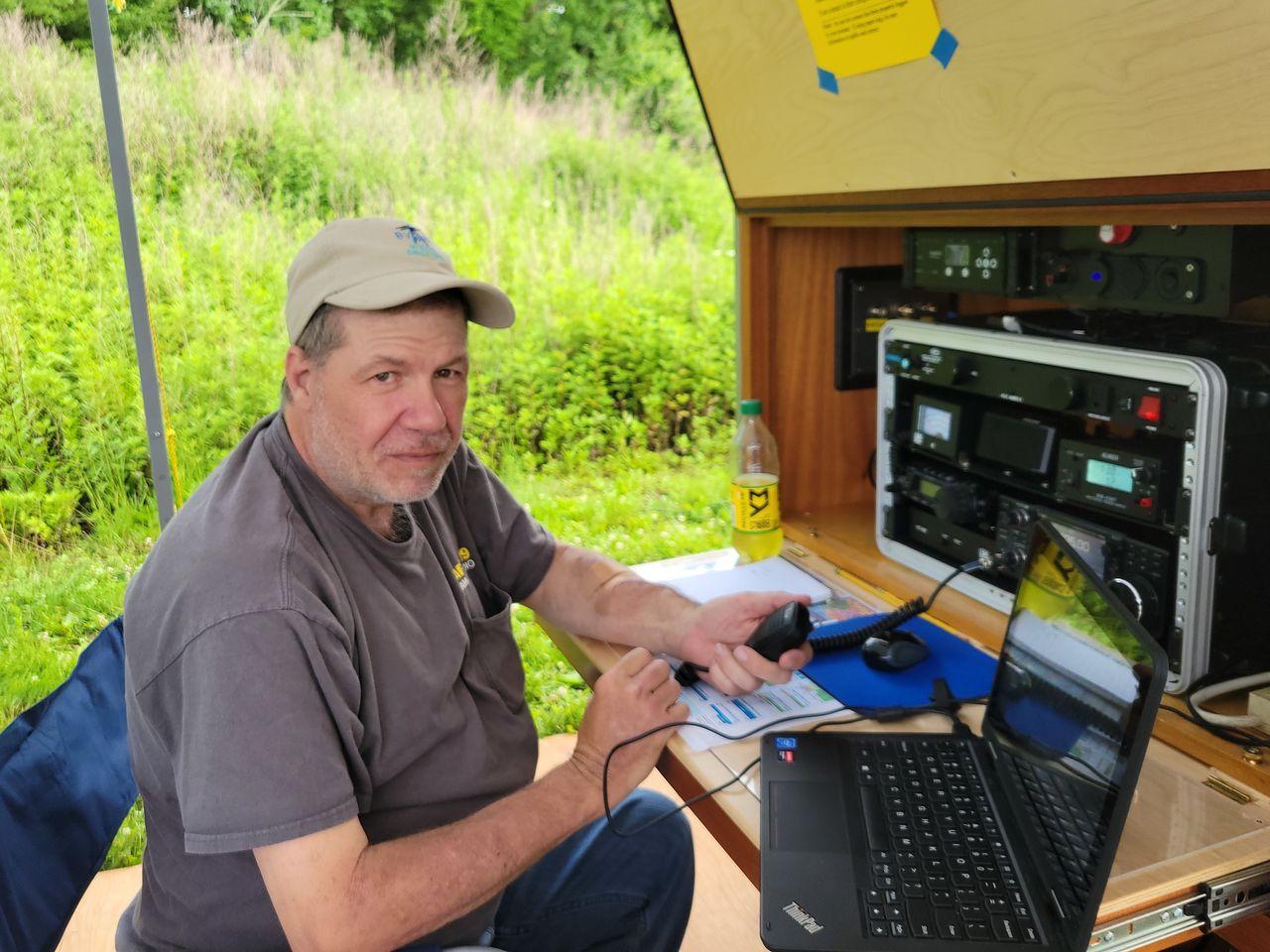
Matthew Penttila uses shortwave radio to chat with ham enthusiasts in other states and countries. Photo: Matthew Penttila
He is indignant that the traders want to use shortwave to save milliseconds and juice their profits.
“I’m just a regular, ordinary guy. I work 2 to 10:30 five days a week to try and keep a roof over my head and food on the table for my family. And these guys are going to try and exploit this for millions and billions of dollars. It just doesn’t seem right,” Penttila said.
If the FCC approves the traders’ petition, Penttila worries it will lead to further encroachment by private firms into bands of the radio spectrum used by amateurs.
“It becomes the camel’s nose under the tent. As soon as it gets its nose under there, it’s going to keep working, and the next thing you know it’s going to take the whole tent down,” he said.
An FCC spokesman said: “We appreciate the importance of amateur radio and make every effort to ensure spectrum uses do not interfere with each other.”
The Shortwave Modernization Coalition says it isn’t looking to grab amateur frequencies. Its petition has a narrower aim: to allow business licenses for the type of fixed, long-distance, point-to-point shortwave data transmissions used by HFT firms. Current FCC rules don’t allow such licenses. Instead, traders have mostly relied on temporary licenses for radio experiments. But experimental licenses generally aren’t intended to be used for commercial activities, and firms that use them for trading are operating in a legal gray area, according to industry veterans.

Leonard Gucciardo says increased interference could render his radio equipment useless. Photo: Leonard Gucciardo
“The big companies have always been nervous that their experimental licenses could get shut down,” said Dave Gustafson, a former head of wireless engineering at Jump.
The roots of ham radio date to the late 19th century. Today there are about 760,000 amateur radio operators in the U.S., according to ARRL, the national association for amateur radio. ARRL says the ham population has climbed in recent years, defying predictions that the internet or social media would kill the hobby’s appeal.
Still, many amateur-radio clubs are dominated by retired men, sparking periodic jitters that there aren’t enough engaged young people to keep the hobby alive.
Leonard Gucciardo, a 62-year-old retired electrical engineer on Long Island, said he worries that traders’ broadcasts could prevent newcomers from embracing ham radio and the financial investment it requires. He estimates that he has spent more than $20,000 on radio equipment and fears that increased interference could render such equipment useless.
“Picture investing $25,000 on equipment, and it becomes a dinosaur that you just can’t use anymore,” he said.
The traders’ proposals have sparked a visceral response from many hams because radio is a way of life, said Rich Donahue, a 62-year-old from South Dakota who spends much of his time on the road in a 22-foot camper, traveling to ham conventions.
“They’re very passionate about their radio communications,” Donahue said. “They get up in the morning, they get a cup of coffee and get on the radio to talk to their friends.”
The Wall Street Journal (archive.ph)
By Alexander Osipovich
2023-08-05 14:00:00GMT
A shortwave antenna outside Chicago used by a high-frequency trading firm. Jamie Kelter Davis for The Wall Street Journal
Ham radio operators are sounding the alarm over the latest threat to their beloved hobby—and this time, it is coming from Wall Street.
A group of high-frequency trading firms is asking the Federal Communications Commission to open shortwave frequencies to greater commercial use, so they can use radio to zip financial data around the world in milliseconds.
Prominent members of the amateur-radio community say interference from traders’ broadcasts could ruin their hobby, which often involves tuning in to weak radio signals so they can chat with fellow hams in faraway places. Hundreds of hams have filed letters with the FCC opposing the traders’ proposal, and some have railed against the plan in YouTube videos.
Brock Fansler is among those speaking out. A 40-year-old Los Angeles resident with shoulder-length hair, he likes using his radio to send digital data about weather conditions to other hams. He complains that the traders are looking to transmit with up to 20,000 watts of power, whereas amateurs are capped at 1,500 watts, and many use off-the-shelf radios with 100 watts.
Shortwave is useful when HFT firms need to send rapid updates about price moves across oceans. Jaime Kelter Davis for The Wall Street Journal
“They’re asking for an insane amount of power,” Fansler said. “It’s like having neighbors move in with a drum set and guitar. This is going to be blasted all over the planet, with how much wattage they’re going to put behind it.”
The group behind the proposal, called the Shortwave Modernization Coalition, says such fears are overblown. The coalition—whose members include such trading giants as Jump Trading Group, DRW Holdings and Virtu Financial —says it has already been using shortwave for several years and there haven’t been any verified complaints of interference.
“The proposed power limit is consistent with, and in many cases lower than, the levels used in these frequencies set aside for certain commercial uses,” a coalition spokeswoman said.
High-frequency traders have been in a yearslong arms race to execute transactions as fast as possible, or else risk losing money to speedier rivals.
In their quest for speed, HFT firms have located their computers in exchanges’ data centers, to avoid wasting fractions of a second transmitting buy or sell orders over computer cables. They have built arrays of microwave towers between Chicago and New York to beam data between markets, while exploring new kinds of cable and even satellite networks.
Shortwave is useful when HFT firms need to send rapid updates about price moves across oceans—for instance, from U.S. futures markets in Chicago to European futures markets in Frankfurt. The usual way to send data from one continent to another is undersea fiber-optic cable. But light moves more slowly through glass cables than through air, so it is faster to use radio—specifically, in shortwave frequencies. That allows waves to bounce up and down off the ionosphere, an upper layer of the atmosphere, allowing them to propagate around the globe.
FCC filings show this antenna near Chicago is licensed to 10Band, part of a joint venture between Jump Trading Group and Virtu Financial. Photo: Jamie Kelter Davis for The Wall Street Journal
Sending data from Chicago to Frankfurt is nine milliseconds quicker by shortwave than by undersea cable, according to data from Deutsche Börse. That is less time than it takes for a hummingbird to flap its wings.
As ultrafast traders have pushed into shortwave, they have aroused the ire of hams such as Matthew Penttila.
Penttila, a 51-year-old mechanic in Blackstone, Mass., routinely uses shortwave radio to chat with hams in other states and countries. Once he even spoke to a cosmonaut aboard the Mir space station, he recalled.
Matthew Penttila uses shortwave radio to chat with ham enthusiasts in other states and countries. Photo: Matthew Penttila
He is indignant that the traders want to use shortwave to save milliseconds and juice their profits.
“I’m just a regular, ordinary guy. I work 2 to 10:30 five days a week to try and keep a roof over my head and food on the table for my family. And these guys are going to try and exploit this for millions and billions of dollars. It just doesn’t seem right,” Penttila said.
If the FCC approves the traders’ petition, Penttila worries it will lead to further encroachment by private firms into bands of the radio spectrum used by amateurs.
“It becomes the camel’s nose under the tent. As soon as it gets its nose under there, it’s going to keep working, and the next thing you know it’s going to take the whole tent down,” he said.
An FCC spokesman said: “We appreciate the importance of amateur radio and make every effort to ensure spectrum uses do not interfere with each other.”
The Shortwave Modernization Coalition says it isn’t looking to grab amateur frequencies. Its petition has a narrower aim: to allow business licenses for the type of fixed, long-distance, point-to-point shortwave data transmissions used by HFT firms. Current FCC rules don’t allow such licenses. Instead, traders have mostly relied on temporary licenses for radio experiments. But experimental licenses generally aren’t intended to be used for commercial activities, and firms that use them for trading are operating in a legal gray area, according to industry veterans.
Leonard Gucciardo says increased interference could render his radio equipment useless. Photo: Leonard Gucciardo
“The big companies have always been nervous that their experimental licenses could get shut down,” said Dave Gustafson, a former head of wireless engineering at Jump.
The roots of ham radio date to the late 19th century. Today there are about 760,000 amateur radio operators in the U.S., according to ARRL, the national association for amateur radio. ARRL says the ham population has climbed in recent years, defying predictions that the internet or social media would kill the hobby’s appeal.
Still, many amateur-radio clubs are dominated by retired men, sparking periodic jitters that there aren’t enough engaged young people to keep the hobby alive.
Leonard Gucciardo, a 62-year-old retired electrical engineer on Long Island, said he worries that traders’ broadcasts could prevent newcomers from embracing ham radio and the financial investment it requires. He estimates that he has spent more than $20,000 on radio equipment and fears that increased interference could render such equipment useless.
“Picture investing $25,000 on equipment, and it becomes a dinosaur that you just can’t use anymore,” he said.
The traders’ proposals have sparked a visceral response from many hams because radio is a way of life, said Rich Donahue, a 62-year-old from South Dakota who spends much of his time on the road in a 22-foot camper, traveling to ham conventions.
“They’re very passionate about their radio communications,” Donahue said. “They get up in the morning, they get a cup of coffee and get on the radio to talk to their friends.”


