From Cosmos Magazine, archive.
6 June 2023 / Evrim Yazgin
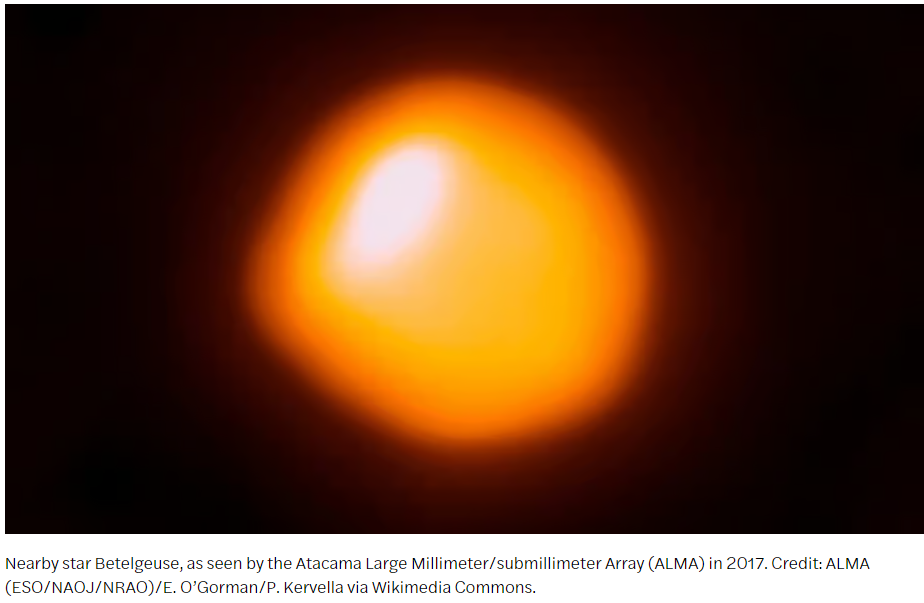
Betelgeuse, the 10th-brightest star in the night sky, is toying with astronomers yet again. This time it has become 50 percent brighter.
The increase in brightness has some speculating whether we’re on the verge of witnessing a Betelgeuse supernova. Thankfully, at about 724 light years from Earth, we would not be adversely affected, yet we would be able to see the awesome flash caused by such an event.
Betelgeuse has been getting darker and brighter in recent years. In 2019, the star dimmed to approximately one-third its normal brightness.
(N.B. Kiwi Farms had an A&N thread on the 2019 "great dimming")
Observations accidentally captured by the Himawari-8 weather satellite suggest the “Great Dimming” was caused by a combination of the star’s cooling and condensation by a nearby dust cloud.
Just a few years later, Betelgeuse is showing that it is not just a one-trick pony.
The red supergiant is the second-brightest star in the Orion constellation. It’s also what is known as a pulsating semiregular variable star. This basically means that its brightness changes on a roughly periodic basis.
Betelgeuse has a 400-day brightness changing cycle. It also has a 125-day cycle, a 230-day cycle, and a 2,200-day cycle.
The star is nearing the end of its life. It’s believed that 8-8.5 million years ago, Betelgeuse left the main sequence of stars and became a red supergiant. This means that the star used up all its hydrogen fuel, fusing it into helium, causing an expansion and cooling of the star.
Now fusing helium into heavier elements like carbon, eventually the star will produce even heavier elements and explode in a supernova.
Some astronomers believe the star is in the latter stages of this process. But how long it has left remains unclear. Even determining where in its evolution Betelgeuse lies is not clear cut and some astronomers suggest that it hasn’t even finished burning its helium.
A study, submitted for peer review, examining the recent increase in the star’s brightness suggests a number of possibilities for the star’s increased visibility. One of them is that Betelgeuse might be going supernova within 10 years. But this isn’t the only possible outcome.
The authors write: “In fact, it is not possible to determine the exact evolutionary stage, because surface conditions hardly change in the late stage close to the carbon exhaustion and beyond.”
Despite the uncertainty around the exact timing, one thing is certain: Betelgeuse will go supernova. Eventually.
And when it does, it will light up the night sky.
The brightest supernova in recorded history, now known as SN 1006, occurred in the year 1006 CE and was visible for months. Some scientists and historians believe that the supernova was so bright that people living over a thousand years ago could read under its light.
Benedictine monks in Switzerland wrote about a star “glittering in aspect and dazzling the eyes, causing alarm.” Egyptian physician and astronomer Ali ibn Ridwan wrote that “the sky was shining” and calculated that the supernova was three times as bright as Venus. Modern astronomers estimate that the star exploded about 7,200 light years from us.
The last supernova to occur in the Milky Way galaxy was recorded by German astronomer Johannes Kepler in 1604. It lasted several weeks. Now known as SN 1604 or “Kepler’s supernova,” and described in Kepler’s book De Stella Nova, the star became brighter than Jupiter and Mars at its brightest.
When Betelgeuse explodes, astronomers believe the supernova may be as bright as the sun.
6 June 2023 / Evrim Yazgin
Betelgeuse, the 10th-brightest star in the night sky, is toying with astronomers yet again. This time it has become 50 percent brighter.
The increase in brightness has some speculating whether we’re on the verge of witnessing a Betelgeuse supernova. Thankfully, at about 724 light years from Earth, we would not be adversely affected, yet we would be able to see the awesome flash caused by such an event.
Betelgeuse has been getting darker and brighter in recent years. In 2019, the star dimmed to approximately one-third its normal brightness.
(N.B. Kiwi Farms had an A&N thread on the 2019 "great dimming")
Observations accidentally captured by the Himawari-8 weather satellite suggest the “Great Dimming” was caused by a combination of the star’s cooling and condensation by a nearby dust cloud.
Just a few years later, Betelgeuse is showing that it is not just a one-trick pony.
The red supergiant is the second-brightest star in the Orion constellation. It’s also what is known as a pulsating semiregular variable star. This basically means that its brightness changes on a roughly periodic basis.
Betelgeuse has a 400-day brightness changing cycle. It also has a 125-day cycle, a 230-day cycle, and a 2,200-day cycle.
The star is nearing the end of its life. It’s believed that 8-8.5 million years ago, Betelgeuse left the main sequence of stars and became a red supergiant. This means that the star used up all its hydrogen fuel, fusing it into helium, causing an expansion and cooling of the star.
Now fusing helium into heavier elements like carbon, eventually the star will produce even heavier elements and explode in a supernova.
Some astronomers believe the star is in the latter stages of this process. But how long it has left remains unclear. Even determining where in its evolution Betelgeuse lies is not clear cut and some astronomers suggest that it hasn’t even finished burning its helium.
A study, submitted for peer review, examining the recent increase in the star’s brightness suggests a number of possibilities for the star’s increased visibility. One of them is that Betelgeuse might be going supernova within 10 years. But this isn’t the only possible outcome.
The authors write: “In fact, it is not possible to determine the exact evolutionary stage, because surface conditions hardly change in the late stage close to the carbon exhaustion and beyond.”
Despite the uncertainty around the exact timing, one thing is certain: Betelgeuse will go supernova. Eventually.
And when it does, it will light up the night sky.
The brightest supernova in recorded history, now known as SN 1006, occurred in the year 1006 CE and was visible for months. Some scientists and historians believe that the supernova was so bright that people living over a thousand years ago could read under its light.
Benedictine monks in Switzerland wrote about a star “glittering in aspect and dazzling the eyes, causing alarm.” Egyptian physician and astronomer Ali ibn Ridwan wrote that “the sky was shining” and calculated that the supernova was three times as bright as Venus. Modern astronomers estimate that the star exploded about 7,200 light years from us.
The last supernova to occur in the Milky Way galaxy was recorded by German astronomer Johannes Kepler in 1604. It lasted several weeks. Now known as SN 1604 or “Kepler’s supernova,” and described in Kepler’s book De Stella Nova, the star became brighter than Jupiter and Mars at its brightest.
When Betelgeuse explodes, astronomers believe the supernova may be as bright as the sun.


