Link (Archive)

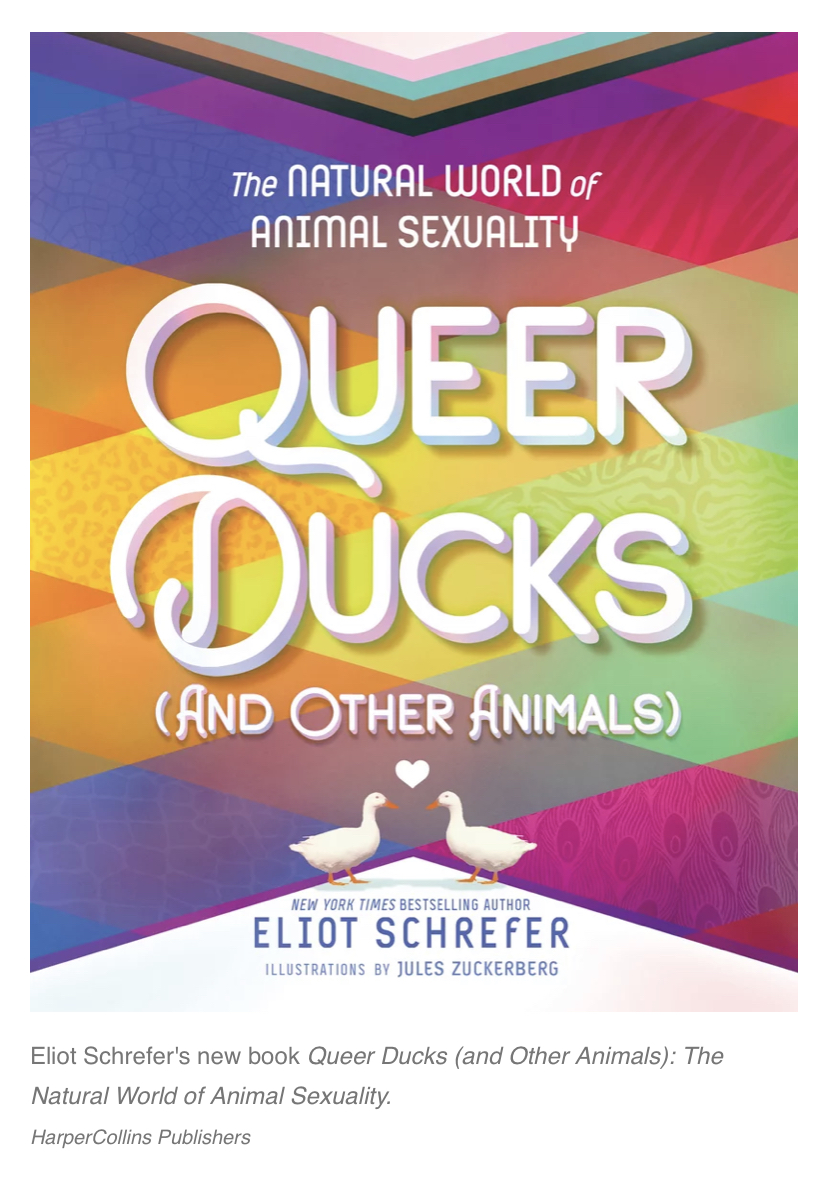
A non-fiction science book about animal sexuality could read like a dry textbook, but that's not the kind of thing that Eliot Schrefer wrote.
Schrefer's book, Queer Ducks (and Other Animals): The Natural World of Animal Sexuality, is designed to be teenager friendly. It's filled with comics and humor and accessible science on the diversity of sexual behavior in the animal world.
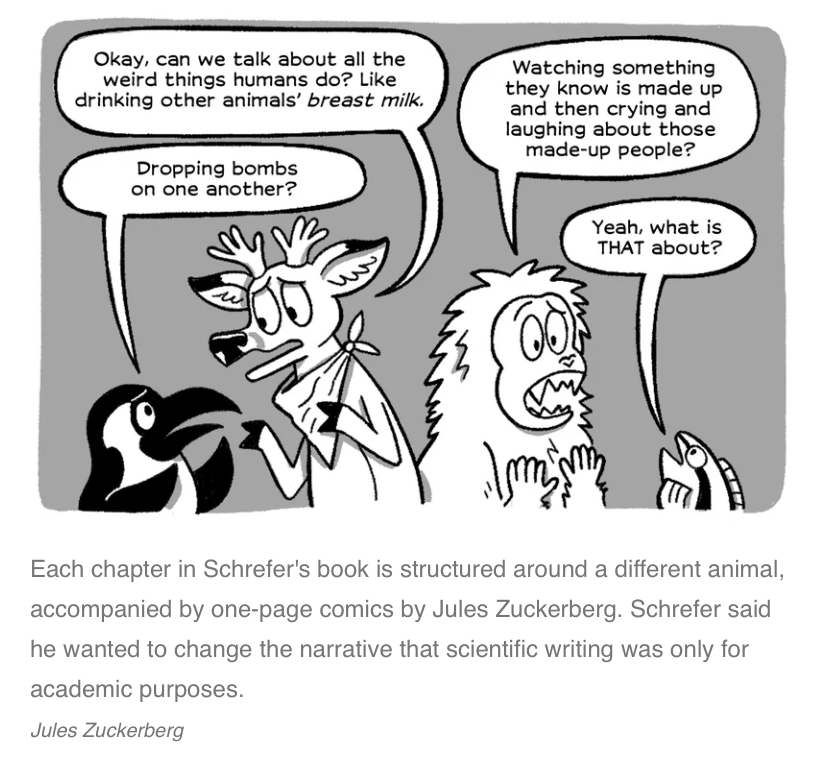
Each chapter is structured around a different animal accompanied by one-page comics by Jules Zuckerberg. Schrefer said he wanted to change the narrative that scientific writing was only for academic purposes.
"There's this feeling of seriousness that comes with a textbook, and for a lot of young readers that's their only exposure to scientific writing," Schrefer said. "I wanted to sort of imagine like we're sitting in the science classroom passing notes back and forth, and it even comes down to the doodles."
The comics depict a Gender Sexuality Alliance meeting where all the animals take a turn introducing themselves.
In the book, Schrefer writes that he is "well aware that this book is bound to be controversial," but at the same time he wants to assure young people that this is quite common in the animal world.
"Some people will say, 'Well, there's all sorts of things that animals do that humans oughtn't to be doing,' right? That we shouldn't cannibalize our partners after we have sex with them. That we shouldn't be living on webs out in the wild. And that we can't just cherry-pick which animal examples we choose to use. But that's really getting the argument of the book backwards."
"I'm not trying to argue for human behaviors from certain ways that animals can behave. Instead, I'm trying to say that we can no longer argue that humans are alone in their queerness or in their LGBTQ identities. Instead, we are part of a millions-of-years tradition within the animal world of a variety of approaches to sex and a ton of advantages that come around from it."
Schrefer said he wished a book like this existed when he was younger when he felt alone in his identity.
"I think there's a loneliness to human queerness. That there is this idea that it is something that happened recently to the species and that we are alone in it," he said. "That queer people can find each other and find community with each other and that that is the goal that they should hope for, when we are heavily integrated into the natural world. And that is the part of the message that I think is lost and that LGBTQ behaviors and identities are absolutely natural."
Schrefer spoke with NPR's All Things Consideredabout some of his favorite animals featured in the book, challenging the idea of what a scientist looks like, and what he took away from some of the interviews he did for the book.
This interview had been edited for length and clarity.
Well, the hard part starting to write this book was figuring out which animals to focus on. The bonobos are famously promiscuous and the majority of their sexual activity is between females, so I knew they had to be in there as an early chapter.
What's interesting about these animals, as you said, is they're very promiscuous. I mean there's almost this orgy-like way about how they behave sometimes.
They're really fairly new to science. We used to call them pygmy chimpanzees and just thought they were small chimps and that was it. And it wasn't until the '90s and the 2000s that we started really studying them and sex, and in particular same-sex sexual activity in Bonobos is a way to avoid conflict and to smooth over feelings after a conflict.
There's also a chapter that I found interesting about bulls. A lot of bulls are used for breeding. They're used to inseminate females, and sometimes the bulls have to kind of get in the mood. The handlers help them get in the mood, and what's interesting is they often bring in other males to do that and it's effective. Tell us why you chose that example.
I mean, bulls aren't just any animal in American culture, so many sports teams are named after bulls and rams, but bovids have one of the largest percentages of same-sex sexual behavior within their populations. It's long been the ace card in the hand of cattle breeders to bring out a steer to get a bull excited in order to perform sexually.
In fact, there was one of the foremost sheep researchers Valerius Geist, who studied bighorn sheep. In the 1960s, he was in the wild observing these big horns and saw that they basically live in an entirely homosexual society until the age of six or seven. The males are off by themselves having frequent intercourse, and he didn't publish on it. He wrote about this in his memoir years later because he couldn't tolerate the idea that these, what he'd quote "magnificent beasts," were queers, and so he resisted publishing on that.
The book includes interviews you've done with scientists, these little question and answer exchanges, I really like those. They not only added to the science of the book but it was interesting that these types of professionals exist. Could you tell us about one that you think is most noteworthy?
I wanted to expand kids' impression of who "gets" to do science – that it's not just old guys in white coats. There's an upswell of young scientists who are doing some wonderful work around queer behavior and queer identities and animals. One person I spoke to was an ecologist who has transitioned genders and is still actively figuring out their place within the broader world and looked forward so much to the days when they could be just with their binoculars in the field, mud up to their ankles, just staring at moose.
Because at that moment the complicated navigation of all of these identities just dropped away and they were just part of nature. They didn't have to explain themselves to the animals, and the animals had no concept of judging or shaming anyone for the choices that they were making around their gender identity. I found that so moving that there's a peace to be found and a simplicity and a radical acceptance within nature.
What 'Queer Ducks' can teach teenagers about sexuality in the animal kingdom
A non-fiction science book about animal sexuality could read like a dry textbook, but that's not the kind of thing that Eliot Schrefer wrote.
Schrefer's book, Queer Ducks (and Other Animals): The Natural World of Animal Sexuality, is designed to be teenager friendly. It's filled with comics and humor and accessible science on the diversity of sexual behavior in the animal world.
Each chapter is structured around a different animal accompanied by one-page comics by Jules Zuckerberg. Schrefer said he wanted to change the narrative that scientific writing was only for academic purposes.
"There's this feeling of seriousness that comes with a textbook, and for a lot of young readers that's their only exposure to scientific writing," Schrefer said. "I wanted to sort of imagine like we're sitting in the science classroom passing notes back and forth, and it even comes down to the doodles."
The comics depict a Gender Sexuality Alliance meeting where all the animals take a turn introducing themselves.
In the book, Schrefer writes that he is "well aware that this book is bound to be controversial," but at the same time he wants to assure young people that this is quite common in the animal world.
"Some people will say, 'Well, there's all sorts of things that animals do that humans oughtn't to be doing,' right? That we shouldn't cannibalize our partners after we have sex with them. That we shouldn't be living on webs out in the wild. And that we can't just cherry-pick which animal examples we choose to use. But that's really getting the argument of the book backwards."
"I'm not trying to argue for human behaviors from certain ways that animals can behave. Instead, I'm trying to say that we can no longer argue that humans are alone in their queerness or in their LGBTQ identities. Instead, we are part of a millions-of-years tradition within the animal world of a variety of approaches to sex and a ton of advantages that come around from it."
Schrefer said he wished a book like this existed when he was younger when he felt alone in his identity.
"I think there's a loneliness to human queerness. That there is this idea that it is something that happened recently to the species and that we are alone in it," he said. "That queer people can find each other and find community with each other and that that is the goal that they should hope for, when we are heavily integrated into the natural world. And that is the part of the message that I think is lost and that LGBTQ behaviors and identities are absolutely natural."
Schrefer spoke with NPR's All Things Consideredabout some of his favorite animals featured in the book, challenging the idea of what a scientist looks like, and what he took away from some of the interviews he did for the book.
This interview had been edited for length and clarity.
Interview highlights
Do you have a favorite animal or one of your favorites that you could tell us about?Well, the hard part starting to write this book was figuring out which animals to focus on. The bonobos are famously promiscuous and the majority of their sexual activity is between females, so I knew they had to be in there as an early chapter.
What's interesting about these animals, as you said, is they're very promiscuous. I mean there's almost this orgy-like way about how they behave sometimes.
They're really fairly new to science. We used to call them pygmy chimpanzees and just thought they were small chimps and that was it. And it wasn't until the '90s and the 2000s that we started really studying them and sex, and in particular same-sex sexual activity in Bonobos is a way to avoid conflict and to smooth over feelings after a conflict.
There's also a chapter that I found interesting about bulls. A lot of bulls are used for breeding. They're used to inseminate females, and sometimes the bulls have to kind of get in the mood. The handlers help them get in the mood, and what's interesting is they often bring in other males to do that and it's effective. Tell us why you chose that example.
I mean, bulls aren't just any animal in American culture, so many sports teams are named after bulls and rams, but bovids have one of the largest percentages of same-sex sexual behavior within their populations. It's long been the ace card in the hand of cattle breeders to bring out a steer to get a bull excited in order to perform sexually.
In fact, there was one of the foremost sheep researchers Valerius Geist, who studied bighorn sheep. In the 1960s, he was in the wild observing these big horns and saw that they basically live in an entirely homosexual society until the age of six or seven. The males are off by themselves having frequent intercourse, and he didn't publish on it. He wrote about this in his memoir years later because he couldn't tolerate the idea that these, what he'd quote "magnificent beasts," were queers, and so he resisted publishing on that.
The book includes interviews you've done with scientists, these little question and answer exchanges, I really like those. They not only added to the science of the book but it was interesting that these types of professionals exist. Could you tell us about one that you think is most noteworthy?
I wanted to expand kids' impression of who "gets" to do science – that it's not just old guys in white coats. There's an upswell of young scientists who are doing some wonderful work around queer behavior and queer identities and animals. One person I spoke to was an ecologist who has transitioned genders and is still actively figuring out their place within the broader world and looked forward so much to the days when they could be just with their binoculars in the field, mud up to their ankles, just staring at moose.
Because at that moment the complicated navigation of all of these identities just dropped away and they were just part of nature. They didn't have to explain themselves to the animals, and the animals had no concept of judging or shaming anyone for the choices that they were making around their gender identity. I found that so moving that there's a peace to be found and a simplicity and a radical acceptance within nature.


